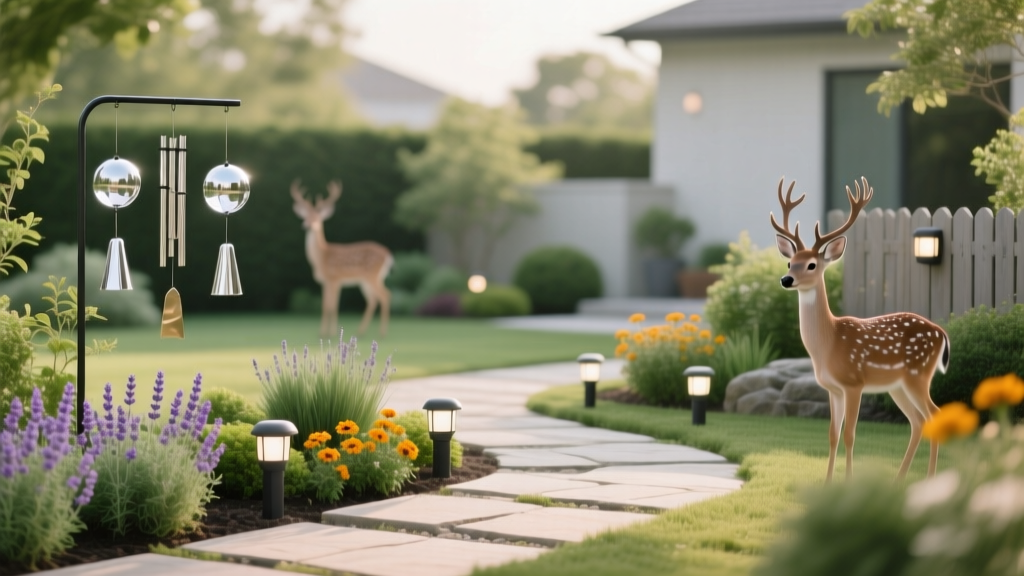
12 Garden Hacks for Deterring Deer
The mistake I see over and over: gardeners try one “magic” deer repellent, get a week of peace, and then declare deer “unstoppable.” Deer aren’t unstoppable—they’re just excellent at learning patterns. If a deterrent doesn’t change, deer get comfortable, and your hostas become the nightly salad bar.
Think like a deer for a second: they’re looking for safe, easy calories. Your job isn’t to win a battle once—it’s to make your yard feel annoying, risky, and unpredictable. The hacks below are grouped so you can layer them (that’s the secret sauce), with real numbers and real-world examples so you can pick what fits your yard and budget.
Start with physical “nope” zones (fastest, most reliable)
1) Double your odds with an 8-foot fence (or a 3D fence when 8 feet isn’t possible)
An 8 ft fence is the gold standard because most deer won’t jump it when they can’t see a safe landing. If 8 ft feels impossible (HOAs, cost, aesthetics), try a “3D fence”: two fences spaced 3–5 ft apart, each 4 ft tall. Deer struggle to judge the width and typically won’t attempt the jump.
Example: A corner-lot gardener in Pennsylvania used 4 ft welded wire in two parallel runs, 4 ft apart, around a 20' x 30' veggie plot. Total materials ran about $180–$260 depending on posts, far less than an 8 ft perimeter fence.
2) Make small beds deer-proof with cattle panels or a pop-up hoop cage
If your problem is a few key plants (new roses, tulips, a tomato bed), don’t fence the whole yard—cage the buffet. Cattle panels (16 ft long x 50 in tall) bent into an arch create a sturdy tunnel, or use 1/2" hardware cloth to build a quick box cage around a shrub. Anchor with 12" landscape staples so deer can’t nose it aside.
Example: In a suburban front yard, a $35 cattle panel plus four T-posts protected a row of peppers and lettuces all season, while nearby unfenced hostas still got nibbled (which proved the cage was doing the work).
3) Protect trunks with 4-foot tree guards (because bucks rub before you notice)
Deer damage isn’t just eating—fall rubbing can kill young trees fast. Wrap trunks with 4 ft tall welded wire (2" x 4" mesh) in a cylinder at least 6" away from the bark so rubbing doesn’t scrape through. Install by late summer (August) before rub season ramps up.
Example: A homeowner with 6 newly planted fruit trees spent about $8–$12 per tree on wire and zip ties—cheap insurance compared to replacing a $60–$120 tree.
Use deer behavior against them (they hate surprises)
4) Aim motion sprinklers like a security system—two units, crossed coverage
Motion-activated sprinklers work best when you don’t give deer an “easy route.” Place two units 20–25 ft apart so their spray zones overlap, and angle them toward the entry path (not the middle of the garden). Run them for 2–3 weeks during peak browsing (spring green-up and late summer), then move them to a new spot so deer don’t memorize the pattern.
Cost note: A quality sprinkler typically costs $45–$75 each; two units can protect a 30' x 30' area more reliably than most sprays.
5) Hang fishing line “tripwire” at nose height—simple, weirdly effective
Deer don’t like walking into invisible barriers. Run clear monofilament fishing line at 30" and 48" heights between stakes around a bed, keeping lines slightly loose so they wobble when touched. It won’t stop a determined deer forever, but it often deters casual browsing long enough to get plants established.
Example: One community garden used $8 worth of line and bamboo stakes to reduce deer entry until a permanent fence could be funded. It wasn’t perfect, but it cut damage noticeably in early summer.
6) Rotate “fear cues”: scent + motion + sound, and switch every 10–14 days
Deer habituate quickly to a single deterrent, especially in neighborhoods where they feel safe. The hack is rotation: use a scent repellent for 10–14 days, then switch to motion sprinklers, then add reflective tape or wind chimes near entry points. Changing the stimulus keeps the yard feeling unpredictable.
Real-world scenario: In a small-town yard bordering woods, rotating deterrents during August–October protected mums and fall greens when deer pressure was highest.
“No repellent will provide 100% protection under all conditions… effectiveness depends on deer density, availability of alternative foods, and the animal’s prior experience.”
—Penn State Extension (2019)
Repellents that actually work (and how not to waste money)
7) Use egg-based spray with the right mix and schedule (DIY that competes with store brands)
Egg-based repellents can be very effective because the odor signals “something is off” to a browsing deer. DIY version: blend 2 eggs with 1 quart of water, add 1 tablespoon mild dish soap as a spreader-sticker, strain, and spray foliage. Reapply every 7–10 days and after heavy rain; the schedule matters more than the brand.
Example: A gardener protecting hostas and daylilies used this mix weekly in May and June—damage dropped sharply until midsummer storms washed it off (then it returned until resprayed).
8) Save your best plants with commercial repellents—apply by the label, not by vibes
When deer pressure is high, commercial products with putrescent egg solids, garlic, capsaicin, or predator scent can outperform casual DIY because they stick better. The trick: spray before deer start feeding, coat new growth thoroughly, and reapply after 1 inch of rain or per label (often every 2–4 weeks). If you wait until plants are already “known good,” deer come back faster.
Budget hack: Treat only the plants deer love most (hosta, hydrangea, tulips, new shrubs). One $20–$30 concentrate bottle can often cover a few thousand square feet when mixed correctly—far cheaper than replacing plants.
9) Add a sticker-spreader so sprays don’t vanish in the first drizzle
Most repellents fail because they don’t stay put. Add 1–2 teaspoons per gallon of an agricultural sticker-spreader (or a tiny amount of mild soap in DIY mixes) so sprays cling to waxy leaves. This is especially helpful on glossy ornamentals and new shrub growth.
Example: A gardener with hydrangeas near a downspout found repellents “never worked” until they added a sticker—then protection lasted closer to the labeled interval.
Landscape tricks: make the buffet hard to reach
10) Use “sacrificial edges” and deer-resistant borders to steer traffic
If deer stroll through your yard like it’s a hallway, block the hallway with plants they dislike. Border beds and entry points with strongly scented or fuzzy-leaved plants (lavender, catmint, Russian sage, yarrow) and keep the favorites deeper inside, closer to the house. You’re not creating a force field—you’re making the approach less appealing.
Real-world scenario: A front-yard bed near a wooded lot became a deer magnet until the outer ring was replanted with catmint and lavender. Browsing shifted away from the walkway bed and toward less valuable “outer” plants.
11) Time your planting to avoid “tender buffet season”
Deer love tender, fresh growth. If deer pressure is intense in spring, delay planting the tastiest transplants until after the first big flush of wild forage settles down—often 2–4 weeks after your last frost date. For fall gardens, protect brassicas and young greens aggressively in the first 3 weeks after planting, when leaves are sweetest.
Example: A veggie gardener shifted lettuce and bean planting later by 3 weeks and used temporary netting early on. The plants grew past the “bite-size” stage before deer got curious.
Quick hacks for specific situations (when deer are already winning)
12) Run targeted “emergency netting” for 14 nights to break the habit loop
Once deer have a nightly route, you have to interrupt it. Drape bird netting or deer netting over hoops (don’t lay it directly on plants) and secure edges tightly with rocks, staples, or boards for 14 nights. After two weeks of “no reward,” many deer shift routes—then you can transition to repellents or a lighter barrier.
Case example: A gardener in a cul-de-sac had deer stripping new rose shoots every night. Two weeks of netting plus a motion sprinkler at the path entrance stopped the routine long enough for the roses to leaf out and toughen.
Which method should you pick? (A quick comparison)
| Method | Typical cost | Best for | How fast it works | Biggest downside |
|---|---|---|---|---|
| 8 ft fence | $8–$20 per linear foot installed (varies by material/terrain) | Whole-yard, high deer pressure | Immediate | Upfront expense, permits/HOA rules |
| 3D fence (two 4 ft fences, 3–5 ft apart) | Often 30–50% less than 8 ft fencing | Garden plots, side yards | Immediate | Needs more space; can look “farmy” |
| Motion sprinklers | $45–$75 per unit | Entry paths, beds near water source | 1–2 nights | Needs hose/water pressure; can trigger on pets |
| Repellent spray (egg/garlic/capsaicin) | $20–$60 per season for targeted use | Ornamentals, new growth | Same day | Reapplication after rain; labor |
| Netting/temporary cages | $15–$60 depending on size/material | Short-term rescue, seedlings | Immediate | Can snag wildlife if loose; must be secured well |
If you only do one thing: fence or cage. If you can do two things: barrier + rotation (sprinkler/repellent). If deer are already bold: add the 14-night “habit breaker” netting, then switch to maintenance mode.
Three “real life” deer problems—and what actually fixes them
Scenario A: The front-yard hosta massacre (suburban, deer are fearless)
This is the classic: deer stroll up, eat hostas and hydrangeas, and leave. A reliable combo is a repellent schedule (every 7–10 days in peak season) plus a motion sprinkler aimed at the sidewalk approach for 2–3 weeks. If you want a cleaner look, swap the hostas nearest the street with catmint or lavender and keep the “candy plants” closer to the house.
Scenario B: Veggie garden near woods (rural edge, high deer density)
When deer density is high, sprays become expensive and exhausting. Put your money into a perimeter: an 8 ft fence if possible, or a 3D fence if you have room. Add one motion sprinkler at the main trail for the first month after planting, when seedlings are most vulnerable.
Scenario C: New trees keep dying (rubbing + browsing)
If young trees look shredded or bark is scraped, repellents won’t save them alone. Install 4 ft trunk guards by August, and cage the tree with welded wire if browsing is heavy. This is one of those “spend $10 now or $100 later” situations.
What the research and extension folks agree on (and why layering matters)
Multiple extension services emphasize that deer deterrence works best when you combine methods and act early—before deer establish a feeding pattern. The University of Minnesota Extension notes that repellents are most effective when applied before damage occurs and reapplied as directed, and that hungry deer will ignore repellents when food is scarce (University of Minnesota Extension, 2020). Penn State Extension also stresses that repellents vary in effectiveness and need reapplication, especially after weather (Penn State Extension, 2019).
That’s why these hacks are designed to stack: a physical barrier to prevent easy access, a behavior disruptor to make the area feel unsafe, and a repellent to make your favorite plants smell like regret.
If you want the simplest plan that still feels realistic: pick one “hard barrier” (fence, cage, or 14-night netting) and one “maintenance tool” (repellent rotation or motion sprinklers). Do that for a month, then adjust based on where deer test your defenses—because they will, and that’s normal.
Sources: Penn State Extension (2019) deer repellents and deterrence guidance; University of Minnesota Extension (2020) deer damage management and repellent timing recommendations.