How to Grow More Food in Less Space
The biggest space-waster in most gardens isn’t a “bad layout”—it’s empty soil. Rows, wide paths, and bare gaps between plants feel tidy, but they can cut your harvest in half because sunlight hits dirt instead of leaves. If you’re gardening in a small yard, on a patio, or even just trying to get more out of a couple raised beds, the trick is to treat space like a budget: spend every square foot on something that produces.
Below are the shortcuts I’ve seen work again and again—stuff you can actually do this weekend, with measurements, timing, and a few money-saving swaps.
First: Stop Wasting Square Footage
Switch from rows to “planting blocks” (and shrink your paths)
Tip: Plant in blocks, not long rows. In beds, ditch traditional 3-foot-wide rows and plant in blocks so your canopy closes faster, shading weeds and keeping moisture in. Aim for 2–4 ft-wide beds with paths as narrow as 12–18 inches—just enough for your feet. Real-world example: a 4' x 8' bed with two 18" paths uses far less “walking space” than a row garden and usually produces more because nearly every inch is planted.
Use a spacing “rule of thumb” that prevents both crowding and wasted gaps
Tip: Space by final leaf size, not seed packet fear. Seed packets often assume row gardening and extra-thinning, so you end up under-planting. A simple hack: when transplants are young, space them so that at maturity their outer leaves just touch—no overlapping for big crops like cabbage, but “touching” is perfect for lettuce and herbs. Example: leaf lettuce can be 8 inches apart for heads, or 4 inches apart if you harvest baby leaves weekly.
Trade bare soil for living mulch (without stealing nutrients)
Tip: Fill gaps with fast “gap crops.” Any empty space between slower plants is a mini-garden waiting to happen—just choose crops that mature fast and don’t compete heavily. Radishes (25–35 days), arugula (30–40 days), scallions (60–75 days), and baby bok choy (30–45 days) are classic gap fillers. Example: tuck a ring of radishes around a pepper transplant; you’ll harvest radishes before the pepper needs the room.
Grow Up: Vertical Tricks That Actually Pay Off
Put the biggest space-hogs on trellises
Tip: Trellis anything that sprawls. Cucumbers, pole beans, peas, indeterminate tomatoes, and even small melons can be trained upward, freeing an entire square of bed space. A basic trellis can be 6–7 ft tall; for cucumbers, a simple cattle panel arch works beautifully and lasts for years. Example: one cattle panel (16 ft long) arched between two beds can turn a path into a productive “tunnel” of cucumbers and beans.
Use “high-wire” tomato training to fit more plants per bed
Tip: Train indeterminate tomatoes to one or two leaders. Instead of letting tomatoes bush out, prune to a single main stem (or two if you have generous sun) and tie it up a sturdy string or stake. You can often plant tomatoes at 18–24 inches apart this way, rather than the common 3–4 feet. Example: in a 4' x 8' bed, you might fit 6–8 trained tomatoes along the back edge, with basil and lettuce in front early in the season.
“Training vining crops vertically can improve air circulation and make harvesting easier, often with equal or higher yields per square foot compared to letting vines sprawl.”
—Extension vegetable production guidance (e.g., trellising recommendations), Purdue Extension, 2020
Try container “towers” for herbs and greens (DIY version included)
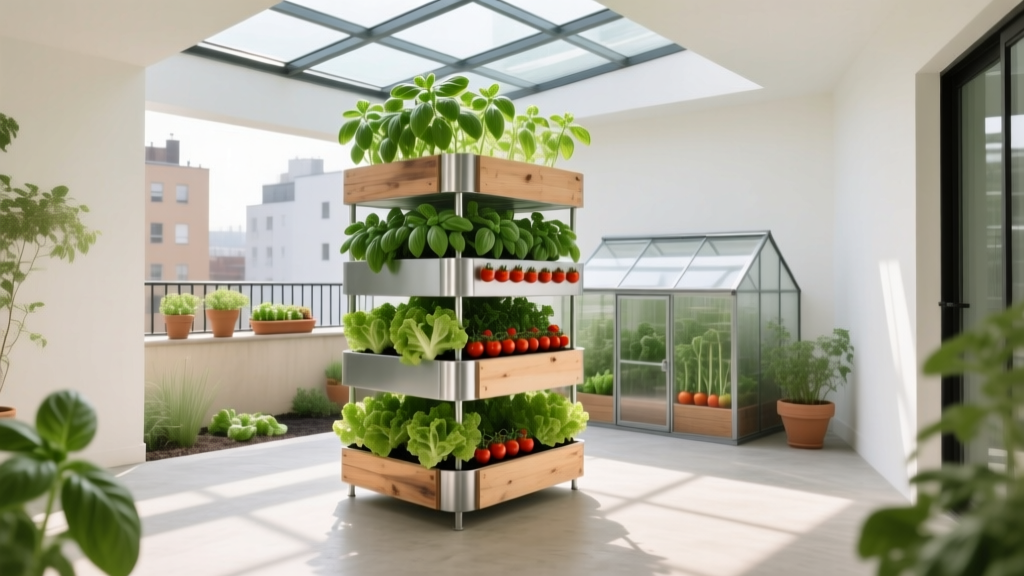
Tip: Stack shallow-rooted crops vertically. Greens, strawberries, and herbs don’t need deep soil, so vertical planters can multiply your planting area. You can buy a tower planter for $60–$150, or DIY one with a food-safe 5-gallon bucket stack or a strawberry pot. Example: a DIY tower with 4 stacked 5-gallon buckets (holes drilled on the sides) can hold 20–30 herb starts for the cost of potting mix and a drill bit.
Succession Planting: The “More Harvests per Year” Cheat Code
Replace “one-and-done” crops with a schedule
Tip: Plant the next crop before you pull the last one. The easiest way to lose production in small gardens is downtime—beds sitting empty while you decide what’s next. When a crop has 2–3 weeks left, start seedlings in plugs so you can transplant immediately after harvest. Example: start broccoli seedlings in late summer while your summer basil is still going; the day basil slows, broccoli goes in.
Use relay planting to overlap seasons in the same square
Tip: Interplant a slow crop with a fast crop. A slow crop (tomato, pepper, cabbage) takes weeks to “claim” its space, so you can harvest a fast crop first. Example: sow spinach between young tomato plants in early spring; you’ll harvest the spinach before the tomato canopy shades it out, turning one bed into two harvest windows.
Keep a simple rotation map to avoid pest pile-ups in tight spaces
Tip: Rotate by plant family, even in small beds. In a compact garden, pests and diseases build up fast if tomatoes or brassicas go in the same spot every year. Use a 4-bed rotation (or 4 zones within one bed): (1) tomatoes/peppers/eggplant, (2) beans/peas, (3) brassicas, (4) roots/greens. Example: if you only have one 4' x 8' bed, split it into four 2' x 4' quadrants and rotate clockwise each year.
Soil and Nutrition: High-Output Beds Need High-Quality Inputs
Feed the soil like you’re running a small farm (without spending a fortune)
Tip: Add compost at a consistent rate. For intensive planting, a reliable baseline is 1–2 inches of compost spread on top of beds each season (spring is easiest). This improves water-holding, supports microbes, and reduces the need for constant fertilizing. Example: a single 4' x 8' bed needs roughly 10–20 cubic feet of compost for a 1–2" layer; that’s about 2–4 large bags, or one small wheelbarrow load if you make your own.
Source note: Compost and soil organic matter benefits are widely supported by extension guidance; see USDA NRCS soil health resources (USDA NRCS, 2019) and university extension publications on compost use.
Use targeted fertilizing instead of “a little of everything”
Tip: Fertilize based on crop appetite. Leafy greens love nitrogen, fruiting crops want more potassium and steady feeding, and root crops get weird if you overdo nitrogen. A practical approach: mix a balanced organic fertilizer into the top few inches at planting, then side-dress heavy feeders (tomatoes, cucumbers) every 3–4 weeks. Example: side-dress tomatoes with a small band of fertilizer 4–6 inches from the stem, water it in, and skip feeding during heat waves when plants aren’t actively growing.
Mulch for yield, not just weed control
Tip: Use the right mulch thickness for the job. In tight gardens, mulching is a yield tool because it stabilizes moisture and reduces stress that shrinks harvests. Use 2–3 inches of shredded leaves or straw around tomatoes and peppers; use 1 inch around carrots so seedlings can emerge. Example: a single bag of shredded leaves (often free from neighbors) can cover multiple containers and a bed edge, saving the cost of bagged mulch.
Containers and Micro-Spaces: Make Patios and Driveways Produce
Choose containers by gallons, not by looks
Tip: Match pot size to crop roots. Small pots are the #1 reason container gardens underproduce—plants stall, then you blame the variety. Use 5 gallons minimum for peppers, 10–15 gallons for tomatoes, and 2–3 gallons for basil or chard. Example: a 15-gallon fabric pot with one tomato and three basil plants around the edge can outproduce a few pretty 8" ceramic pots by a mile.
Use fabric grow bags to save money and boost growth
Tip: Swap expensive pots for fabric bags. Fabric grow bags usually cost $3–$8 each and air-prune roots, which keeps plants vigorous in small volumes. They also store flat in winter and are easy to move to chase sun. Example: if your patio gets best sun in one corner, you can cluster 6 grow bags there for peak production, then spread them out later for airflow.
“Salad rail” planters: turn a railing or fence into weekly harvests
Tip: Grow cut-and-come-again greens at arm’s reach. Shallow planters (6–8" deep) on a railing or mounted to a fence are perfect for lettuce mixes, arugula, and Asian greens. Sow a pinch every 10–14 days for steady harvests and snip leaves when they’re 4–6 inches tall. Example: three 24" railing planters can supply salads for one person most weeks in spring and fall.
Crop Choices That Give You More Calories (and More Meals) per Square Foot
Grow “high-value” crops you actually buy at the store
Tip: Prioritize expensive-per-pound crops in small spaces. If you’re tight on room, grow what’s pricey and perishable: herbs, salad greens, cherry tomatoes, snap peas, and specialty peppers. A $4 clamshell of mixed greens is often the yield of a small planter—so it pays fast. Example: one 4' x 4' patch of cut-and-come-again lettuce can replace multiple store trips if you harvest twice a week.
Choose varieties bred for compact habits and continuous harvest
Tip: Pick the right genetics for tight spaces. Bush cucumbers, patio tomatoes, compact zucchini, and day-neutral strawberries exist for a reason. Look for words like “patio,” “container,” “dwarf,” or “compact,” and check mature size before you plant. Example: a compact “patio” tomato in a 10-gallon pot can be manageable on a balcony, while an indeterminate slicer will turn into a vine monster unless you trellis aggressively.
Use multi-sow clusters for onions and beets to pack more into beds
Tip: Plant small bulbs and roots in clusters, then harvest selectively. For scallions and bunching onions, sow 6–10 seeds per “clump” and space clumps 8 inches apart; harvest a few stems at a time. For beets, sow 2–3 seeds per spot and thin by eating baby beets. Example: in a 2' x 4' section, clustered scallions can give you weeks of stir-fry add-ins without dedicating a whole row.
Three Real-World Space-Saver Setups (Steal These Layouts)
Scenario #1: The 4' x 8' raised bed that feeds a household with smart timing
Tip: Divide your bed into “season lanes.” Use the north edge for trellised crops, the center for rotating staples, and the south edge for quick greens. Example plan: spring—peas on a trellis at the north edge with spinach and radishes in front; summer—swap peas for pole beans and replace spinach with basil; fall—pull beans and plant kale plus a late sowing of arugula. With this approach, you’re rarely staring at bare soil longer than a week.
Scenario #2: Apartment balcony with only 20 square feet of sun
Tip: Build a “three-layer” balcony garden. Use one 15-gallon pot for a tomato (top layer), two railing planters for greens (middle), and a shallow tub for herbs (bottom). Put everything on rolling plant caddies if your sun shifts; a caddy is often $10–$15 and saves plants from shade problems. Example: one balcony setup like this can produce tomatoes, weekly salads, and enough herbs to stop buying bundles that wilt in the fridge.
Scenario #3: Tiny backyard with kids/pets (you need paths and durability)
Tip: Use a central path with beds you can reach from both sides. Instead of lots of narrow paths that waste space, build two 3' x 10' beds with a single 24-inch central path between them. You get efficient access, and you can fence just the beds instead of the whole yard. Example: add a simple 3–4 ft tall wire fence around each bed to keep dogs out and still maximize planting area.
What Works Better? Quick Comparison Table for Small-Space Yield
| Method | Space Efficiency | Typical Cost | Best For | Main “Gotcha” |
|---|---|---|---|---|
| Traditional rows | Low (lots of paths) | $0 extra | Large plots, mechanized feel | Wasted soil + more weeds |
| Raised beds (block planting) | High | $100–$300 per 4' x 8' bed (materials vary) | Small yards, intensive planting | Needs compost/fertility upkeep |
| Containers (grow bags) | Medium–High | $3–$8 per bag + potting mix | Patios, rentals | Dries out faster than beds |
| Vertical trellis (cattle panel / netting) | Very high | $20–$40 for netting system; $30–$60 for a panel | Cukes, beans, peas, tomatoes | Must be anchored well in wind |
Small Moves That Add Up Fast
Harvest earlier and more often to keep plants producing
Tip: Treat harvesting like pruning. Many crops produce more when you harvest young and regularly because the plant stays in “growth mode.” Example: pick zucchini at 6–8 inches, not baseball-bat size; you’ll get more total fruit over the season and avoid the one-giant-zucchini problem that slows production.
Use shade tactically to extend the season in tight beds
Tip: Add temporary shade cloth for summer greens. If your small garden is full sun, summer heat can end lettuce and cilantro early, creating empty gaps. A 30–40% shade cloth hung on hoops or clipped to a fence can keep greens going longer. Example: a $20 piece of shade cloth can buy you a few extra weeks of greens—often worth more than its cost in produce.
Keep a “plug tray nursery” so you’re never waiting on empty soil
Tip: Always have 6–12 seedlings ready to swap in. The gardeners who harvest the most in small spaces have a bench, shelf, or sunny window with seedlings at the ready. Use a simple cell tray (36–72 cells) and start replacements every couple of weeks during the season. Example: when garlic comes out in midsummer, you can immediately plug in basil, bush beans, or fall brassicas instead of losing a month deciding.
Lean on university spacing and timing charts (they’re free and reliable)
Tip: Use extension schedules to dial in planting windows. Guessing planting dates causes gaps—too early and seedlings stall, too late and you miss the fall window. Extension services publish planting calendars based on frost dates and regional trials; these are gold for succession planting. For example, many regions can start fall brassicas 8–12 weeks before first frost for solid heads and better flavor (University extension planting calendars; see Iowa State University Extension, 2021; Cornell Cooperative Extension, 2018).
If you take only one idea from all of this, let it be this: small-space gardening is less about cramming plants in, and more about keeping your beds “on payroll” year-round—vertical where you can, succession where you should, and never leaving premium sunlight to hit bare dirt. The moment you start thinking in weeks (what can I harvest next?) instead of seasons (what do I plant this year?), your garden suddenly feels twice as big.