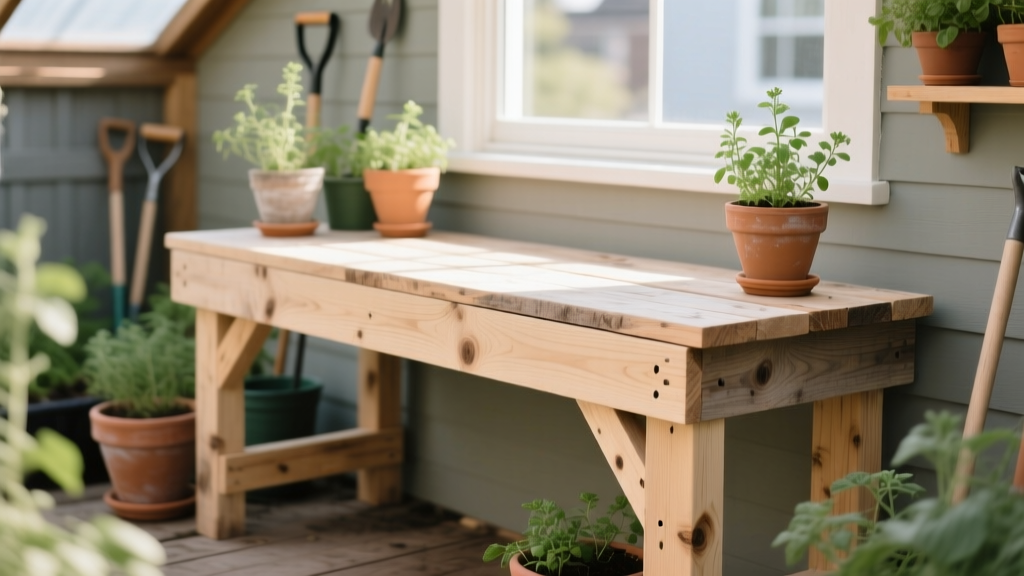
Building a Potting Bench from Scrap Wood
The most common potting bench mistake isn’t flimsy legs or ugly screws—it’s building it too low. After an hour of potting up seedlings, a bench that’s even 3–4 inches short will have you hunched like you’re weeding with your forehead. A scrap-wood bench can feel “free,” but if it doesn’t fit your body and workflow, you’ll avoid using it—and your potting mess will migrate right back to the patio table.
The good news: you can build a sturdy, comfortable potting bench from leftovers—old deck boards, shipping pallets, busted fence pickets—if you plan for strength, moisture, and cleanup from the start. Below are the shortcuts and proven tricks that keep a DIY bench standing for years (and keep your back happy).
Plan for comfort and workflow (before you cut anything)
Set the bench height using the “knuckle rule” (and lock it in)
Stand straight with your arms relaxed; measure from the floor to your knuckles. For most adults, that lands around 34–38 inches, which is a sweet spot for potting without shoulder lift or back bend. If you share the bench, split the difference—or build the legs 2 inches long and trim them after a quick test fit in your workspace.
Example: Marcy (5'2") built hers at 34 inches and added a 1-1/2 inch thick scrap-top; her taller partner added a 2-inch anti-fatigue mat to “raise” the working height without rebuilding.
Make the top depth 24 inches unless you love chasing tools
Deeper than 24 inches looks roomy but turns into a black hole where hand trowels disappear under pots. A 24-inch deep top fits a standard 10" x 20" nursery tray with space for soil scooping in front. If you only have narrow lumber, 18 inches works—just plan a side shelf for trays.
Give yourself a “dirty zone” and a “clean zone”
Split the bench mentally: one side for soil and messy work, one side for labels, snips, and clean pots. This keeps seed packets dry and prevents your marker from vanishing under compost. A simple divider can be a 1x4 scrap screwed down the middle as a curb.
Example: Luis added a 3-1/2 inch curb (ripped from a 2x4) and stopped losing plant tags into the soil pile every weekend.
Scrap wood selection that won’t betray you outdoors
Skip mystery treated wood for the work surface (use it for the frame)
If you don’t know what a board was treated with, don’t use it where you’ll set pots and mix soil—especially for edibles. Pressure-treated lumber today is typically ACQ or CA, but older scraps may be CCA; best to keep “unknown” boards for the legs or lower shelf where contact is minimal. When in doubt, line the top with a removable tray or sheet.
For safety context, the USDA Forest Service notes that older CCA-treated wood contains arsenic and shouldn’t be sanded or burned; using newer, labeled treated wood is generally preferred for outdoor structures (USDA Forest Service, 2010).
Use pallet wood only if it’s stamped and clean
Only use pallets marked “HT” (heat-treated), and avoid “MB” (methyl bromide fumigated). Pallet slats are handy for shelves and back panels, but they’re often thin—so plan more supports (every 12 inches) to prevent sagging. If the pallet smells like chemicals or has mystery stains, let it go.
Orient your scraps for strength: crown up, rings down
Boards have a slight “crown” (a gentle curve). Place the crown up on horizontal surfaces so weight flattens it rather than exaggerating the sag. On legs, aim the growth rings like a “smile” (rings down) to reduce cupping where it matters.
Build a frame that’s rock-solid (even if your scraps aren’t perfect)
Use a simple 2x4 “ladder frame” to compensate for ugly boards
Even if your top boards are mismatched, the frame carries the load. Build two rectangles (front/back rails with side rails) and tie them with 2–3 crosspieces; think of it like a tiny deck. With crosspieces spaced about 16 inches apart, you can use thinner top boards without bounce.
Example: Priya used leftover 1x6 fence pickets for the top—thin and cupped—so she added three 2x4 crosspieces on a 48-inch bench and the flex disappeared.
Prevent wobble with diagonal bracing (the 10-minute fix)
Wobble comes from racking (side-to-side shear), not weak legs. Add a diagonal brace on the back using any straight scrap (even a 1x3), running from the top left to bottom right. If you want it cleaner, use two shorter diagonals in the corners.
Specific: A brace 30–40 inches long at a 30–45° angle makes a dramatic difference on a 36-inch-tall bench.
Use exterior screws and pre-drill near board ends
Scrap boards are often dry and split-prone. Pre-drill within 2 inches of an end, especially on 1x material, and use 2-1/2 inch exterior deck screws for the frame. For the top, 1-5/8 inch exterior screws usually bite without poking through.
Add adjustable feet if your ground isn’t level (cheap, life-changing)
If your bench sits on pavers, gravel, or soil, it’ll rock. Threaded leveling feet cost about $8–$15 for a set of four, and they let you fine-tune stability in seconds. DIY option: screw a short block under the short leg and sand it down gradually—crude, but it works.
Design features that make potting faster and cleaner
Build a soil bin that holds exactly one bag (and stops the avalanche)
A common soil management win: a small bin sized to a typical 1.5–2.0 cubic foot potting mix bag. Build a three-sided box (open top and front) about 18 inches wide x 16 inches deep x 16 inches tall and line it with a scrap of pond liner or heavy plastic. You’ll scoop neatly and stop the “bag slump” that dumps soil on your shoes.
Example: Jen kept a 2 cu ft bag in her bin and reported she stopped wasting mix to wind and spills on her deck.
Add a removable “mess tray” instead of fighting your tabletop
Rather than sealing every crack perfectly, drop a removable tray into a framed opening. A $12 concrete mixing tub from a home center fits many DIY frames; common sizes are around 20" x 28". Build a rim from 1x2 scraps so the tub sits flush and can be lifted out to dump or rinse.
Hang tools on the backboard, not the side
Side hooks snag pockets and hose lines. A simple pallet-slat backboard gives you vertical storage for hand tools, twine, and a spray bottle. Screw in cup hooks at 6–8 inch spacing so tools don’t clack together.
Include one “no-brainer” shelf height for buckets
Most 5-gallon buckets are about 14.5 inches tall. Set your lower shelf 18 inches below the top so a bucket slides in easily, even with a handle. If you use a lidded tote, measure it and leave 2 inches of clearance so you’re not wedging it in sideways.
Weatherproofing that actually works on a bench (and doesn’t cost much)
Keep wood off wet ground by at least 1 inch
Even rot-resistant wood fails faster when it wicks moisture from the ground. Add feet, pavers, or scrap composite shims so the legs sit 1–2 inches above soil or concrete. This small gap dramatically reduces constant dampness at the end grain—the spot rot loves most.
Seal end grain like you mean it
End grain drinks water like a straw. Brush on exterior primer or an end-grain sealer, focusing on leg bottoms and cut ends of the top boards. If you only do one sealing step, do this one.
Moisture management matters: wood-decay fungi generally need sustained high moisture, often above ~20% moisture content in wood, to thrive—so keeping water out is the whole game (USDA Forest Products Laboratory, 2010).
Use a “cheap and tough” finish: exterior paint over primer
Outdoor paint protects better than most quick oil wipes. If you have leftover exterior latex paint, prime first (especially on mixed species scraps), then apply two coats; it’s often under $25 if you’re using remnants. For a natural look, an exterior oil stain works, but it usually needs recoat sooner on horizontal surfaces.
Add a sacrificial top skin if you pot constantly
If you’re potting every week, protect the wood with a replaceable layer: a sheet of corrugated plastic sign board, vinyl flooring offcut, or even a cookie sheet screwed down. It’s easier to replace a $5 skin than rebuild a top. Leave a 1/8 inch gap at the back edge so water can escape instead of pooling.
Fastener and joinery shortcuts (strong without fancy tools)
Use pocket holes only where they shine: keeping tops flat
Pocket screws help pull warped boards together on the underside of a top. If your scrap boards are cupped, clamp them, drill pocket holes, and stitch them into two wider panels before attaching to the frame. If you don’t have a pocket jig, a simple batten strip screwed across the underside every 12 inches achieves a similar flattening effect.
Reinforce corners with gussets from plywood scraps
Thin plywood triangles in the corners add stiffness with almost no cost. Cut 6" x 6" right triangles and screw them into the inside corners of the frame. This is a go-to trick when your 2x material is slightly twisted or your cuts aren’t perfectly square.
Match screw length to wood thickness (avoid surprise spikes)
Nothing ruins a potting day like slicing your wrist on a screw tip poking through. For two 3/4" boards joined together, a 1-1/4" to 1-5/8" screw is usually safe. Reserve 2-1/2" screws for 2x framing where you need deep bite.
Three real-world builds (pick the one that matches your space)
Scenario 1: The tiny patio bench (48" wide) built from fence pickets
If you’re working on a balcony or small patio, build narrow and vertical. A 48-inch wide x 18-inch deep bench fits against a wall and still holds a tray and a soil bin. Use fence pickets for the top (they’re often cheap or free), and stiffen with a 2x4 ladder frame and a back diagonal brace.
Cost snapshot: Free pickets + $18 for a box of exterior screws + $12 mixing tub = about $30 total, assuming you already have a drill.
Scenario 2: The heavy-duty garden bench (60–72" wide) from old deck boards
Deck boards are made for weather and load, so they’re ideal for a long bench. Build a 72-inch top with three crosspieces and a lower shelf to store mix and pots. Add leveling feet because long benches exaggerate uneven ground—one corner always wants to float.
Example: Sam reused 5/4 deck boards and added a center leg to prevent sag; his 6-foot span stayed flat even with two full bags of potting mix stored below.
Scenario 3: The greenhouse bench with washable surfaces
In a greenhouse, algae and damp are constant, so prioritize cleanability. Make the top removable (mixing tub insert or plastic skin) and leave 1/4 inch gaps between any wood slats for drainage. Add a small side rail so fertilizer scoops and dibbers don’t roll off onto seedlings.
Timing tip: Plan a 10-minute end-of-day rinse; a bench designed to shed water dries faster and grows less slime.
Cost-saving swaps (where to spend, where to scavenge)
| Bench Feature | Scrap / DIY Option | Buy-New Option | What I’d Pick (and why) |
|---|---|---|---|
| Work surface | Old deck boards + removable tray | Stainless steel table top | Scrap + tray: easier to replace and cheaper |
| Mess tray | Cookie sheet or cafeteria tray (thrifted) | Concrete mixing tub (~$12) | Mixing tub: perfect depth, lifts out easily |
| Fasteners | Reclaimed screws (only if rust-free) | Exterior deck screws ($15–$25/box) | Buy-new screws: rust stains are forever |
| Feet | Composite shims or paver offcuts | Leveling feet ($8–$15/set) | Leveling feet if outdoors on uneven ground |
Spend money on screws, not fancy lumber
Rusty or brittle fasteners are what make “free” benches fail. A $20 box of exterior-rated screws prevents wobbles and black streaks running down your legs after the first rain. If your scrap pile is questionable, strong fasteners and bracing are what keep the bench trustworthy.
Scavenge smart: one straight 2x4 is worth five pretty slats
When you’re hunting scraps, prioritize straight framing pieces for legs and rails. Slightly ugly boards are fine for shelves and backboards. If you only find thin material, plan closer support spacing—every 12 inches instead of 16—to prevent sag.
Make it safer and nicer to use (small upgrades, big payoff)
Protect your lungs: don’t sand mystery finishes
Scrap wood may have old paint, sealers, or treatments you can’t identify. Skip aggressive sanding; instead, scrub with soapy water and a stiff brush, then seal. If you must sand, wear a properly fitted respirator and work outside.
Add a bag hook and a clamp point
Drive a large screw hook into a side post to hang an open soil bag or a bucket. Add a 6-inch section of 2x4 overhang on one side so you can clamp boards when repairing pots or cutting labels. It’s one of those “why didn’t I do that sooner?” features.
Build in a simple fertilizer safety habit
Keep fertilizers and amendments in lidded containers on the lower shelf, not on the top where spills happen. The Potting Bench Law of Physics is that the one time you set bone meal on the top, you’ll knock it into your tray of seedlings. A $2 used plastic jar with a tight lid beats leaving bags open.
“Keeping work surfaces clean and tools organized isn’t just about neatness—it reduces plant disease spread and makes repetitive tasks less tiring.” — Extension educators routinely emphasize sanitation and organization as core greenhouse and propagation practices (e.g., University of Minnesota Extension, 2019).
Quick build sequence (so you don’t get stuck mid-project)
Dry-fit first, then screw
Lay your scraps out as a top first and decide where the best-looking boards go. Then build the frame to fit the top—not the other way around—because scrap sizes rarely match your original sketch. A 5-minute dry-fit saves an hour of recutting later.
Square the frame using diagonal measurements
Measure corner-to-corner diagonals on your top frame; if both diagonals match, you’re square. If they differ by more than 1/4 inch on a 4-foot bench, push the long diagonal inward and re-check before fastening tight. This keeps drawers/trays (if you add them later) from sticking.
Do the “rock test” before finishing
Set the bench in its final spot, press down on each corner, and twist gently side to side. Fix wobble now with bracing or feet—finish won’t hide movement. Once it’s stable, then paint/seal so you’re not reworking coated parts.
If you build with comfort-height legs, a stiff ladder frame, and one washable surface, a scrap-wood potting bench stops being a weekend project and becomes the spot where everything in your garden starts. And when you inevitably change your workflow next season—seed-starting grows, tools multiply—you’ll be glad you built it from scraps, because you won’t feel bad modifying it with one more hook, one more shelf, or a bigger tray.
Sources: USDA Forest Service (2010) guidance on treated wood safety and handling; USDA Forest Products Laboratory (2010) Wood Handbook moisture and decay fundamentals; University of Minnesota Extension (2019) sanitation and organization practices for propagation/growing areas.