Japanese Garden Elements: Create Zen Serenity in Your Backyard on Any Budget
The Philosophy Behind Japanese Gardens
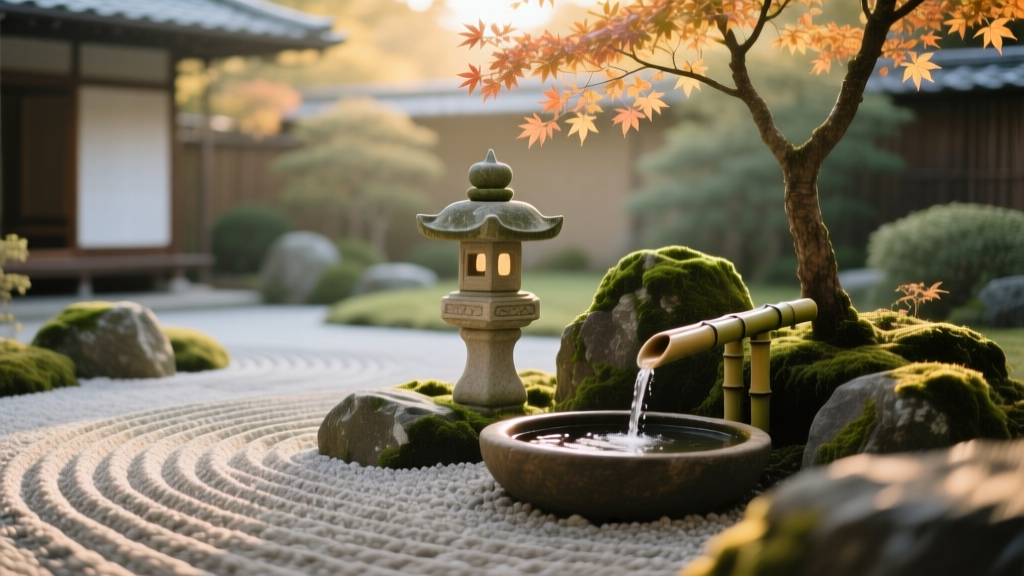
Japanese gardens are designed to capture the essence of nature in miniature form. Every element has symbolic meaning: rocks represent mountains, gravel represents water, and moss represents forests. The goal is to create a space that invites contemplation and connection with nature — regardless of yard size or budget.
Element 1: Karesansui (Dry Rock Garden)
The iconic raked gravel garden is the most accessible Japanese element to create.
How to Build:
- Clear a 6x8 foot area (minimum) and level the ground
- Lay landscape fabric to prevent weeds
- Add 3-4 inches of white or gray crushed gravel (not round pebbles — angular gravel holds rake patterns)
- Place 3, 5, or 7 rocks (always odd numbers) — these are your "islands" or "mountains"
- Rake concentric circles around rocks, straight lines between them
Budget: $50-150 for materials. Maintenance: Re-rake weekly for meditation practice.
Element 2: Tsukubai (Stone Water Basin)
A low stone basin for ritual hand-washing before entering a tea garden. Creates the soothing sound of trickling water.
DIY Version:
Use a large flat stone with a natural depression, or a ceramic bowl set at ground level. Add a bamboo ladle beside it. A small solar pump creates a gentle trickle.
Budget: $30-80 (found stone + solar pump).
Element 3: Shishi-odoshi (Bamboo Deer Scarer)
The iconic bamboo tube that fills with water and tips with a distinctive "clack." Adds both movement and sound.
Materials:
- 3 bamboo poles (1-2 inch diameter)
- Bamboo pivot pin
- Small stone (for the striking surface)
- Tubing to supply water
Budget: $20-40 for bamboo. Many tutorials available online.
Element 4: Stepping Stone Path (Tobi-ishi)
Irregular natural stones placed at walking pace intervals guide visitors through the garden and create a sense of journey.
Rules:
- Space stones 18-24 inches apart (one natural stride)
- Use flat-topped natural stones, 12-18 inches wide
- Bury stones slightly below ground level for stability
- Plant low ground cover (moss, creeping thyme) between stones
Element 5: Bamboo Fencing (Take-gaki)
Bamboo screens define boundaries, create privacy, and add vertical structure.
Simple Version:
Buy bamboo fence rolls ($30-60 for 6x3 feet) and attach to existing fence or posts. For authenticity, use black bamboo ties and cap the top with a horizontal bamboo pole.
Element 6: Moss Garden
Moss replaces lawn in Japanese gardens, creating a carpet of green that requires no mowing.
How to Grow:
- Choose a shady area (moss needs shade and moisture)
- Acidify soil to pH 5.0-5.5 with sulfur
- Transplant moss patches from existing shady areas
- Mist daily for 3 weeks until established
- Remove leaves and debris regularly
Alternative for dry climates: Use Irish moss (Sagina subulata) or creeping thyme as moss substitutes.
Element 7: Pruned Trees (Niwaki)
Cloud-pruned trees are living sculptures. Start with an existing tree and shape it over years.
Beginner Approach:
- Choose a multi-stemmed evergreen (Japanese maple, pine, or azalea)
- Remove crossing branches and open the structure
- Prune branch tips into rounded "cloud" shapes
- Maintain with selective pruning twice per year
Element 8: Lantern (Toro)
Stone or metal lanterns mark path intersections and create focal points.
Budget Options:
- Concrete reproduction lanterns: $40-80
- DIY stacked stone lantern: Free (if you have flat stones)
- Small solar lantern inside a traditional housing: $15-30
Design Principles to Follow
- Asymmetry: Avoid symmetry — nature isn't symmetrical
- Borrowed scenery (Shakkei): Frame distant views as part of your garden
- Hide and reveal: Never show the whole garden from one viewpoint
- Ma (negative space): Empty space is as important as filled space
- Wabi-sabi: Embrace imperfection — weathered, aged, and irregular is beautiful
Final Thoughts
A Japanese garden doesn't require a large budget or yard. Start with a small dry garden and a bamboo water feature — these two elements alone create a meditative atmosphere. Add elements gradually over seasons, and let the garden mature naturally.