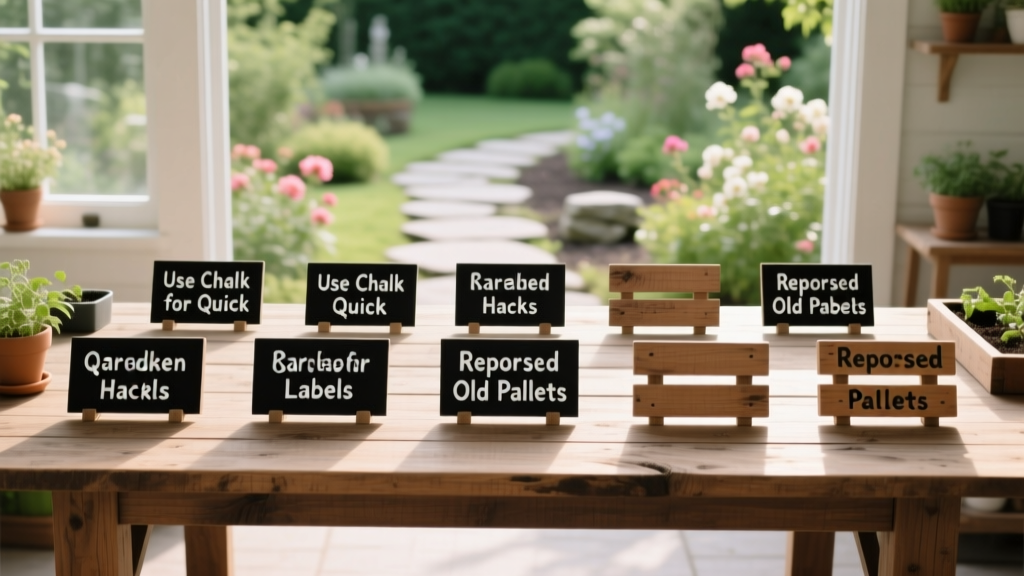
10 Garden Hacks for Garden Sign Making
The most common garden-sign mistake isn’t messy handwriting—it’s picking the wrong material. A cute “craft wood” sign can warp after one rainy weekend, and suddenly your tomato row looks like a mystery novel. The good news: making durable, readable garden signs doesn’t require fancy tools, just a few smart shortcuts that experienced gardeners lean on.
Below are 10 practical hacks grouped by what actually makes signs succeed: weatherproofing, readability, and speed. I’ll also flag budget swaps and real-life scenarios so you can copy what works.
Group 1: Start with materials that won’t fail in the rain
1) Hack: Use the “2-season rule” to choose your sign base
If you want a sign to last longer than one season, skip untreated wood and thin cardboard. A simple rule: if it can’t survive two seasons of sun + rain, it’s a temporary label—plan for that. For long-life signs, use UV-stable plastic (like recycled HDPE cutting boards), aluminum, or exterior-grade PVC trim boards.
Real-world example: A community garden that swaps crops twice a year can use paint-stir sticks for spring, but should move perennials (herbs, strawberries) onto HDPE or aluminum tags so you aren’t re-labeling every month.
2) Hack: Turn dollar-store cutting boards into pro-level labels
Those thin plastic cutting mats or small cutting boards are usually HDPE or polypropylene—both handle moisture well and clean easily. Cut them into 1.5" x 6" strips with heavy scissors or tin snips, punch a hole, and mount on a stake. If you buy a $1–$3 board and get 10–15 labels out of it, you’re often under $0.30 per sign.
Scenario: If you’re labeling 40 seedling starts, this trick avoids the “I spent more on labels than seeds” problem—especially when seed packets are already $3–$6 each.
3) Hack: Seal wood fast with a glue-and-water “paint primer”
If you love the look of wood, give it a fighting chance. Mix 1 part exterior wood glue to 1 part water, brush on a thin coat, and let it dry for 30–60 minutes before painting. It reduces paint soak-in and slows warping—especially on cheap pine stakes.
Real-world example: For a kitchen herb bed, this lets you use free scrap wood while still getting a smoother lettering surface (no fuzzy grain after the first rain).
4) Hack: Use vinyl leftovers for “laminated” sign faces
Got leftover adhesive vinyl (from Cricut projects or sign shops)? Stick it over your finished label like a clear laminate. Burnish the edges hard with an old credit card so water can’t creep under. For an ultra-budget version, use clear packing tape—but overlap strips by 1/8" so seams don’t lift.
Case example: One home gardener in a windy backyard found packing tape corners peeled in a week; switching to a single sheet of clear vinyl offcut fixed it for the whole season.
Group 2: Make signs readable from where you actually stand
5) Hack: Follow the “10-foot test” for letter height
If you can’t read it while holding a hose, you’ll stop using it. A simple standard is to use at least 1 inch letter height for readability from around 10 feet in the garden (bigger if your beds are wide or your eyesight is picky). Use thick strokes, not thin script—paint pens and bold markers beat elegant fonts outdoors.
Real-world example: In a 4' x 8' raised bed, a 1" label lets you identify the row without stepping into the bed and compacting soil.
6) Hack: Put variety + date on the sign (future-you will thank you)
Don’t just write “Tomato.” Add the variety and a date: “Tomato: Sun Gold — transplanted 5/12.” That single line helps you track timing, spot performance patterns, and avoid repeating duds next year. It’s also handy when you’re comparing two varieties side by side.
Case example: A gardener testing two basil types (“Genovese” vs. “Lemon”) labeled planting dates and realized the lemon basil bolted 2–3 weeks earlier in the same bed—information you only capture if the sign holds details.
7) Hack: Color-code by plant family using paint pen caps
Instead of painting whole signs (time sink), color-code with a small stripe or dot at the top—use the paint pen cap color as your system. Example: red = tomatoes/peppers/eggplant, green = brassicas, blue = peas/beans. One dot takes 2 seconds, and you can visually rotate families year-to-year to reduce disease carryover.
Expert note: Crop rotation is widely recommended to help manage pests and diseases; Penn State Extension (2023) highlights rotation as a key tool in vegetable garden planning.
“A label that stays readable is part of good garden recordkeeping—when you know what was planted and when, it’s easier to troubleshoot issues and improve results next season.” — Extension horticulture guidance, adapted from recordkeeping recommendations common across university extension programs
Group 3: Weatherproof the message, not just the board
8) Hack: Use pencil on paint for a low-cost, rewriteable “chalkboard” sign
Here’s the weird one: ordinary pencil can last surprisingly well on a painted surface. Paint the sign with flat exterior paint, let it cure overnight, then write with a soft pencil (2B or carpenter’s pencil). It’s water-resistant enough for most gardens, and you can erase and update with a damp rag.
Scenario: If you succession-sow lettuce every 14 days, this saves you from making a new sign for every planting—just erase the date and write the next one.
9) Hack: For permanent ink, pair the right marker with a UV topcoat
Most “permanent” markers fade fast in sunlight, even if they laugh at water. Use an oil-based paint marker (like Sharpie Oil-Based or a hardware-store paint pen), let it dry for 15 minutes, then spray a UV-resistant clear coat (two light coats, 10 minutes apart). This combo holds up far better than marker alone.
Supporting research: Sunlight (UV) is a major driver of plastic and pigment degradation; the USDA Forest Service Forest Products Laboratory (2010) notes that UV exposure breaks down lignin in wood and contributes to surface weathering—another reason topcoats matter for outdoor signage.
10) Hack: Mount signs like a fence builder, not a crafter
Most signs fail at the stake: they snap, tilt, or get yanked by dogs and hoses. Use a stake that’s at least 12 inches in the soil for stability (more in sandy beds), and attach the sign with two fasteners so it can’t spin. Cheap option: two zip ties; durable option: two stainless screws with washers.
Real-world example: In a school garden with kids watering daily, zip-tied signs survived better than nailed ones because they flexed instead of splitting the board.
Fast methods vs. long-life methods (pick what matches your garden)
| Method | Best for | Typical lifespan | Approx. cost per sign | Notes |
|---|---|---|---|---|
| Paint-stir stick + marker | One-season veggies | 1 season | $0.00–$0.25 | Fast, but ink fades; seal for longer use |
| HDPE cutting board strips + paint pen | Perennials, long-term beds | 2–5+ seasons | $0.20–$0.60 | Waterproof; add UV clear coat for best results |
| Aluminum tag + stamped letters | Permanent labeling | 5–10+ seasons | $0.75–$2.00 | Most durable; higher upfront cost, nearly zero upkeep |
| PVC trim board + acrylic paint | Raised beds, neat aesthetics | 3–7 seasons | $0.50–$1.50 | Clean look; pre-drill to avoid cracking |
Extra tricks that save time when you’re making a lot of signs
You don’t need a craft room to batch out great labels. The biggest “pro move” is setting up a tiny assembly line: cut everything first, then prime, then letter, then seal, then mount. That keeps you from constantly washing brushes and hunting for tools.
Scenario: For a new raised-bed setup (say 6 beds), you can knock out 30–50 signs in one evening if you batch steps and let drying happen while you do the next task.
Another time-saver: keep a “sign kit” in a shoebox—paint pen, zip ties, a hole punch, a small screwdriver, and a few blank tags. When you transplant a surprise volunteer tomato or change a row, you can label it immediately instead of telling yourself you’ll remember (you won’t).
Real-world sign-making setups (copy-paste ideas)
Setup A: The budget community-plot system
Use paint-stir sticks (often free) sealed with the glue-water mix, write with an oil-based paint marker, and topcoat once. Stake them deep enough that the mower edge won’t knock them over—aim for 12 inches in the soil and place signs 3–4 inches inside the bed edge so foot traffic misses them.
Setup B: The tidy raised-bed “matching set”
Cut PVC trim into identical 2" x 8" plaques, drill two holes, and mount on short cedar stakes with stainless screws. Paint the bed name large (1" letters), then the variety smaller below. It looks cohesive, and you can swap signs between beds during rotation without re-making anything.
Setup C: The low-maintenance perennial garden approach
Use aluminum tags or thick HDPE strips and engrave or stamp names. For herbs and perennials, include the year planted (e.g., “Sage — 2024”) so you know the age of the clump when it’s time to divide. This is especially useful for plants that change shape dramatically over time.
Sources you can trust (and why they matter for sign durability)
Weather and sunlight are relentless outdoors, and the same forces that break down decks and fences also attack your cute little labels. The USDA Forest Service Forest Products Laboratory (2010) documents how UV exposure contributes to surface weathering in wood—meaning a topcoat and smart material choice aren’t “extra,” they’re the difference between readable and ruined.
For garden planning and crop management habits (like rotation and recordkeeping), university extension resources consistently recommend keeping planting notes to improve outcomes year over year. Penn State Extension (2023) emphasizes crop rotation as a practical tool for home vegetable gardens—color-coding your signs by family is a quick way to actually follow through on that advice.
If you only adopt two changes, make it these: choose a sign base that matches how long you need it to last, and protect the lettering from UV. Do that, and your garden stops being a guessing game—especially in mid-summer when everything looks like “some kind of green thing” and you’re trying to remember what you planted where.
Citations:
USDA Forest Service, Forest Products Laboratory. (2010). Wood Handbook—Wood as an Engineering Material (weathering and UV-related surface degradation).
Penn State Extension. (2023). Crop Rotation in the Home Vegetable Garden (rotation as a pest/disease management practice).