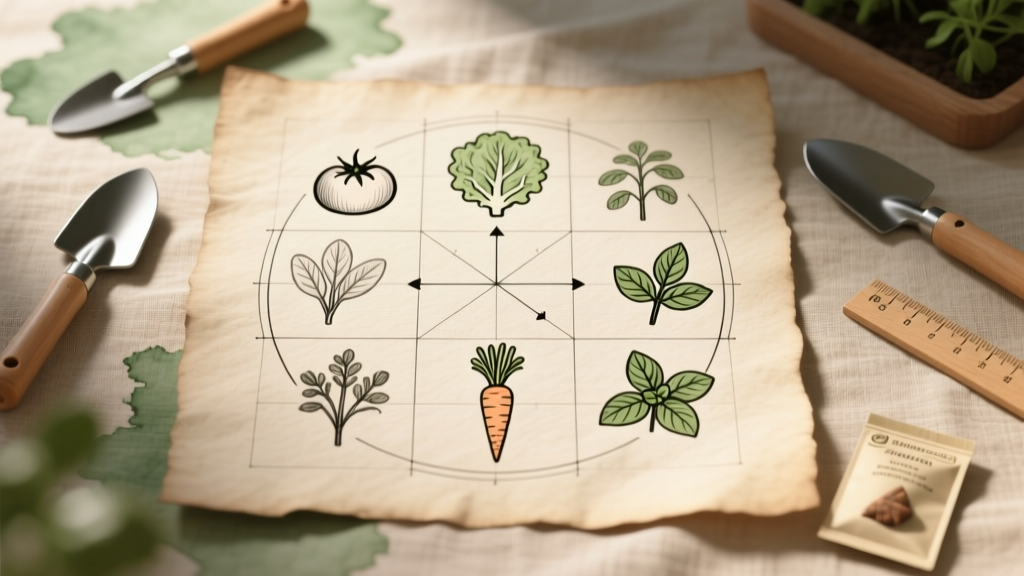
Making a Garden Plant Rotation Chart
If you’ve ever “rotated” crops by simply planting tomatoes on the other side of the same bed and calling it good, you’re in crowded company—and it’s one of the fastest ways to keep soil diseases and pests on repeat. Many common problems (like early blight, clubroot, and onion maggots) don’t care that you moved plants 3 feet; they care whether you planted the same family in the same soil zone too soon.
A good rotation chart isn’t a pretty spreadsheet you forget by July. It’s a working map that tells you exactly what goes where, when, and what you’ll do next year so you’re not guessing with seedlings in hand. Below are the practical shortcuts I’ve seen save time, money, and headaches—especially in small gardens where “just move it” isn’t enough.
Start with a chart that matches how gardens actually work
Tip: Map your garden into repeatable “zones,” not vague beds
Instead of thinking “Bed 1” and “Bed 2,” divide each bed into zones you can consistently re-use: halves, thirds, or 4x4-foot squares. A simple rule: make the smallest zone at least 4 ft x 4 ft so it can hold a meaningful crop block (like 4 tomato plants or a dense patch of carrots). Example: a 4x12 raised bed becomes three 4x4 zones—easy to rotate without over-complicating.
Tip: Use family groups, not individual crops
Rotation works because pests and diseases often target plant families, not just one crop. Group your chart by family: Solanaceae (tomatoes, peppers, eggplant, potatoes), Brassicaceae (cabbage, kale, broccoli), Alliums (onions, garlic), Cucurbits (squash, cucumbers), Fabaceae (beans, peas), and so on. Real-world example: swapping tomatoes for peppers is not rotation—they’re both Solanaceae.
Tip: Pick a rotation “cycle length” you can actually maintain
The sweet spot for many home gardens is a 3-year or 4-year cycle. Longer than 4 years looks great on paper but falls apart when you impulse-buy seedlings. Many extension recommendations emphasize multi-year gaps for soilborne disease suppression; for example, Penn State Extension notes longer rotations reduce disease and insect buildup (Penn State Extension, 2023).
Tip: Build your chart around your top 6 crops, not your whole wish list
Most gardens are driven by a handful of heavy hitters: tomatoes, peppers, cucumbers, beans, squash, and greens. Anchor your chart with your top 6 “must-grow” crops, then fit everything else around them. Example: if tomatoes and peppers take up 40% of your sunny space, your rotation chart needs a dedicated plan for Solanaceae first—everything else is just accessories.
Make it disease-smart (this is where charts pay off)
Tip: Treat “same soil” as the real issue—aim for 3–4 years between same-family plantings
If you’ve battled blight, clubroot, or wilt, give that family a real break: 3 years minimum, 4 years is better. That means tomatoes shouldn’t return to the same zone until year 4 in a 4-zone plan. Example: if Zone A had tomatoes in 2026, keep all Solanaceae out of Zone A until 2029 or 2030.
“Rotation is one of the most effective cultural practices for managing soilborne diseases because it reduces the carryover of pathogens and pests between crops.” — University of Minnesota Extension (2020)
Tip: Put your “problem beds” on their own stricter rotation
If one bed always gets powdery mildew on cucumbers or flea beetles on arugula, don’t treat it like the rest of the garden. Label it as a hot zone and extend rotations there by one extra year, or avoid that family entirely for a cycle. Case example: a damp, low bed that always mildews cucurbits might become a “brassica + allium” bed for 2 seasons while you improve airflow and drainage.
Tip: Track diseases as part of the chart (one word is enough)
Add a tiny note in each zone each year: “blight,” “clubroot,” “borer,” “mildew,” or “clean.” This is the cheat code that turns your chart into a decision tool. Example: seeing “clubroot” in the brassica zone in 2025 is your signal to keep brassicas out for 4+ years and consider liming to raise pH (clubroot pressure increases in acidic soils).
Tip: Rotate by “feeding level” to avoid fertilizer whack-a-mole
Heavy feeders (tomatoes, corn, brassicas) should follow soil-building crops (beans/peas, cover crops) or areas that got compost. A common home-garden pattern that behaves well: legumes → leafy greens → fruiting crops → roots/alliums. Example: peas in spring, then a fall cover crop, then next year tomatoes—your soil will feel the difference.
Shortcuts for small spaces (raised beds, tiny yards, and containers)
Tip: Use “micro-rotation” in raised beds with 4-square zones
When you only have one or two raised beds, micro-rotation keeps you from planting the same family in the exact same soil. Divide each bed into 4 squares (like 4x4 within a larger bed) and rotate families through the squares yearly. Scenario: a 4x8 bed becomes two 4x4 squares—Solanaceae on the left in year 1, on the right in year 2, then out of the bed entirely in year 3.
Tip: For containers, rotation means swapping soil—or at least the top layer
In pots, the “zone” is the pot itself. If you grow tomatoes in a 15–20 gallon container, don’t plant peppers in that same pot next year unless you refresh soil aggressively. Money-saving alternative: replace the top 6 inches of mix and add 2–3 inches of compost, then plant a different family (like herbs or lettuce) instead of another Solanaceae.
Tip: Use a cheap color-code system so you can spot mistakes in 2 seconds
Assign each plant family a color and mark zones with colored dots on your chart (and even on bed corners). A pack of 500 colored dot stickers often costs around $6–$10 and lasts years. Example: red = Solanaceae, green = legumes, blue = brassicas; if you see two reds in the same zone two years in a row, you caught a rotation break instantly.
Build a rotation chart that survives real life
Tip: Make a “Plan A / Plan B” line for each zone
Seedlings sell out, weather shifts, and sometimes you just don’t feel like trellising cucumbers. Give each zone a backup family that still respects rotation. Example: if Zone B’s Plan A is cucurbits but you skip them, Plan B could be beans (legumes) or leafy greens—anything but another cucurbit.
Tip: Lock in permanent crops so they don’t wreck your chart
Asparagus, rhubarb, berries, and perennial herbs don’t rotate, so treat them as fixed zones that don’t participate. Mark them clearly and rotate everything else around them. Scenario: if strawberries take a 4x12 strip, your “rotation grid” should start next to it, not pretend it’s movable space.
Tip: Schedule successions inside the same family (so you don’t accidentally double-plant)
Succession planting can accidentally sabotage rotation when you replant the same family in the same spot after an early crop finishes. Put timing right into the chart: “peas (Mar–Jun) → buckwheat cover (Jun–Aug) → spinach (Sep–Oct).” That’s still rotation because spinach isn’t a legume, and buckwheat helps smother weeds in as little as 30–40 days.
Tip: Keep your chart visible where decisions happen
A chart buried in a folder won’t stop you from planting tomatoes “where there’s room.” Tape it inside the shed door, greenhouse, or seed bin lid. Real-world example: one laminated page plus a dry-erase marker beats a perfect spreadsheet you never open.
What to put in the chart (and what to leave out)
Tip: Record the family, not every single variety
You don’t need “Brandywine tomato” in your rotation chart—“Solanaceae” is the useful part. Save variety details for your seed log. This keeps the chart clean and fast to update when you swap varieties mid-season.
Tip: Add one soil note per zone per year: compost, mulch, or cover crop
Rotation is half pest management, half soil management. Put a simple tag like “+compost,” “leaf mulch,” or “crimson clover.” Example: if Zone C gets 1 inch of compost in fall (about 0.33 cubic yards per 100 sq ft), note it—next year that’s where your heavy feeders belong.
Tip: Track costs once, then design the chart to save money
Rotation can cut inputs if you plan for soil building. Example numbers: buying bagged compost at $6 for a 1.5 cu ft bag adds up fast; covering 100 sq ft with 1 inch takes roughly 25 bags (often $150+). Money-saver: a local bulk delivery of 1 cubic yard compost is commonly $35–$60 plus delivery, and covers about 324 sq ft at 1 inch—build your rotation so you only “boost” the zones that need it most.
Rotation methods that work (pick one and stick with it)
| Method | Best for | How it works | Tradeoff |
|---|---|---|---|
| 4-Zone Family Rotation | Raised beds, organized gardens | Each year, families move to the next zone; same family returns in year 4 | Needs enough space to keep family blocks together |
| Bed-Swap Rotation | Two or three large in-ground beds | Swap “fruiting crops” bed with “roots/alliums” bed, etc. | Less precise; can fail if beds have mixed families |
| Container Soil-Swap Rotation | Patios, balconies | Rotate families AND refresh top 6 inches (or fully dump/rehab soil) | More labor; may require storing used mix |
Tip: If you’re overwhelmed, start with a 4-zone rotation template
A classic workable pattern is: Zone 1: Solanaceae, Zone 2: Brassicas, Zone 3: Legumes/leafy, Zone 4: Roots/Alliums. Next year, shift each family one zone forward. Example: tomatoes move from Zone 1 to Zone 2—but only if Zone 2 is designated for Solanaceae next year; the “zone label” rotates, not the physical bed.
Tip: Use “crop blocks” even if you interplant
Interplanting basil under tomatoes is great—but rotation still needs a dominant crop block per zone. Mark the zone by the crop family that occupies the most space for the longest time. Example: a zone with tomatoes (May–Oct) plus quick radishes (Apr) is still a Solanaceae zone for rotation purposes.
Three real-world scenarios (and how the chart handles them)
Scenario: The two-bed raised garden with heavy tomato habits
If you have two 4x8 beds and always grow 8 tomato plants, your chart needs to prevent tomatoes from returning to the same soil too soon. Hack: split each bed into two 4x4 zones (4 zones total), and limit Solanaceae to only one zone per year—use the other sunny zones for beans, cucumbers, or brassicas. Example rotation: 2026 Solanaceae in Zone A, 2027 in Zone B, 2028 in Zone C, 2029 in Zone D—tomatoes return to Zone A in year 5.
Scenario: The in-ground garden with a “mystery disease patch”
You notice one corner always produces weak peppers and yellowing leaves—classic sign of soil issues or disease pressure. On your chart, label that zone “rest” and plant a non-host family plus a cover crop. Example: for 60–90 days, grow buckwheat, then follow with fall garlic (Allium) instead of more Solanaceae; keep Solanaceae out for 3–4 years while you improve organic matter and drainage.
Scenario: The container gardener who wants tomatoes every summer
If your patio is all containers, you can still rotate by dedicating pots to families and refreshing soil strategically. Example: Tomato Pot #1 gets tomatoes this year; next year it gets lettuce (Asteraceae) and herbs after you replace the top 6 inches and mix in compost at roughly a 3:1 ratio of old mix to fresh compost for the refreshed portion. Keep a second pot in the rotation so tomatoes “move” to a different container each season.
Insider tricks for keeping the chart accurate all season
Tip: Do a 5-minute midseason audit in late June
By late June (or about 6–8 weeks after last frost for many regions), you’ve made most planting decisions—and also most of the “I’ll just tuck this here” mistakes. Walk the beds with your chart and correct it to match reality. That one update makes next year’s plan dramatically easier.
Tip: Use simple symbols for repeat problems (so you see patterns across years)
Add icons like “B” for blight, “F” for flea beetles, “M” for mildew, “C” for cutworms. Patterns jump out after 2–3 seasons. Example: if mildew marks show up every year in the same zone, you’ll know it’s not just the cucumber variety—it’s airflow, shade, or that zone’s moisture profile.
Tip: Put a reminder in your calendar for chart updates
Rotation charts fail when they’re only updated “when you have time,” which is basically never. Add two recurring reminders: one at spring planting, and one at fall cleanup. Example: “Update rotation chart” on May 15 and Oct 15 keeps your notes from disappearing into garden amnesia.
DIY chart formats (choose what you’ll actually use)
Tip: The one-page paper chart (fastest and cheapest)
Print a simple grid and keep it on a clipboard in the shed. Cost: about $0.10–$0.50 per page, and you can laminate it for a few dollars or slide it into a binder sleeve. Example: each zone gets one box per year with “family + quick note,” like “Brassicas / flea beetles.”
Tip: The whiteboard chart (best for constant tinkering)
A small whiteboard (often $10–$20) lets you rearrange plans on the fly without rewriting. Use tape to create a grid and dry-erase markers by family color. Example: you can swap Zone C and D plans in seconds if one bed floods after heavy rain.
Tip: The spreadsheet chart (best if you love tracking)
Spreadsheets shine when you also want to track yields, planting dates, and costs. Keep one tab for the rotation grid and another for a crop log; link them if you’re fancy. Example: you’ll quickly see that “Zone B + compost + legumes last year” correlates with your best tomato harvest—and you can repeat that pattern on purpose.
Plant rotation charts aren’t about being perfect—they’re about being consistent enough that pests don’t get a yearly invitation and your soil gets a chance to recover. Once you’ve got your zones, your family colors, and a realistic 3–4 year cycle, the whole thing becomes a low-effort habit: plant, note it, rotate it, repeat. Next spring, you’ll thank past-you when you’re holding seedlings and your chart tells you exactly where they should go.