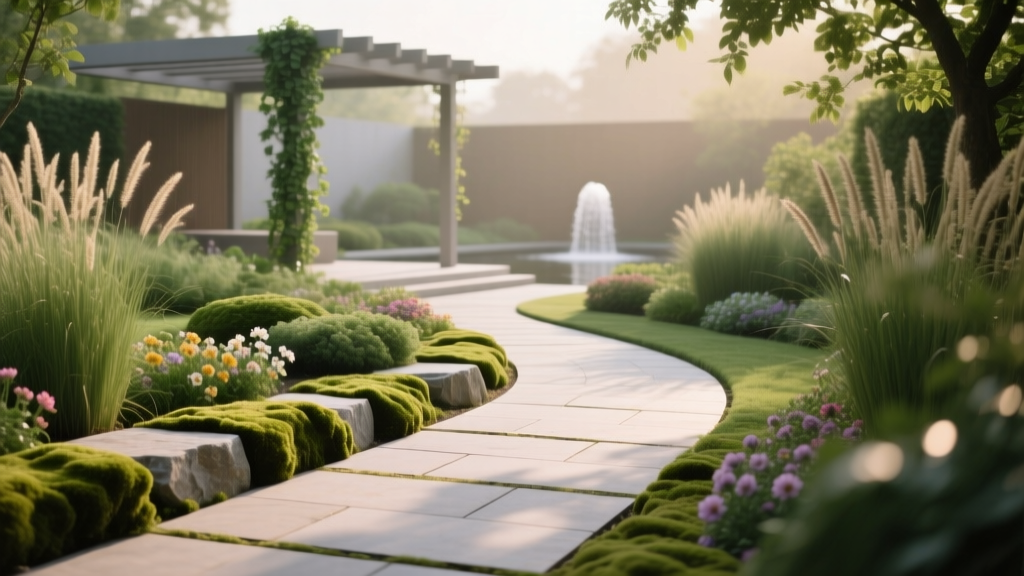
10 Garden Hacks for Garden Path Design
The most common garden-path mistake isn’t choosing the “wrong” material—it’s building a path that’s too narrow. A 24-inch path looks fine on paper, but it forces you to shuffle sideways with a wheelbarrow, and then you start cutting corners… right onto your plants. Fixing a too-narrow path later usually costs more than doing it right the first time, because you end up regrading, re-edging, and replacing materials that were “good enough” at the start.
Below are ten field-tested hacks that make paths sturdier, cleaner, cheaper, and easier to maintain—without turning your yard into a hardscape project that never ends.
Group 1: Layout hacks that prevent regret
1) Build for how you actually walk (not how you wish you walked)
Before you dig anything, mark your path and “test-drive” it for a week. Use a garden hose or painter’s tape to outline the route, then walk it with groceries, a hose, and a wheelbarrow to see where you naturally drift.
Shortcut standard: 36 inches wide for one person with tools, 42–48 inches if you regularly use a wheelbarrow or garden cart. In a small front yard, I’ll still try to keep the main artery at at least 36 inches, then let secondary paths narrow to 24–30 inches.
Real-world example: In a 10' x 20' side yard, a client insisted on 24" pavers to “save space.” After one muddy spring of clipped hips and crushed border plants, we widened it to 36"—and the garden looked bigger because the path finally felt intentional instead of accidental.
2) Use the “string + stake” trick to get curves that don’t look wiggly
Wavy paths are harder to install and they often look amateurish because the curve radius changes every few feet. For a curve that feels natural, set two stakes and run a string between them; then use a third stake to “bow” the string outward for a consistent arc.
As a practical guide, aim for a minimum curve radius of 6–8 feet on main routes—tighter curves can feel cramped and make mowing edges annoying.
Case example: A backyard path to a shed kept looking “snake-y” even though the homeowner used a hose template. We switched to a single, long-radius curve (about 7 feet) and suddenly the path looked like it belonged there, not like it was dodging imaginary obstacles.
3) Size the slope now, so puddles never become your personality
If your path holds water, it’ll grow algae, heave in freeze-thaw cycles, and eventually become a mud conveyor belt into the house. A small grade fixes most of this: shoot for a cross-slope of 1–2% (that’s roughly 1/8–1/4 inch per foot) so water sheds off the walking surface.
For longer runs, add a slight “crown” in the middle or a gentle pitch to one side—especially on gravel paths.
Expert-backed note: The Interlocking Concrete Pavement Institute recommends a minimum slope of about 2% for pavement drainage (ICPI, 2020), which is a solid benchmark even for DIY paver paths.
Group 2: Base + drainage hacks (where paths are won or lost)
4) Use the right base depth—then stop overbuilding
Most DIY path failures come from a skimpy base, but the second most common issue is overbuilding (wasted money, wasted digging). For a typical foot-traffic path, a reliable starting point is 3–4 inches of compacted crushed stone base (like 3/4" minus), topped with 1 inch of leveling sand for pavers or a thin layer of screenings for flagstone.
If your soil is clay or you get heavy rain, bump the base to 5–6 inches and compact in two lifts. Rent a plate compactor for about $60–$90/day—it’s cheaper than redoing a sinking path next year.
Scenario: In a Midwestern yard with clay soil, a homeowner laid stepping stones on top of topsoil. By June, they were all tilted. Rebuilding with 5" compacted base and proper edging stopped the wobble completely.
5) Lay down geotextile fabric only when it actually helps
Landscape fabric under gravel is great for keeping stones from disappearing into soft soil, but it’s not a magic weed force field. Use non-woven geotextile under gravel paths when you’re dealing with sandy soil, muddy areas, or when you want the gravel layer to stay clean and separate from subsoil.
Skip fabric under pavers if you’ve built a proper crushed-stone base; instead, focus on compaction and edging. A good non-woven fabric typically costs $0.30–$0.70 per sq ft, so save it for where it earns its keep.
Research-backed reality check: Many university extension resources note that landscape fabric does not permanently prevent weeds because windblown seeds germinate on top of the fabric in accumulated debris (e.g., University of Minnesota Extension, 2019). Translation: fabric helps with separation; mulch/gravel depth helps more with weed suppression.
6) “Catch the roof” with a mini dry creek crossing
Downspout splash and roof runoff are path destroyers—especially where a path runs near the house. Instead of fighting water, route it: create a shallow swale that crosses under or alongside the path and fill it with 2–4" river rock, or install a 4-inch solid drainpipe that outlets to a safe area.
Keep the crossing slightly lower than the path surface, so water chooses the rock channel instead of pooling on your walking line.
Case example: One front walkway repeatedly iced over because a downspout dumped right beside it. A $35 length of 4" pipe plus a rock-lined outlet solved the winter slip hazard without touching the walkway itself.
Group 3: Material hacks (cheap wins and cleaner installs)
7) Use “two-size gravel” so it locks in like it’s glued
If you’ve ever kicked gravel off a path like you’re shoveling snow with your shoes, you probably used round pea gravel alone. The hack is blending sizes: use an angular base (3/4" minus) and top it with 1 inch of smaller gravel (like 3/8" minus) so fines settle in and bind the surface.
For a budget blend, ask your local quarry for “crusher fines” or “screenings.” It’s often cheaper per ton than bagged decorative gravel, and it compacts into a surprisingly stable surface.
Cost note: Bulk gravel commonly runs $40–$90 per ton (region dependent), while bagged gravel can effectively exceed $200+ per ton once you do the math. If you need 2 tons, buying bulk can pay for delivery.
8) For stepping stones, set them in a “mow strip” so your mower stops eating edges
Stepping stones look best when they’re not surrounded by ragged grass and string-trimmer scars. Here’s the trick: create a 4–6" wide strip of compacted gravel or mulch on both sides of the stepping-stone line (like a mini runway). It gives you a clean buffer for mowing and keeps grass from creeping between stones as fast.
Set the stone tops 1/2 inch above surrounding soil if you mulch around them, or flush if the path runs through lawn so a mower can pass over safely.
Real-world example: In a backyard veggie garden, a stepping-stone route became a weekly trimming chore. Adding a 6" gravel border cut maintenance down to a quick rake-up once a month.
9) Use polymeric sand selectively (and save it for where it matters)
Polymeric sand is fantastic between pavers because it hardens and resists washout, but it’s overkill for every situation. Use it on main walkways, slopes, and anywhere you blast with a hose; skip it for patio edges you expect to rework or for rustic flagstone joints where plants will fill in.
Most polymeric sand wants joints about 1/4 inch deep minimum to lock properly, and a typical bag (often 40–50 lb) runs about $25–$45. It’s a “spend smart” product: use it where movement and erosion are most likely.
Expert reminder: “Proper compaction and edge restraint matter more than any joint material. Joint sand can’t compensate for a weak base.”
“Edge restraints and a well-compacted aggregate base are the backbone of a paver installation; without them, joint materials won’t prevent spreading or settling.” — Interlocking Concrete Pavement Institute (ICPI), 2020
Group 4: Edging + maintenance hacks (the stuff that keeps paths neat)
10) Install edging like a pro: pin it, bury it, and lock the corners
Edging is the unsung hero of path design—it stops gravel from migrating and keeps pavers from “walking” outward. For gravel paths, use steel or aluminum edging buried so the top sits about 1/2 inch above the finished gravel; pin it every 12–18 inches with spikes.
On paver paths, an edge restraint on both sides is non-negotiable, especially on curves. If you’re DIY-ing on a budget, pressure-treated 2x4s can work as temporary edging for a season, but plan to replace with proper restraint once the path proves its layout.
Quick comparison table: pick the path surface that fits your life
Not every “pretty” path is pleasant to live with. Use this as a gut-check before you commit.
| Path type | DIY difficulty | Typical base | Best for | Common failure | Ballpark cost (materials) |
|---|---|---|---|---|---|
| Compacted gravel (angular) | Easy–medium | 3–6" compacted crushed stone + 1" fines | Utility paths, side yards, quick upgrades | Gravel migration without edging | $1.50–$4.00/sq ft |
| Pavers (concrete/clay) | Medium | 3–6" base + 1" bedding sand + edge restraint | Main walkways, clean modern look | Spreading/settling from weak base | $4.00–$12.00/sq ft |
| Flagstone (dry-laid) | Medium–hard | 4–6" base + screenings/stone dust | Natural style, irregular shapes | Rocking stones from uneven bedding | $6.00–$20.00/sq ft |
| Mulch/wood chips | Easy | Weed knockdown + 3–4" chips | Temporary paths, cottage gardens | Breakdown/refresh needed yearly | $0.50–$2.00/sq ft |
Bonus “sticky situations” and how these hacks play out
Scenario 1: The muddy side yard that eats shoes. This is where Tip #4 (base depth) and Tip #5 (geotextile) shine. Add 5–6" of compacted crushed stone, use non-woven fabric underneath, and edge it well (Tip #10). You’ll turn a mud lane into a firm utility path without needing a full paver build.
Scenario 2: The front walkway that looks fine but feels cramped. Tip #1 fixes this immediately: widen the main run to 36–42", especially from driveway to door. If you can’t widen, fake the feeling of width by running a straight edge line and using a consistent border (brick soldier course or steel edging) so it reads as intentional, not squeezed.
Scenario 3: The sloped path that keeps washing out. Combine Tip #3 (1–2% cross-slope) with Tip #9 (polymeric sand on critical joints) and Tip #10 (strong edging). On gravel slopes, use the two-size gravel method (Tip #7) and consider adding 2–3 subtle “speed bumps” made of buried timber or stone every 6–10 feet to slow runoff and keep gravel in place.
A few last insider moves (tiny effort, big payoff)
Do a “string test” for trip hazards. After setting stones or pavers, drag a tight string line across the surface. If anything catches more than 1/4 inch, you’ll feel it underfoot—fix it now while your bedding layer is still workable.
Buy one extra unit per 10. For pavers or edging pieces, a 10% overage usually covers cuts, chips, and future repairs. It’s cheaper than hunting down a discontinued color later.
Time your install for cooperative soil. If you can choose, build after a light rain when soil is damp but not sticky—digging is easier, and compaction is more predictable. Avoid installing on saturated clay; it pumps and shifts under compaction, setting you up for settling.
If you steal nothing else from this list, steal this: make the path wide enough, give water somewhere to go, and lock the edges like you mean it. Do those three things and even budget materials start behaving like premium ones—your garden stays cleaner, your maintenance drops, and the path feels like it was always meant to be there.
Sources: Interlocking Concrete Pavement Institute (ICPI), 2020; University of Minnesota Extension, 2019.