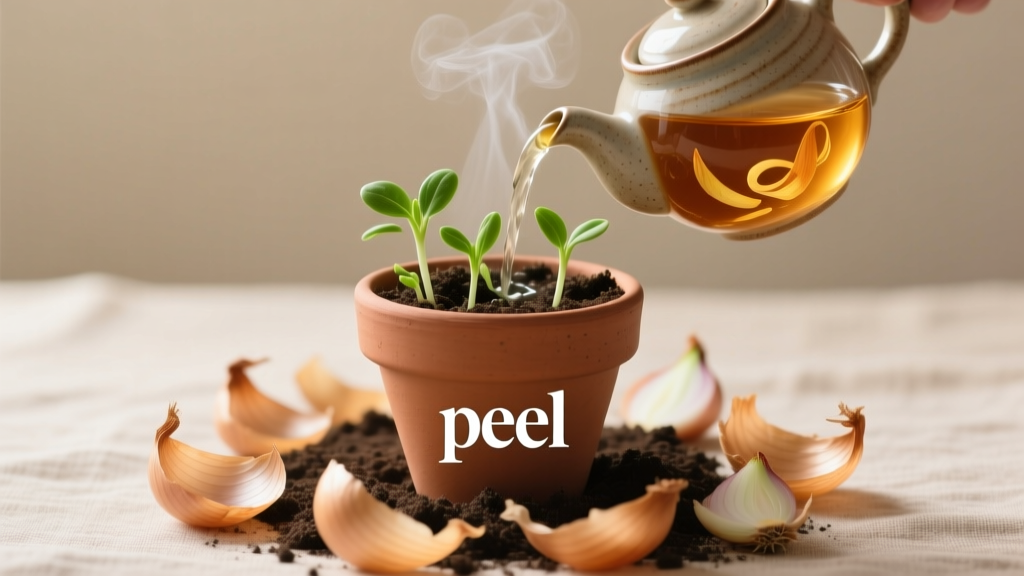
Onion Peel Tea as a Potassium-Rich Fertilizer
Most gardeners toss onion skins like they’re useless trash—then spend $10–$25 on a bag of “bloom booster” to fix weak flowering or bland tomatoes. Here’s the twist: those papery peels are one of the easiest kitchen scraps to turn into a potassium-leaning plant tonic, and you can make it in under 15 minutes of hands-on time. The common mistake is treating onion peel tea like a miracle fertilizer you can splash on anything, anytime; it works best when you use it as a targeted supplement, not a one-size-fits-all feed.
Onion peel tea isn’t a complete fertilizer (it won’t replace compost or balanced feeding), but it can provide a gentle nudge of potassium (K) plus small amounts of micronutrients. Potassium is the nutrient most associated with fruit quality, flower formation, and stress tolerance—so this is a handy trick to keep in your back pocket when plants are setting buds, fruiting, or recovering from heat stress.
Before You Brew: Getting the “Tea” Right (So It Helps, Not Hurts)
Tip: Use only clean, dry outer skins—skip slimy scraps
Stick to the papery outer peels from onions you’ve stored dry. Avoid peels that are wet, moldy, or stuck to rotting onion layers; those can turn your tea funky fast and invite unwanted microbes. If your skins have dirt, give them a quick rinse and let them air-dry for 30–60 minutes before steeping.
Real-world example: If you keep a “scrap jar” on the counter for a week, your onion skins may absorb moisture from other scraps—those are the ones that tend to make tea smell sour in 24 hours.
Tip: Aim for a repeatable ratio so you don’t overdo it
For a consistent batch, use 2 loosely packed cups (about 10–15 g) of dry onion skins per 1 gallon (3.8 L) of water. That strength is mild enough for most garden plants when diluted (more on that below), and it keeps you from making random “mystery brews” that vary every time.
Shortcut: Save peels in a paper bag; when it’s half full, that’s roughly enough skins for 2–3 gallons of tea.
Tip: Choose steeping, not fermenting, for a clean-smelling fertilizer
Steeping is faster and less risky than fermenting: pour boiling water over the peels, cover, and let it sit. A practical steep time is 12–24 hours; after that, it doesn’t usually get “stronger” in a helpful way—just smellier. If you want a zero-odor routine, steep 2 hours using hot water and use the tea the same day.
Tip: Strain well if you’ll use a watering can or sprayer
Onion skins shred into tiny flakes that clog spouts and sprayer nozzles. Strain through a fine kitchen sieve or a piece of old T-shirt fabric. If you plan to foliar spray, strain twice—clogs are annoying, but uneven application is worse.
Brewing Methods You Can Actually Stick With
Tip: The “Overnight Jar” method for small gardens
Add 1/2 cup dry onion skins to a 1-quart (1 L) jar, fill with hot tap water, and cap loosely. Let sit overnight, then strain. This makes a quick concentrate you can dilute into a watering can for patio containers.
Case example: Balcony gardeners growing peppers often struggle with small pots drying out. This method lets you make just enough tea for 2–4 containers without storing leftovers.
Tip: The “Stockpot Steep” for fast turnaround
If you want tea today, simmer skins gently for 10 minutes, then let cool and steep for another 1–2 hours. This is great when you notice blossoms dropping and want to respond quickly, especially on tomatoes and squash. Keep the heat low—rolling boils can make the brew smell sharper and doesn’t add extra benefit.
Tip: Freeze peels in portions so you always have enough
Onion skins are light; it takes time to accumulate a useful amount. Freeze peels in a zip bag until you hit your target—like 2 cups—then brew. Freezing doesn’t harm the mineral content, and it prevents that damp-counter smell that makes people quit this habit.
How to Apply Onion Peel Tea Without Guesswork
Tip: Dilute like you mean it—start at 1:3 for soil drench
Onion peel tea varies in strength, so a safe starting point is 1 part tea to 3 parts water for a soil drench. Apply to already-moist soil to reduce any chance of root irritation—think “after a normal watering,” not on bone-dry pots.
Specific timing: Use it every 10–14 days during flowering and fruiting, then stop about 2 weeks before final harvest on fast crops like bush beans or cucumbers.
Tip: For seedlings and houseplants, go weaker (1:5) and less frequent
Seedlings and many houseplants don’t need much potassium, and they’re more sensitive to any homemade brew. Dilute to 1:5 and apply no more than once a month. This keeps it in “gentle tonic” territory rather than acting like a heavy feed.
Real-world example: If you’ve got pothos or spider plants in 6-inch pots, a few ounces of diluted tea is plenty—don’t soak the whole pot like you would a tomato bed.
Tip: Foliar spraying is optional—do it only at the right time of day
If you want to foliar spray, strain extremely well and dilute to 1:10. Spray early morning or late evening to avoid leaf burn and to give leaves time to absorb before heat. Skip foliar use on fuzzy-leaf plants (like African violets) and avoid spraying right before rain.
Where Onion Peel Tea Shines (And Where It Doesn’t)
Tip: Use it as a potassium “top-up” during bloom and fruit set
Potassium supports flowering, fruit fill, and general stress tolerance. Onion peel tea is most useful when plants transition from leafy growth to reproductive growth—tomatoes, peppers, eggplants, cucumbers, squash, and strawberries are classic candidates. If you’re already using a balanced fertilizer, this can be your occasional booster rather than a daily habit.
Tip: Don’t use it to “fix” nitrogen hunger—pair with compost or a balanced feed
Yellowing lower leaves and slow growth usually point to nitrogen deficiency, not potassium shortage. Onion peel tea won’t correct that; it’s like taking vitamin C when you really need protein. If plants are pale, add compost, worm castings, or a balanced fertilizer instead.
Tip: Be cautious with onions/garlic beds if disease pressure is high
It’s tempting to use onion peel tea on alliums, but if you’ve had fungal issues (like downy mildew) you don’t want extra moisture splashing around. Use it as a soil drench at the base only, keep foliage dry, and water early in the day so the bed dries quickly.
Three Real-World Scenarios (With Numbers You Can Copy)
Scenario 1: Tomatoes with loads of flowers but meh fruit size
If your tomato plant is flowering like crazy but fruits are small and slow to fill, try onion peel tea as a gentle K supplement. Mix 1 quart of tea into 3 quarts of water (that’s the 1:3 dilution) and drench the root zone of one in-ground plant with 1/2 gallon. Repeat once after 14 days, then reassess—don’t keep dosing if growth looks balanced.
Extra hack: Pair the tea with a 1-inch compost top-dress to cover the “complete nutrition” side without buying multiple specialty products.
Scenario 2: Patio peppers in 5-gallon containers that keep dropping blossoms
Containers leach nutrients fast, and peppers are famously dramatic in heat swings. Use a weaker drench: 1:5 dilution, about 2 cups per 5-gallon pot, every 2 weeks during flowering. If daytime temps are consistently above 90°F (32°C), focus on shade cloth and consistent moisture first—tea won’t solve heat stress by itself, but it can support recovery once conditions stabilize.
Scenario 3: Strawberries that taste watery and don’t color evenly
Fruit quality problems often come down to inconsistent watering, but potassium plays a role in sugar movement and overall fruit development. Apply onion peel tea at 1:3 dilution as a soil drench at the start of bloom, then again when green fruit is visible—two applications total is usually enough. Use about 1 quart diluted mix per 3–4 plants in a bed, aiming at the soil, not the fruit.
How Onion Peel Tea Stacks Up Against Other Potassium Options
Here’s the practical comparison gardeners actually want: speed, smell, cost, and risk. Potassium sources vary wildly in strength—so think in terms of “gentle supplement” vs “serious fertilizer.”
| Option | Best Use | Typical Cost | Speed | Risk / Downsides |
|---|---|---|---|---|
| Onion peel tea | Light K boost during bloom/fruiting | $0 (kitchen scrap) or ~$0.50 per batch (energy/water) | Fast (same day to 24 hrs) | Inconsistent strength; can smell if left too long |
| Compost top-dress | Broad nutrition + soil health | $0–$8 per bag equivalent | Slow (weeks) | Not a quick fix; may not supply enough K for heavy fruiting alone |
| Sulfate of potash (0-0-50) | Strong K correction for known deficiency | ~$12–$25 per 5 lb bag | Fast (days) | Easy to overapply; best guided by soil test |
| Wood ash | K boost in acidic soils (sparingly) | $0 | Fast | Raises pH; can burn plants; not for alkaline soils |
What the Research and Experts Say (And What It Means in Your Garden)
Onion peels are known to contain minerals and plant compounds, but the exact nutrient extraction into “tea” depends on peel amount, water volume, and steep time. That’s why this works best as a mild supplement and why dilution matters.
“The only way to know what nutrients your soil needs is to test it. Fertilizers should be applied to meet plant needs—more is not better.” — University of Minnesota Extension, Soil Testing guidance (2020)
That soil-testing advice matters here: if your soil already has adequate potassium, piling on more won’t magically increase yields and can interfere with uptake of other nutrients. A basic soil test often costs around $15–$30 through local extension programs, and it prevents months of guesswork.
For nutrient roles, potassium is consistently documented as essential for overall plant function and stress tolerance. The Royal Horticultural Society notes potassium’s role in flower and fruit quality and general plant health (RHS, 2023). Meanwhile, onion byproducts have been studied for their chemical composition and beneficial plant compounds; onion skins are particularly rich in flavonoids such as quercetin (for example, reviews discussing onion waste composition and value-added uses such as Khiari et al., 2014). The garden takeaway: onion peels aren’t just “brown paper”—they carry useful compounds, but your application should still be guided by plant needs and soil context.
Troubleshooting: Fix the Two Biggest Problems (Smell and Mold)
Tip: If it stinks like rotten eggs, you went anaerobic—dump it
A sulfur/rotten smell means the brew likely turned anaerobic (low oxygen), which is not what you want around roots. Don’t “power through” and apply it anyway; compost it or dump it away from the garden. Next time, steep for 12–24 hours max, use clean containers, and keep it cool and shaded.
Tip: White film on top? Strain and use immediately—or start over
A thin white film can be yeast or harmless microbes, but it’s also a sign the brew is aging. If the tea still smells normal (earthy/onion-y, not rotten), strain it and use it the same day as a soil drench only. If you see fuzzy mold or it smells “off,” toss it.
Tip: Don’t store it longer than 48 hours unless you refrigerate
Homemade plant teas aren’t shelf-stable. At room temperature, plan to use within 1–2 days. If you must store, refrigerate up to 5 days, then bring to ambient temperature and dilute before applying.
Smart Pairings: Make Onion Peel Tea Work Harder
Tip: Combine with compost tea (not fertilizer tea) for a broader boost
If you already brew aerated compost tea for microbial support, you can add a small handful of onion skins during the last 2–4 hours of brewing for a “bonus steep.” Keep it modest—think 1/2 cup skins per 5 gallons—so you don’t create a funky, sulfur-heavy brew. This is a nice way to stretch one garden chore into two benefits.
Tip: Use it after heavy rain to replace what containers lose
After a soaking rain, nutrients flush out of pots faster than in-ground beds. A single application of diluted onion peel tea (1:5) can act like a gentle reset for container fruiting plants. It’s not a full feed, but it’s a cheap “nudge” when you can tell plants have been washed out.
Tip: DIY alternative for stronger potassium: banana peel “cold soak” (with the same dilution rules)
If you’re specifically chasing potassium and you have more banana peels than onion skins, a cold soak works similarly: soak 2 banana peels in 1 quart of water for 24–48 hours, strain, then dilute 1:3 for soil drench. Like onion peel tea, it’s inconsistent, so treat it as a supplement—not a precision fertilizer.
Money-Saving Angles (Because Fertilizer Adds Up Fast)
Tip: Replace “bloom booster” purchases for small gardens
If you only grow a few containers of tomatoes and peppers, you may not need a specialty potassium product at all. Onion peel tea costs basically nothing beyond water and a bit of energy—call it $0.25–$0.50 per batch if you factor in heating water. Compare that with a $15 bottle of liquid bloom fertilizer that you’ll use twice and forget under the sink.
Tip: Spend your fertilizer budget on one good balanced product instead
Instead of buying three niche fertilizers, put your money into one reliable balanced feed (or good compost) and use onion peel tea as the “fine-tuning” tool. This prevents the classic garage shelf of half-used bottles. A single 5 lb box of general organic fertilizer can run $12–$20 and cover an entire season for many backyard gardens.
Quick Safety Notes (Pets, Pests, and Common Sense)
Tip: Keep brewed tea away from pets—especially dogs
Onions are toxic to dogs if ingested in sufficient amounts, and while the tea is diluted, it’s not something pets should drink. Apply it directly to soil and don’t leave buckets where animals can access them. If you have a dog that loves puddles, water it in well so it soaks quickly.
Tip: Don’t expect onion tea to repel pests reliably
Some gardeners swear onions repel everything; in practice, pest control is inconsistent. Use physical controls (netting for brassicas, sticky traps for fungus gnats, hand-picking for hornworms) and treat onion peel tea as nutrition support only. If pests are chewing leaves, potassium isn’t the missing ingredient.
If you want the simplest routine: keep a bag of dry onion skins, brew 2 cups per gallon, steep overnight, strain, dilute 1:3, and use it every 10–14 days on fruiting plants—then stop if plants look dark green and vigorous. It’s one of those kitchen-scrap habits that quietly pays off, especially in containers and during the bloom-to-fruit transition, and it’s a lot more satisfying than buying yet another bottle of “magic” plant food.
Sources: University of Minnesota Extension (2020), soil testing and fertilizer guidance; Royal Horticultural Society (RHS) (2023), nutrient roles including potassium; Khiari et al. (2014), research review on onion byproducts/peel composition and value-added uses.