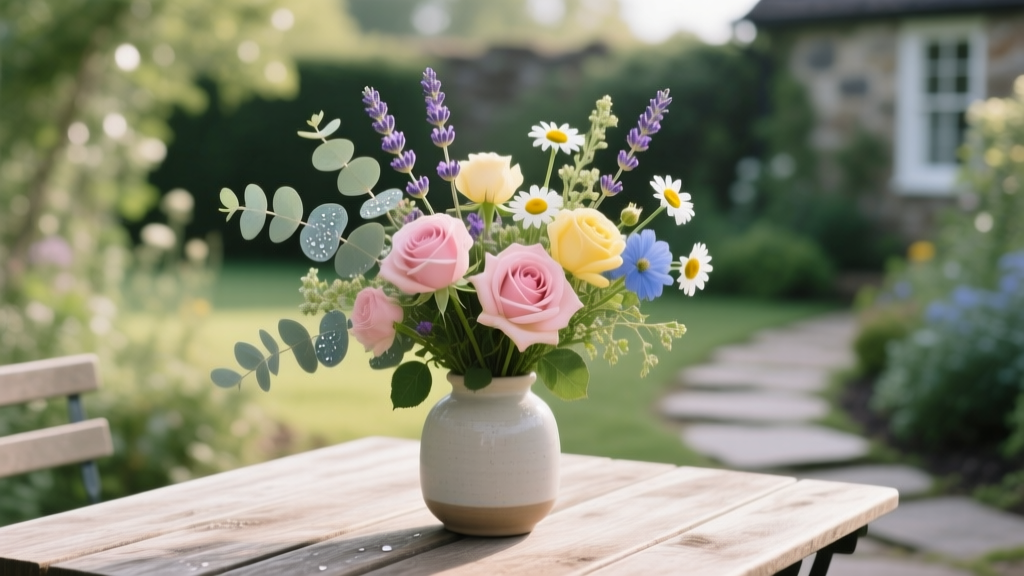
15 Garden Hacks for Flower Arranging from Your Garden
The fastest way to make a garden bouquet look tired isn’t “not enough water”—it’s harvesting at the wrong stage. Cut too late and petals shatter overnight; cut too early and buds stall in the vase. The good news: a few small, repeatable hacks (most of them free) will make your homegrown arrangements look like they came from a florist cooler.
Group 1: Harvest Like a Florist (So Stems Last)
1) Cut at the “right-open” stage (not “fully pretty”)
Most flowers last longest when you cut them just before peak. For zinnias, use the “wiggle test”: hold the stem 6–8 inches below the bloom and gently shake—if the head flops, it’s too young; if it stays firm, it’s ready. Example: a zinnia cut firm will commonly give you 7–10 days indoors, while a floppy one may brown in 48 hours.
2) Harvest early morning, then hydrate in shade for 1 hour
Plant tissues are naturally more hydrated before midday heat, which gives you a bigger “water tank” to start with. Cut stems early, then put them immediately into a bucket in the shade for at least 60 minutes before arranging; this simple pause reduces droop while you work. Real-world scenario: if you’re cutting for a 4 p.m. dinner, harvest at 8–9 a.m., condition in shade, then assemble after lunch.
3) Use the 45° cut + re-cut rule (and do it under water for picky stems)
Make your first cut at a 45° angle to increase the intake surface and keep the stem from sealing flat against the vase bottom. Then re-cut 1–2 inches off each stem right before arranging, especially if they sat dry even briefly. For extra-sensitive stems (like roses or hydrangeas), re-cutting underwater can reduce air entering the stem and help prevent sudden wilting.
4) Strip foliage up to the waterline (more than you think)
Leaves left underwater rot fast and feed bacteria, which clogs stems and shortens vase life. Remove all foliage that would sit below the vase’s waterline, plus any bruised leaves near the bottom third of the stem. Example: in a 10-inch vase filled to 6 inches, strip at least the bottom 6 inches of leaves—yes, it looks dramatic, and yes, it works.
5) Condition “thirsty divas” with a quick dip or a boil trick
Some stems collapse because sap or latex blocks water uptake. Dip poppy, euphorbia, and milkweed ends in just-boiled water for 10 seconds (or pass the cut end through a flame for 2–3 seconds) to seal latex; for woody stems like lilac or hydrangea, smash is overrated—split the bottom 1 inch with pruners instead for a cleaner intake. Case example: a bucket of hydrangeas often perks up overnight after a fresh re-cut plus full submersion of the blooms in cool water for 30–60 minutes.
Group 2: Vase Life Hacks (Cheap, Specific, Proven)
6) DIY flower food that actually follows the “sugar + acid + biocide” logic
Commercial flower food works because it feeds the bloom (sugar), lowers pH for uptake (acid), and controls bacteria (biocide). A solid DIY version: mix 1 quart (32 oz) water + 1 teaspoon sugar + 1 teaspoon lemon juice (or white vinegar) + 1/4 teaspoon household bleach. Use this for most mixed bouquets; avoid bleach on very delicate blooms if you’ve had issues, and never “double dose.”
Source note: Extension publications commonly recommend commercial preservatives because they combine sugar, acidifiers, and antimicrobial ingredients; see University of Florida IFAS Extension guidance on cut flower care (UF/IFAS, 2017) and Purdue Extension recommendations on sanitation and preservatives (Purdue Extension, 2020).
7) Change water on a schedule: every 2 days for mixed bouquets
A bouquet can look fine while the water turns into a bacterial soup. Set a simple rule: dump, rinse, and refill every 48 hours—more often if your room is warm (over 75°F). Real-world scenario: if you place flowers near a sunny kitchen window, expect to swap water daily to keep stems from sliming up.
8) The “1 drop” trick for cloudy water: a tiny bit of bleach goes a long way
If you don’t want full DIY flower food, you can still reduce bacteria. Add 1–2 drops of unscented household bleach per quart of water (not per vase—measure roughly) and stir before adding stems. Cost hack: a $2–$4 bottle of bleach can replace many packets of preservative if you’re arranging weekly.
9) Keep arrangements away from fruit bowls and heat vents
Ripening fruit releases ethylene gas that speeds aging in flowers—especially carnations, sweet peas, and many lilies. Keep bouquets at least 6 feet away from bananas, apples, and avocados, and never park them above a radiator or HVAC vent. Case example: a mixed bouquet that lasted 8 days on a dining room sideboard may drop to 3–4 days if moved next to a fruit bowl.
“Clean buckets, clean tools, and clean water are the foundation of cut-flower longevity—bacteria is the silent killer in the vase.”
—Purdue Extension cut flower handling guidance (2020)
10) Use the “cooler corner” hack: 55–65°F overnight
You don’t need a florist cooler to slow respiration—just a cool spot. If you can keep your arrangement overnight in a 55–65°F room (a basement, mudroom, or air-conditioned office), you’ll often gain 1–3 extra days of vase life. Example: move your centerpiece to a cool laundry room at night, then bring it back out in the morning.
Group 3: Design Shortcuts (So Bouquets Look Intentional)
11) Follow the florist ratio: 60% focal, 30% supporting, 10% airy
This ratio is a cheat code for balance. Use big “wow” blooms (focals) for roughly 60% of the visual weight, medium fillers for 30%, and light, airy bits for 10% to create movement. Example: 5 zinnias (focal) + 3 marigolds or calendula (supporting) + 1 sprig of basil flowers or ammi (airy) makes a bouquet read “designed,” not “random handful.”
12) One vase, three heights: tall, medium, and collar
Instead of fussing with complicated spirals, build height in layers. Start with 3–5 tall stems for the skyline, add medium stems to fill, then finish with a “collar” of short greenery around the rim (mint, geranium leaves, or hosta). Real-world scenario: when you’re arranging fast for guests, this layered method gives a full look in 10 minutes.
13) The rubber band grid hack (for wide-mouth jars)
Wide-mouth vases make stems splay; a simple grid forces structure. Cross 3–4 rubber bands over the opening to make squares about 1–1.5 inches wide, then place stems into the gaps. DIY alternative: floral tape works too, but rubber bands are reusable and basically free.
14) Grow “bouquet makers” on purpose: the 5-stem rule
If you want reliable arrangements, plant with cutting in mind: aim for at least 5 plants each of two focal flowers, two supporting flowers, and two foliage/filler plants. In a small bed, that might look like 10 zinnias + 10 calendula + 10 basil + 10 cosmos + 10 dusty miller (or artemisia), spaced per variety. Scenario: a 4x8-foot bed can supply a weekly pint-jar bouquet if you’re cutting consistently and deadheading.
Group 4: Container & Mechanics Hacks (No Fancy Supplies Required)
15) Replace floral foam with cheaper, greener mechanics
Floral foam is convenient but adds cost and waste; you can often skip it. Use one of these: a thrifted frog pin ($3–$8), a ball of chicken wire (a $10 roll lasts many seasons), or a “tape lattice” across the vase top. For heavy blooms (like dahlias), chicken wire holds stems securely without the foam crumbling into your water.
| Mechanic | Best for | Typical cost | Reusability | Quick notes |
|---|---|---|---|---|
| Floral foam | Complex shapes, event installs | $5–$12 per brick | One-time | Soaks up water but breaks down; not great for everyday garden bouquets. |
| Chicken wire “pillow” | Most vase arrangements | $10–$20 per roll | Many uses | Ball it up, fit snugly, and reuse; excellent stem control. |
| Pin frog (kenzan) | Minimalist, ikebana-style | $12–$30 (often $3–$8 thrifted) | Many years | Great for single stems and clean lines; needs a stable, low container. |
| Tape grid | Quick fixes, parties | $3–$6 per roll | Single-use | Works best on smooth rims; replace if it gets wet and peels. |
Three Quick Real-World Setups You Can Copy This Week
Scenario 1: The “I forgot we have guests” jar bouquet (10 minutes). Grab a quart mason jar, add a rubber band grid, and fill with 5 sturdy focals (zinnias or black-eyed Susans), 3 medium blooms (calendula), and 2 airy sprigs (basil flowers). Strip leaves below the waterline, use the DIY preservative mix, and park it away from fruit.
Scenario 2: Heat-wave rescue bouquet (when everything wilts fast). Harvest at 7–8 a.m., condition stems in a shaded bucket for 1 hour, and arrange with extra foliage stripped. Store overnight in the coolest room you have (aim for 55–65°F). Change water daily until the heat breaks.
Scenario 3: A “from the garden” centerpiece that doesn’t flop mid-meal. Skip foam; use a chicken-wire pillow in a low bowl for stability. Use woody greens (rosemary, bay, or small shrub stems) as your base, then add dahlias or roses re-cut 1–2 inches right before placement. Keep the centerpiece off a sunny windowsill and at least 6 feet from the fruit bowl.
A few trustworthy references to keep you out of trouble
For science-backed handling and sanitation basics (the unsexy stuff that makes bouquets last), skim guidance from UF/IFAS Extension (2017) on cut flower care and Purdue Extension (2020) on postharvest handling and cleanliness. If you want to go deeper on ethylene sensitivity and how fruit affects floral longevity, university floriculture resources consistently flag ethylene as a major aging trigger (for example, extension floriculture notes compiled across land-grant programs).
If you try only two changes this week, make them these: cut at the correct stage (slightly early) and treat your vase like a food container—clean, measured, and refreshed every couple of days. Your garden already grew the beauty; these hacks just help you keep it on display longer.