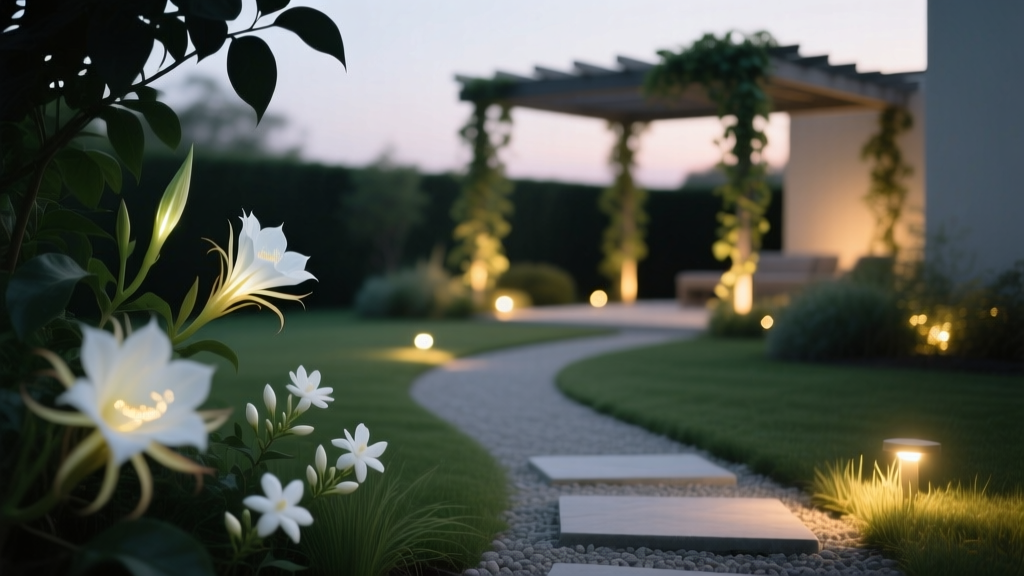
10 Garden Hacks for Night-Blooming Garden Design
The biggest mistake people make with moon gardens isn’t plant choice—it’s lighting. A single bright porch bulb (especially a cool-white LED) can wash out fragrance cues, confuse night pollinators, and make your “night-blooming” plants look flat and gray. The hack is to design for darkness first, then add soft, targeted light only where you need it.
Night gardens are a different game: scent carries farther, white and pale colors glow, and small reflective surfaces do more work than a dozen daytime flowers. Below are 10 practical hacks—organized by layout, plant performance, and low-cost lighting—that make your night-blooming garden feel intentional (and way easier to maintain).
Set the Stage: Layout Hacks That Make Night Gardens Work
1) Build a “Moon Viewing Loop” (Not a Straight Path)
At night, people move slower and look closer, so give them a loop instead of a line. Create a simple 20–40 ft circuit that passes your most fragrant plants twice—once up close, once at a distance—so the scent “layers” as you walk. If you only have space for a short run, add a small turn-around pad (about 4 ft x 4 ft) so guests can pause without stepping into beds.
Real-world example: A side-yard moon garden in Sacramento used a 28 ft looping gravel path with a 4 ft turn pad near a jasmine trellis; it made the space feel twice as big because people naturally slowed down and lingered at the scent peak.
2) Use the “3-2-1 Scent Rule” to Prevent Nose-Blindness
Too much fragrance clustered together can read as “perfume aisle,” and after a few minutes you stop noticing it. Aim for 3 scent zones (front, middle, back), with 2 fragrance plants in each zone, plus 1 neutral buffer (like grasses, ferns, or foliage plants) between zones. This keeps the sensory experience changing as you move.
DIY alternative: If you don’t want more plants, use a “buffer” made from a 24-inch-wide strip of mulch and one clump of ornamental grass to break up scent-heavy areas.
3) Paint (or Limewash) One Background Wall to Multiply Glow
White flowers only pop if there’s something darker behind them—or a bright surface bouncing light back. If you have a fence, shed, or wall, paint a 6–10 ft section a soft matte white or pale gray to reflect moonlight and low lighting onto blooms. Matte matters: glossy paint can create glare and harsh hotspots.
Cost hack: A gallon of exterior latex paint is often $25–$45 and covers around 300–400 sq ft. For a cheaper, more breathable look, use DIY limewash (hydrated lime + water; test first) on masonry.
Planting Hacks: Make Night Bloomers Perform on Schedule
4) Plant Night Bloomers Where You’ll Actually Smell Them (10–15 ft Rule)
Many night-bloomers are grown for fragrance more than visuals, and scent doesn’t travel evenly. Put your strongest fragrance plants within 10–15 ft of seating, doorways, or windows you open at night. Beyond that, even wonderful bloomers can fade into background unless the air is still.
Real-world example: A renter in Austin moved two pots of night-blooming jasmine (Cestrum nocturnum) from the back fence to a patio corner about 12 ft from the kitchen door; the scent became noticeable indoors after 9 p.m. without adding more plants.
5) Cheat Bloom Timing With “Heat Sinks” (Stones, Bricks, and Water)
Many night bloomers open more reliably when evenings stay warm. Place dark stones, a short brick edging, or a water feature near plants to store daytime heat and release it after sunset. Even a small area—10–20 sq ft of stone—can slightly bump nighttime microclimate right where buds are deciding whether to open.
DIY alternative: Set a row of dark pavers behind a planter or tuck a 5-gallon black bucket (with lid) behind foliage as a hidden heat sink.
6) Make White Flowers Look Whiter: Pair With Deep Foliage (Not More White)
If you cram all-white blooms together, your eye loses contrast and everything reads as one pale blob. Instead, pair pale blooms with dark-leaved plants (burgundy heuchera, dark coleus in warm climates, or even a black-painted container). You’ll get more glow with fewer flowers—especially under low light.
Case example: In a small courtyard, swapping one white-flowering filler plant for a single dark-leaved container plant made moonflowers (Ipomoea alba) look brighter without changing lighting at all.
7) Put Pollinator-Friendly Night Blooms in Clumps of 3 or 5 (Not Singles)
Nocturnal pollinators like moths respond to scent and mass; single plants can be too easy to miss. Plant key night bloomers in clumps of 3 or 5 with 12–18 inches between plants (or one big specimen plus two companions). This also makes maintenance easier: one watering zone, one mulch ring, one deadheading routine.
Research note: Many moths are attracted to pale, fragrant flowers that are easier to locate in low light. Penn State Extension notes that night-pollinated flowers tend to be light-colored and strongly scented (Penn State Extension, 2020).
Soil, Water, and Containers: Low-Effort Systems That Keep Nights Low-Stress
8) Use a “Fragrance Potting Mix” Ratio for Night-Scented Containers
Night-scented plants in pots often disappoint because they dry out fast—stressed plants drop buds and reduce scent. For containers, mix 2 parts high-quality potting mix + 1 part compost + 1/2 part perlite or pumice for airflow. Top with 1 inch of fine mulch to slow evaporation (especially in warm climates where many night bloomers thrive).
Money-saving tip: Buying perlite in a larger bag (4 cu ft) can cut the per-quart cost by half compared to small bags; compost can be homemade or sourced locally to save $5–$15 per container fill-up depending on your area.
9) Install One Cheap “Night Watering Cue” So You Don’t Overwater
Night gardening invites overwatering because you can’t see soil texture well. Push a simple wooden chopstick or bamboo skewer 4 inches into the soil near the root zone; if it comes out clean and dry, water—if it’s dark and damp, skip it. This works shockingly well for both pots and in-ground plantings, and it costs basically nothing.
Research-backed caution: Overwatering is a common cause of root disease in landscape plants; extension guidance repeatedly emphasizes watering based on soil moisture rather than a calendar. The University of Minnesota Extension highlights checking soil moisture before watering to avoid root problems (University of Minnesota Extension, 2022).
Lighting Without Ruining the Night: Practical Tricks That Protect Mood (and Wildlife)
10) Use Warm, Low Lumen “Glow Pockets” Instead of One Bright Light
A night garden looks best with multiple small light sources rather than a single floodlight. Aim for warm lighting (around 2200K–2700K) and keep each fixture modest—think 20–80 lumens for path markers and 100–200 lumens for a focal plant. Place lights low (8–18 inches high) and shield them so the bulb isn’t visible from seating; you want reflected light on plants, not glare in your eyes.
“Outdoor lighting works best when it’s targeted and shielded—glare reduces visibility and comfort, and it can disrupt nighttime behavior of wildlife.” — International Dark-Sky Association guidance on responsible outdoor lighting (2023)
Real-world scenario: A suburban front yard with one 800-lumen porch light felt harsh and “empty” at night. Switching to two 150-lumen shielded uplights on a white-flowering shrub plus three 30-lumen path lights made the garden feel brighter while using less total light and creating better contrast.
Quick Comparison Table: Two Ways to Light a Moon Garden
| Feature | Method A: One bright fixture (porch/flood) | Method B: Multiple low “glow pockets” |
|---|---|---|
| Total brightness | High in one spot; dark elsewhere | Even, comfortable illumination |
| Recommended output | Often 600–1200 lumens (too much for mood) | Path: 20–80 lumens; accents: 100–200 lumens |
| Color temperature | Commonly 3000K–5000K (looks harsh) | 2200K–2700K (warmer, softer) |
| Glare at seating | High (bulb visible) | Low (lights shielded/hidden) |
| Cost to try | $15–$50 for a brighter bulb/fixture | $30–$120 depending on number of small fixtures; DIY reflectors can cut cost |
Extra “Insider” Fixes for Common Night-Garden Problems
Bonus Hack: Make DIY Reflectors From Scrap to Boost Plant Glow
If you don’t want to add more fixtures, add reflectors. Cut a piece of white corrugated plastic (old sign board) or paint scrap plywood matte white and place it behind a pale-flowering plant, angled slightly downward. A reflector about 18 x 24 inches can noticeably brighten a plant with the same light output—especially near seating areas.
Bonus Hack: Put a Timer on Scent Plants’ Irrigation—Earlier, Not Later
Evening watering can spike humidity right when you’re outside, and wet foliage can invite disease. If you’re using drip, schedule it for early morning (like 4–7 a.m.) so plants are hydrated for the day and still comfortable by nightfall. You’ll also avoid the common “night garden mosquito buffet” that happens when people water at dusk.
Case example: A coastal garden with heavy evening dew reduced powdery mildew on nicotiana by moving drip irrigation from 8 p.m. to 6 a.m., while still keeping fragrance strong at night because plants weren’t stressed during hot afternoons.
Bonus Hack: Use One “Night Focal Point” Per 100 sq ft
At night, you can’t visually process a dozen focal points—you’ll lose the magic. A good rule is one clear focal point per 100 sq ft: a pale-flowering shrub, a white bench, a simple water bowl, or a trellis with moonflowers. Everything else supports that focal point through scent, texture, and shadow.
When you build your night-blooming garden around darkness (instead of fighting it with bright lights), everything gets easier: fewer plants have to work harder, scent becomes a real feature, and your evening time outside feels like a reward instead of another chore. Pick two hacks to try this week—one layout change and one lighting tweak—and you’ll notice the difference the very next night.
Sources: Penn State Extension (2020), guidance on traits of night-pollinated flowers; University of Minnesota Extension (2022), soil moisture checks to prevent overwatering and root issues; International Dark-Sky Association (2023), recommendations for shielded, targeted outdoor lighting.