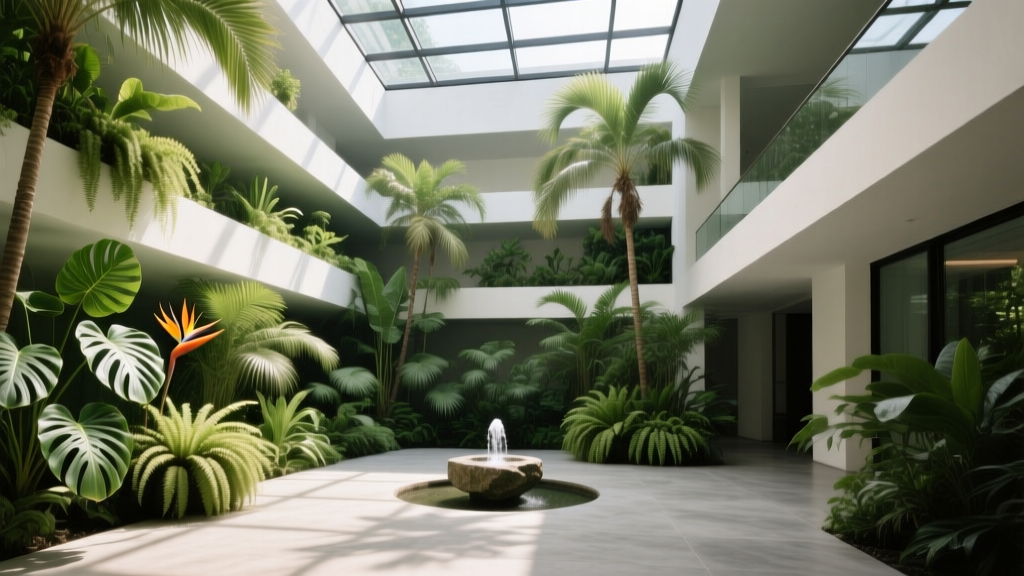
Atrium Garden Design with Tropical Plants
It’s 2:00 p.m., and your atrium is doing that familiar thing: bright overhead light pouring in, footsteps echoing off tile, and a lonely spider plant clinging to life in the corner. The space feels like it should be lush—like a small indoor courtyard—but instead it’s either too hot, too shady, or too awkwardly shaped to know what to do with. The good news is atriums are made for tropical plants. The trick is designing for what an atrium actually is: a vertical light well with unique airflow, reflective surfaces, and microclimates that can change from one end of the floor to the other.
I’m going to walk you through an atrium garden layout the same way I would on a site visit: we’ll read the light, map circulation, choose materials that can handle moisture, then select tropical plants that look dramatic but behave well indoors. Along the way, you’ll see three real-world scenarios—from a narrow rental atrium to a family home with a double-height skylight—so you can adapt the plan to your space and budget.
Start With the Site: Light, Height, and Foot Traffic
Measure first (you’ll design faster)
Before shopping for plants, take four measurements: length, width, height to the skylight, and the widest walking path you must keep clear. A very common atrium size is around 8 ft x 12 ft (96 sq ft), but many townhomes have something like 4 ft x 10 ft. Write it down. A practical minimum path width is 30–36 inches if the atrium is used as a passage; if it’s purely visual, you can go tighter and treat it like a planted light well.
Track sunlight hours like a designer (not a guess)
Atriums can look bright but still behave like “bright shade” because the sun is high overhead and blocked by roof lines. Stand in the atrium and note direct sun patches over a day. Most tropical foliage plants are happiest with 4–8 hours of bright, indirect light; a few can take 2–4 hours of direct sun if humidity is decent. If you’re not sure, use a phone light meter app for a week and record the brightest spot and the darkest corner.
Also note nighttime temperature swings. Many tropical houseplants slow down if temps regularly dip below 60°F (15.5°C), especially in winter near glass.
Humidity and airflow: your hidden constraints
Atriums often run dry because warm air rises and escapes through vents. You’ll design for humidity by grouping plants, using larger soil volumes, and adding water features only if you can manage splash and maintenance. Research from NASA’s interior plantscaping work popularized the idea that indoor plants can improve air quality in controlled settings (NASA, 1989), but for atrium design, the more useful takeaway is practical: plants transpire. A dense grouping of leafy tropicals raises local humidity around the planting zone.
Layout Strategies That Make Atriums Feel Intentional
Principle 1: Build a “canopy-to-carpet” structure
Tropical plantings feel convincing when they have layers. In an atrium, aim for three tiers:
- Canopy (6–10 ft): one or two tall statement plants
- Mid-layer (2–5 ft): bold foliage clumps that repeat
- Ground layer (0–2 ft): low plants and mossy textures to hide soil and edges
This structure also solves the common atrium problem: plants look like “pots on the floor.” Layers make it read as a garden.
Principle 2: Keep a clean service corridor
Every atrium garden needs a way to water, prune, and rotate plants without stepping into a jungle. I like a 18–24 inch hidden service gap behind the main planting line if the space allows, or a clearly defined stepping-stone route if you’re planting in a bed. This reduces soil compaction and keeps leaves from getting shredded by daily traffic.
Principle 3: Use repetition to calm the space
Atriums can visually overwhelm because walls rise up, light bounces, and sound echoes. Repetition gives your eye a rhythm. Instead of 20 different species, pick 5–7 plant types and repeat them in groups of three. This also simplifies care—plants with similar needs live together.
Principle 4: Design the “view angles”
You usually see an atrium from above (a landing), from a hallway, or from a living room. Pick one main viewing angle and design a focal point for it: a tall palm, a sculptural pot, or a water bowl. Place it slightly off-center so it feels natural, not staged.
Three Layout Blueprints You Can Copy
Scenario A: Narrow rental atrium (4 ft x 10 ft) with bright shade
This is the classic “renter light well.” You can’t build beds, and drainage is limited. The move: create a staged container garden with a waterproof catch system.
Layout: one tall plant at the far end, two medium plants staggered, and three low plants running like a border along the wall. Keep a 30-inch clear walking lane if it’s a pass-through.
DIY trick: use rolling plant caddies (rated for 150–200 lb) under the largest pots so you can pull them out for watering and cleaning.
Scenario B: Family home atrium (8 ft x 12 ft) under a skylight with 2–3 hours of direct sun
This is where you can build a true “indoor courtyard” feel. If the floor is waterproof (tile or sealed concrete), create a U-shaped planting zone along two walls with a central focal pot.
Layout: a 24-inch wide planting strip along the long wall, a 18-inch strip along the short wall, and a 36-inch open zone for access and visual breathing room. Place a single tall canopy plant where the skylight beam hits most consistently.
Scenario C: Apartment atrium/balcony hybrid (6 ft x 8 ft) with morning sun and wind
These spaces feel tropical in summer and punishing in winter. Choose flexible plants: things that can live outside part of the year and come indoors when nights drop below 55°F.
Layout: cluster plants tightly in one corner to cut wind exposure, use a trellis or screen to create a calm microclimate, and reserve a 2 ft x 3 ft open patch for a chair or stepping access.
Plant Selection: Tropical Varieties That Behave Well in Atriums
Good atrium plants do three things: tolerate indoor light levels, accept container life, and look architectural without constant fuss. Below are reliable choices, with spacing and placement notes.
Canopy statements (pick 1–2)
- Rhapis excelsa (Lady palm): Extremely tolerant of lower light, slow-growing, and tidy. Place in a 16–20 inch diameter pot; allow 3–4 ft of width for a mature clump.
- Howea forsteriana (Kentia palm): Classic atrium palm with elegant arching fronds. Works in bright indirect light. Plan for 6–10 ft eventual height indoors; keep 3 ft clearance from walkways to avoid frond snags.
- Ficus lyrata (Fiddle-leaf fig): Best for atriums with steady light and minimal drafts. Use only if you can keep it from cold glass in winter. One plant can anchor the whole design.
Mid-layer “texture makers” (repeat in groups)
- Monstera deliciosa: Big-leaf drama, tolerates bright shade. Give a moss pole or coir to climb; space plants 24–36 inches apart so leaves can expand.
- Philodendron ‘Xanadu’ (Thaumatophyllum xanadu): Dense, self-heading form that reads like a shrub. Great for repeating mounds; space 24 inches apart.
- Strelitzia nicolai (White bird of paradise): For high-light atriums; it’s bold and upright. Needs room—plan at least 4 ft of width at maturity. Use as a focal if you have height.
- Alocasia ‘Regal Shields’: Striking dark leaves; wants consistent moisture and warmth. Place where it’s protected from drafts.
Ground layer and edge softeners
- Asplenium nidus (Bird’s nest fern): Loves humid clusters, smooth texture contrast. Space 18–24 inches apart; keep soil evenly moist.
- Calathea orbifolia: Bold striping, prefers lower light and higher humidity. Best grouped; avoid direct sun.
- Epipremnum aureum ‘Marble Queen’ (Pothos): Trailing plant that can cascade from a pedestal or shelf. Excellent for renters because it’s forgiving.
- Ophiopogon japonicus (Mondo grass): Not tropical, but it reads like a lush carpet and handles indoor conditions surprisingly well with adequate light.
For plant care guidance, the Royal Horticultural Society emphasizes that most houseplants perform best when matched to light levels and not overwatered—watering should follow growth rate and seasonality (RHS, 2023). That’s especially true in atriums, where light can be strong overhead but roots may stay cooler and wetter.
“The right plant in the right place is 80% of successful design—maintenance becomes a simple rhythm instead of a constant rescue.” — Adapted from widely taught landscape design principle in professional practice; supported by RHS houseplant guidance on matching plants to conditions (RHS, 2023).
A Quick Comparison: Top Atrium Tropical Plants
| Plant | Light Tolerance | Best Use in Layout | Typical Pot Size | Notes |
|---|---|---|---|---|
| Rhapis excelsa (Lady palm) | Low to bright indirect | Canopy anchor in corners | 16–20 in | Slow, tidy; great for echoey atriums |
| Howea forsteriana (Kentia palm) | Medium to bright indirect | Main focal near skylight | 18–24 in | Elegant fronds; protect from drafts |
| Monstera deliciosa | Bright shade | Mid-layer massing | 12–16 in | Give climbing support; rotate monthly |
| Asplenium nidus (Bird’s nest fern) | Low to medium | Ground layer softness | 10–14 in | Likes humidity; avoid cold air blasts |
| Strelitzia nicolai | Bright, some direct sun | Architectural accent | 18–24 in | Needs room; wipe dust for best look |
Step-by-Step: Setting Up an Atrium Tropical Garden
This is the practical sequence I use to avoid backtracking and messy resets.
- Map the “no-go zones.” Mark doors, vents, drain access, and required walkway width (aim for 30–36 inches if it’s a passage).
- Locate your brightest patch. Stand at noon and again mid-afternoon. That spot usually belongs to your canopy plant.
- Choose your containment system. If you can’t plumb a drain, plan on saucers, hidden trays, or a waterproof mat system under grouped pots.
- Place the biggest plant first. Set the palm/fig/bird of paradise in position and step back to check sightlines from the main viewing angle.
- Build your mid-layer in repeats. Add 2–4 medium plants in triangular groupings; keep 24 inches between pots so leaves don’t crush each other.
- Fill edges and soil lines with ground layer plants. Ferns, calatheas, pothos, mondo grass—these make the design feel “finished.”
- Add lighting only after plants are placed. If evenings matter, install 2–3 uplights aimed through foliage, not at walls. Warm LEDs around 2700–3000K look natural.
- Mulch or top-dress containers. A 1-inch layer of orchid bark or coco chips reduces fungus gnats and gives a cohesive look.
Materials, Costs, and DIY Alternatives
Cost depends on plant size and whether you’re using designer pots. Here are realistic numbers you can plan around (pricing varies by region, but these ranges keep budgets grounded):
- 6–7 ft Kentia palm: roughly $180–$450 depending on maturity and retailer.
- 14–16 inch ceramic or fiberglass pot: $60–$200. (DIY: use a nursery pot dropped into a decorative basket, $25–$60.)
- Bagged indoor potting mix (1–2 cu ft): $12–$25. For a large atrium grouping, expect 6–10 cu ft total.
- Rolling plant caddy: $20–$45 each; buy 2 for your heaviest pots.
- Small humidifier (if needed): $40–$120. Often optional if you cluster plants and avoid placing them under vents.
If you want a “built-in” look without construction, group pots on a low platform (a sealed plywood plinth or a composite deck tile base). It visually unifies the garden and catches minor spills. For renters, peel-and-stick waterproof mats under the cluster can protect flooring with minimal fuss.
Microclimate Fixes: When the Atrium Fights You
If your atrium is too sunny and hot
Direct overhead sun can scorch thin leaves. Use sheer shade cloth under the skylight or apply a removable window film. Then choose tougher tropicals: Strelitzia nicolai, Rhapis, and some Dracaena varieties handle brighter conditions better than calatheas.
If your atrium is bright but drafty
Drafts are often the real plant killer. Move sensitive plants (calatheas, alocasias, some ficus) away from vents and exterior doors by 3–5 ft. Use taller plants as living windbreaks and cluster pots so leaves protect each other.
If your atrium is dim
Pick plants that genuinely tolerate lower light: Rhapis excelsa, Asplenium nidus, pothos, and some philodendrons. Add a discreet grow light if you want more variety—two LED grow bulbs in attractive fixtures can make a huge difference with minimal visual intrusion.
Maintenance Expectations: What It Takes to Keep It Lush
A well-designed atrium tropical garden should not feel like a second job. Plan for 30–60 minutes per week on average, plus a slightly longer monthly reset.
Weekly rhythm (30–60 minutes)
- Water check: test the top 1–2 inches of soil. Water thoroughly only when that zone is dry for most foliage plants (ferns may need steadier moisture).
- Leaf cleanup: remove yellowing leaves and wipe dusty foliage (especially palms and bird of paradise).
- Rotate key plants: quarter-turn your Monstera or Ficus so it grows evenly toward the light.
Monthly tasks (60–90 minutes)
- Inspect for pests: check leaf undersides for spider mites and mealybugs.
- Flush salts: run extra water through pots and discard runoff to reduce mineral buildup—especially if you fertilize.
- Prune for pathways: keep that 30–36 inch circulation zone clean so the garden stays livable.
Seasonal tasks
- Spring: start light fertilizing; consider repotting if roots are circling heavily.
- Summer: monitor for faster drying; sun patches shift, so watch for scorch.
- Fall: reduce fertilizer; clean skylight area if accessible for maximum winter light.
- Winter: water less often; protect plants from cold glass and dry heating air.
Design Details That Make It Feel Like a Destination
Once plants are placed, the finishing touches elevate the atrium from “plants live here” to “this is a garden.” Use a limited palette: one pot color, one wood tone, one metal finish. Add one sculptural element—like a stone bowl or a simple bench—only if you can still service the plants without contortions.
If sound echoes, add softening elements: a jute rug runner (kept away from frequent watering), a slatted wood screen, or dense foliage near reflective walls. The garden should change the acoustics as much as the visuals—lushness you can feel.
Citations
NASA. Interior Landscape Plants for Indoor Air Pollution Abatement. 1989.
Royal Horticultural Society (RHS). Houseplant care guidance. 2023.
When your atrium is planted in layers—with one confident canopy plant, repeated mid-layer forms, and a soft ground plane—it stops feeling like an awkward gap in the house. It becomes a small indoor climate you control. Start with the light you actually have, design a layout that respects the walkway, and choose tropicals that match your maintenance reality. A month from now, that 2:00 p.m. glare will be filtered through leaves, and the echo will be replaced by the quiet presence of a real, living courtyard.