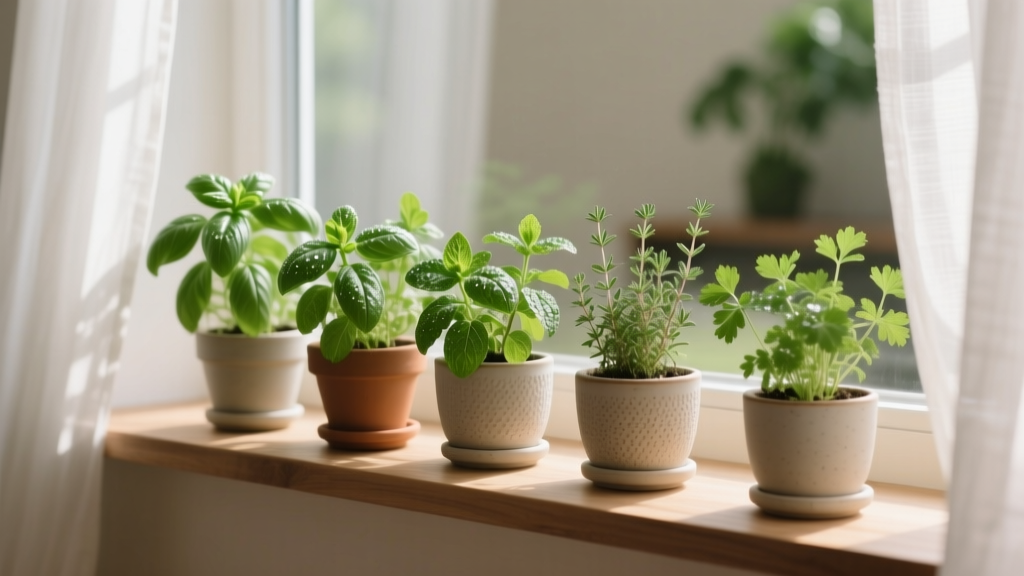
Windowsill Herb Garden Setup Guide
You meant to cook something simple—pasta, maybe—and the recipe asked for “fresh basil.” You opened the fridge, found a limp plastic clamshell, and did that familiar math: the herbs cost $4.99, you’ll use a few leaves tonight, and the rest will liquefy by Thursday. Now picture the opposite moment: you reach to the windowsill, pinch a sprig, and the kitchen smells like summer. That’s what we’re designing—an herb garden that fits on a ledge, behaves like a well-planned landscape, and keeps producing without turning your window into a jungle of sad pots.
As a designer, I treat a windowsill the way I treat a narrow side yard: it’s a micro-site with real constraints—light angles, heat swings, airflow, and access. The good news is you don’t need much space. A standard interior sill is often 4–8 inches deep and 24–60 inches long. With smart container choices and plant pairing, that’s enough for a weekly rotation of flavor.
Start With the Site: Measure, Observe, and Choose a “Style”
Step 1: Measure the usable footprint (and respect the window)
Before buying a single pot, measure three things:
- Depth of sill (front edge to glass): common ranges are 4–8 in. If it’s under 5 in, plan on slim planters or 3–4" nursery pots.
- Length of clear space: even 18–24 in can host 3–4 herbs.
- Vertical clearance: make sure plants won’t get crushed by blinds or curtains. Most herbs are happy kept at 6–12 in tall with regular pinching.
Step 2: Track sunlight hours (not just direction)
Directions are helpful, but hours of direct sun are the real design driver. Watch the window for one day (or use a phone app) and estimate direct sun:
- 6–8 hours direct sun: basil, thyme, rosemary (best case for culinary variety)
- 4–6 hours: parsley, chives, mint (mint still thrives—sometimes too much)
- 2–4 hours: cilantro (often happier with less heat), chervil, microgreens; consider a small grow light
For indoor edible plants, university extension guidance consistently emphasizes adequate light as the limiting factor. Cornell Cooperative Extension notes that most herbs need “at least 6 hours of sunlight daily” indoors for strong growth (Cornell Cooperative Extension, 2020).
Step 3: Pick a layout approach: “Chef’s Line,” “Cluster,” or “Tier”
Once you know the light and dimensions, choose a layout style that matches how you cook and how you live.
- Chef’s Line (best for narrow sills): a straight row of matching small pots, easy to rotate for even light.
- Cluster (best for deeper sills): group herbs by water needs—one “dry” cluster (thyme/rosemary) and one “moist” cluster (parsley/chives).
- Tier (best for short sills): add a small riser so shorter herbs don’t get shaded behind taller plants. A simple riser can be a 3–4 in tall wood block or an inverted loaf pan.
“Herbs are happiest when their light and moisture needs are matched; mixing a drought-tolerant rosemary with a thirsty parsley in the same pot is a common design mistake.” — Penn State Extension, Indoor Herb Gardening guidance (Penn State Extension, 2019)
Design Principles That Make a Windowsill Garden Look Intentional (and Grow Better)
Principle 1: Group by water needs, not by cuisine
A windowsill is small, but your plants still have different “personalities.” Mediterranean herbs (thyme, rosemary, oregano) want sharper drainage and less frequent watering. Leafy herbs (parsley, cilantro) prefer consistently moist soil. When you group plants with similar needs, maintenance drops to a routine instead of a guessing game.
Design move: create two zones even if you only have four pots—two pots on the left are “dry zone,” two on the right are “moist zone.” Label them once; your future self will thank you.
Principle 2: Keep roots comfortable—container size matters indoors
Small pots dry out quickly; oversized pots stay wet and can invite fungus gnats. For most windowsill herbs, these sizes work consistently:
- 3–4 in pot: thyme, oregano, chives (single plant)
- 4–6 in pot: basil, parsley, cilantro (one strong plant or a small cluster)
- 6–8 in pot (deeper): rosemary (best long-term choice), mint (to contain it)
Spacing goal: allow 2–3 inches of air gap between pots for airflow and easy watering. This is the indoor equivalent of avoiding overcrowded borders outdoors.
Principle 3: Make watering clean and predictable
Design isn’t just visual—it’s how the system behaves. Indoors, messy drainage is the fastest way to quit. Use one of these methods:
- Saucers under each pot (simple, flexible)
- A single watertight tray spanning the sill (tidy, modern)
- Self-watering planters (best for forgetful waterers, but not ideal for rosemary)
Practical note: most herbs do best when you water thoroughly, then let the top 1 inch of mix dry before watering again. This aligns with common indoor herb recommendations from extension sources (Cornell Cooperative Extension, 2020).
Principle 4: Control the microclimate (windows are dramatic)
Glass creates temperature swings. In winter, leaves touching the pane can chill. In summer, a sunny south window can spike heat fast.
- Keep leaves 1–2 inches off the glass.
- Avoid placing herbs directly above a radiator or heat vent.
- If your kitchen gets steamy, prioritize herbs that tolerate humidity: chives, mint, parsley.
Plant Selection: Specific Varieties That Actually Behave on a Windowsill
Choose plants like you’d choose shrubs for a foundation bed: match the site, pick reliable performers, and mix forms—upright, mounding, and grassy—for a balanced look.
Sun-loving “Dry Zone” herbs (best for 6+ hours)
- Thyme ‘German Winter’: compact, tough, and forgiving if you miss a watering. Great for a 4 in pot and frequent snipping.
- Oregano ‘Greek’: stays relatively tight compared to some common oreganos; strong flavor even under indoor light.
- Rosemary ‘Arp’ (or ‘Tuscan Blue’ if you have very bright light): rosemary wants maximum sun and excellent drainage. Give it a 6–8 in pot and don’t overwater.
Moist-leaning “Leaf Zone” herbs (best for 4–6 hours)
- Parsley ‘Italian Flat Leaf’: better culinary flavor than many curled types, and it tolerates moderate indoor light.
- Chives (common chives): upright, neat, and one of the easiest windowsill herbs. A strong “architectural” accent in a row of round-leaf herbs.
- Cilantro ‘Slow Bolt’: indoors, cilantro often lasts longer with cooler temps and 3–5 hours of direct sun; harvest young and re-sow every 3–4 weeks for continuity.
Proceed with strategy: basil and mint
- Basil ‘Genovese’: classic and productive with 6–8 hours of sun or a small grow light. Pinch early to keep it bushy at 8–12 in.
- Mint ‘Spearmint’ or ‘Kentucky Colonel’: thrives in moderate light and regular moisture. Always pot mint alone (a design boundary as much as a horticultural one).
A Quick Comparison: Match Herbs to Light and Pot Size
| Herb (Variety) | Best Direct Sun | Recommended Pot Size | Water Preference | Designer Note |
|---|---|---|---|---|
| Basil (‘Genovese’) | 6–8 hours | 6 in | Evenly moist | Pinch weekly to prevent legginess |
| Parsley (‘Italian Flat Leaf’) | 4–6 hours | 6 in | Moist | Deep roots; avoid tiny pots |
| Thyme (‘German Winter’) | 6+ hours | 4 in | Drier | Perfect for the “dry zone” edge |
| Rosemary (‘Arp’) | 6–8 hours | 8 in | Drier | Needs airflow; don’t crowd it |
| Chives | 4–6 hours | 4–6 in | Moist | Clean vertical form; great in tight layouts |
| Mint (‘Spearmint’) | 3–6 hours | 6–8 in | Moist | Pot alone; harvest aggressively |
Step-by-Step Setup: Build Your Windowsill Herb Layout Like a Mini Landscape
This is the practical build-out I use for clients who want it to look good and function daily.
- Clean and protect the sill. Add a waterproof tray or a strip of shelf liner. If the sill is wood, this prevents water rings.
- Choose containers that fit the depth. For a 5 in deep sill, use round 4 in pots or a slim rectangular planter no wider than 4.5 in.
- Add drainage and saucers. Use pots with holes. If you love cachepots (no holes), keep plants in nursery pots inside and lift them out to water.
- Use a high-quality potting mix. Avoid heavy garden soil. For the dry zone, mix in extra perlite at about 20–30% by volume.
- Place tall plants at the edges or on a riser. Rosemary is an “anchor plant.” Put it on one side so it doesn’t shade basil or parsley.
- Plant or pot up starts. If using seedlings, choose sturdy, dark-green plants. For basil, one strong plant per 6 in pot is easier than a crowded clump.
- Water thoroughly once, then observe. Let excess drain for 10 minutes, then empty saucers. This one habit prevents most indoor herb failures.
- Add labels you’ll actually read. Small stake labels or a strip of painter’s tape on the tray edge keeps harvest and watering consistent.
Three Real-World Windowsill Scenarios (and Layouts That Work)
Scenario 1: The rental apartment with a narrow, shaded kitchen window
Site: A 24 in long sill, 4 in deep, with 2–3 hours of morning light.
Design strategy: Keep pots small and uniform (Chef’s Line), and add a clip-on grow light to extend day length. A simple LED grow bulb (around $15–$25) in a clamp lamp can provide consistent results without installing anything permanent.
Planting plan: chives (4"), parsley (6"), cilantro ‘Slow Bolt’ (6"). Skip rosemary here; it will sulk. If you want basil, grow one basil plant under the light and pinch hard to keep it compact.
Scenario 2: The sunny homeowner kitchen with a deep south-facing ledge
Site: A 48 in long sill, 7 in deep, getting 6–8 hours of direct sun.
Design strategy: Use a two-zone Cluster: dry herbs on one side, leafy herbs on the other, with a low tray unifying the look.
Planting plan: rosemary ‘Arp’ (8") as the anchor, thyme ‘German Winter’ (4"), oregano ‘Greek’ (4") in the dry zone; basil ‘Genovese’ (6") and parsley ‘Italian Flat Leaf’ (6") in the moist zone.
Spacing: Keep at least 2 in between pots for airflow, and rotate pots weekly to keep growth upright.
Scenario 3: The busy household that travels or forgets to water
Site: Bright window but inconsistent care; the goal is resilience.
Design strategy: Pick herbs that tolerate a missed watering, use slightly larger pots to buffer moisture swings, and simplify the palette so maintenance is automatic.
Planting plan: thyme (4–6"), oregano (6"), chives (6"). Add mint in its own 8 in pot only if you’ll harvest it often. Consider one self-watering planter for parsley, but keep rosemary in a standard pot to avoid soggy roots.
Budget and DIY Alternatives (Without Cutting Performance)
You can build a handsome, productive windowsill garden on a tight budget. Here are realistic cost ranges (prices vary by region):
- Herb starts: $3–$6 each (often cheaper than buying cut herbs weekly)
- 4–6 in pots with saucers: $2–$8 each
- Potting mix: $8–$15 for an 8–12 qt bag (enough for several small pots)
- Simple tray: $6–$20 (baking sheet, boot tray, plant tray)
- Clip-on grow light (optional): $15–$40
DIY swaps that still look designed:
- Use matching recycled containers (like identical glass jars) as cachepots—just keep plants in nursery pots inside so you can lift and drain.
- Make a riser from a scrap of wood cut to 3 in height, sanded and sealed. It creates a tiered effect without buying a stand.
- Repurpose a shallow baking tray as the “unifying base” that makes mixed pots read as one intentional installation.
Maintenance Expectations: The Rhythm That Keeps Herbs Lush
If the layout is right, maintenance becomes a quick weekly ritual, not a daily chore.
Weekly time commitment
Plan on 15–25 minutes per week total for a 4–6 pot windowsill garden:
- Watering: 2–3 quick checks per week (more in summer sun, less in winter)
- Pinching/harvest: 5 minutes weekly; basil especially benefits from regular pinching
- Rotation: 1 minute weekly—turn pots a quarter-turn for even growth
Seasonal tasks (indoors still has seasons)
- Winter: Growth slows with low light. Reduce watering frequency, keep leaves off cold glass, and consider a grow light for basil. Expect rosemary to prefer cool, bright conditions and drier soil.
- Spring: This is your reset season—refresh potting mix top layer and start a new round of cilantro if it’s fading.
- Summer: Watch for heat stress in south windows. Water earlier in the day; provide a sheer curtain if basil wilts midday.
- Fall: Take cuttings of basil if you want to extend it, or simply replace with cooler-season herbs like parsley and chives.
When to repot (and how to keep it tidy)
Most herbs appreciate a repot every 9–12 months if they’re permanent residents. Signs you need to size up: water runs straight through, roots circle the bottom, or the plant dries out within a day. Move up just one size (for example, from a 4" to a 6") to avoid waterlogged soil.
Troubleshooting by Design (Fix the System, Not Just the Symptom)
Leggy, pale herbs: almost always a light issue. Move to a brighter window or add a grow light for 10–12 hours daily in winter. Prune back by 1/3 to encourage branching.
Fungus gnats: usually a watering pattern problem. Let the top inch dry, bottom-water leafy herbs occasionally, and remove any standing water from saucers after 10 minutes.
Brown leaf tips on basil: can be cold drafts or inconsistent watering. Keep basil away from cold glass and stabilize moisture.
Rosemary dropping needles: often too little light or too much water. Give it the sunniest spot, space it for airflow, and water only when the pot feels lighter and the top layer is dry.
A Windowsill Garden That Feels Like Part of the Room
The finishing touch is visual unity—this is where it stops feeling like “a few pots” and starts feeling designed. Pick one container color (all terracotta, all matte white, or all black nursery pots hidden inside matching cachepots). Keep the tallest plant as your anchor, repeat two or three herb forms for rhythm, and leave a small open space—4–6 inches of empty sill—so the composition can breathe.
Once it’s set up, the reward is quiet but constant: better cooking, less waste, and a living strip of green that earns its keep. The next time dinner needs “a handful of parsley,” you won’t negotiate with a plastic clamshell. You’ll just reach up to the window and take what you need.
Citations: Cornell Cooperative Extension (2020), indoor herb light requirements; Penn State Extension (2019), indoor herb gardening and matching herbs to moisture/light needs.