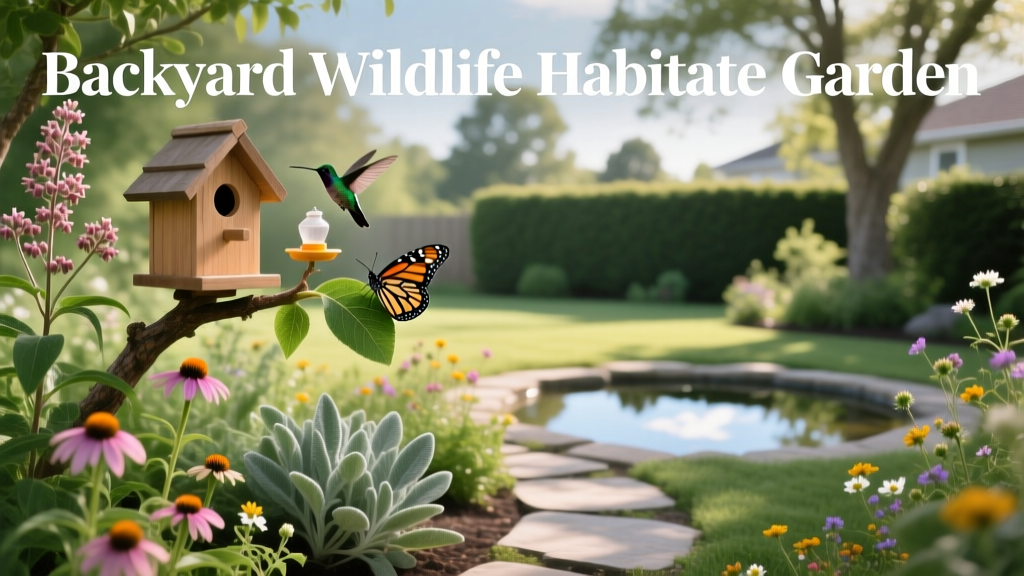
Backyard Wildlife Habitat Garden
The first clue you’re missing wildlife is usually silence. No finches picking at seed heads, no bumblebee buzz in the afternoon, no frogs calling from anywhere near the downspout. You step outside with coffee, scan the fence line, and realize the yard is tidy—but it doesn’t feed anyone. The good news: a wildlife habitat garden isn’t about letting everything go wild. It’s about arranging food, water, shelter, and safe nesting in a layout that fits your exact space and your tolerance for “mess.”
Think of this as a design project, not a plant-shopping spree. We’ll work like a landscape designer: assess the site, map circulation, decide where habitat “rooms” go, and then choose plants that behave well while still doing real ecological work.
Start with a quick site sketch (15 minutes that saves you weeks)
Before you buy a single plant, walk your yard with a tape measure. You’re looking for three things: sun pattern, wind exposure, and where water naturally moves. Most wildlife-friendly plants need 6+ hours of sun to bloom heavily; some habitat features (like a small pond) are easier in partial sun (4–6 hours) to slow algae growth.
Measure the usable space (and be honest about it)
Wildlife gardens work at any size, but scale changes the layout. Use these common footprints as references:
- Micro space: 6 ft x 10 ft (60 sq ft) side yard strip
- Small yard: 20 ft x 30 ft (600 sq ft) behind a townhome
- Typical suburban backyard: 40 ft x 60 ft (2,400 sq ft)
Mark two paths on your sketch: your “human path” (trash cans, grill, gate) and the “don’t-step-here” zones where plants can grow undisturbed. Wildlife returns fastest when you stop trampling the same corners.
Design principles: build habitat like a layered neighborhood
Wildlife doesn’t need a single perfect feature—it needs overlap. Birds want berries near cover. Pollinators want blooms near water and bare soil. Beneficial insects want leaf litter near evergreen shelter. When these elements are close together, animals spend less energy traveling and more time feeding and nesting.
Principle 1: Layering—ground, mid-story, canopy
A habitat garden behaves best when you include at least three vertical layers:
- Ground layer: sedges, violets, creeping thyme, leaf litter pockets
- Mid layer: flowering perennials, native grasses, berry shrubs
- Upper layer: small trees or large shrubs for nesting and winter cover
This structure is repeatedly emphasized by habitat organizations; for example, the National Wildlife Federation highlights providing food, water, cover, and places to raise young as core elements of a certified habitat (National Wildlife Federation, 2023).
Principle 2: Cluster plants for efficient foraging
Instead of single “specimen” flowers scattered around, group plants in drifts. A practical rule: plant flowering species in clusters of 3, 5, or 7 of the same variety. Pollinators find and work those patches more efficiently, and the garden looks designed rather than random.
Principle 3: Edges matter—soften boundaries without blocking access
Wildlife loves edges: where tall meets short, where sun meets shade, where meadow meets shrub. Your job is to create edges while still keeping the yard functional. A simple approach is a 3–6 ft deep border around the perimeter, leaving a central open area for kids, dogs, or a sitting space.
Layout strategies that fit real backyards
The “Habitat Triangle” plan (works in almost any yard)
Put three anchors in a triangle, each about 10–25 ft apart depending on yard size:
- Water: birdbath, small pond, or recirculating bowl
- Shelter: shrub thicket or brush pile tucked behind plantings
- Food: a sunny pollinator bed plus berry-producing shrubs
Animals can move between anchors with short, safe hops. Your “human path” skirts the triangle rather than cutting through it.
Keep it legible: one clean edge, one wild edge
If you’re worried about the “unkempt” look, give yourself a design rule: one edge is crisp (mowed strip, pavers, steel edging), and the other edge can be loose (meadow plants, seed heads, leaves). A 4-inch steel edge or a 6-inch mowed strip instantly signals intention.
Spacing that prevents chaos later
Most habitat gardens fail because plants are crammed in and then flop or compete. Use these spacing guidelines:
- Medium perennials (coneflower, bee balm): space 18 inches apart
- Large perennials (Joe-Pye weed, cup plant): space 30–36 inches apart
- Shrubs (serviceberry, viburnum): space 5–8 ft apart depending on mature width
Plant selection: specific varieties that feed wildlife and behave in gardens
Choose plants that do at least two jobs: nectar/pollen, seeds/berries, larval host value, winter structure, or shelter. If you’re planting in the U.S., prioritizing native species generally supports more insect and bird life; a widely cited study found native plants supported significantly more caterpillar biomass than non-natives, which matters because caterpillars are key bird food (Tallamy & Shropshire, 2009).
“Most terrestrial birds rear their young on insects, and those insects are far more likely to be supported by native plants.” — Tallamy & Shropshire, 2009 (study on native vs. non-native plants and caterpillar biomass)
Sunny pollinator core (6–8 hours sun)
These are reliable bloomers that also provide seed heads or habitat structure. Plant them in clusters for impact.
- Echinacea purpurea ‘Magnus’ (purple coneflower): long bloom window; seed heads feed finches in fall/winter.
- Monarda fistulosa (wild bergamot): excellent for bees; aromatic foliage; tolerates clay once established.
- Solidago rugosa ‘Fireworks’ (goldenrod): late-season nectar when gardens go quiet; supports many beneficial insects.
- Asclepias tuberosa (butterfly weed): monarch host plant; tidy compared to common milkweed; thrives in lean soil.
- Nepeta ‘Walker’s Low’ (catmint): not native, but exceptionally useful as a long-blooming “bridge” plant; softens edges and suppresses weeds.
Part-shade support planting (4–6 hours sun)
- Aquilegia canadensis (eastern red columbine): early nectar for hummingbirds; self-sows politely.
- Heuchera ‘Palace Purple’ (coral bells): evergreen-ish structure in mild winters; tiny flowers loved by small pollinators.
- Carex pensylvanica (Pennsylvania sedge): a lawn alternative in shade; creates cover for ground beetles and nesting material.
- Viola sororia (common blue violet): host plant for fritillary butterflies; fills gaps.
Shrubs and small trees: the wildlife backbone
If you plant only perennials, you’ll get pollinators, but birds won’t fully commit. Add woody plants for nesting, berries, and winter cover.
- Amelanchier canadensis (serviceberry): early flowers, edible berries, great fall color; a “three-season” anchor.
- Ilex verticillata (winterberry holly): vivid winter fruit for birds; plant one male pollinator for multiple females.
- Viburnum dentatum ‘Blue Muffin’ (arrowwood viburnum): berries for birds; dense branching for nesting.
- Cornus sericea (red osier dogwood): red stems in winter; excellent for wet spots and rain-garden edges.
Grasses that function as shelter (and look intentional)
- Schizachyrium scoparium ‘Standing Ovation’ (little bluestem): upright habit; winter structure; bird cover.
- Panicum virgatum ‘Northwind’ (switchgrass): strong vertical form; handles drought once established.
A practical comparison: bird-friendly shrub options
| Shrub/Small Tree | Typical Mature Size | Sun Needs | Wildlife Value | Best Use in Layout |
|---|---|---|---|---|
| Serviceberry (Amelanchier canadensis) | 15–25 ft tall x 10–15 ft wide | Full sun–part shade | Early nectar + berries + nesting | Corner anchor, near patio (light canopy) |
| Winterberry (Ilex verticillata) | 6–10 ft tall x 6–10 ft wide | Full sun–part shade | Winter fruit for birds | Back border, visible from windows |
| Arrowwood viburnum ‘Blue Muffin’ | 5–7 ft tall x 5–7 ft wide | Full sun–part shade | Dense cover + berries | “Thicket” planting along fence |
| Red osier dogwood (Cornus sericea) | 6–9 ft tall x 8–12 ft wide | Full sun–part shade | Cover + stems + wet-soil tolerance | Rain-garden zone, downspout area |
Step-by-step setup: build a habitat garden without redoing everything later
Here’s the sequence I use on real projects so you don’t end up digging out new plants to install irrigation or edging.
- Mark the footprint with a hose or rope. Aim for a bed depth of 3–6 ft so plants can layer properly.
- Decide your “clean edge” (pavers, steel edging, or a mowed strip). Install it now.
- Remove turf using sheet mulching: overlap cardboard by 6 inches, wet it, then add 3–4 inches of mulch. (Avoid landscape fabric—wildlife gardens need soil access.)
- Place anchors first: one shrub cluster, one water feature, one log/brush pile zone. Keep water within 20 ft of cover so birds can drink and retreat quickly.
- Plant shrubs and grasses. Water deeply at install, then 1 inch/week for the first 6–8 weeks if rain doesn’t supply it.
- Plant perennials in drifts, spacing based on mature width (commonly 18 inches apart).
- Add nesting and overwintering cues: leave a 3 ft x 3 ft leaf-litter pocket under shrubs; place a few fist-sized rocks for basking insects and lizards (where applicable).
- Install a simple sign or marker (even a small “Pollinator Habitat” stake). It sounds minor, but it reduces neighbor pressure to “tidy up” and reminds you to leave seed heads standing.
Water and shelter features that don’t blow the budget
Water: the fastest way to increase wildlife visits
A basic birdbath can be enough if it’s cleaned and refilled. If you want to level up, add movement—wildlife hears it.
- DIY birdbath: a shallow terracotta saucer on bricks. Target water depth: 1–2 inches.
- Solar bubbler: typically $25–$60; improves bird use and reduces mosquito risk by moving water.
- Mini pond-in-a-tub: a 20–30 gallon stock tank with a few aquatic plants; add a rock ramp so small animals can climb out.
Shelter: make one spot “messy on purpose”
Brush piles are underrated. If you prune shrubs or cut back perennials, stack stems in a hidden corner behind grasses. A brush pile roughly 4 ft long x 3 ft wide x 3 ft tall can shelter wrens, toads, and overwintering insects.
Budget planning (with realistic numbers)
You can build a credible habitat garden on a renter-friendly budget or invest in a more permanent landscape. Here are three cost snapshots (prices vary by region, but the proportions hold).
- Starter habitat strip (60 sq ft): 12 perennials in 1-gallon pots (~$6–$12 each), 2 grasses, 1 birdbath. Approx. $150–$320.
- Small-yard perimeter border (250 sq ft planted): 20–30 perennials, 5 grasses, 3 shrubs, mulch delivery. Approx. $450–$1,100.
- Full backyard plan (600–1,000 sq ft planted): 8–12 shrubs/small trees, larger mulch order, edging, water feature. Approx. $1,200–$3,500.
DIY alternative: If nursery costs are the barrier, prioritize structure first—two shrubs and two grasses—and then fill with perennials via fall sales, plant swaps, or dividing from friends. Many habitat staples (bee balm, coneflower, goldenrod) divide easily after year 2.
Three real-world layout scenarios (and how I’d design each)
Scenario 1: Townhome patio + narrow side yard (6 ft x 20 ft)
The challenge here is “corridor wind” and a feeling that plants will swallow the walkway. Keep a 24–30 inch clear path and plant in a single deep border on the sunnier side.
Layout: Put a wall-mounted water dish near the patio door for easy refills. Use ‘Northwind’ switchgrass at the far end as a visual stop, then drifts of catmint, coneflower, and butterfly weed. Add a compact shrub like ‘Blue Muffin’ viburnum at the back corner for cover.
Why it works: Wildlife gets a safe corridor, you keep circulation, and everything is reachable for maintenance. This is renter-friendly if you use containers for the shrubs (large 18–24 inch diameter pots).
Scenario 2: Suburban yard with a big lawn and one soggy corner
You don’t need to erase the lawn. Convert the problem area first: the downspout zone that’s always muddy. That’s a ready-made rain garden.
Layout: Create a 10 ft x 12 ft kidney-shaped bed where water collects. Place red osier dogwood at the lowest point, then ring with Joe-Pye weed (space 36 inches), blue flag iris (if appropriate for your region), and sedges along the edges. Keep a 3 ft mowed border around it so it reads as intentional.
Why it works: You solve drainage, add a bird-and-pollinator magnet, and reduce mowing. Birds also love dogwood thickets for quick cover.
Scenario 3: Rental backyard where you can’t dig much
If your lease limits digging, you can still build habitat with containers and “portable” features.
Layout: Use 5–7 large containers (15–25 gallon) grouped as a mini habitat island. Put a shallow water dish with stones in the center. Plant one container with serviceberry (dwarf form if needed), two with grasses like little bluestem, and the rest with long-bloom perennials: catmint, coneflower, columbine for part shade.
Why it works: You create a concentrated feeding station that’s easy to water and move. When you relocate, the garden comes with you.
Maintenance expectations (so it stays wildlife-friendly and neighbor-friendly)
A habitat garden is not no-maintenance, but it’s predictable maintenance. Plan on 30–60 minutes per week during the first growing season (mostly watering and weeding). By year two, many gardens settle into 15–30 minutes per week in peak season.
Weekly rhythm (growing season)
- Watering: first year only, aim for 1 inch/week total moisture (rain + hose).
- Weeding: 10 minutes of “walk-and-pull” prevents big resets.
- Water feature care: rinse and refill birdbaths every 2–3 days in hot weather to reduce mosquito breeding.
Seasonal tasks that support wildlife
- Spring: cut back perennials only when daytime highs are consistently above 50°F for a stretch (many beneficial insects overwinter in stems). Leave some hollow stems 8–12 inches tall for native bees.
- Summer: deadhead selectively. Leave some seed heads forming; you can tidy the front edge while letting the back drift stand.
- Fall: resist the full cleanup. Keep seed heads (coneflower, grasses, goldenrod) for birds and overwintering habitat; rake leaves into your designated 3 ft x 3 ft leaf-litter pocket instead of bagging.
- Winter: check that water sources aren’t frozen solid if you’re able—heated birdbaths exist, but even occasional warm-day refills help.
Small design moves that make a big difference
Limit pesticide use. Pollinator and bird food chains are sensitive to broad-spectrum insecticides. If you need intervention, start with hand removal or targeted methods. The Xerces Society emphasizes reducing pesticide risks to pollinators and other beneficial insects (Xerces Society, 2020).
Add nighttime restraint. If you can, reduce bright exterior lighting near habitat beds. Many insects are disoriented by strong night lighting, which affects the animals that feed on them.
Include at least one “host plant” you can point to. Milkweed for monarchs is the classic, but violets for fritillaries or native grasses for skipper butterflies also count. This is the shift from “flowers for adults” to “plants for life cycles.”
A finished backyard that still feels like your backyard
The best wildlife habitat gardens don’t read as a science project—they read as a comfortable yard where life happens. Keep your seating area, keep a patch of lawn if you use it, and frame the wilder plantings with a crisp edge and a clear path. If you start with one triangle—water, shelter, food—and plant in layered drifts with mature spacing, the silence breaks faster than you’d expect. One morning you’ll hear it: the yard isn’t just pretty anymore. It’s occupied.
Sources: National Wildlife Federation (2023); Tallamy, D.W. & Shropshire, K.J. (2009); Xerces Society (2020).