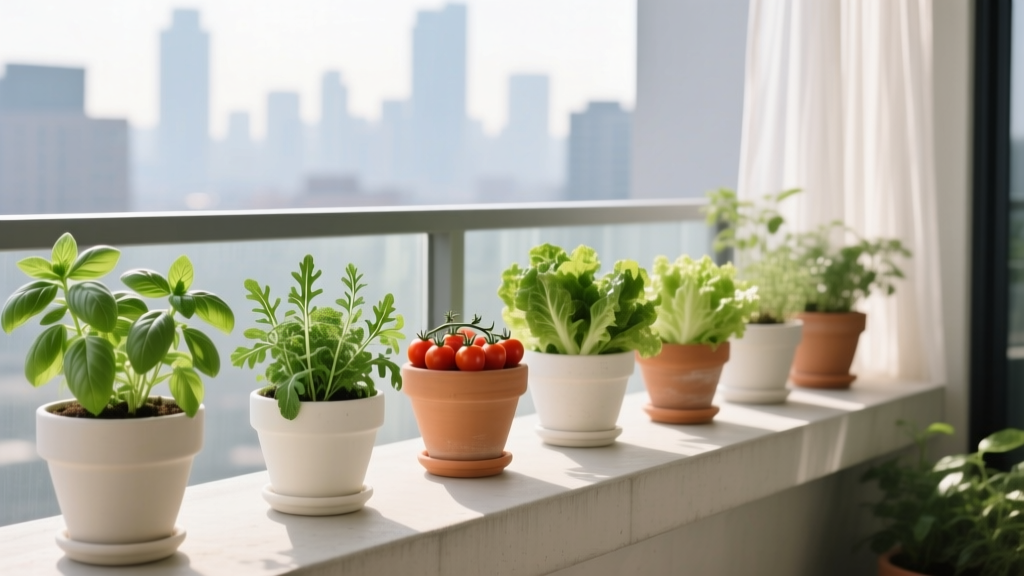
Balcony Salad Bar Garden in Pots
The bag of salad greens in your fridge looks fine—until you open it three days later and it’s a slick, wilted mess. You bought it with good intentions, but weeknight dinners happen, the weather swings, and that “fresh” clamshell becomes compost. Now imagine stepping onto your balcony with scissors, snipping a handful of crisp leaves, a few cherry tomatoes, and a sprig of basil—exactly what you need, exactly when you need it. No waste. No soggy surprises. Just a small, designed “salad bar” that lives in pots and behaves like a miniature, edible landscape.
This project is built for renters and homeowners who want a real harvest without committing to raised beds or a yard. Think of it like a designer’s plan for a compact outdoor room: clean circulation, layered heights, repeatable modules, and plants chosen for flavor, speed, and reliability in containers.
Design Principles: Make a Balcony Feel Like a Tiny Farm Stand
Start with the “Reach Zone” and a Simple Footprint
Balconies rarely fail because they’re too small—they fail because they’re cluttered. A working salad garden needs a clear path and pots you can actually reach. As a baseline, preserve a 24–30 inch clear walking lane from the door to your seating spot or railing. Put your most-harvested plants (lettuces, herbs) within arm’s reach of where you naturally stand.
A practical layout for many apartment balconies is a 2 ft x 6 ft growing strip along the railing, plus one vertical element at a side wall. If your balcony is narrower than 4 feet, avoid wide pots that force you to sidestep—go taller instead (stacked planters, wall trellis, railing planters).
Layer Heights Like a Border: Low, Mid, Tall
Designers use vertical layering to make small spaces feel intentional. In a salad bar balcony, layering is also yield strategy:
Low layer (4–8 inches tall): cut-and-come-again greens and quick herbs in trays and bowls.
Mid layer (10–18 inches tall): bushy basil, cilantro, parsley, compact peppers.
Tall layer (3–6 feet): trellised tomatoes, cucumbers, or pole beans—plants that turn airspace into food.
Place tall crops at the back (against the railing or wall) so they don’t shade the greens. If your sunlight is limited, the “tall layer” becomes optional and you focus on greens and shade-tolerant herbs.
Use Repeating Pot Sizes for a Clean, Flexible Layout
A balcony feels calmer when containers repeat. Here’s a designer-friendly pot kit that fits most spaces and simplifies soil, watering, and rotation:
- Two 14–16 inch diameter pots (tomatoes or cucumbers)
- Three 10–12 inch pots (basil, parsley, peppers)
- Two window boxes around 24 inches long (greens and scallions)
- One shallow bowl around 12 inches wide (microgreens or baby leaf lettuce)
Spacing matters even in pots: plan for 6 inches between containers so leaves can dry after watering. Better airflow is one of the easiest ways to prevent mildew.
Sunlight: Treat It Like a Budget You Spend
For salads, the sweet spot is 4–6 hours of sun for greens and herbs, and 6–8 hours for fruiting crops like tomatoes and cucumbers. If your balcony gets blazing afternoon sun, lettuces can bolt fast; give them a little shade from taller plants or a 30–40% shade cloth panel clipped to the railing.
University Extension guidance consistently emphasizes that vegetables perform best with ample sun; fruiting crops especially need long exposure. For example, University of Minnesota Extension notes most vegetables require at least 6 hours of sun daily, and more is better for fruiting types (University of Minnesota Extension, 2020).
Layout Strategies That Work in Real Balconies
The “Rail + Wall” Plan (Most Efficient for Narrow Balconies)
Put a line of railing planters for greens and herbs, then add a vertical trellis on the side wall for one tall crop. This keeps the floor open and prevents the balcony from feeling like a storage unit.
Suggested dimensions: a wall trellis 18–24 inches wide and 5–6 feet tall; railing planters 24 inches long by 7–9 inches deep.
The “Two Big Anchors” Plan (Stable and Wind-Resistant)
If your balcony is windy, anchor the design with two heavy planters on the corners near the railing. Use one for a tomato and the other for a cucumber or pepper. Then tuck smaller herb pots between them like understory planting.
A lightweight balcony garden can become a safety issue in gusts; choose heavier containers or add weight at the base. Wind also dries pots quickly—expect to water more often in summer.
The “Rolling Salad Cart” Plan (For Renters Who Need Flexibility)
A metal utility cart with two shelves can act like a moveable salad station. Put greens on the top shelf for easy snipping, heavier pots on the bottom shelf for stability. On hot days, roll it back from harsh sun; on cool days, roll it into the light.
Look for a cart around 30 inches wide; avoid flimsy wheels. Add a waterproof tray liner to protect the shelves from constant moisture.
Plant Choices: Varieties That Behave in Pots and Taste Great
Container salad gardens shine when you pick plants that do three things: grow fast, tolerate repeated harvest, and stay compact. Fruiting plants are the “treat,” but greens are the weekly workhorses.
Greens (Fast, Repeatable, Balcony-Friendly)
- Lettuce ‘Little Gem’ (romaine mini): compact heads, crisp texture, performs well in containers and doesn’t sprawl.
- Lettuce ‘Salad Bowl’ (looseleaf): classic cut-and-come-again habit; harvest outer leaves every few days.
- Spinach ‘Bloomsdale Long Standing’: better bolt resistance than many older strains; good for spring/fall and cooler balconies.
- Arugula ‘Astro’: quick (often ready to cut in 25–35 days), peppery, thrives in smaller pots.
- Swiss chard ‘Bright Lights’: ornamental and edible; handles more heat than lettuce and keeps producing.
Herbs (High Flavor per Square Foot)
- Basil ‘Genovese’: reliable for pesto and caprese; pinch tips weekly to keep it bushy.
- Basil ‘Prospera’: bred for downy mildew resistance—helpful in humid balcony microclimates.
- Parsley ‘Italian Flat Leaf’: long season, strong flavor, tolerates partial shade.
- Cilantro ‘Slow Bolt’: buys you extra time before flowering, especially in spring.
- Chives: perennial in many areas; great edging plant for pots and easy to shear.
Fruiting Crops (Choose Compact, Proven Performers)
- Cherry tomato ‘Sungold’: exceptionally sweet; vigorous, so commit to a 10–15 gallon pot and strong support.
- Cherry tomato ‘Tumbling Tom’: made for containers and hanging baskets; good for railings with strong brackets.
- Patio tomato ‘Tiny Tim’: very compact; ideal when you only have 4–5 hours of sun and want a manageable plant.
- Cucumber ‘Patio Snacker’: bred for containers; train up a trellis to save floor space.
- Sweet pepper ‘Lunchbox’: smaller plant, snack-size fruit, good yield in a 3–5 gallon pot.
For container success, soil quality matters more than in-ground planting. Research-based guidance from Extension services emphasizes using a potting mix (not garden soil) for drainage and root health; Cornell Cooperative Extension’s container gardening resources reinforce that containers need lightweight, well-drained media and consistent watering (Cornell Cooperative Extension, 2021).
“In small spaces, design and horticulture have to cooperate: vertical structure, repeated containers, and plant choices matched to light are what turn a collection of pots into a working garden.” — Adapted from principles commonly taught in landscape design education and small-space food gardening research
Quick Comparison: Pick Your Crops Based on Light and Pot Size
| Crop | Best Sunlight | Minimum Pot Size | Spacing / Plants per Pot | Why It Works on a Balcony |
|---|---|---|---|---|
| Looseleaf lettuce (‘Salad Bowl’) | 4–6 hours | 8–10 in deep window box | Plant ~6 in apart | Cut-and-come-again; fast and forgiving |
| Arugula (‘Astro’) | 4–6 hours | 6–8 in deep pot | Thin to 3–4 in | Quick harvest; great flavor in small footprint |
| Basil (‘Genovese’/‘Prospera’) | 6+ hours | 10–12 in pot | 1 plant per pot | High yield, high value, loves warmth |
| Cherry tomato (‘Sungold’) | 6–8 hours | 10–15 gallon | 1 plant per pot | Big payoff if you can give sun + support |
| Cucumber (‘Patio Snacker’) | 6–8 hours | 7–10 gallon | 1 plant per pot | Vertical training saves space; fresh crunch |
Step-by-Step Setup: Build Your Balcony Salad Bar Like a Designer
Plan on a single afternoon for setup, then small weekly rhythms afterward. The goal is a layout that’s easy to water, easy to harvest, and easy to keep tidy.
- Measure your balcony. Note the usable length and depth and mark a 24–30 inch walking lane. Also note railing height and where a trellis could attach.
- Track sunlight for one day. Even a quick check at 9am, 12pm, 3pm helps. If you get 4 hours or less, focus on greens and herbs; if you get 6–8 hours, add tomatoes/cucumbers.
- Choose containers with drainage. Prioritize pots with holes; add saucers or trays. For fruiting plants, commit to 10–15 gallon containers to avoid constant stress.
- Fill with quality potting mix. Use a vegetable-friendly potting mix; avoid heavy garden soil. Pre-moisten the mix so it hydrates evenly.
- Install support before planting tall crops. Add a 5–6 ft trellis or stake system so roots aren’t disturbed later.
- Plant by layers. Tall crops at the back/side, mid-layer herbs in the middle, greens at the front and in railing planters.
- Water deeply and label. First watering should saturate the root zone until water runs out the bottom. Labels save your future self from mystery seedlings.
- Add a simple feeding plan. Mix in slow-release fertilizer at planting, or plan on liquid feed every 2 weeks for heavy feeders like tomatoes.
Three Real-World Balcony Scenarios (and What I’d Plant)
Scenario 1: The Hot, Sunny South-Facing Balcony (6–8 Hours Sun)
Design move: Put a trellised cherry tomato and a cucumber at the back corners to create a green “screen,” then protect lettuces with partial shade from those taller plants.
Planting set: ‘Sungold’ tomato in a 15-gallon pot, ‘Patio Snacker’ cucumber in a 10-gallon pot, basil ‘Prospera’ in a 12-inch pot, and two 24-inch window boxes of ‘Salad Bowl’ lettuce and arugula.
Why it works: Fruiting crops use the sun budget; greens stay in the cooler, filtered light. You’ll harvest daily in summer, but you’ll also water more—often 5–10 minutes per day during heat waves.
Scenario 2: The Bright Shade Balcony (2–4 Hours Sun, Lots of Reflected Light)
Design move: Go heavy on greens and herbs, skip tomatoes, and use light-colored pots to brighten the composition and reduce heat stress.
Planting set: ‘Little Gem’ lettuce, spinach ‘Bloomsdale Long Standing,’ parsley, chives, and mint (keep mint in its own pot). Add Swiss chard for color and resilience.
Why it works: Leafy crops tolerate lower light far better than fruiting crops. You still get that “salad bar” feeling without frustration.
Scenario 3: The Windy High-Rise Balcony (Good Sun, Constant Breeze)
Design move: Use two heavy anchor planters and keep the profile tidy—no flimsy trellises. Choose compact varieties and secure everything.
Planting set: Patio tomato ‘Tiny Tim’ (less sail effect than a vining type), peppers ‘Lunchbox,’ sturdy herbs like rosemary (if enough sun) and chives, plus greens in lower window boxes sheltered behind larger pots.
Why it works: Wind increases transpiration and can shred soft leaves. Compact plants and stable containers reduce damage. Expect to water more frequently, but disease pressure may be lower thanks to airflow.
Budget and DIY Alternatives (Without Sacrificing the Design)
A balcony salad bar can be polished or scrappy—both can be beautiful. Here are realistic cost ranges with options to scale.
Starter budget: around $80–$150 for a small set of containers, potting mix, and seeds (assuming you already have a watering can and scissors). A more built-out setup with large self-watering containers and trellises often lands around $200–$350.
- DIY container hack: Food-grade 5-gallon buckets (often $5–$8) drilled with drainage holes make excellent tomato pots. Wrap them in reed fencing or place them inside a nicer outer pot for aesthetics.
- DIY trellis: A $12–$25 roll of jute twine and three bamboo stakes can create a strong teepee support for cucumbers.
- Railing planter alternative: Instead of buying multiple railing planters, use one long window box on a narrow bench or shelf for a unified look (just make sure it’s secure and rated for weight).
- Seed-first strategy: Greens and herbs are cost-effective from seed; buy one high-quality tomato transplant if you want quick fruit.
One caution: balance aesthetics with weight. Wet potting mix is heavy. If your balcony has weight restrictions (common in older buildings), choose fewer large pots rather than many small ones filled to the brim, and confirm rules with your building management.
Maintenance Expectations: The Rhythm That Keeps It Productive
A salad bar garden should feel like a convenience, not another chore. Most weeks, plan on 30–60 minutes total maintenance, plus watering time that varies with weather.
Weekly Tasks (Most of the Season)
- Watering: In mild weather, every 1–3 days; in hot spells, daily. Expect 10–20 minutes per week in spring and 30–50 minutes per week in summer if hand-watering.
- Harvesting: Snip greens 2–3 times per week to keep them tender and productive.
- Pinching herbs: Basil especially—pinch tips weekly to prevent legginess.
- Quick inspection: Check leaf undersides for aphids and look for mildew on cucumbers.
Seasonal Tasks That Make a Big Difference
- Spring: Start with cool-season greens when nights are still crisp; they taste better and grow fast. If you’re sowing, stagger plantings every 2 weeks for steady harvest.
- Early summer: Swap bolting greens for heat-tolerant options like chard and more basil. Add shade cloth if lettuce becomes bitter.
- Mid-summer: Feed fruiting plants and keep trellises tied. This is when consistent moisture matters most for tomatoes (to reduce cracking and blossom-end rot).
- Fall: Replant spinach and lettuce as temperatures drop; the same pots can produce again with fresh mix added to the top few inches.
If you can only commit to minimal care, prioritize: chives, parsley, looseleaf lettuce, and one compact tomato. If you enjoy tending plants, add cucumbers and succession sowing for a continuous “salad bar” effect.
The best part of designing a balcony salad garden is that it’s modular: you can refine it each month. If a pot underperforms, swap it out. If you discover your balcony bakes at 3pm, shift greens into the shaded pocket and let basil take the heat. Over time, your layout becomes less like a row of containers and more like a small, edible room—one where dinner starts outside with a pair of scissors and a bowl.
Citations: University of Minnesota Extension (2020) guidance on vegetable sun requirements; Cornell Cooperative Extension (2021) container gardening recommendations on potting media and drainage.