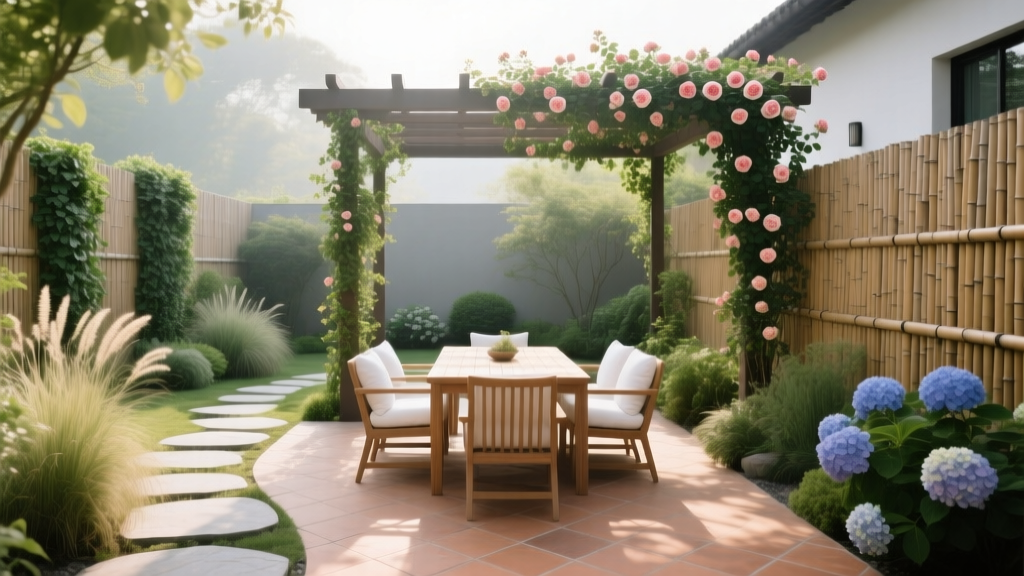
Courtyard Garden Ideas for Privacy and Beauty
The neighbors aren’t doing anything wrong. They’re just… there. You step into your courtyard with a cup of coffee, and the sound bounces off brick walls while sightlines shoot straight from the upstairs window next door to your patio chair. You want softness, shade, fragrance, and a little mystery—but you also need a plan that fits a tight footprint and doesn’t turn into a maintenance monster by July.
Think of a courtyard as an outdoor room: walls already exist, so your job is to shape what people see first, where the eye rests, and how you feel when you sit down. Privacy and beauty happen when the layout is intentional—layered screening, a focal point, and plants chosen for the light and the microclimate that courtyards create.
Start with a quick site sketch (and one honest measurement)
Before you buy a single plant, walk the space with a tape measure and mark three things: the widest length, the narrowest pinch point, and where you naturally want to sit. Many courtyards are between 10–20 ft wide and 12–30 ft long; that’s enough for a dining nook, a path, and dense planting—if you control circulation.
Key measurements that drive the whole design
- Clear walking path: aim for 36 in minimum (comfortable for two people passing is closer to 42–48 in).
- Dining zone: a 4-person table wants roughly 7 ft x 7 ft including chair pull-out space.
- Planting bed depth: for layered privacy (shrub + grasses/perennials), plan 24–36 in minimum; 48 in is luxurious.
- Sunlight hours: track morning vs afternoon. A “bright shade” courtyard can still receive 3–5 hours of direct sun; a sunnier courtyard may get 6–8 hours.
If you rent, don’t skip the sketch. A movable screen wall plus containers can achieve nearly the same feeling as built-in beds—without altering the property.
Design principles that create privacy without feeling boxed in
1) Layered screening: the 3-tier rule
Privacy works best when it’s not a single hedge line. Use three heights so the courtyard feels planted, not barricaded:
- High screen (6–10 ft): slim trees, tall clumping bamboo alternatives, trellis vines.
- Mid layer (3–5 ft): flowering shrubs, airy evergreens, tall perennials.
- Low layer (0–2 ft): groundcovers, edging grasses, seasonal color.
This approach also supports urban wildlife—more structure, more habitat. The Royal Horticultural Society notes that dense, layered planting improves shelter and feeding opportunities for garden wildlife (RHS, 2020).
2) Break direct sightlines with “soft corners”
Most courtyard privacy problems are straight lines: door to gate, window to chair, patio to neighbor’s balcony. You don’t need to cover every inch of wall; you need to interrupt the view.
Try one of these:
- Offset a tall planter 18–24 inches in front of a seating area, planted with an upright evergreen and a trailing spiller.
- Angle a trellis panel (not flat to the wall) so it creates a visual “fold” that blocks a key window view.
- Use a small tree canopy to blur second-story sightlines while keeping air flow.
3) Choose one focal point so the courtyard feels intentional
Privacy is partly psychological: if your eye has somewhere beautiful to land, you stop scanning the perimeter. A focal point can be:
- A wall fountain (great for sound masking)
- A specimen plant in a statement pot
- A small fire bowl (if permitted)
- A sculptural trellis with a vine
“People are comfortable in spaces that offer both refuge and prospect—a sense of protection with a view out.” — Jay Appleton’s prospect-refuge theory, widely applied in landscape design (Appleton, 1975)
In courtyard terms, “refuge” is your screen planting and overhead canopy; “prospect” is a clear view to your focal point or a small open area of paving.
Layout strategies that work in real courtyards
The L-shaped planting bed: the designer’s shortcut
If your courtyard is roughly 12 ft x 18 ft, an L-shaped bed along two sides is often the easiest way to get depth for screening without choking circulation. Build (or place) a bed 30–36 in deep, then keep the center open for seating and a small path.
Why it works: You gain room for layered planting in the corner—the most powerful spot for height—while leaving one wall lighter (great for a bench or a simple vine trellis).
The “green wall + floor space” plan for narrow courtyards
For long, skinny spaces (say 8 ft x 20 ft), prioritize vertical planting so you can still walk comfortably. Use:
- Wall trellis panels (2 ft wide each) spaced every 3–4 ft
- One row of tall containers (18–24 in diameter) instead of a full bed
- Foldable furniture so the path stays clear
Diagonal paving to make a small courtyard feel larger
If your courtyard is compact (around 10 ft x 10 ft), laying pavers on a diagonal visually widens the space. Pair that with a planting pocket in the far corner (even just a 24 in x 24 in container grouping) to pull the eye outward.
Materials and structures: privacy that looks good year-round
Trellis, screens, and panels (with renter-friendly options)
A basic wood trellis panel typically costs $40–$120 depending on size and material. For renters, choose freestanding options:
- Weighted planters with an attached trellis frame
- Expandable willow or reed screens zip-tied to a freestanding frame
- Outdoor curtain rods mounted to existing posts (no drilling into masonry)
For homeowners, a slatted screen with 1x2 boards spaced 1/2–3/4 in apart gives privacy while still letting light through—especially helpful in shaded courtyards that already feel enclosed.
Sound masking: the overlooked privacy tool
Visual privacy is only half the comfort equation. A small recirculating wall fountain often runs $150–$600 and can reduce the sense that conversations carry. If a fountain isn’t feasible, a dense cluster of grasses (like switchgrass) will add soothing movement and rustle.
Plant selection: specific varieties that earn their keep
Courtyards create microclimates: reflected heat from walls, wind tunnels, and rain shadows. Choose plants that handle these quirks and look good from close range (because you’ll be near them).
Evergreen backbone (privacy in every season)
- Ilex crenata ‘Sky Pencil’ (Sky Pencil holly): Narrow, upright, and tidy—excellent for tight spaces. Space plants 24–30 in apart for a slim screen; grows best with 4–6+ hours of sun but tolerates part shade.
- Thuja occidentalis ‘North Pole’: A columnar arborvitae that stays narrower than many common types. Space 30–36 in apart for a hedge effect; likes 6+ hours sun.
- Podocarpus macrophyllus (Japanese yew pine): Great for containers and clipping into clean shapes; useful in warmer zones and sheltered courtyards.
Flowering shrubs that soften walls and add scent
- Hydrangea paniculata ‘Little Lime’: Reliable blooms, more sun-tolerant than bigleaf hydrangeas; space 3–4 ft apart.
- Sarcococca confusa (sweet box): One of the best for shade courtyards—glossy evergreen leaves and winter fragrance. Space 3 ft apart; happy with 2–4 hours of dappled light.
- Philadelphus ‘Belle Etoile’ (mock orange): For fragrance near seating; give it room—about 4–5 ft wide.
Climbers for vertical privacy (big impact, small footprint)
- Trachelospermum jasminoides (star jasmine): Evergreen in many climates, fragrant, and well-behaved on a trellis; plant about 12–18 in from the wall and tie in as it grows.
- Clematis ‘Etoile Violette’: Long bloom season, lightweight coverage; pair with a shrub or trellis.
- Hedera helix (English ivy): Effective but can be aggressive and damaging to masonry—use only on a freestanding trellis and keep it off walls.
Grasses and perennials for movement and a “designer” finish
- Calamagrostis x acutiflora ‘Karl Foerster’ (feather reed grass): Upright, architectural, and narrow; space 18–24 in apart for a screen-like rhythm.
- Pennisetum alopecuroides ‘Hameln’ (dwarf fountain grass): Softer form for edges; space 18–24 in.
- Heuchera ‘Caramel’: Great in shade/part shade; warm foliage brightens dark corners.
- Lavandula angustifolia ‘Hidcote’: For sunny courtyards; space 18 in, keep dry-ish, and enjoy pollinators.
Quick comparison: privacy options at a glance
| Privacy approach | Time to impact | Typical footprint | Approx. cost | Best for |
|---|---|---|---|---|
| Slatted screen panel (6 ft tall) | Immediate | 4–12 in depth | $120–$400 per panel | Blocking direct views fast |
| Trellis + star jasmine | 6–18 months | 12–18 in depth | $60–$250 (trellis + plant) | Fragrance + soft vertical cover |
| Columnar evergreens (e.g., Sky Pencil holly) | 1–3 years | 24–36 in depth | $40–$150 per plant | Year-round structure |
| Large planters with mixed planting | Immediate to 1 season | 18–30 in diameter each | $80–$300 per container (plus soil/plants) | Renters, flexible layouts |
Three real-world courtyard scenarios (with workable layouts)
Scenario 1: The overlooked rental courtyard (8 ft x 16 ft) with strict rules
The problem: You can’t attach anything to the fence, and you need privacy from a neighboring patio.
The plan: Create a movable green “wall” using three large containers and one freestanding screen.
- Place 3 containers (each 20–24 in wide) along the most exposed edge.
- Plant each with 1 upright evergreen (Podocarpus or Sky Pencil holly), underplanted with heuchera and trailing vinca.
- Add a freestanding slatted panel behind the center container to reach 6 ft height immediately.
Budget idea: Use galvanized stock tanks or resin planters instead of ceramic to save money and weight. Expect $250–$700 total depending on container choices and plant size.
Scenario 2: The sunny townhouse courtyard (12 ft x 22 ft) that feels too hard and hot
The problem: Paving reflects heat, and you want privacy without losing the bright, open feel.
The plan: An L-shaped bed plus a small canopy tree.
- Install (or edge) a 36 in deep bed along the back and one side.
- Plant a row of 3–5 feather reed grasses spaced 20 in apart to create a light screen.
- Add 2 ‘Little Lime’ hydrangeas for mass and bloom.
- Anchor the corner with a small tree (multi-stem serviceberry if climate allows) to soften upper-level views.
Cost reality: If you’re adding soil and edging, plan $150–$300 for materials. Plants vary widely, but a realistic planting budget is $400–$1,200 depending on sizes.
Scenario 3: The shaded, enclosed courtyard (10 ft x 14 ft) with damp corners
The problem: It’s private enough, but it feels dark and a bit gloomy. You want beauty and softness without feeding mildew.
The plan: Bright foliage, winter fragrance, and reflective surfaces.
- Use 2 sweet box shrubs (Sarcococca) as the evergreen base, spaced 3 ft apart.
- Add heuchera and Japanese forest grass (Hakonechloa macra) for luminous texture.
- Paint one fence panel a light, warm gray and add a simple mirror designed for outdoors (placed where it reflects plants, not neighbors).
Microclimate tip: Courtyards can trap humidity. Keep airflow by avoiding a solid wall of foliage; choose plants with an open habit and prune lightly.
Step-by-step setup: a practical build order
- Measure and mark zones with string or painter’s tape: seating, path (minimum 36 in), and planting areas.
- Identify the main sightline from the house door and the neighbor’s most direct view into your space.
- Place hard elements first: screens, large pots, bench, fountain—move them around until the sightline breaks.
- Plan irrigation: for containers, a simple drip kit can cost $30–$80 and saves time; for in-ground beds, soaker hose works well.
- Prep soil: add compost to beds (aim for a 2–3 in layer worked in if possible). For containers, use quality potting mix—don’t use straight garden soil.
- Plant from tallest to shortest: trees/evergreens first, then shrubs, then grasses/perennials, then groundcovers.
- Mulch beds 2 in deep to conserve moisture and reduce weeds (keep mulch off plant crowns).
- Light it: one warm LED uplight at the base of a tree and two path lights can transform nighttime privacy and mood.
Budget choices and DIY alternatives (without sacrificing style)
If you’re working with a limited budget, focus spending where it shows: a couple of “bones” plants (evergreens or a small tree), plus one screen panel. Then fill in with smaller perennials and grasses that grow quickly.
- DIY slatted screen: build a 6 ft x 3 ft panel from basic lumber; seal it well. If you can’t build, buy one panel and “extend” it with tall planting on either side.
- Affordable containers: use resin, fiberglass, or stock tanks; they can look high-end when planted generously.
- Plant size strategy: buy 1-gallon perennials and grasses, but invest in 5–7 gallon shrubs where you need instant presence.
- Gravel + pavers: instead of fully paving, set pavers into gravel to cut costs and improve drainage.
Maintenance expectations (so your courtyard stays a retreat)
A well-designed courtyard should be easy to keep looking sharp because everything is close at hand. Plan on 30–60 minutes per week in the growing season for watering checks, quick deadheading, and a light tidy.
Seasonal task checklist
- Spring (1–2 hours total): cut back ornamental grasses, refresh mulch, feed containers with slow-release fertilizer.
- Summer (weekly 30–60 minutes): monitor watering—containers may need water 3–5 times/week during heat; prune fast climbers to keep airflow.
- Fall (1–3 hours total): remove fallen leaves from tight corners (helps reduce disease), plant spring bulbs in gaps.
- Winter (15 minutes/week): check that pots haven’t dried out completely; protect tender plants if exposed to wind.
If you add a vine, expect the first year to be about training: tying stems to the trellis every couple of weeks. After that, it’s mostly seasonal pruning.
Smart finishing touches that make privacy feel luxurious
Once the layout and planting are in, the courtyard becomes a sensory space. Add one element for each sense, and it stops feeling like a passageway.
- Sound: fountain or rustling grasses.
- Scent: star jasmine near the seating zone, sweet box near the door for winter fragrance.
- Touch: herbs in a pot (rosemary, thyme) where you brush past.
- Light: warm LEDs aimed at foliage, not your eyes.
A final design note: privacy doesn’t have to mean shutting everything out. The most beautiful courtyards feel like a gentle “edited” view—screen the parts you don’t want, frame the parts you do, and let plants do the work of softening the edges.
Sources: Royal Horticultural Society (RHS), advice on wildlife-friendly planting and garden shelter value, 2020. Appleton, Jay. The Experience of Landscape, prospect-refuge theory, 1975.