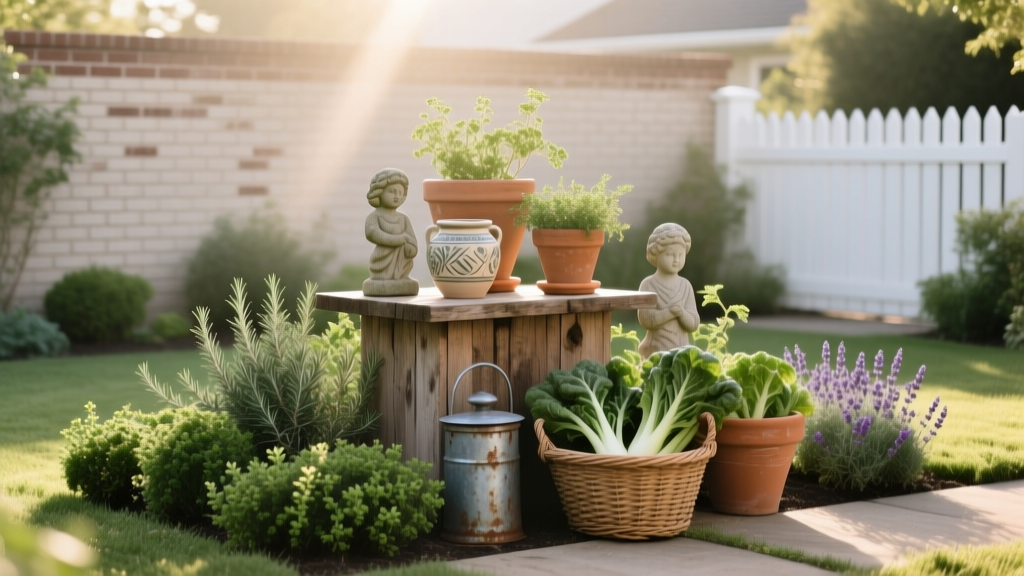
Front Yard Heritage Heirloom Display
The front yard is where the pressure shows up first: a patchy rectangle you pass twice a day, a view your neighbors share, and a space that’s supposed to look “kept” without demanding a second job. Maybe you’ve got a rental with rules about permanence, or a narrow lot where everything feels exposed. The good news is that heirloom plants—old-fashioned roses, cottage perennials, and time-tested edibles—solve a modern problem: they’re resilient, recognizable, and they make a small space feel intentional. This design creates a front-yard display that reads like a curated collection, not a random assortment of “pretty things.”
Picture this: a defined path to the door, a low border that frames the yard like a gallery edge, and a few showpiece heirlooms placed where they’ll be noticed from the sidewalk. You’ll end up with something that looks established within one season, and even better the second year—without needing a full teardown of your existing lawn.
Design principles: make it read from the street, then reward up close
Start with a simple geometry you can repeat
Heritage gardens can get busy fast. The trick is to let the plant list be romantic while the layout stays calm. Choose one primary shape—rectangle, L-shape, or crescent—and repeat it in beds and edging. For a typical 30 ft x 20 ft front yard (600 sq ft), you can convert just 200–300 sq ft into planting beds and still keep an open “lawn rug” look.
A practical rule: keep bed depth between 4–6 ft so you can reach the back without stepping into plants. If your yard is narrow, even a 3 ft deep border along the walk can carry the whole style.
Layer by height: low edge, mid mass, tall punctuation
A heritage display works best in three readable layers:
- Edge (6–18 inches tall): crisp borders, small repeats, long season.
- Middle (18–36 inches): the body of the garden—most flowers live here.
- Punctuation (3–6 ft): one or two taller anchors so the garden feels “composed.”
Spacing matters as much as variety. Overcrowding is the fastest way to make heirlooms look like a thrift-store pile instead of an heirloom display. Use mature widths and be honest about how big plants get.
Plan for sunlight like a designer, not a wishful thinker
Most heirloom bloomers want 6+ hours of direct sun for peak flowering. Track your yard for one day: morning, noon, and late afternoon. If you get 4–5 hours, you can still do a heritage look—just lean on part-shade classics like foxglove (in cooler climates), bleeding heart, and certain hydrangeas, and use foliage texture as “flower.”
For edible heirlooms (like rhubarb or strawberries), 6–8 hours is ideal. Roses are pickier: many perform best with 6+ hours plus good airflow.
Layout strategies that look established fast
The “gallery border” along the walk (smallest footprint, biggest impact)
If you can only change one thing, change the walkway edge. A 3 ft wide border along a 20 ft front walk creates a 60 sq ft “frame” that visitors see up close. Keep plants tighter and more repetitive here: think dwarf edging, a mid-layer of reliable bloomers, and one showpiece near the porch.
Spacing guide for this border:
- Edgers (alyssum, thrift, dwarf dianthus): 8–12 inches apart
- Mid-layer perennials (salvia, yarrow, hardy geranium): 16–24 inches apart
- Accent shrubs/roses: allow 3–4 ft diameter each
The “heritage parlor” bed (a focal patch near the street)
For a more traditional look, place one bed near the sidewalk like a parlor rug—an oval or rectangle that you can admire from the curb. A good starter size is 8 ft x 10 ft (80 sq ft). This is where you put your most nostalgic plants: peonies, antique roses, and a small obelisk with a flowering climber.
Keep the tallest element no more than 5–6 ft if you’re near a driveway intersection to preserve sightlines.
Edging: the quiet detail that makes “heritage” look intentional
Heirloom style loves a strong boundary. Use one of these, depending on budget and permanence:
- Brick-on-edge: classic, salvage-friendly, easy to repair.
- Steel edging: clean line; great for modern-heritage blends.
- Living edge: thrift (Armeria), creeping thyme, or dwarf dianthus for renters who can’t dig deep.
“The most successful landscapes are those with a clear structure—plants come and go, but the framework holds.” — Royal Horticultural Society, garden design guidance (RHS, 2023)
Plant selection: heirlooms that perform in real front yards
This palette focuses on varieties with proven garden performance, strong identity, and availability. Mix perennials (structure), annuals (quick color), and one or two shrubs/roses (presence). For many regions, these plants also support pollinators; the Xerces Society notes that diverse flowering plants across seasons improve forage for bees and butterflies (Xerces Society, 2020).
Signature anchors (1–3 plants that make the display feel collected)
- Old garden rose: ‘Madame Hardy’ (Damask) or ‘Souvenir de la Malmaison’ (Bourbon). Why it works: iconic form and fragrance; reads “heritage” instantly. Placement: one near the porch or centered in the parlor bed. Space: allow 4 ft width; keep 18–24 inches away from hardscapes for airflow.
- Peony: ‘Sarah Bernhardt’ (classic double pink) or ‘Karl Rosenfield’ (deep red). Why it works: longevity—these can live for decades. Space: 3 ft per plant; stake early if in a windy exposure.
- Rhubarb: ‘Victoria’ or ‘Canada Red’. Why it works: big, architectural leaves—edible and ornamental. Space: 3–4 ft wide; best in the back corner of a bed where it won’t bully smaller plants.
Reliable mid-layer bloomers (the engine of seasonal color)
- Yarrow (Achillea): ‘Paprika’ for hot color or ‘Moonshine’ for soft yellow. Why it works: drought-tolerant, long bloom, upright habit.
- Bearded iris: ‘Immortality’ (reblooming white) or ‘Wabash’ (purple/white). Why it works: sword foliage looks tidy even when not blooming; classic cottage feel. Space: plant rhizomes 12–18 inches apart with tops exposed.
- Salvia (perennial): ‘Caradonna’ (not an heirloom, but visually “heritage-friendly”). Why it works: upright spires bring order; excellent with roses and peonies.
- Hardy geranium: ‘Rozanne’ (again, modern but seamless). Why it works: long bloom; softens edges; great filler without looking messy.
Edge plants (keep the front crisp and photo-ready)
- Sweet alyssum: ‘Snow Crystals’ from seed for a cloud edge. Why it works: fast, fragrant, low.
- Dwarf dianthus: ‘Firewitch’ (spicy clove scent). Why it works: evergreen-ish in many climates; neat mounds.
- Creeping thyme: ‘Elfin’ or ‘Minus’. Why it works: handles heat, tolerates some foot traffic, and looks intentional along brick or stone.
Heirloom annuals for instant charm (and renter flexibility)
- Sweet peas: ‘Cupani’ (historic, fragrant). Train on a 6 ft trellis near the porch for scent at the door.
- Calendula: ‘Indian Prince’ (bronze-orange). Great filler; edible petals.
- Nasturtium: ‘Empress of India’. Spills over edges; peppery leaves for salads.
- Hollyhock: ‘Nigra’ (dark) or ‘Chater’s Double’. Use against a fence or wall; allow 18–24 inches spacing.
Comparison table: choose the right “heritage anchor” for your yard
| Anchor Plant | Best Sun | Mature Size | Spacing | Strength in Front Yard | Watch-outs |
|---|---|---|---|---|---|
| Old garden rose (e.g., ‘Madame Hardy’) | 6+ hours | 4 ft x 4 ft | 4 ft | Fragrance + instant heritage identity | Needs airflow; potential black spot in humid areas |
| Peony (‘Sarah Bernhardt’) | 6 hours (tolerates 4–5) | 3 ft x 3 ft | 3 ft | Longevity and spring drama | May need staking; ants on buds are normal |
| Rhubarb (‘Victoria’) | 6–8 hours | 4 ft x 4 ft | 4 ft | Bold foliage + edible harvest | Needs room; looks rough in late summer heat |
| Serviceberry (Amelanchier) | 4–8 hours | 12–20 ft (multi-stem) | 10–15 ft | Four-season structure; flowers + berries | Too big for tiny yards; prune for clearance |
Three real-world scenarios (and how the same design adapts)
Scenario 1: The narrow urban strip (12 ft x 25 ft, mostly sun)
In a skinny front yard, the goal is to avoid a “corridor” feel. Use one continuous border on the sunniest side and keep the other side open with mulch and containers.
Layout move: a 2.5–3 ft deep border along the walk, plus a single “parlor bed” circle 6 ft across near the sidewalk.
Planting approach: one rose near the porch, two clumps of iris repeated, and a thyme edge. Add sweet peas on a slender trellis so vertical interest doesn’t steal floor space.
Scenario 2: Rental front stoop with rules (no digging, partial sun)
If you can’t remove turf or install permanent edging, you can still make a heritage display using containers and a temporary border.
Layout move: three large pots (at least 18 inches wide) grouped like a mini “foundation bed,” plus two window-box style planters on shepherd hooks.
Planting approach: a dwarf rose or compact hydrangea in the largest pot, trailing thyme or nasturtium at the edges, and calendula for repeat bloom. Use a roll-out coir or no-dig temporary edging to define a small mulched patch—easy to reverse at move-out.
Scenario 3: Suburban corner lot (big exposure, wind, and salty winter spray)
Corner lots need plants that don’t collapse in wind and a layout that looks good from two directions.
Layout move: an L-shaped border: 5 ft deep along the front, 4 ft deep along the side. Keep the tallest plants at the inside corner, stepping down toward sidewalks for visibility.
Planting approach: serviceberry as a small tree anchor (if space allows), yarrow and salvia for upright stability, and dianthus at the edge for evergreen neatness. Skip floppy hollyhocks in the windiest zones unless you can stake them discreetly.
Step-by-step setup (a designer’s order of operations)
- Mark the shape with a hose or rope. Stand at the street and adjust curves until the bed looks intentional from 30–40 ft away.
- Measure and commit to dimensions. Example: one border 3 ft x 20 ft and one parlor bed 8 ft x 10 ft. Write it down so the plan doesn’t drift mid-project.
- Edge first. Install brick-on-edge or steel. For brick, plan about 20 linear ft per walkway border; for an 8x10 bed, perimeter is roughly 36 ft.
- Sheet mulch to suppress grass (no-dig). Overlap cardboard, wet thoroughly, then add 3 inches of compost and 2 inches of mulch. This reduces digging and helps renters avoid major disruption.
- Place anchor plants while still in pots. Keep roses/peonies as your “furniture.” View from street, then from the front door.
- Add mid-layer in repeating drifts. Repeat groups of 3–5 of the same plant for calm. Avoid one-of-everything.
- Finish with the edge plants. Treat the edge like a stitched hem: consistent spacing, consistent line.
- Water deeply and mulch. First month: deep watering 2x per week if no rain; after establishment, most perennials shift to weekly in summer depending on climate.
Budget and DIY alternatives (with real numbers)
Costs vary widely by region and plant size, but you can plan a realistic range for a 200 sq ft bed conversion.
- Edging: steel edging often runs about $2–$4 per linear foot; reclaimed brick can be cheaper if sourced secondhand, but labor is higher.
- Compost and mulch: for 200 sq ft at 3 inches compost + 2 inches mulch, you’ll need roughly 3.1 cubic yards total material. Bulk delivery may cost less than bags; bagged mulch commonly adds up fast.
- Plants: expect $15–$45 per perennial in 1–2 gallon pots, $25–$60 for a quality rose, and $4–$8 per annual six-pack (prices vary heavily by market).
- DIY trellis: cattle panel cut and arched, or a simple cedar ladder trellis. Plan about $30–$80 depending on materials on hand.
Sample budget tiers (for ~200 sq ft planted area):
- Lean ($250–$450): seeds + small perennials, minimal edging (living edge), DIY sheet mulch, one feature plant.
- Midrange ($600–$1,200): steel or brick edging, 12–18 perennials, 1–2 roses, bulk mulch/compost.
- Premium ($1,500–$2,500): larger plant sizes for instant fullness, upgraded hardscape, irrigation add-ons.
Maintenance expectations (so it stays charming, not chaotic)
Heritage style should feel lush, but it must