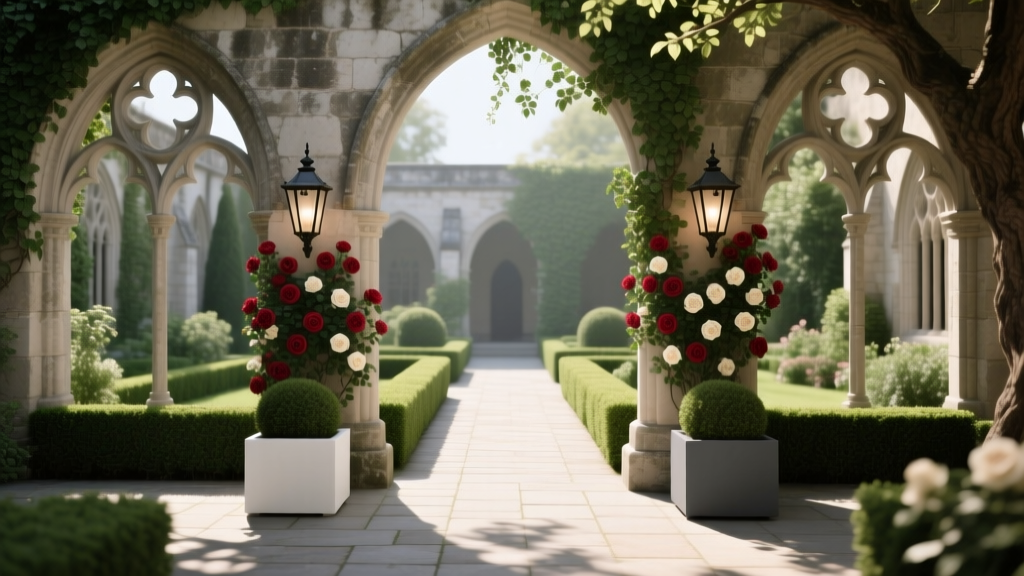
Courtyard Gothic Garden Aesthetic
The trouble with most courtyards isn’t that they’re small—it’s that they feel exposed. You step outside with a cup of coffee and the space reads like a bright box: hard paving, blank walls, and a view into someone else’s window. A Gothic courtyard flips that script. Instead of fighting the enclosure, you lean into it: shadow and texture, vertical drama, deep greens, pale blooms that glow at dusk, and a layout that makes even a 10 ft x 12 ft rectangle feel like a private outdoor room.
Think of this as designing a space that looks moody and romantic at 7 p.m., but still functions at 7 a.m. when you’re taking the trash out. We’ll build structure first (lines, heights, circulation), then layer in plants with the right habits for tight quarters, and finish with lighting and details that create that “old-world courtyard” atmosphere without turning maintenance into a second job.
Design principles that make Gothic work in a courtyard
1) Make the courtyard feel taller than it is
Gothic style is architectural—pointed arches, spires, vertical rhythm. In a courtyard, your fastest win is to pull the eye upward. Use at least one strong vertical element that reaches 6–8 ft high: a narrow trellis, an obelisk, or a wall-mounted espalier system. If you rent, choose freestanding uprights in large planters rather than drilling into masonry.
A practical trick: place the tallest element on the far end of the courtyard (opposite the door). That “backstop” makes the space feel deeper and more intentional.
2) Keep circulation clear—Gothic doesn’t mean cluttered
In small spaces, the path is the layout. Aim for a main walkway of 36 inches wide (comfortable for two people passing or carrying a chair). If you truly can’t spare that, 30 inches is workable for one-person circulation. Use straight lines or a single, gentle diagonal; too many curves in a courtyard often read as fussy rather than medieval.
3) Use a restrained color palette (then punctuate it)
For plants and hardscape, keep your base palette to: deep green, charcoal/black, stone gray, and one “moonlight” accent (white, cream, pale blush). Then add a controlled hit of burgundy or near-black foliage. The contrast is what sells the Gothic mood without feeling like Halloween décor.
4) Texture is the real drama
Since courtyards can be low on sunlight, flowers may be intermittent. Texture carries the style year-round: glossy leaves, serrated margins, feathered ferns, and architectural evergreens. One coarse-textured plant per grouping is usually enough—more than that can feel heavy in tight quarters.
5) Respect sunlight reality and design for dusk
Many courtyards receive 3–5 hours of direct sun (or less), especially with tall walls. Plan for shade-tolerant structure and put your sun-loving bloomers in the brightest pocket. If your courtyard only gets 2 hours of sun, treat it like bright shade and you’ll stop fighting it.
Lighting matters more in Gothic style than in almost any other courtyard look. A single warm uplight under a climbing vine can do more than a dozen decorative objects.
Layout strategies: three courtyard templates you can copy
The “Cloister Walk” (best for narrow courtyards)
Scenario: A 6 ft x 18 ft side courtyard between a townhouse and boundary wall. You need a clear path to the gate, but you want it to feel like a secret passage.
Layout: Keep a 30–36 inch straight path down the center or slightly offset. On the wall side, use slim containers (10–14 inches wide) with vertical supports every 4–6 ft. On the house side, mount lantern-style lights (battery/solar options exist) or place candle-style LED lanterns on the ground at intervals.
Key move: Repeat one plant form (like clipped evergreen cones) every few steps for rhythm—this is the “Gothic corridor” feeling.
The “Black Mirror Court” (best for square courtyards)
Scenario: A 12 ft x 12 ft courtyard with paving, enclosed by fences/walls on three sides. You want a focal point and a place for two chairs.
Layout: Set a central feature (a shallow bowl fountain, reflecting basin, or even a black glazed pot with still water) and ring it with planting in four quadrants. Reserve a seating pad of 6 ft x 6 ft with two café chairs and a small table.
Key move: Use dark materials (charcoal gravel, black planters) to make pale flowers and silvery foliage read brighter at twilight.
The “Wall Reliquary” (best for renters who can’t alter surfaces)
Scenario: A rental patio 8 ft x 10 ft where drilling is not allowed. You want vertical greenery and a Gothic “chapel wall” vibe.
Layout: Line the back edge with three tall planters (18–22 inches diameter) holding narrow evergreens or clumping bamboo alternatives (non-invasive choices only). In front, place a movable metal screen/trellis in a planter. Add one “artifact” object: a stone-look urn, a carved-look planter, or a weathered bench.
Key move: Use a freestanding trellis plus climbing annuals/perennials that don’t require wall anchors.
Step-by-step setup (works for most courtyards)
- Measure the usable rectangle. Write down length/width and mark doors that swing out. Keep at least 24 inches clear in front of doors.
- Track sunlight for one day. Note direct sun hours in each zone: morning, midday, late afternoon. Most Gothic courtyard plantings thrive with 3–6 hours sun or bright shade.
- Choose one focal point. Options: a narrow obelisk (7 ft), a bowl fountain, a bench, or a single specimen shrub in a dramatic pot.
- Lay out the path first. Mark a 36-inch route using painter’s tape or a garden hose. Don’t compromise this—Gothic feels intentional when movement is easy.
- Place “structure plants” next. Aim for 2–4 evergreen anchors depending on size. Keep them in matching dark containers for cohesion.
- Add climbers and mid-layer texture. This is where you get height without losing floor space.
- Finish with pale blooms and dark accents. Keep accents concentrated (two or three spots), not scattered everywhere.
- Install lighting last. Uplight one vertical element and add one low path light every 6–8 ft if needed for safety.
Hardscape and material choices that read “Gothic” without feeling theme-park
Stone, iron, and dark wood do the heavy lifting. If your courtyard is already paved, you can still change the mood with overlays: charcoal gravel bands, dark planters, and a restrained set of ornaments (one urn, one finial, one lantern grouping).
For surfaces, keep sheen low. Matte black planters and honed stone look more authentic than glossy finishes.
“Good lighting comes from a balance of ambient, task and accent lighting—layering is what creates comfort and atmosphere.” — American Society of Landscape Architects (ASLA), 2020
That layering principle is perfect here: ambient (a warm wall light), task (a small light near steps), accent (an uplight under a vine).
Plant selection: specific varieties that fit the Gothic courtyard aesthetic
Courtyards are microclimates—often warmer in winter, hotter in summer, and windier in a tunnel-like space. Choose plants that behave well in containers and tolerate reflected heat or shade. Below are reliable picks, with spacing guidance for small layouts.
Evergreen structure (the bones)
1) Taxus baccata (English yew) or Taxus x media cultivars (columnar forms if available). Yew is classic Gothic: dark, dense, and clip-friendly. In containers, choose a pot at least 18 inches wide. Space as single specimens rather than hedging unless you have ground beds.
2) Ilex crenata ‘Sky Pencil’ (Japanese holly). A narrow, upright “spire” that reads like a mini column. Works well in pots; place one every 4–6 ft in a long courtyard for rhythm.
3) Buxus alternatives for boxwood look (if boxwood blight is a concern): Ilex crenata ‘Compacta’ or Lonicera nitida (box honeysuckle) in mild climates. Clip into low mounds to edge a path.
Climbers and vertical drama
4) Clematis ‘Niobe’ (velvety red) or Clematis ‘Jackmanii’ (deep purple). These give you Gothic color without needing full sun. Provide a trellis and plant in a container 16–20 inches wide; keep roots shaded (top-dress with mulch or underplant with a small fern).
5) Hydrangea anomala subsp. petiolaris (climbing hydrangea) for shade walls. It’s slower initially, but it’s one of the best for north-facing courtyards. If you can’t attach to walls, train it on a sturdy freestanding trellis.
6) Rosa ‘Zephirine Drouhin’ (thornless bourbon rose) for a more romantic Gothic courtyard. It tolerates partial shade better than many roses, though it still prefers 4–6 hours of sun for best bloom.
Moody foliage (the atmosphere)
7) Heuchera ‘Obsidian’ or Heuchera ‘Palace Purple’. Dark leaves that hold color for months; perfect in containers and at the front of beds. Space about 12–16 inches apart.
8) Sambucus nigra ‘Black Lace’ (black elder) for lacy, near-black foliage—use only if you have space and can prune hard. In a courtyard, treat it as a feature shrub in a large container (24 inches wide) and cut back annually to keep it compact.
9) Ferns for shade texture: Athyrium niponicum (Japanese painted fern) for silver tone, or Dryopteris erythrosora (autumn fern) for coppery new growth. Space 18 inches for clumps.
Moonlight blooms (so it glows at dusk)
10) Hydrangea macrophylla ‘White Wave’ or other white mopheads/lacecaps for partial shade. Big pale blooms read like lanterns against dark foliage.
11) Helleborus x hybridus (hellebores) in white, near-black, or speckled forms. They flower in late winter/early spring when courtyards can look bare. Space 18–24 inches.
12) Digitalis purpurea ‘Alba’ (white foxglove) for vertical spires in brighter courtyards. Biennial, but it self-sows politely if you allow a few to set seed.
Ground layer and edging (polish and control)
13) Ophiopogon planiscapus ‘Nigrescens’ (black mondo grass). Excellent edging for Gothic style; it’s slow but dramatic. Space 6–8 inches apart for a tight line over time.
14) Thymus serpyllum (creeping thyme) if you have sun and want a scented edge along pavers; it softens hard lines without looking messy.
Comparison table: picking plants by courtyard conditions
| Courtyard condition | Best Gothic plant picks | Light needed | Container size (minimum) | Maintenance level |
|---|---|---|---|---|
| Bright shade, 2–3 hours sun | Climbing hydrangea, hellebores, ferns, Japanese holly | Shade/part shade | 16–22 in for shrubs; 12–16 in for perennials | Low–Medium |
| Part sun, 4–6 hours sun | Clematis ‘Niobe’, white hydrangea, heuchera, yew | Part sun | 18 in for yew/holly; 16–20 in for climbers | Medium |
| Sunny pocket, 6–8 hours sun | Rose ‘Zephirine Drouhin’, foxglove ‘Alba’, thyme edging | Sun/part sun | 20–24 in for rose; 12–14 in for edging | Medium–High |
Budget and DIY: where to spend, where to improvise
A Gothic courtyard doesn’t require rare plants—your money is better spent on structure (planters, trellis, lighting) because those items define the look in every season.
Typical cost ranges (U.S.):
$40–$120 for a large black planter (18–22 inch diameter), $25–$80 for a steel obelisk trellis, $15–$40 per low-voltage path light, $60–$180 for a small fountain bowl or water feature insert, and $8–$15 per bag of decorative gravel (coverage varies, but a small band in a courtyard is often enough).
DIY alternatives that still look refined:
- Spray paint mismatched pots in a matte charcoal (use a plastic-bonding primer for resin pots). Let them cure 48 hours before planting.
- Use livestock troughs or simple galvanized containers painted black as oversized planters—cheap volume, big impact.
- Make a “reflecting basin” with a wide black ceramic pot saucer filled with water and a few stones. It’s not a fountain, but it gives that still, moody focal point.
For renters, prioritize movable upgrades: planters, screens, lighting on timers, and a freestanding trellis. You can take the whole atmosphere with you when you move.
Three real-world courtyard scenarios (and exactly what I’d do)
Case 1: The shaded city courtyard with high walls
Conditions: 10 ft x 14 ft, only 2–3 hours of direct light, cool and slightly damp.
Design move: Use shade-friendly Gothic structure. I’d place two ‘Sky Pencil’ hollies in matching 20-inch planters at the far corners, a climbing hydrangea on a freestanding trellis at the back wall, and a simple bench (black metal or dark-stained wood) centered on the long side. Underplant with hellebores and Japanese painted ferns, then edge with black mondo grass in the sunniest strip.
Why it works: The evergreens keep the courtyard from looking empty in winter, and the pale hellebore blooms carry the “moonlight” theme when most gardens are quiet.
Case 2: The rental patio that needs privacy yesterday
Conditions: 8 ft x 10 ft, neighbor windows overlook it, landlord doesn’t allow wall mounts.
Design move: Create a portable privacy wall. I’d set three tall planters (18–22 inches wide) along the exposed edge with upright evergreens (Japanese holly or narrow conifers suited to your climate). In front of them, add a metal screen panel in a weighted planter and plant a clematis to climb it. For mood, one lantern-style floor light and one uplight aimed at the clematis.
Why it works: You get height and screening without drilling, and the climbing plant softens the “fence of pots” effect.
Case 3: The sunny courtyard that feels too hot and bright
Conditions: 12 ft x 16 ft, 6+ hours of sun, reflective paving, summer heat.
Design move: Use shade as a design element. I’d add a pergola-style freestanding frame (or a large offset umbrella) to create a shadow pocket for seating. Plant a thornless rose like ‘Zephirine Drouhin’ on a trellis in a 24-inch container, add heuchera ‘Obsidian’ in the foreground for dark contrast, and keep the rest of the palette pale—white hydrangea where it gets afternoon shade, foxglove ‘Alba’ for vertical spires, and thyme along sunny edges.
Why it works: In strong sun, Gothic becomes about high contrast and controlled shadow; without shade, it can look washed out.
Maintenance expectations (so the mood stays, not the mess)
Plan on 30–60 minutes per week in the growing season for container watering checks, quick deadheading, and guiding climbers onto supports. In hot spells, container courtyards can need water 3–5 times per week, especially for roses and clematis. A simple drip system on a timer is one of the best “quiet luxuries” you can add.
Seasonal rhythm:
- Spring (1–2 hours/month): top-dress containers with compost, refresh mulch, prune dead growth on perennials, feed roses and clematis.
- Summer (30–60 minutes/week): check water, clip any formal shapes lightly, deadhead roses, watch for aphids and powdery mildew.
- Autumn (1 hour/month): remove tired annuals, cut back foxgloves after seed if you want self-sowing, tidy leaves to prevent slippery paving.
- Winter (15–30 minutes/month): protect pots in severe cold, water evergreens lightly during dry periods, clean and reposition lighting for long nights.
For plant health and fewer pests, keep airflow in mind. In courtyards, crowding is tempting—leave 2–4 inches between containers and walls when possible, and avoid pressing dense shrubs directly against seating.
Notes on sustainability and plant performance (with sources)
If your courtyard is paved, you’re essentially gardening in containers and pockets of soil. Prioritize drought-smart irrigation and organic matter. The RHS notes that improving soil structure with organic matter supports plant health and water retention (Royal Horticultural Society, 2023). In other words: compost isn’t glamorous, but it’s what keeps a moody courtyard from turning into crispy pots by July.
For lighting, choose efficient, warm-toned LEDs—energy use drops dramatically compared with older technologies. The U.S. Department of Energy reports that LEDs use at least 75% less energy and last much longer than incandescent lighting (U.S. Department of Energy, 2022). That matters when your courtyard mood depends on reliable evening light.
Finishing touches that make it feel intentional
When the planting is in, you’ll be tempted to keep adding objects. Resist. Gothic atmosphere comes from a few well-placed elements: one urn, one bench or chair pair, one vertical “spire,” and lighting that makes leaves and stone cast interesting shadows.
My favorite last step is to stand in the doorway at dusk and ask: where does my eye land first? If it lands on a hose reel or recycling bin, solve that with a dark screen panel or a tall planter placed as a visual shield. If it lands on your focal point—an obelisk wrapped in clematis, a still basin of water, or a pale hydrangea bloom lit from below—you’ve built the courtyard you wanted: private, practical, and quietly dramatic every time the light starts to fade.