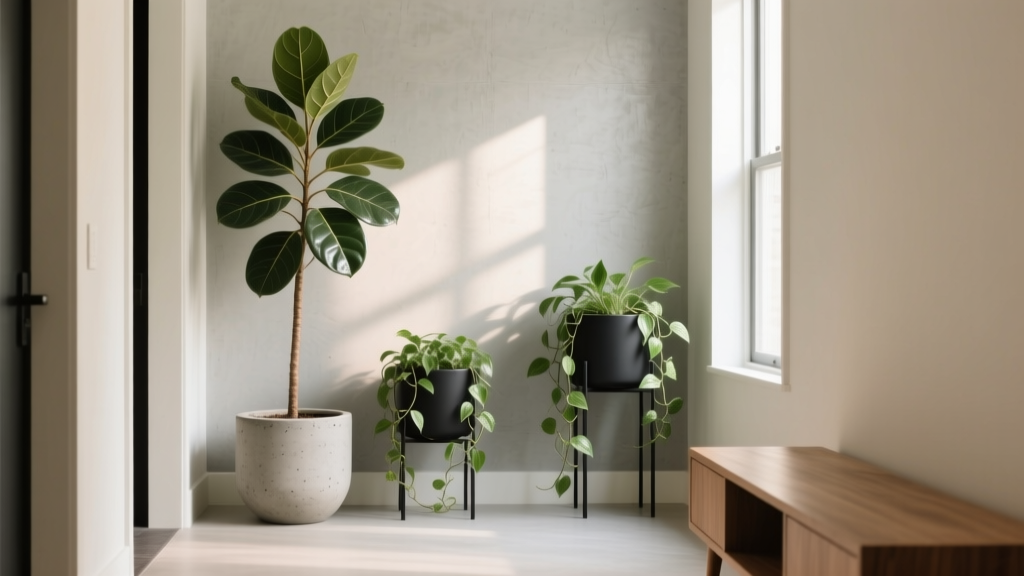
Entryway Plant Arrangements That Impress
You open the front door with groceries balanced on your hip and immediately notice it again: the entryway looks a little… unfinished. Maybe it’s a narrow walkway that feels like a hallway outdoors, or a tiny stoop that echoes when you step onto it. Sometimes the problem is the opposite—too much space, a blank stretch that makes your front door feel far away and unwelcoming. The good news is that entryway plant arrangements can fix all of that fast, because they’re doing two jobs at once: guiding movement and setting a mood.
I’m going to walk you through entryway layouts the way I’d sketch them for a client—starting with the “bones” (circulation, scale, and sightlines), then choosing plants that behave well near doors, paths, and mail carriers. Along the way you’ll see real spacing, container sizes, sunlight requirements, and what it typically costs to pull off.
Start With the Walk: Layout Principles That Make an Entryway Feel Designed
1) Keep a clear travel lane (and measure it)
Your first design line isn’t a plant—it’s the path. For comfortable entry movement, aim for a clear walking lane of 36 inches wide (minimum), and 42–48 inches if two people often pass each other or you frequently carry packages. If your existing walkway is only 30–32 inches, you can still make it work; you’ll just choose slimmer containers and keep plant overhang trimmed back.
Practical rule: once you place pots or beds, leave at least 6 inches of “forgiveness space” on either side so plants can grow without brushing coats and sleeves every time you enter.
2) Design for the “door view” and the “street view”
Stand in two places: (1) where you turn the key and (2) where visitors first see your home from the sidewalk/drive. Your entry planting should create a visual “pull” toward the door. Use one anchor (a tall plant or vertical structure) and two supporting masses (lower, fuller plants) so the eye lands and then travels.
If your door is recessed, place your anchor slightly forward (near the outer corner of the recess). If your door sits flush with the façade, anchor on the latch side so it frames the handle rather than blocking it.
3) Scale: match plant size to architecture, not wishful thinking
Small houses often look best with mid-sized containers and tight masses. Large façades need something with height—either a tall container, a narrow evergreen, or a trellis. I frequently spec a paired container height of 18–24 inches for modest entries, and 24–30 inches for taller, more formal entries. The taller container gives plants the “lift” to read from the street.
4) Repeat materials and shapes for instant cohesion
If you only do one designer move: repeat. Two matching pots. A repeated plant form (mounded, spiky, trailing). Or a repeated color (deep green + white blooms + one accent like burgundy). Repetition is what makes a rental entry look intentionally styled rather than “I bought three random plants.”
5) Plan for light: your entry might be a microclimate
Entryways can be brighter or dimmer than you think. A south-facing stoop may get 6–8 hours of sun; a covered porch may only see 2–4 hours of bright indirect light. Before you buy plants, check your light at three times: morning, midday, and late afternoon. The difference determines whether you choose boxwood and lavender or ferns and hydrangea.
For guidance on plant performance by light exposure and climate, rely on research-based sources like the USDA Plant Hardiness Zone Map (USDA, 2023) and university extension recommendations.
Three Layout Templates That Consistently Look Polished
Template A: The “Matched Pair” (symmetry without stiffness)
Best for: steps, a centered door, classic façades, narrow stoops.
Footprint: Two containers, each placed 6–12 inches from the door trim, leaving the walking lane clear.
Container size: 18–24 inch diameter for most entries; go to 24–30 inch diameter if the façade is tall or the door is oversized.
Design trick: keep both pots identical, but vary the seasonal “topper” (spring bulbs vs. summer annuals) so it stays lively.
Template B: The “Offset Anchor + Sweep” (for doors off to one side)
Best for: ranch homes, townhouses with a side-entry, modern homes with asymmetry.
Footprint: One tall anchor pot on the latch side + a low, elongated bed or row of smaller pots that “sweeps” toward the steps.
Spacing: If using a bed, keep plants 12–18 inches back from the walkway edge so mature growth doesn’t narrow passage.
This layout feels designed because it creates direction. It’s also forgiving: you can adjust the sweep length as budget allows.
Template C: The “Layered Threshold” (porch or covered entry)
Best for: covered porches, shaded entries, rentals where you can’t dig.
Footprint: Back layer = taller plants against the wall; middle layer = mounded foliage; front layer = trailing plants to soften edges.
Key dimension: Leave 8–10 inches behind pots for airflow and cleaning; it prevents mildew staining and makes sweeping easy.
Plant Selection: Varieties That Behave Beautifully at the Front Door
Entry plants need good manners: tidy growth, resilience to heat reflected off hardscape, and minimal shedding near door mats. Here are reliable choices, with what they’re good at and how to use them.
Evergreen structure (the “bones”)
Boxwood (Buxus) — Compact, formal, and easy to clip into a clean shape. Use dwarf cultivars like ‘Green Velvet’ or ‘Winter Gem’ in beds; in containers, keep them watered consistently. Boxwood is classic for matched pairs and reads well from the street.
Inkberry holly (Ilex glabra ‘Shamrock’) — A boxwood-like alternative that handles wetter soils better. Great in mixed foundation beds near entries.
Dwarf Alberta spruce (Picea glauca ‘Conica’) — Narrow conical evergreen that instantly “frames” a door, especially for taller façades. Best in cool climates; in hot zones it can struggle in reflected heat.
Flowering shrubs for the “welcome moment”
Hydrangea macrophylla (‘Endless Summer’ types) — Ideal for bright shade/part sun entries. Their large blooms read from the street. Give them 4–6 hours of sun (morning sun is best in warmer climates).
Lavender (Lavandula ‘Hidcote’ or ‘Munstead’) — For sunny entries with good drainage. The fragrance at the threshold is unbeatable. Needs 6+ hours sun and dislikes soggy soil; use gritty potting mix in containers.
Perennials and grasses that keep things tidy
Heuchera (coral bells) — Outstanding foliage color (caramel, burgundy, lime) and a neat mound habit. Great for part shade, and it won’t flop into the walkway.
Liriope muscari (lilyturf) — Tough edging plant that handles part shade and heat. Use it to line a path without constant babysitting.
Festuca glauca (blue fescue) — Compact, spiky texture for sunny entries; looks sharp in modern designs and in gravel strips.
Annuals and “seasonal swaps” that punch above their cost
Caladium (shade/bright indirect) — Big leaf drama for covered entries that don’t get enough sun for flowers.
Petunia (sun) — Trailing color that softens pot edges. Choose one color in mass for a cleaner, designer look.
Pansies/violas (cool season) — Excellent for fall-through-spring color in many climates; easy to tuck into the front of containers.
Why these choices work near entries
They hold their shape, they read clearly from a distance, and they tolerate the real conditions at a front door: wind tunnels, reflected heat, intermittent watering, and occasional brushing past. University extension resources repeatedly emphasize “right plant, right place” for lower maintenance and better long-term success (see: University of Minnesota Extension, 2020, woody landscape plant guidance and establishment practices).
“The best low-stress landscape is built on matching plant requirements to the site—light, soil, and moisture—so routine care becomes simple maintenance rather than constant correction.” — University Extension horticulture guidance (University of Minnesota Extension, 2020)
A Quick Comparison: Containers vs. In-Ground Beds at the Entry
| Approach | Best for | Upfront cost (typical) | Watering need | Flexibility |
|---|---|---|---|---|
| Large containers (18–24" pots) | Renters, porches, hardscape-only entries | $120–$350 for two pots + soil + plants | Higher (2–4x/week in heat) | High (swap plants seasonally) |
| In-ground beds (2–4' deep along walk) | Homeowners, long-term structure | $200–$900 depending on edging/mulch/plants | Moderate (1–2x/week to establish) | Medium (changes take digging) |
| Hybrid (one bed + one anchor pot) | Most real-life entries | $180–$600 | Moderate | High (pot provides seasonal interest) |
Step-by-Step: Build a Professional-Looking Entry Arrangement in One Weekend
Use this process for either a matched pair or an offset anchor + sweep. It’s the same method I use to avoid awkward spacing and “too many small things.”
- Measure the entry zone. Note door swing, walkway width, and the depth available for pots or beds. Example: walkway width 40 inches, porch depth 60 inches, door swing clearance 28–32 inches.
- Mark the clear lane. Use painter’s tape or a garden hose line to reserve 36 inches minimum for walking.
- Place the anchor(s) first. Set your largest container(s) or tallest plant(s) where they frame the door without blocking house numbers, the doorbell, or the handle.
- Add the “body” plants. In beds, plant mounded shrubs/perennials at their mature spacing—often 18–24 inches apart for medium perennials, 24–36 inches for small shrubs. In pots, choose one mounded filler per container.
- Edge with something that behaves. Add a tidy border plant (liriope, heuchera, or low annuals). Keep the edge 12 inches back from the walkway so it doesn’t creep into the lane.
- Top-dress and tidy. In beds, add 2 inches of mulch (keep it off stems). In containers, top-dress with pine bark mini nuggets or compost for a finished look.
- Water deeply and set a simple schedule. Plan a weekly check, plus extra watering during heat waves (containers dry out fast).
Three Real-World Scenarios (With Designs You Can Copy)
Scenario 1: The renter’s tiny stoop (no digging allowed)
Space: 4' wide stoop, 3' deep, part shade (2–4 hours bright light).
Goal: Make it feel intentional without blocking the door.
Layout: Template C (Layered Threshold). Place one tall pot in the back corner and one medium pot on the opposite side, leaving the center open. Add a slim railing planter if allowed.
Plant recipe:
Back layer: 1x Japanese forest grass (Hakonechloa macra ‘Aureola’) in a 16–18 inch pot for arching movement.
Middle layer: 2–3x heuchera (choose one color family) in a rectangular trough, spaced 10–12 inches apart.
Front layer: 2x trailing ivy geranium (if light allows) or creeping Jenny (Lysimachia) for a spillover edge.
Budget: Two quality resin pots ($35–$60 each), potting mix ($15–$25), plants ($60–$120). Total typical spend: $145–$265. DIY alternative: thrifted pots + exterior spray paint + one “hero” plant; keep the rest simple and green.
Maintenance: 20–30 minutes/week watering and deadheading; rotate pots monthly so plants grow evenly toward light.
Scenario 2: The narrow walkway that feels cramped
Space: 30–36" walkway, full sun (6–8 hours), beds possible but must stay tight.
Goal: Add softness without stealing walking space.
Layout: Template B (Offset Anchor + Sweep). Use one anchor pot near the door, then a low linear planting on the opposite side—kept back from the path.
Plant recipe (sun, tidy forms):
Anchor: 1x dwarf Alberta spruce in a tall 20–22 inch pot (or a narrow columnar juniper where spruce struggles).
Sweep: 5–7x lavender ‘Munstead’ spaced 18 inches apart in a bed that’s 24 inches deep.
Edge softener: 5–7x blue fescue spaced 12 inches apart (or thyme if you prefer a lower mat).
Costs (typical): One tall container ($60–$120), shrub ($35–$80), lavender ($8–$18 each), mulch ($20–$40). Total typical spend: $220–$480 depending on plant size.
Maintenance: 30–45 minutes/week first season (watering + light pruning). Seasonal task: shear lavender lightly after bloom; keep it off the walkway to avoid that “brushing through a bush” feeling.
Scenario 3: The homeowner’s blank front door on a wide façade
Space: Wide front elevation, shallow foundation bed 3–4' deep, mixed sun (4–6 hours).
Goal: Make the entry visible from the street and visually “attach” the house to the landscape.
Layout: A hybrid of Template A + B: a matched pair at the door plus a bed that extends outward in one direction to connect to the driveway or walk.
Plant recipe (four-season structure):
Matched pair: 2x boxwood ‘Green Velvet’ in 22–24 inch pots, underplanted with seasonal violas (cool season) or white petunias (summer).
Bed backbone: 3x inkberry holly ‘Shamrock’ spaced 36 inches apart.
Flower mass: 3x hydrangea ‘Endless Summer’ spaced 4 feet apart (give them room; cramped hydrangeas look stressed).
Front edging: 7–9x liriope spaced 12–15 inches apart for a clean border.
Budget: Expect $450–$1,100 depending on pot material (terra cotta vs. glazed ceramic), shrub size (1-gallon vs. 5-gallon), and whether you add edging stone. DIY alternative: start with 1-gallon shrubs and smaller pots, then upgrade the containers later—containers are often the “jewelry,” but plants do the heavy lifting early.
Maintenance: After establishment, plan 30 minutes/week during the growing season. Seasonal tasks: spring mulch refresh, hydrangea pruning per cultivar, and a mid-summer edging check so liriope stays off the path.
Budget-Smart Design Moves (That Still Look High-End)
Spend on size, save on quantity. One 24-inch container with a strong evergreen will look more expensive than three small mismatched pots. If your budget is tight, buy fewer plants but buy the right scale.
Use “green mass” + one accent color. Designers often limit the palette at the entry. Try deep green foliage as the base (boxwood/inkberry/heuchera) and add one accent: white blooms, burgundy leaves, or silvery lavender. It photographs well and looks intentional.
DIY container upgrade: Paint inexpensive resin pots with an exterior paint formulated for plastics, then seal. Pairing two identical painted pots can mimic high-end sets that run $150–$300 each.
Soil is not the place to skimp. For containers, use a quality potting mix and plan on refreshing the top 2–3 inches each spring. Healthy roots are the difference between “thriving” and “limping along.”
Maintenance Expectations: What It Takes to Keep the Entry Looking Sharp
Weekly time: Most entry arrangements take 20–45 minutes per week in the growing season. Containers trend toward the higher end due to watering.
Simple seasonal checklist
Spring: Refresh mulch (beds) or top-dress containers; prune winter damage; apply slow-release fertilizer if needed. Check that mature growth still leaves your 36-inch clear lane.
Summer: Water deeply (containers may need checks 3–4 times/week during hot spells); deadhead annuals; trim back anything that leans into the walkway.
Fall: Swap in cool-season color (pansies, ornamental kale); remove tired annuals; consider adding a small evergreen bough arrangement in pots for winter presence.
Winter: In cold regions, protect ceramic pots from freeze-thaw if they’re not rated for it; use simple winter structure (evergreen branches, red twig dogwood stems). For climate guidance and winter hardiness planning, reference the USDA Plant Hardiness Zone Map (USDA, 2023).
Small Details That Make Visitors Feel Welcomed (Without Adding Clutter)
Keep plants off the door hardware zone. If a pot forces someone to sidestep while reaching for the handle, it will always feel “in the way,” no matter how pretty it is.
Match the container finish to the home. Matte black and charcoal suit modern façades; aged terracotta fits cottage and Mediterranean looks; glazed ceramic works best when the home has one other glossy element (like a painted door).
Use lighting as part of the planting plan. If you have a porch light, place your most textural plant where it catches the glow—boxwood, ornamental grass, or a glossy-leafed shrub reads beautifully at night.
The best entryway plant arrangements don’t rely on exotic plants or complicated geometry. They rely on clear walking space, a confident anchor, and a plant palette that’s happy in your specific light and maintenance reality. Once those pieces are in place, the front door stops feeling like a blank boundary and starts feeling like a destination—one you’ll enjoy walking up to every single day.
Sources: USDA Agricultural Research Service, USDA Plant Hardiness Zone Map (2023). University of Minnesota Extension, woody landscape plant establishment and maintenance guidance (2020).