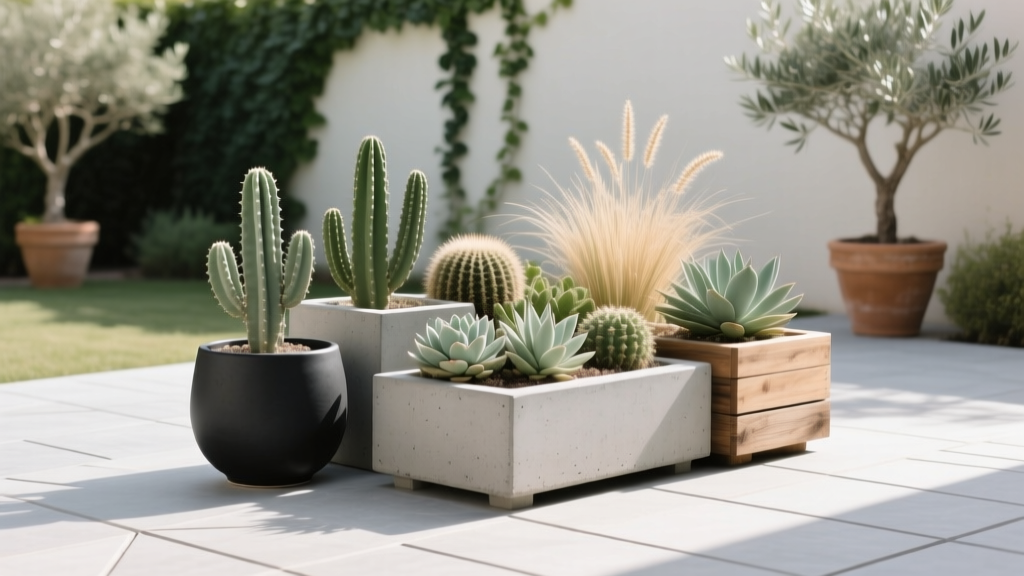
Patio Container Garden Design Ideas
The patio is clean, the chair cushions are out, and you’re ready to use the space—until you notice the view: a blank stretch of paving, a glaring fence line, and a corner that bakes in afternoon sun like a skillet. You want softness, color, maybe dinner ingredients within arm’s reach, but you don’t want to trip over pots or commit to anything permanent (especially if you rent). This is where container design shines: you can build a layered, room-like garden that fits your patio’s exact dimensions, sunlight, and lifestyle—then tweak it as the season (or your lease) changes.
Below is how I’d lay out a patio container garden if we were standing there together with a tape measure, a coffee, and a cart full of pots.
Start with a quick site “sketch”: measure, sun, and how you move
Measure like a designer (it takes 10 minutes)
Before buying plants, capture three numbers: patio length, patio depth, and the clear walking lane you need. A comfortable path is 36 inches wide; 42 inches feels luxurious if two people pass each other. If your patio is a common 10 ft × 12 ft (120 sq ft), you can still fit a lush container garden while preserving a functional seating zone.
Track sun by hours, not guesswork
Containers respond fast to sun and wind. Do a simple check: note sun exposure at 9 a.m., 12 p.m., and 3 p.m. over two days. Count “direct sun” hours:
- Full sun: 6–8+ hours (tomatoes, rosemary, lavender)
- Part sun: 4–6 hours (peppers, many herbs, compact hydrangeas in some climates)
- Bright shade: 2–4 hours or dappled light (ferns, begonias, coleus)
Most fruiting edibles need at least 6 hours of direct sun to perform well, which aligns with standard extension guidance for vegetable production (e.g., University of Minnesota Extension, 2020).
Wind and heat: the patio microclimate multiplier
A south- or west-facing patio can run hotter than your yard. Dark pots can heat up root zones; breezy corners dry out fast. Plan on using larger containers (they buffer moisture) and consider light-colored pots for the sunniest spots. If your patio is on an upper floor, wind exposure often acts like an extra “sun hour” in terms of drying—so irrigation planning is part of design, not an afterthought.
Design principles that make containers feel intentional (not like a pot collection)
Think in layers: canopy, mid-layer, and edge spill
A patio garden looks designed when you repeat a simple vertical structure:
- Canopy: tallest elements (3–6 ft) to frame views and create privacy.
- Mid-layer: flowering/perennial body (12–30 in) for color and mass.
- Edge/spill: trailing plants that soften pot rims and hard paving.
This mirrors a core landscape idea: unify with structure, then decorate with seasonal detail. The same principle is echoed in container planting guidance from the Royal Horticultural Society (RHS, 2023), emphasizing balancing height, bulk, and trailing forms for pleasing composition.
Use “anchors” to calm the scene
If you only do one design trick, do this: pick 2–3 anchor pots (usually larger, heavier, evergreen or long-season plants) and build smaller pots around them. Anchors stop the patio from feeling fussy.
Practical sizing: on a 10 ft × 12 ft patio, I like anchors in the 18–24 inch diameter range. They read as furniture-scale and hold enough soil to reduce daily watering.
Repeat materials and colors for cohesion
Choose one pot finish for anchors (for example, matte charcoal or warm terracotta) and one for accents. Repeat plant colors too: maybe white + lavender + deep green, or hot pink + lime + bronze. Repetition is what makes a small space feel curated.
“Good planting design is less about collecting plants and more about composing relationships—repetition, contrast, and seasonality—so the space reads as a whole.” — Nigel Dunnett, planting designer and author, quoted in multiple interviews on naturalistic planting (e.g., Dunnett, 2019)
Layout strategies that work on real patios
The “Outdoor Room” layout (best for entertaining)
Imagine your patio as a living room: plants become the walls. Place taller containers at the perimeter to create enclosure, leaving the center open for movement and seating.
- Perimeter: 3–5 tall pots (18–24 in wide) for screening and structure.
- Corners: the tallest plants go here to pull the eye outward and make the patio feel larger.
- Center: low pots (10–14 in) or a single statement bowl on a table.
Leave at least 36 inches between the main pots and your seating edge so chairs can slide out.
The “Galley” layout (best for narrow balconies and tight walkways)
If your space is long and skinny (say 3 ft × 12 ft), treat it like a kitchen galley: keep one side clear for walking and load the other side with vertical planting.
- Use railing planters or a slim shelf (8–10 inches deep) for herbs and flowers.
- Place two larger floor containers at the ends to visually “cap” the space.
This keeps your path intact while still giving you a garden moment at eye level.
The “Triangle” layout (best for tiny patios that need flexibility)
For patios under 6 ft × 8 ft, a triangle arrangement avoids clutter. Use three pots of different heights, grouped tightly so they read as one composition.
- Pot A (tall): 20–24 in diameter
- Pot B (medium): 14–16 in diameter
- Pot C (low bowl): 12–14 in diameter
Keep them within 6–10 inches of each other to feel intentional—and to make drip irrigation easier if you add it later.
Container choices: performance, weight, and cost
Pick pots based on how you live. If you move often, lightweight materials matter. If you hate watering, size matters more than style.
| Container Type | Best Use | Weight (empty) | Watering Frequency | Typical Cost (US) |
|---|---|---|---|---|
| Terracotta (18–20 in) | Mediterranean herbs, classic look | Medium | More frequent (porous) | $35–$80 |
| Glazed ceramic (18–22 in) | Statement anchors, less evaporation | Heavy | Moderate | $60–$150 |
| Resin/fiberglass (18–24 in) | Renters, rooftop patios | Light | Moderate | $40–$120 |
| Fabric grow bag (10–20 gal) | Vegetables, seasonal setups | Very light | More frequent (air pruning) | $6–$25 |
| Self-watering planter (12–20 in) | Busy schedules, thirstier plants | Medium | Less frequent (reservoir) | $35–$110 |
Budget tip: spend on two anchor containers you love and build the rest with DIY. A simple cedar box, a galvanized tub (with drainage holes), or even a grouped set of matching nursery pots inside inexpensive baskets can look surprisingly polished.
Step-by-step setup: a designer’s order of operations
- Set your “no-go” path. Mark a 36-inch walkway with painter’s tape so you don’t design yourself into a corner.
- Place anchors first. Put the largest pots where you want height: corners, privacy edges, or beside the door to soften the threshold.
- Group in odd numbers. Use 3s and 5s for smaller pots. Keep groups tight (within 6–10 inches).
- Match plant to pot size. A 5-gallon nursery plant typically wants at least an 18-inch diameter container for comfort.
- Use quality potting mix. Plan on 1.5–2 cu ft of mix for a large 20-inch pot; don’t use garden soil (it compacts).
- Add drip or a watering plan. Even a simple soaker line on a timer can cut maintenance drastically.
- Mulch the surface. A 1-inch layer of fine bark or compost reduces evaporation and makes pots look finished.
Plant selection: specific varieties that behave well in containers
Evergreen structure (the “bones”)
These give your patio a designed look even when flowers fade:
- Buxus microphylla ‘Winter Gem’ (boxwood): Dense, tidy, takes pruning well; great in a 18–24 inch pot for year-round structure.
- Ilex crenata ‘Sky Pencil’ (Japanese holly): Upright and narrow for tight patios; reads like a living column without needing a wide footprint.
- Chamaecyparis obtusa ‘Nana Gracilis’: Slow-growing, sculptural evergreen for a single statement container.
Sun-loving flowers with long performance
For patios that get 6+ hours of sun:
- Lavandula angustifolia ‘Hidcote’: Compact, fragrant, drought-tolerant once established; pairs beautifully with terracotta.
- Salvia nemorosa ‘Caradonna’: Vertical purple wands, tough and repeat-blooming with deadheading.
- Calibrachoa (Superbells series): Reliable trailing color; excellent pot-edge spill without constant pinching.
Bright shade winners (for north patios and covered spaces)
- Coleus ‘ColorBlaze’ series: Bold foliage that reads from across the patio; thrives with 2–4 hours of sun.
- Begonia ‘Dragon Wing’: Glossy leaves, nonstop flowers, handles shade and humidity.
- Heuchera ‘Caramel’ or ‘Obsidian’: Perennial foliage contrast; great as a mid-layer “mound.”
Edibles that actually earn their footprint
For renters and cooks, I like edibles that look ornamental and produce reliably:
- Tomato ‘Sun Gold’ (cherry): Prolific and flavorful; needs a 15–20 gallon container and a sturdy cage/trellis.
- Pepper ‘Lunchbox’ (mini sweet): Compact, colorful, productive in a 3–5 gallon pot.
- Basil ‘Prospera’ (downy mildew resistant): A practical upgrade; fuller harvests on humid patios.
- Rosemary ‘Arp’: Cold-hardy for many regions, upright habit, doubles as evergreen structure in mild winters.
- Strawberry ‘Albion’ (day-neutral): Continuous fruiting; attractive trailing habit for bowls or railing planters.
Three real-world patio scenarios (with layouts, numbers, and plant recipes)
Scenario 1: The renter’s 5 ft × 10 ft balcony with wind and 4–6 hours of sun
Goal: privacy + herbs + low maintenance, no heavy ceramic.
Layout: Galley. Keep a 36-inch walking lane. Place two tall, lightweight resin planters at the far end to form a green “screen,” then run slim railing planters along the sunny side.
Plant recipe:
- 2 × Ilex crenata ‘Sky Pencil’ in 18-inch resin pots (privacy columns)
- 3 × railing planters with thyme, parsley, and basil ‘Prospera’
- 1 × medium pot with Salvia ‘Caradonna’ + trailing Calibrachoa
Budget snapshot: two resin planters ($60 each = $120), potting mix ($18), plants ($90–$140). Total: roughly $230–$280, depending on plant size.
DIY alternative: swap resin planters for two 20-gallon fabric grow bags ($12–$20 each) tucked into tall baskets. You’ll water more often, but you’ll save weight and cost.
Scenario 2: A 10 ft × 12 ft family patio that needs kid-friendly durability and evening color
Goal: soften edges, keep a clear play path, and avoid breakable pots.
Layout: Outdoor Room. Use five unbreakable fiberglass or resin containers around the perimeter, leaving the center open.
Placement: two anchors in back corners, one by the grill (but at least 24 inches away for heat safety), and two flanking the door for a “garden entry.”
Plant recipe:
- 2 × Chamaecyparis ‘Nana Gracilis’ (anchors)
- 2 × Hydrangea macrophylla ‘Endless Summer’ (if you have part sun and adequate watering)
- Fillers: Heuchera ‘Caramel’, Begonia ‘Dragon Wing’ for long bloom in bright shade edges
- Spillers: Sweet potato vine ‘Marguerite’ (lime trail) or Dichondra ‘Silver Falls’
Cost control: buy hydrangeas as 2-gallon plants instead of 5-gallon; they’ll catch up in a season with consistent watering and feeding. Use a slow-release fertilizer and top-dress compost instead of weekly liquid feeds.
Scenario 3: The sunny “food-first” patio (8+ sun hours) with a grill and big appetites
Goal: produce a meaningful harvest without turning the patio into a farm.
Layout: Triangle groups. Cluster edibles into three stations so hoses and harvesting are simple.
Container plan:
- 2 × 20-gallon grow bags for tomatoes (‘Sun Gold’ and one slicer like ‘Celebrity’)
- 2 × 5-gallon pots for peppers (‘Lunchbox’ and a jalapeño)
- 1 × 12–14 inch bowl for strawberries ‘Albion’
- 1 × 14–16 inch pot for rosemary ‘Arp’ + thyme edging
Spacing reality: give each tomato station about 24–30 inches of elbow room for airflow and access; crowding invites disease and makes harvesting annoying.
Practical yield note: with 2 tomato plants, you’ll harvest enough to snack daily in peak season, but only if watering is consistent. A drip timer is the difference between abundance and blossom-end rot.
Budget planning: where to spend and where to save
For most patios, a realistic starter budget falls between $150 and $500, depending on how many large containers you choose.
- Spend on: anchor pots (they define the style), high-quality potting mix, and one or two long-lived shrubs or evergreens.
- Save on: annual color (buy smaller packs), DIY trellises (bamboo teepees), and upcycled containers (just add drainage holes).
A smart compromise: use one self-watering planter ($50–$110) for your thirstiest, most failure-prone plant (often basil or a patio tomato). Put tougher plants (lavender, salvia) in standard pots.
Maintenance expectations: what it really takes
Container gardens are intense but predictable. Here’s the honest rhythm:
- Weekly time: plan on 30–60 minutes per week for checking moisture, deadheading, and quick grooming. Food patios may run 60–90 minutes in peak harvest season.
- Watering: in summer heat, many patios require watering 3–7 times per week. Large containers and mulch reduce frequency; wind increases it.
- Feeding: use slow-release fertilizer every 8–12 weeks during active growth, or a diluted liquid feed every 1–2 weeks for heavy feeders like tomatoes.
Seasonal tasks (keep this simple)
- Spring: refresh top 2 inches of mix with compost; prune evergreens lightly; check drainage holes.
- Summer: deadhead, harvest, and rotate pots if one side bakes; watch for spider mites in hot, dry corners.
- Fall: swap tired annuals for pansies or ornamental kale; cut back perennials; reduce feeding.
- Winter: cluster pots against a wall for insulation, elevate slightly so they don’t sit in water, and protect tender plants if freezes are common. (Many extension services recommend overwintering containers by reducing exposure and preventing waterlogging; see, for example, Oregon State University Extension, 2021.)
Finishing touches that make it feel like a designed space
Add one non-plant element that supports how you actually use the patio: a small bistro table, a weatherproof rug, or a narrow bench that doubles as storage. Lighting matters too—warm LEDs aimed through foliage make the garden usable at night and turn leaves into texture. If you can only do one upgrade, install a simple timer light or a solar uplight near an anchor pot; the whole patio will look more intentional after dark.
Once your anchors are in and your walking lane feels generous, you’ll notice something surprising: the patio doesn’t feel smaller with plants. It feels finished. And because containers are movable, the design can evolve—spring bulbs give way to summer herbs, and a tired pot can be swapped out in five minutes. That flexibility is the real luxury of patio gardening: you’re not locked into a layout—you’re composing a space you can keep editing until it fits you perfectly.
Sources: Royal Horticultural Society (RHS), container gardening guidance (2023). University of Minnesota Extension, vegetable gardening sunlight requirements and basics (2020). Oregon State University Extension, overwintering container plants and winter care considerations (2021).