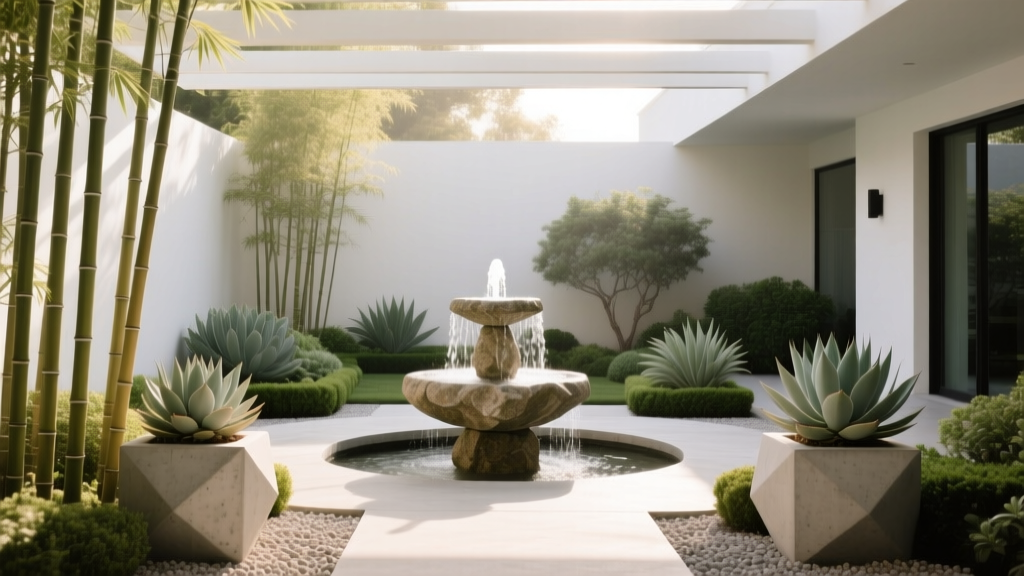
Courtyard Fountain and Plant Design
You step outside with a cup of coffee and realize the courtyard is doing that awkward thing: it’s technically outdoors, but it doesn’t feel restorative. Sound carries oddly between walls. The air is still. The view is a hard mix of paving, bins, and a lonely pot that always looks thirsty. What’s missing isn’t more furniture—it’s a focal point and a living edge. A small fountain paired with the right plants can turn a boxed-in space into something that feels cooler, calmer, and surprisingly spacious.
Think of this as a designer’s walk-through: we’ll pick a fountain that fits, lay out paths and planting so it feels intentional, and choose plants that thrive in the courtyard microclimate (heat, reflected light, wind tunnels, or deep shade). Along the way, you’ll get specific dimensions, spacing, and costs you can use to sketch a plan and shop efficiently.
Start with the feeling: sound, movement, and a clear focal point
In courtyards, the fountain is rarely about a “big water feature.” It’s about a consistent, pleasant sound that masks street noise and gives your eye somewhere to rest. Water also makes light—sparkle on the surface, a soft shimmer on walls, moving reflections on nearby leaves.
Choose the “sound radius” before you choose the style
Stand where you most often sit and measure the distance to the likely fountain spot. In many courtyards, that’s only 6–12 ft. For that range, a compact recirculating fountain with a 6–12 inch spill height usually creates enough white noise without splashing the paving. If your courtyard is long and narrow (say 8 ft x 20 ft), place the fountain at the far end so it draws you outward; in a square space (12 ft x 12 ft), it often works best slightly off-center to avoid a “bullseye” feeling.
“Moving water is one of the quickest ways to introduce sensory richness and mask unwanted noise in a confined outdoor room.” — American Society of Landscape Architects (ASLA) guidance on designing outdoor spaces (ASLA, 2020)
Layout strategies that make a courtyard feel bigger
A courtyard is basically an outdoor room. The trick is to control sightlines, soften hard edges, and preserve circulation so the space feels effortless. The fountain becomes your anchor, and everything else supports it.
Use the 60/30/10 balance (hardscape/greenery/focal)
As a practical rule of thumb for small spaces: aim for roughly 60% hardscape (paving, gravel, seating pad), 30% planting (beds, pots, climbers), and 10% focal elements (fountain + a feature pot or sculpture). This helps avoid the two common mistakes: too much paving (sterile, echoey) or too many pots (cluttered, hard to maintain).
Give yourself a real path width
Even tiny courtyards need comfortable movement. Plan a main walkway at 36 inches wide if possible; 30 inches works in very tight rentals, but it will feel narrow when you carry trays or move a chair. Leave at least 24 inches clear behind chairs so people can pass.
Respect microclimates: courtyards run hotter or darker than you expect
Walls amplify conditions. South- or west-facing masonry can increase heat stress in summer; north-facing courtyards may get only 2–4 hours of sun in peak season. Use this to your advantage: heat lovers near warm walls, shade plants in the cool zones, and evergreens where you want year-round structure.
Fountain placement: where it goes matters more than what it is
A fountain can be centered, tucked, or layered into planting. The best placement is almost always determined by: power access, splash management, and what you see from indoors.
Key placement rules (with real clearances)
- Keep the fountain 18–24 inches from walls to prevent algae staining and allow access for cleaning.
- Allow a 30-inch service zone on at least one side so you can lift the pump and rinse filters.
- Keep it 3–5 ft from seating if you want audible sound without needing to raise your voice.
- Avoid trees that drop heavily (seeds, catkins, leaves) directly overhead, unless you’re committed to frequent skimming.
Water and electricity basics (practical and safe)
Most small courtyard fountains use a submersible pump (often 120–400 GPH) and plug into a GFCI outlet. If you don’t have an exterior outlet, an electrician can add one; in many regions, a simple exterior GFCI install commonly runs $200–$600 depending on distance and wall type. For renters, consider a solar fountain for birds and sparkle, but expect weaker sound and performance in shade.
For water use: recirculating fountains don’t “consume” much water, but they lose water to evaporation and splash. In summer, topping up 1–3 gallons per week is typical for small features, more in hot, windy courtyards.
Comparing fountain options for small courtyards
| Fountain type | Typical footprint | Sound level | Best for | Typical cost (USD) |
|---|---|---|---|---|
| Self-contained bowl/urn | 24–36 in diameter | Soft to medium | Rentals, patios with limited digging | $150–$600 |
| Wall fountain | 18–30 in projection | Medium (good bounce) | Narrow courtyards; strong vertical focus | $250–$1,200 |
| Pondless spillway + reservoir | 36–60 in wide area | Medium to loud (adjustable) | Family spaces; less open water for safety | $800–$3,000 |
| Bubbling boulder | 24–48 in area | Soft to medium | Naturalistic look; pairs well with grasses | $500–$2,500 |
Budget note: you can absolutely create a strong courtyard moment with a $200–$400 self-contained fountain and invest the rest in plants and lighting—often the better long-term choice for renters and first-time courtyard renovators.
Plant design that makes the fountain look intentional
A fountain without planting looks like an appliance. Plants provide scale, soften edges, and make the feature feel “placed.” In small courtyards, I like to work in three layers: evergreen structure, texture around the water, and seasonal highlights.
Layer 1: evergreen structure (the “bones”)
These are your reliable shapes that look good in February and frame the fountain year-round. Use 1–3 structural plants—more can feel busy.
- Boxwood (Buxus sempervirens ‘Green Velvet’): dense, clip-friendly, great in pots; space 18–24 inches apart for a low hedge effect. (If boxwood blight is common in your area, swap to Ilex crenata.)
- Japanese holly (Ilex crenata ‘Sky Pencil’): narrow vertical accent, perfect beside a wall fountain; allow 24 inches width for maturity.
- Dwarf olive (Olea europaea ‘Little Ollie’) in warmer regions: silvery leaves that echo water shimmer; needs 6+ hours of sun.
Layer 2: plants that love the fountain zone (humidity + splash tolerance)
The air near a fountain is slightly more humid, and the soil in adjacent pots can stay evenly moist. Choose plants that won’t rot if they get occasional splash.
- Japanese forest grass (Hakonechloa macra ‘Aureola’): arching form that “moves” like water; part shade is ideal; space clumps 18 inches apart.
- Heuchera ‘Caramel’ or ‘Obsidian’: color contrast against stone; tolerate part shade; space 12–16 inches.
- Carex oshimensis ‘Evergold’: reliable in containers; brightens shade; space 12–18 inches.
- Sweet flag (Acorus gramineus ‘Ogon’): grassy texture, handles consistent moisture; lovely at the fountain’s edge in a pot.
Layer 3: seasonal highlights (controlled drama)
Pick a limited palette—two flowering “moments” per year is plenty in a courtyard. Too many bloomers can fight with the fountain’s calm.
- Hydrangea macrophylla ‘Endless Summer’: big impact in part sun; needs consistent water; give it a pot at least 18–20 inches wide.
- Salvia nemorosa ‘Caradonna’: upright purple spikes, attracts pollinators; best with 6 hours sun; space 12–18 inches.
- White impatiens (Impatiens walleriana) for deep shade containers: clean, bright, easy to swap seasonally; plant 8–10 inches apart.
Climbers: the fastest way to soften courtyard walls
Vertical green makes the courtyard feel deeper. For renters, use a freestanding trellis in a long planter so you’re not drilling into walls.
- Star jasmine (Trachelospermum jasminoides): glossy evergreen in mild climates; fragrant; give a trellis 5–6 ft tall.
- Clematis ‘Etoile Violette’: long bloom season; likes cool roots—plant low companions at the base; provide a 1–2 inch trellis grid.
- Climbing hydrangea (Hydrangea anomala subsp. petiolaris): for shade walls; slow start, then lush; excellent for north-facing courtyards.
Three real-world courtyard scenarios (and how the fountain plan changes)
Courtyards may share walls, but they don’t share conditions. Here are three common layouts I design for, with fountain and plant strategies that fit real constraints.
Scenario 1: The narrow rental courtyard (8 ft x 16 ft) with partial shade
Problem: not enough floor space for big planters, and you can’t excavate. Solution: a wall-mounted look without the construction.
Design move: Place a slim wall fountain or self-contained pedestal fountain on the short end, so the sound carries down the length. Use two tall, narrow planters (10–12 inches wide) to flank it and make it feel built-in.
Plant palette: Ilex crenata ‘Sky Pencil’ for height, Carex ‘Evergold’ for brightness, and Heuchera for color. Add a trellis planter with star jasmine if you get 4–6 hours of sun; otherwise, climbing hydrangea for shade.
Budget reality: A self-contained fountain ($200–$450), two tall planters ($60–$150 each), and plants ($150–$300) can transform the space without changing the hardscape.
Scenario 2: The sunny brick courtyard (12 ft x 12 ft) that feels like an oven
Problem: reflected heat, glare, and crispy pots by July. Solution: create shade and choose plants that can take sun and drying winds.
Design move: Use a bubbling boulder or low bowl fountain placed 24 inches off the wall to reduce algae streaking. Surround it with gravel mulch (not bark) to keep things tidy and reflect less heat than pale paving.
Plant palette: Dwarf olive ‘Little Ollie’ or compact rosemary (where hardy) as structure; lavender ‘Hidcote’ at 18-inch spacing if you have 6+ hours sun; add Stipa tenuissima (Mexican feather grass) for movement.
Water note: Expect to top up more often in heat—often closer to 2–3 gallons per week during hot spells.
Scenario 3: The family courtyard with safety concerns and messy trees overhead
Problem: open water worries, plus constant leaf litter. Solution: a pondless system and a planting buffer that catches debris.
Design move: Install a small pondless spillway over a hidden reservoir, so there’s no standing pool. Position it away from the heaviest drop zone, and add a simple prefilter box for easier cleaning.
Plant palette: Use evergreen structure (boxwood or Japanese holly) and broad-leaf accents like Fatsia japonica (great in shade) to hide the reservoir access point. Add Hakonechloa and Carex to soften edges and look good even when you’re not fussing with flowers.
Cost reality: Pondless kits vary widely, but a modest DIY build often lands around $800–$1,800 for basin, pump, liner, and stone—less if you already have rock and can do the labor yourself.
Step-by-step: setting up a compact courtyard fountain (designer workflow)
This sequence avoids the most common mistakes: crooked basins, hard-to-access pumps, and splashy placement.
- Mark the footprint with painter’s tape or a rope. Include a 30-inch access zone for maintenance.
- Test sightlines from indoors (kitchen sink, sofa). The fountain should be visible from at least one primary viewpoint.
- Confirm power (GFCI outlet). If using an extension cord temporarily, keep it rated for exterior use and route it where it won’t be pinched or tripped over.
- Level the base. For a self-contained fountain on paving, use shims and a level. For gravel, create a compacted pad at least 2 inches deep with fines.
- Assemble and fill. Start with clean water, then run the pump and adjust flow to avoid splash. If water jumps out in wind, reduce the pump output.
- Add planting in a “frame”: two taller elements behind/alongside, medium mounding plants at the base, and a trailing plant to soften the pot edge.
- Light it. A single warm LED uplight (often 3–5 watts) aimed at the moving water is more effective than multiple small lights scattered around.
Budget planning and DIY alternatives that still look polished
Good courtyard design isn’t about spending big—it’s about editing. Here’s how I’d allocate money for the biggest visual return.
Budget tiers (realistic ranges)
- Lean budget: $300–$800 — self-contained fountain, two to four quality plants, one large pot, gravel mulch, simple solar or plug-in light.
- Mid-range: $800–$2,500 — better fountain materials (stone/resin that reads like stone), larger planters, drip irrigation for pots, layered planting, low-voltage lighting.
- Higher investment: $2,500–$7,500+ — pondless feature, new paving, built-in seating, professional electrical, integrated drainage.
DIY that doesn’t scream “DIY”
- Convert a glazed pot into a bubbling urn using a fountain kit and a hidden basin. Use a pot at least 18 inches wide for stability.
- Use gravel “planting bays” to reduce clutter: sink pots into gravel so the rims sit just above grade. It looks intentional and cuts watering evaporation.
- Choose fewer, larger containers. One 20–24 inch diameter pot reads calmer than three small ones and often costs less overall when you factor soil and plants.
Plant care and fountain maintenance (what it really takes)
Courtyard spaces are close to the house, so maintenance is more noticeable—good news is, a well-designed courtyard can be kept sharp with short, regular sessions. Plan for 30–60 minutes per week in the growing season and 15–30 minutes per week in cooler months.
Weekly rhythm
- Top up water: usually 1–3 gallons depending on heat and wind.
- Quick skim and rinse: remove leaves; rinse the pump prefilter if flow slows.
- Check pots: courtyard pots dry faster near reflective walls; water deeply rather than frequently.
Seasonal tasks
- Spring: refresh mulch/gravel, prune evergreens lightly, divide grasses if crowded, flush the fountain system.
- Summer: watch algae in full sun—shade from plants helps; trim spent flower spikes; adjust flow during windy spells to prevent splash loss.
- Autumn: netting or strategic pruning if you have heavy leaf drop; clean pump and tubing more often.
- Winter: in freeze climates, many manufacturers recommend draining and storing pumps to prevent damage. The U.S. Environmental Protection Agency notes that efficient pumps and right-sizing equipment can reduce unnecessary energy use (EPA, 2023).
Water quality tip: algae is usually a light problem, not a “dirty water” problem. If your fountain sits in 6+ hours of sun, add shade via a nearby tall plant or small canopy, or reduce the basin’s exposure by repositioning it slightly. Also avoid over-fertilizing nearby pots—nutrient runoff can feed algae.
Design details that elevate the whole courtyard
After the fountain and plants are in, a few finishing choices make the space feel designed rather than assembled.
Material echoes: repeat one texture from fountain to planting
If the fountain is dark stone, repeat that tone in a charcoal pot or slate gravel. If it’s warm terracotta, echo it with coppery foliage (Heuchera ‘Caramel’) or warm uplighting. Repetition is what makes small spaces feel calm.
Use scent carefully in tight spaces
Fragrance is amplified in courtyards. One star jasmine or a pot of night-scented stock near seating goes a long way. Too many scented plants can feel heavy, especially on still evenings.
Give yourself one clear “resting view”
From your main indoor window, aim for a simple composition: fountain centered in view, a vertical plant behind it, and a low ring of texture at the base. When the view is clean, the courtyard feels larger because your eye isn’t snagging on clutter.
Courtyards reward small, precise moves. A fountain doesn’t need to be large to change the atmosphere—it just needs to be placed where you’ll hear it, framed by plants that soften and support it, and maintained with a quick, steady routine. If you start with a taped outline, commit to a comfortable path width, and plant in layers, your courtyard stops being a leftover space and becomes the part of the home you drift toward at the end of the day.
Sources: American Society of Landscape Architects (ASLA), 2020. U.S. Environmental Protection Agency (EPA), 2023.