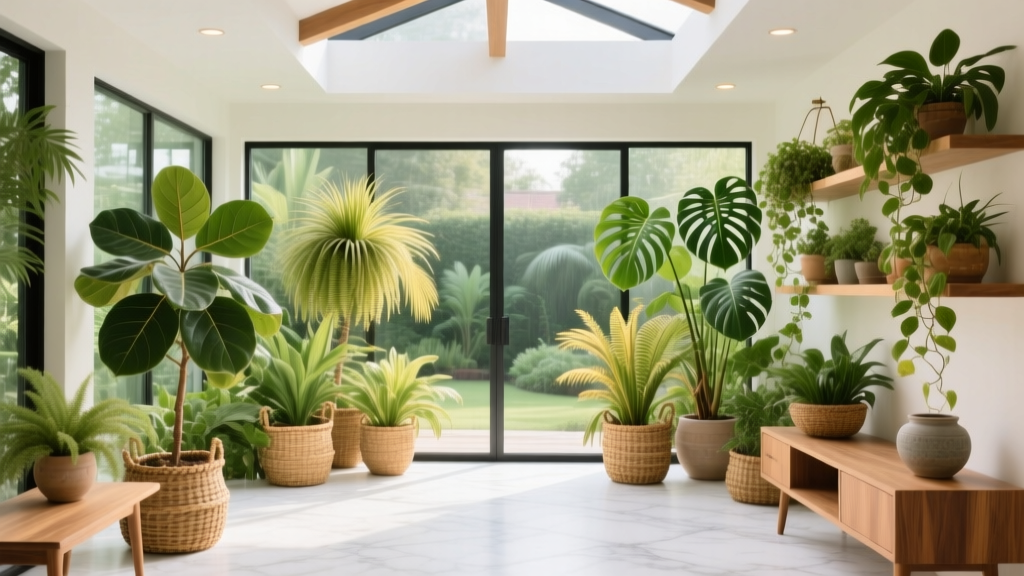
Sunroom Tropical Plant Collection Ideas
It starts the same way for a lot of sunroom owners: you buy one glorious tropical—maybe a bird of paradise with leaves like green oars—then you set it by the brightest glass. Two weeks later it’s leaning, one side is bleached, and every time you open the door you get a whiff of potting mix and mild regret. The space is sunny but not evenly sunny, warm but not consistently warm, and the floor is suddenly a patchwork of saucers. The good news is that a sunroom is basically a controlled microclimate; with a little layout planning, you can make it look intentional, lush, and easy to maintain—more conservatory than clutter.
Think of this as a design project with plants as your furniture. We’ll map light, build layers, and choose a plant collection that reads like a tropical landscape—canopy, midstory, understory—without turning your sunroom into a daily chore.
Start With Light: Map the Sunroom Like a Designer
Before you buy another plant, do one quick diagnostic: where does the sun actually fall? Tropical plants tolerate bright light, but most dislike harsh, all-day direct sun through glass. Your goal is to match plants to light zones so the collection looks calm and balanced.
Do a 48-hour light map (simple, renter-friendly)
- Pick a sunny weekday and a weekend day.
- Every 2–3 hours, note where direct sun hits the floor (a quick phone photo works).
- Label three zones on a sketch: Hot/Direct, Bright/Indirect, and Low/Edge.
As a rule of thumb, many “tropical houseplants” are happiest with 4–6 hours of bright indirect light, while sun-lovers (like some palms and succulents) handle more direct exposure. If your sunroom is south-facing, it’s common to see 6–8 hours of direct sun in summer—often too much for thin-leaved plants unless filtered with sheers or a shade cloth.
“The right plant in the right place is the most sustainable design move you can make—most ‘difficult’ plants are simply mismatched to light and temperature.” —Thomas Rainer, landscape designer and author of Planting in a Post-Wild World (Rainer & West, 2015)
Layout Strategies That Make a Sunroom Feel Like a Mini Jungle (Not a Storage Room)
A strong layout gives you two things: a cohesive look and predictable maintenance. You’re designing sightlines, walking clearance, and watering access—not just filling sunny spots.
Use the “3-layer tropical border” indoors
Borrow a classic garden composition and adapt it to containers:
- Canopy layer (tall anchors): 5–8 ft plants in 12–18 in pots to create height and a lush ceiling line.
- Midstory (texture + volume): 2–4 ft plants in 8–12 in pots to fill the body of the room.
- Understory (groundcover feel): trailing and compact plants in 4–8 in pots to soften edges and shelves.
Design tip: aim for odd-number groupings (3, 5, 7) so the collection reads natural rather than symmetrical.
Build clear circulation: the 30-inch rule
Even small sunrooms feel bigger when you preserve a comfortable pathway. Leave at least 30 inches of clear walking space from door to seating. If your room is narrow, make one side the “plant wall” and keep the opposite side lighter with hanging plants and a slim bench.
Put water where it’s easiest, not where it’s prettiest
Watering is what makes indoor jungles fall apart. Plan for it:
- Keep your heaviest plants within 6–8 ft of a sink or water source if possible.
- Use deep saucers or hidden trays in decorative cachepots (no more random mismatched plastic).
- Group plants with similar watering needs together so you’re not playing plant roulette.
Three Practical Sunroom Layout “Blueprints” (Pick One and Customize)
Scenario 1: The narrow rental sunroom (6 ft x 10 ft) with a door swing
This is common in apartments and older homes: long and bright, but tight. The trick is to go vertical and keep the floor path clean.
- One long plant bench: a 10 ft bench (or two 5 ft benches) along the brightest wall. Depth: 14–16 inches so it doesn’t eat your walkway.
- Two tall anchors: one at each end of the bench to frame the view, in 14-inch pots.
- Hanging line: 3–4 hooks set 24 inches apart for trailing plants above the bench.
DIY alternative: use a simple 2x12 plank on cinder blocks for a bench (often $35–$60 depending on lumber prices), and paint the blocks to match your trim.
Scenario 2: The family sunroom (12 ft x 14 ft) that doubles as a reading room
Here, the plants need to frame a seating zone without crowding it. Treat plants like living walls that create a cozy “room within a room.”
- Anchor cluster: 3 tall plants in a triangular grouping, spaced 18–24 inches apart (pot rim to pot rim) near the sunniest corner.
- Midstory arc: 5 medium plants along the window line with 12–16 inches between pots to allow airflow.
- One statement shelf: a 48–60 in wall shelf for understory plants and propagation jars.
Budget note: a sturdy metal-and-wood plant shelf typically runs $90–$180. A DIY shelf with brackets and a sealed pine board can land closer to $35–$70.
Scenario 3: The bright, hot sunroom (8 ft x 12 ft) with intense summer sun
If your sunroom bakes in July, your design job is light filtration and heat buffering. Start by softening the light so leaves don’t scorch.
- Sheer curtain layer: hang sheers that cut glare while keeping brightness. A basic set is often $25–$60.
- Heat-tolerant lineup: choose thicker-leaved and palm-like plants near glass.
- Move sensitive plants back: put calatheas and ferns 3–5 ft from the hottest panes.
Plant Selection: A Tropical Collection That Looks Designed (and Lives Well Indoors)
Good collections mix forms: big paddle leaves, fine fronds, upright spears, and trailing vines. Below are reliable tropicals with specific varieties that perform well in sunrooms, plus why they’re worth your square footage.
Canopy anchors (height + drama)
1) Bird of Paradise (Strelitzia nicolai)
Why it works: Architectural, fast-growing in bright light, and reads instantly “tropical resort.” Give it a pot that’s 14–18 inches wide; rotate monthly to prevent leaning.
2) Kentia Palm (Howea forsteriana)
Why it works: Softer, more forgiving than many palms; tolerates bright indirect light and doesn’t demand constant humidity. Great for reading-room sunrooms where you want calm greenery.
3) Rubber Plant ‘Burgundy’ (Ficus elastica ‘Burgundy’)
Why it works: Thick leaves handle brighter light and occasional watering lapses. The dark foliage adds contrast so the collection doesn’t become a single green blur.
Midstory volume (texture, color, and “fullness”)
4) Monstera deliciosa
Why it works: The classic for a reason—large leaves, sculptural splits in good light. Give it a moss pole and a footprint of about 24 inches once mature.
5) Philodendron ‘Rojo Congo’
Why it works: Broad, glossy leaves with reddish tones; stays tidy without climbing everywhere. Good for filling gaps between tall anchors.
6) Alocasia ‘Regal Shields’
Why it works: Big, velvety leaves that look like living decor. Best in bright indirect light; avoid harsh midday sun that can burn foliage.
7) Cast Iron Plant (Aspidistra elatior)
Why it works: This is your “insurance plant” for edges and slightly dimmer corners. It keeps the design lush where sunlight fades.
Understory and trailing plants (soften edges, add movement)
8) Pothos ‘Neon’ (Epipremnum aureum ‘Neon’)
Why it works: Bright chartreuse lights up shelves and hanging baskets, tolerates a range of light, and gives you instant cascade.
9) Heartleaf Philodendron ‘Brasil’ (Philodendron hederaceum ‘Brasil’)
Why it works: Variegation reads cheerful; it trails or climbs, so it can fill vertical gaps without extra furniture.
10) Boston Fern ‘Kimberly Queen’ (Nephrolepis obliterata)
Why it works: More upright and less messy than some ferns, excellent for that “tropical porch” feel—especially if your sunroom stays moderately humid.
Quick Comparison: Pick Plants Based on Light and Fuss Level
| Plant | Best Light in a Sunroom | Watering Rhythm | Approx. Mature Size Indoors | Designer Use |
|---|---|---|---|---|
| Strelitzia nicolai (Bird of Paradise) | Bright indirect to some direct | Moderate; let top inch dry | 6–8 ft tall | Statement anchor, corner focal point |
| Howea forsteriana (Kentia Palm) | Bright indirect | Moderate; dislikes soggy soil | 5–7 ft tall | Soft canopy, calming “resort” feel |
| Monstera deliciosa | Bright indirect | Moderate; consistent moisture | 4–6 ft tall / 2 ft wide | Midstory mass + bold leaf texture |
| Ficus elastica ‘Burgundy’ | Bright indirect to some direct | Low-moderate; drought tolerant | 5–8 ft tall | Vertical accent, dark contrast |
| Nephrolepis ‘Kimberly Queen’ | Bright indirect | Higher; keep evenly moist | 2–3 ft tall/wide | Understory fullness, porch-like texture |
Design Details That Make It Feel Intentional
Choose a pot palette (so the greenery shines)
A collection looks designed when containers relate to each other. Pick one of these approaches:
- Warm terracotta spectrum: terracotta + tan ceramics + natural baskets. Great with teak or rattan furniture.
- Modern neutral: matte white/gray planters with black metal stands. Clean and architectural.
- Vintage conservatory: glazed greens and blues, mixed with a few weathered clay pots.
Cost reality: attractive 12–14 in planters often run $25–$60 each; mixing in baskets (with plastic liners) can cut that by 30–40% while keeping a warm, tropical texture.
Stands and risers create a “leaf skyline”
In a sunroom, height variation is your best tool for depth. Use plant stands to lift medium plants by 8–16 inches so leaves overlap rather than forming a flat line. Overlap is what reads lush.
Step-by-Step Setup: From Empty Sunroom to Tropical Collection
- Measure your usable footprint. Note the walkway you must keep (aim for 30 inches).
- Define 1–2 focal points. Usually a sunniest corner and the view from the door.
- Place canopy anchors first. Start with 2–3 tall plants in 14–18 in pots.
- Add midstory plants in clusters. Group in threes, leaving 12–18 in between pots for airflow and access.
- Fill shelves and edges with understory. Use trailing plants to soften lines and link groupings.
- Dial in light filtration. If leaves bleach or curl, add sheers or move plants back 2–3 ft.
- Standardize watering tools. One slim watering can, one moisture meter if you like, and matching saucers/trays.
Maintenance Expectations (So It Stays Fun)
A well-planned tropical sunroom shouldn’t eat your weekends. For a collection of 12–18 plants, expect 45–75 minutes per week for watering checks, leaf wiping, and quick grooming.
Weekly rhythm (set it and relax)
- Water check (20–40 minutes): test soil with your finger; water thoroughly when needed, then empty trays after 15 minutes.
- Leaf care (10 minutes): wipe big leaves (Monstera, Ficus, Strelitzia) so they photosynthesize efficiently.
- Rotate and inspect (10 minutes): rotate sun-facing plants a quarter turn; look for mites or scale.
Seasonal tasks that prevent common problems
- Winter: keep plants away from cold glass at night; many tropicals dislike drops below ~55°F. Watch for dry air; group plants or add a humidifier if leaf tips brown.
- Spring: refresh the top 1–2 inches of potting mix; start light fertilizing.
- Summer: filter harsh sun; check moisture more often as sunrooms can heat up quickly.
- Fall: reduce watering as growth slows; clean shelves and trays to prevent fungus gnats.
For fertilizer and potting media guidance, university extensions consistently emphasize drainage and avoiding chronic overwatering. The University of Minnesota Extension notes that most houseplant issues trace back to watering and drainage mismanagement (University of Minnesota Extension, 2021).
Budget Planning and DIY Alternatives
Your cost depends on how fast you want the jungle to look “done.” A realistic starter collection can be built in phases.
Three budget tiers (typical ranges)
- Starter ($150–$300): 1 tall anchor (6 in pot size up-potted), 4–6 mid/understory plants, DIY bench, basic saucers.
- Designed ($400–$900): 2–3 tall anchors in larger pots, cohesive planter palette, a shelf system, a few statement plants (Monstera, Alocasia).
- Conservatory vibe ($1,000–$2,000+): large specimen plants, premium planters, lighting add-ons, humidifier, and upgraded furniture.
DIY swaps that still look polished:
- Cachepot hack: keep plants in nursery pots and slip them into baskets with waterproof liners—easier repotting and usually cheaper.
- Propagation shelf: a $10 set of glass jars on a thrifted tray creates a designer moment and multiplies pothos/philodendron for free.
- Rolling caddies: put heavy plants on rolling stands so you can rotate and water without strain; many run $15–$30.
Case Examples: Three Collections That Work in Real Homes
Case 1: The renter who can’t drill or install permanent shades
A renter with a 6 x 10 ft sunroom used a freestanding garment rack as a “plant rail” for hanging pothos and philodendron cuttings. Under it, a 10 ft narrow bench held a Monstera, a ‘Rojo Congo’ philodendron, and a ‘Kimberly Queen’ fern. Result: vertical abundance with zero holes in the wall, and the whole setup could move out in one afternoon.
Case 2: The homeowner with a south-facing glass box that scorches plants
In a newer build with large south glazing, the client kept losing calatheas and ferns to crispy edges. We added sheer panels to cut intensity and shifted sensitive plants back 3–5 ft from the glass. Near the windows, we placed a bird of paradise and rubber plant to take the brunt of the light. This “buffer planting” is a classic landscape move—tough plants on the edge, delicate ones behind—and it works beautifully indoors.
For broader indoor air and plant health context, NASA’s well-known indoor plant research is often cited, but it was conducted in controlled conditions and doesn’t directly translate to whole-home air cleaning. Still, the study remains a useful reference point for understanding plant interactions with certain pollutants (Wolverton et al., 1989).
Case 3: The busy household that wants tropical style with low maintenance
A family wanted a lush look but only had about an hour a week to maintain it. We skipped high-humidity divas and built the collection around Kentia palm, rubber plant, Monstera, cast iron plant, and pothos varieties. The design leaned on texture contrast (fronds + glossy leaves + split leaves) instead of rare plants. The result: a room that looks like a boutique hotel conservatory but tolerates missed watering and kid traffic.
Small Details That Keep the Collection Healthy and Good-Looking
Spacing for airflow: Leave at least 2–4 inches between leaves of neighboring plants. It reduces pest pressure and helps soil dry evenly.
Soil choice matters: Most tropicals do best in a chunky, well-draining mix. If you buy a bagged indoor potting mix, amend it with orchid bark and perlite so water doesn’t linger around roots.
Plan for growth: That cute 6-inch Monstera wants to become a 24-inch-wide personality. When you place plants, imagine their next size up; it’s how you avoid the midseason reshuffle.
Make one spot a “plant service station”: A small waterproof mat and a tucked-away bin of soil, pruners, and ties saves time and keeps mess contained—especially in carpeted sunrooms.
Once your layout is set, the sunroom starts to feel less like a bright spare space and more like a lived-in indoor garden. The best moment is a quiet one: morning light filtered through leaves, a chair angled toward the green, and plants placed so naturally you forget you ever had to plan it. That’s when you know the design is doing its job—supporting the life in the room, including yours.
Sources: University of Minnesota Extension (2021), Houseplant care and watering guidance. Wolverton, B.C., Johnson, A., & Bounds, K. (1989), Interior Landscape Plants for Indoor Air Pollution Abatement, NASA/Stennis Space Center. Rainer, T. & West, C. (2015), Planting in a Post-Wild World.