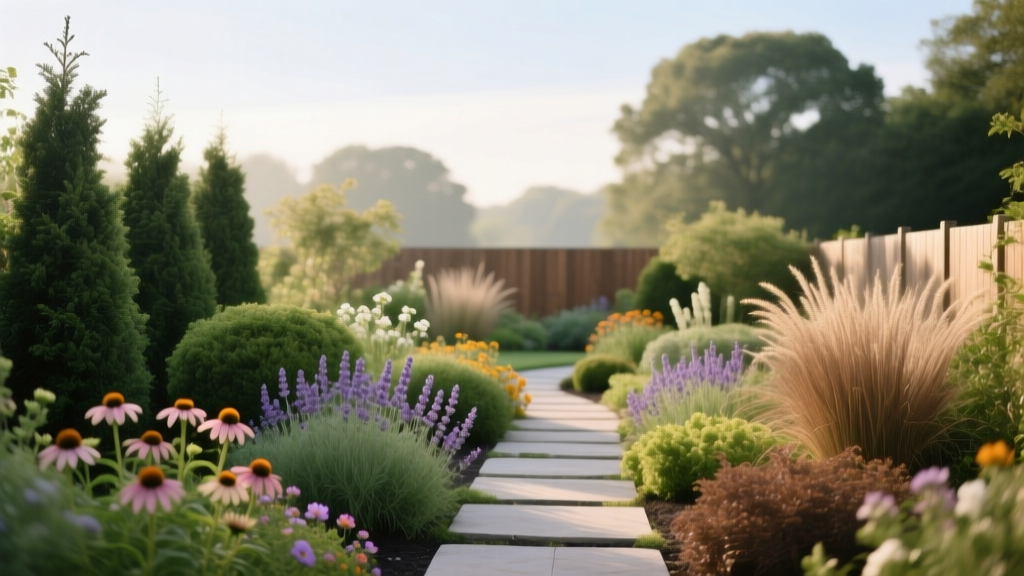
Front Year-Round Interest Garden Plan
You pull into the driveway in late February and the front bed looks… flat. The lawn is still sleeping, the shrubs are a tangle of sticks, and the house feels like it’s waiting for spring to show up and do all the work. Then, fast-forward to August: the same spot is a blaze of growth that needs water every other day and still manages to look tired by Labor Day. If that sounds familiar, you don’t need more plants—you need a plan that’s designed to carry the view from January through December.
This front year-round interest garden plan is laid out like I’d walk a client through it: quick to read, easy to measure, and flexible enough for a rental or a forever home. The goal is a front bed that looks intentional in every season, supports pollinators, and doesn’t demand constant babysitting.
The project brief (so the design stays practical)
Assumed space: a typical foundation bed that’s 20 ft long × 8 ft deep (about 160 sq ft), running along the front of a house or porch. If your bed is smaller, you can scale down by repeating fewer plants; if it’s larger, repeat the same “modules” (anchor shrubs + perennials + bulbs) to keep it cohesive.
Sun target: 6–8 hours of sun is ideal for the exact plant list below. If you get 4–6 hours, it still works with a few swaps I’ll note. If you’re under 4 hours, you’ll want a shade-focused palette.
Maintenance goal: average 30–45 minutes per week March–October, and 10 minutes per week in winter (mostly cleanup checks).
Budget range: roughly $350–$900 depending on plant size, mulch choice, and whether you DIY installation. (I’ll break this down later with money-saving options.)
Design principles that make a front bed look good all year
1) Build a “winter backbone” first
Year-round interest starts in winter. That means evergreen structure, stems with color, and a few plants that hold their shape. Think of these as your bed’s permanent scaffolding: they make the garden look designed even when everything else is dormant.
A simple ratio that works well in front yards: 30–40% evergreen structure, 40–50% long-blooming perennials/ornamental grasses, and 10–20% bulbs + seasonal accents. This keeps the bed from becoming either a shrub blob or a high-maintenance perennial jungle.
2) Use layers: tall in back, medium in middle, low at the edge
This is the classic “foundation bed” strategy, but the trick is to keep the front edge crisp so it reads as intentional from the street. Plan for three height zones:
- Back row: 3–6 ft tall anchors (shrubs, small conifers, upright grasses)
- Middle: 18–36 in perennials and subshrubs
- Front edge: 6–14 in groundcovers/tufted plants for a clean border
Leave a 12–18 in buffer between mature plants and the sidewalk/driveway edge so nothing flops into foot traffic.
3) Repeat shapes and colors (not everything)
Front yards need restraint. Choose two “anchor” shapes to repeat—like mounded evergreens and upright grasses—then use perennials to provide seasonal fireworks. For color, pick a tight palette (for example: white + purple + soft pink + silver foliage). It photographs well and looks calm from the curb.
4) Plant for staggered peaks, not one big show
Instead of trying to make everything bloom at once, plan for a relay: bulbs and early shrubs in spring, long-blooming perennials in summer, seedheads and foliage in fall, and stems/evergreens in winter.
“Landscape design is the art of arranging and modifying the features of a landscape… for aesthetic and practical purposes.” — American Society of Landscape Architects (ASLA), 2023
The layout: a 20 ft × 8 ft plan you can measure with a tape
Here’s the layout I use frequently because it’s modular and forgiving. You can mirror it or stretch it by repeating the center section.
Spacing rules (so it fills in without overcrowding)
- Large shrubs (3–5 ft wide): space 4–5 ft on center
- Medium perennials (18–30 in wide): space 18–24 in on center
- Clumping grasses (2–3 ft wide): space 30–36 in on center
- Edgers/groundcovers: space 10–12 in on center
Simple layout map (described in zones)
Back row (against house, 6–24 in off the wall for airflow):
- Left anchor: 1 × Ilex crenata ‘Sky Pencil’ (upright, narrow) or similar vertical evergreen
- Center anchors: 2 × Hydrangea paniculata ‘Bobo’ (compact, reliable bloom)
- Right anchor: 1 × Picea glauca ‘Conica’ (dwarf Alberta spruce) or a compact conifer alternative
Middle layer (in front of anchors):
- 3 × Nepeta ‘Walker’s Low’ (long bloom, pollinator favorite, softens edges)
- 3 × Echinacea ‘PowWow White’ or ‘Magnus’ (summer structure + seedheads)
- 3 × Panicum virgatum ‘Northwind’ (upright grass for fall/winter)
Front edge (clean line at sidewalk/drive):
- 12–16 × Lavandula ‘Hidcote’ (or a hardy substitute if humid climates struggle)
- Alternative edge: Geranium ‘Biokovo’ for part shade or Thymus ‘Elfin’ for hot, dry edges
Bulb layer (tucked between perennials): plant 60–80 bulbs total—enough to read from the street without becoming a maintenance chore.
Plant selection: specific varieties that earn their place
Below are plants chosen for multi-season performance: flowers, foliage, form, and winter presence. I’ll note why they work and what to watch for.
Evergreen structure (winter backbone)
Ilex crenata ‘Sky Pencil’ (Japanese holly): A clean vertical accent—great when your house façade needs a “comma” at the corners. Stays narrow (often 2–3 ft wide) and doesn’t eat the sidewalk. Use 1–2 plants as punctuation rather than a hedge.
Picea glauca ‘Conica’ (Dwarf Alberta spruce): Classic for a reason: strong winter form, slow-growing, tidy. Give it breathing room and avoid sites that bake it with reflected heat off glass or pavement.
Boxwood alternative (if boxwood blight is a worry): Consider Ilex crenata ‘Green Mound’ for a similar clipped look without the same disease profile. (Boxwood blight has been widely documented; see Extension resources for local risk.)
Flowering shrubs with long seasons
Hydrangea paniculata ‘Bobo’: Compact (~3 ft tall), blooms reliably on new wood, and the flower heads dry beautifully for fall into winter. If you’ve had “hydrangea disappointment” from bigleaf types that don’t bloom after cold winters, panicle hydrangeas are the practical swap.
Spiraea japonica ‘Magic Carpet’ (optional color pop): If you want chartreuse foliage from spring to frost, add one. It’s a strong performer, but in some regions spirea is considered invasive; check local guidance before planting.
Perennials that look good even when not blooming
Nepeta ‘Walker’s Low’: Blue-purple flower haze from late spring into summer, with quick rebloom after shearing. It creates that soft, designer “spill” without actually flopping into the walkway if spaced properly.
Echinacea ‘Magnus’ or ‘PowWow White’: Strong stems, bold centers, and seedheads that stand into winter for texture and birds. Leave seedheads up until late winter cleanup for the best off-season look.
Heuchera ‘Caramel’ (part-shade friendly accent): If your bed gets only 4–6 hours of sun, tuck heuchera into the front/middle for foliage color that doesn’t depend on flowers.
Ornamental grasses for fall and winter payoff
Panicum virgatum ‘Northwind’: Upright, architectural, and stays standing through winter in many climates. It’s a “structure plant” disguised as a perennial—one of the best bargains in design value per square foot.
Calamagrostis ‘Karl Foerster’ (swap option): If you need earlier summer vertical interest and a narrower footprint, it’s dependable. Use one grass type consistently for a cleaner look.
Bulbs for early curb appeal
Narcissus ‘Thalia’ (daffodil): Reliable, critter-resistant, and returns for years. Plant in groups of 12–15 bulbs for a visible drift.
Allium ‘Purple Sensation’: Spherical flowers in late spring that read from the street and pair beautifully with nepeta. Bonus: after bloom, the seedheads can be left for a bit of sculptural detail.
Crocus tommasinianus: Early, cheerful, and one of the best for naturalizing. Use it near the very front edge where you’ll notice it in March.
Comparison table: best choices by condition
| Design Need | Top Pick | Why It Works | Tradeoffs |
|---|---|---|---|
| Narrow evergreen accent | Ilex crenata ‘Sky Pencil’ | Vertical, tidy, small footprint; strong winter form | Prefers consistent moisture; protect from drying winter winds |
| Reliable shrub blooms | Hydrangea paniculata ‘Bobo’ | Blooms on new wood; compact; dried flowers look good into winter | Needs sun for best flowering; may require staking first year |
| Long-blooming pollinator perennial | Nepeta ‘Walker’s Low’ | Long season; easy rebloom after a cutback | Can spread wide; give it 24 in space |
| Winter texture + fall color | Panicum ‘Northwind’ | Upright; great winter silhouette; strong fall color | Takes time to size up; looks best year 2+ |
Three real-world scenarios (and how the plan adapts)
Scenario 1: The rental front bed—maximum impact, minimum permanence
If you rent, you may not want to invest in large shrubs. Keep the backbone portable:
- Use 2 tall containers (18–22 in diameter) with a narrow evergreen like ‘Sky Pencil’ or a small conifer.
- In the bed, prioritize perennials you can divide and take with you: nepeta, echinacea, hardy geranium.
- Bulbs are renter-friendly if allowed: they’re inexpensive and often considered an “improvement.” Plant them deeper (6–8 in) so you can leave them without fuss if you move.
Cost control: two nice resin pots can be $40–$80 each, but you can also use galvanized tubs with drainage holes for $25–$35.
Scenario 2: The tiny urban strip—4 ft deep, high heat, reflected glare
When the bed is only 20 ft × 4 ft, you can’t fit big mounds. Go vertical and tough:
- Swap hydrangea for Juniperus scopulorum ‘Blue Arrow’ (very narrow) or a columnar arborvitae suited to your climate.
- Use drought-tolerant perennials: Salvia nemorosa ‘Caradonna’, nepeta, and sedum ‘Autumn Joy’.
- Edge with thyme or low sedum to handle hot pavement.
Mulch matters more here: a 2–3 in layer reduces soil temperature swings and watering frequency.
Scenario 3: The suburban foundation bed—part shade from a porch roof
If you get only 4–6 hours of sun, you can still have four-season appeal—just shift from “full sun stars” to foliage performers:
- Keep one conifer and one vertical evergreen for winter structure.
- Swap echinacea for Helleborus × hybridus (late winter/early spring flowers) and add Heuchera for foliage color.
- Use Hakonechloa macra (Japanese forest grass) for graceful movement in shade.
This version leans more “woodland modern,” but it still reads clean and designed from the street.
Step-by-step setup (DIY-friendly, with the right order)
- Measure and sketch. Mark a 20 ft length and 8 ft depth (or your actual dimensions). Note downspouts and hose reach.
- Check sunlight. On a clear day, note sun on the bed at 9am, noon, and 3pm. Add it up—aiming for 6–8 hours for the main plan.
- Edge the bed. Cut a clean line with a spade. A crisp edge is the cheapest way to make any planting look professional.
- Weed and prep soil. Remove perennial weeds. Mix in 2–3 in compost where you’re planting (not necessarily the entire bed if budget is tight).
- Place shrubs first. Set your anchors in pots on top of the soil and step back to check sightlines from the curb.
- Add perennials and grasses. Arrange in drifts of 3s and 5s. Keep front edge plants uniform for a clean border.
- Plant bulbs last. Tuck bulbs between perennials in clusters (not evenly spaced like polka dots). Plant daffodils at 6 in deep; alliums at 6–8 in.
- Mulch and water in. Apply 2–3 in mulch, keeping it a few inches away from shrub trunks. Water deeply after planting and weekly during establishment.
Budget: what this plan costs (and how to trim it)
Prices vary by region and plant size, but these ballparks help you decide where to spend.
- Anchors (4 shrubs/conifers, 2–3 gallon pots): $45–$90 each → $180–$360
- Perennials/grasses (18–25 plants, 1 gallon): $12–$22 each → $216–$550
- Bulbs (60–80 bulbs): typically $0.50–$1.50 per bulb → $30–$120
- Mulch (10–12 bags at 2 cu ft for ~160 sq ft at 2–3 in): $4–$7 per bag → $40–$84
DIY alternatives that still look designer:
- Buy smaller plants: a 1-gallon shrub is cheaper and often establishes faster than a stressed, oversized plant.
- Replace mulch with shredded leaves in fall (free, soil-building). The U.S. EPA has long recommended composting yard trimmings to reduce waste (EPA, 2023).
- Start with fewer perennials and space for year-2 divisions. Nepeta and many grasses can be divided after 2–3 years.
Maintenance expectations (what it really takes)
The biggest secret to low-maintenance is doing two short seasonal “edits” instead of constant fussing.
Weekly (March–October): 30–45 minutes
- Quick weed pass (10 minutes)
- Check moisture; deep water if needed (10–20 minutes depending on irrigation)
- Deadhead or shear nepeta after the first big bloom (once, mid-season)
Spring tasks (late February–April): about 1–2 hours total
- Cut back grasses before new growth emerges.
- Remove old echinacea stems if you left seedheads for winter.
- Top-dress with compost around heavy feeders like hydrangeas.
Summer tasks (June–August): 30 minutes here and there
- Shear nepeta by about 1/3 after flowering for a clean rebloom.
- Stake hydrangeas only if needed in year 1 (after that they usually stand well).
Fall and winter tasks (October–January): 10 minutes per week
- Leave grasses and seedheads standing for winter interest and wildlife value.
- After heavy snow, gently brush off conifers if branches are bending.
If you want a science-based nudge on watering: deep, infrequent irrigation encourages roots to grow down. Many Extension resources emphasize watering newly planted shrubs regularly through the first growing season; after establishment, you can reduce frequency based on rainfall and soil type (e.g., University Extension guidance varies by state but consistently stresses establishment watering).
Make the view work from inside the house, too
Front beds shouldn’t only perform for the street. Position one standout plant (like ‘Northwind’ grass or a dwarf conifer) where it’s visible from a front window. That way, winter structure isn’t just “curb appeal”—it’s something you enjoy on a gray day.
If you only do one upgrade to this plan, do this: add lighting. Even a simple set of 2 solar uplights aimed at the vertical evergreens can make the garden read as intentional at night, especially in winter when the bed is otherwise quiet.
When the design is doing its job, you’ll notice the front bed looks “finished” in every season: crocus and hellebores pushing up at the edges, nepeta spilling into early summer, hydrangeas and coneflowers taking over in July, grasses and seedheads catching low autumn light, and evergreen shapes holding the whole thing together when frost arrives. That’s year-round interest—less about nonstop bloom, more about a landscape that keeps showing up.
Citations: American Society of Landscape Architects (ASLA), 2023. U.S. Environmental Protection Agency (EPA), 2023 (yard trimmings and composting guidance).