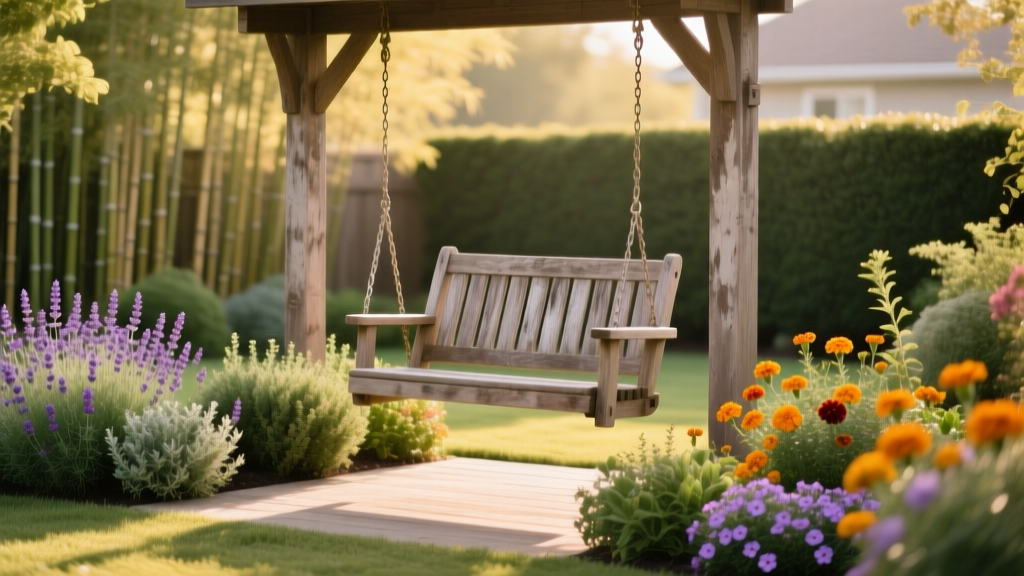
Porch Swing Garden Companion Plants
The swing squeaks once, the chain settles, and you finally get that five-minute pause you’ve been chasing all day. Then you notice what’s missing: the view. Maybe the porch feels exposed to the street, or the afternoon sun hits like a spotlight, or the bed below the swing is a patchy mix of “whatever survived.” A porch swing is a focal point—so the planting around it can’t be an afterthought. The good news is you don’t need a full landscape overhaul. You need companion plants chosen like good neighbors: they make the swing more comfortable, more private, more fragrant, and easier to maintain.
This design walk-through treats your porch swing like an outdoor room. We’ll shape sightlines, soften edges, and build plant layers that look intentional from the sidewalk and feel calming from the seat. Along the way, you’ll get specific varieties, spacing, sunlight targets, and a few real-world layouts that fit common porch situations—rental-friendly included.
Start with the swing: clearances, comfort, and what the plants must do
Before you pick plants, set the “no-fuss” boundaries. Swings move, feet kick out, and you’ll want a clear line for getting in and out with a coffee mug.
Keep a swing-safe planting buffer
Use these baseline dimensions (adjust if your swing is oversized):
- Minimum forward/back swing clearance: 24 inches of open space in front of the swing arc.
- Side clearance for elbows and chains: 18 inches on each side.
- Planting edge setback: Keep the nearest plant mass at least 12 inches from the outermost arc of the swing to avoid constant brushing and breakage.
- Bed depth that reads well from the swing: 30–48 inches deep (a 36-inch bed is a sweet spot for most porches).
If you’re working with containers, the same rules apply: place the largest pots outside the swing arc, not directly under it. Your goal is to make the swing feel like it floats in comfort, not like it’s stuck in a thicket.
Sunlight reality check (and why it matters)
Most porch fronts land in one of three light categories:
- Bright shade: 2–4 hours of direct sun (or dappled light all day). Choose foliage and bloomers that don’t sulk without full sun.
- Part sun: 4–6 hours. This is the easiest range for mixed plantings.
- Full sun: 6–8+ hours. Plan for heat, reflected glare from siding, and faster watering needs.
For a quick, reliable reference on light levels, many Extension resources define “full sun” as at least 6 hours of direct sun. The University of Minnesota Extension uses similar thresholds for site assessment and plant selection (University of Minnesota Extension, 2020).
Layout strategies: designing the porch swing “room” in layers
Think like a landscape designer: you’re not placing individual plants—you’re composing layers that control view, airflow, and mood.
Layer 1: the “soft wall” (privacy + backdrop)
This layer sits farthest from the swing, often at the bed’s outer edge or against railings. Use it to screen the street, hide utilities, or create a green backdrop for flowers.
- Height target: 30–60 inches (tall enough for privacy, not so tall it blocks windows).
- Spacing: Shrubs typically 24–36 inches apart (variety dependent); clumping grasses 18–30 inches apart.
Layer 2: the “armrest” (mid-layer texture and bloom)
This is the band you’ll look at most while sitting: plants from 12–30 inches tall with soft forms, repeat bloom, and minimal flop.
- Spacing: Many perennials look best at 12–18 inches on center for a full, intentional look in year two.
- Design tip: Repeat 2–3 species in drifts instead of collecting one of everything. Repetition reads calm.
Layer 3: the “spill and edge” (welcome at your feet)
Use low plants to soften hard lines and prevent soil splash on rainy days.
- Height target: 2–10 inches.
- Spacing: 8–12 inches on center for groundcovers; trailing container plants can be closer.
Fragrance and pollinators: place scent where you’ll actually smell it
Scent works best within arm’s reach of the swing—roughly a 3-foot radius. Put fragrant plants in containers near the swing chains or at the bed’s inner edge. And if you want butterflies and bees, continuous bloom matters more than a single big flush.
“The most successful gardens are composed the way rooms are—by managing enclosure, circulation, and views.” — University of Washington professor of landscape architecture, Richard Weller (as quoted in public lectures and design writing on landscape as spatial room-making, 2018)
That idea translates perfectly to a porch: the swing is your chair; the planting is the wall, rug, and lighting.
Companion plant palettes that behave (with specific varieties)
Below are reliable combinations, chosen for non-invasive habits, manageable litter, and good performance near foot traffic. I’m including specific varieties because porch gardens benefit from predictable size and bloom timing.
For full sun (6–8+ hours): bright, resilient, not too thirsty
Back layer (30–60 inches):
- Hydrangea paniculata ‘Bobo’ (compact panicle hydrangea): stays around 30–36 inches, big white blooms that age pink; great backdrop without overwhelming a porch. Space 3 feet apart.
- Calamagrostis acutiflora ‘Karl Foerster’ (feather reed grass): upright, tidy, winter interest; place 30 inches apart for a thin screen.
Mid layer (12–30 inches):
- Nepeta ‘Walker’s Low’ (catmint): long bloom, soft haze, drought tolerant once established; space 18 inches apart and shear once mid-season for rebloom.
- Echinacea purpurea ‘PowWow Wild Berry’: strong stems, pollinator magnet; space 12–18 inches apart.
- Salvia nemorosa ‘Caradonna’: vertical purple spikes that echo swing chains; space 12 inches apart.
Edge/spill (2–10 inches):
- Thymus serpyllum (creeping thyme): fragrant, durable edging in sun; space 8–12 inches.
- Sedum ‘Angelina’: chartreuse color that pops against dark porch steps; space 12 inches.
For part sun (4–6 hours): the “most-porches” sweet spot
Back layer:
- Itea virginica ‘Little Henry’ (Virginia sweetspire): fragrance in late spring, fall color; tolerates moisture swings better than many shrubs. Space 3 feet apart.
- Aronia melanocarpa ‘Low Scape Mound’: tough, compact, glossy foliage; good for low hedging. Space 3 feet apart.
Mid layer:
- Heuchera ‘Caramel’: warm foliage that glows in filtered light; space 12–16 inches.
- Brunnera macrophylla ‘Jack Frost’: silver leaves brighten shaded porches; space 18 inches.
- Geranium ‘Rozanne’: long blooming, mounding, friendly at the edge; space 18 inches.
Edge/spill:
- Carex oshimensis ‘Evergold’: neat, arching grass for soft movement; space 12–15 inches.
- Lysimachia nummularia ‘Aurea’ (creeping Jenny): best in containers to prevent spread; trails beautifully from pots near the swing.
For bright shade (2–4 hours): cool, calming, and low-glare
Back layer:
- Hydrangea arborescens ‘Incrediball’: big blooms in partial shade; place 4 feet apart (it gets wider than people expect).
- Fatsia japonica (in mild climates): bold leaves for a tropical feel; excellent porch plant where winters allow.
Mid layer:
- Hosta ‘June’: blue-green with chartreuse center; strong in bright shade. Space 24 inches.
- Athyrium niponicum ‘Pictum’ (Japanese painted fern): silver, burgundy accents; space 18 inches.
- Helleborus x hybridus (Lenten rose): early-season flowers, evergreen-ish foliage; space 18 inches.
Edge/spill:
- Ajuga reptans ‘Chocolate Chip’: low, dark, tidy groundcover; space 8–10 inches.
- Heuchera ‘Obsidian’: near-black foliage reads crisp against porch floors; space 12–16 inches.
Note on pollinators: to support bees and butterflies, prioritize a sequence of blooms. Xerces Society plant lists emphasize season-long floral resources (Xerces Society, 2023).
Comparison table: choosing companions by function
| Plant (variety) | Best light | Typical size (H x W) | Spacing | Why it’s great by a porch swing |
|---|---|---|---|---|
| Nepeta ‘Walker’s Low’ | Full sun–part sun | 18–24 in x 24–36 in | 18 in | Soft edge, long bloom, aromatic, doesn’t mind heat |
| Brunnera ‘Jack Frost’ | Part sun–bright shade | 12–18 in x 18–24 in | 18 in | Brightens shady porches; tidy mound; spring flowers |
| Hydrangea paniculata ‘Bobo’ | Sun–part sun | 30–36 in x 30–36 in | 36 in | Compact “backdrop” shrub; big blooms without blocking windows |
| Carex ‘Evergold’ | Part sun–shade | 12–18 in x 12–18 in | 12–15 in | Movement and texture; stays neat near foot traffic |
| Creeping thyme | Full sun | 2–4 in x 12–18 in | 8–12 in | Fragrant edging; handles heat; softens hard borders |
Step-by-step setup: a simple layout that looks designed
This process works for an in-ground bed or a “container border” lined along the porch.
- Measure the swing zone. Mark the swing arc on the ground using a stick and string; keep plants at least 12 inches beyond that arc.
- Pick a bed footprint. For most porches, aim for a bed that’s 36 inches deep and runs at least the length of the swing plus 24 inches on each side to “frame” it.
- Choose 1 backdrop plant and repeat it. Use 2–3 matching shrubs or grasses for unity (odd numbers look natural).
- Add 2 mid-layer perennials in drifts. Group in clusters of 3–5 each for visual calm.
- Finish with an edge plant. Run a continuous ribbon of thyme, carex, or ajuga to make the bed look intentional even off-season.
- Mulch to reduce watering and mud splash. Apply 2 inches of shredded bark, keeping it a couple inches away from plant crowns.
- Install a simple watering plan. If you can, add a soaker hose loop; if not, plan on deep watering 1x/week the first season (more in heat).
Budgets, costs, and DIY alternatives
You can spend as much as you want near a porch, but you don’t have to. Here are realistic numbers that help you plan.
- 3-gallon flowering shrub (hydrangea/itea): typically $35–$60 each.
- 1-gallon perennial (nepeta/salvia/heuchera): often $10–$18 each.
- Mulch: about $4–$7 per 2-cubic-foot bag; a 36-inch-deep by 12-foot-long bed at 2 inches thick needs roughly 12–14 bags (depending on soil grade and settling).
- Soaker hose: $15–$30.
- Two 18-inch resin pots (rental-friendly): $40–$120 total, depending on style.
DIY alternative: If shrubs are out of budget, build the “soft wall” with tall seasonal structure: two large pots with Pennisetum setaceum ‘Rubrum’ (purple fountain grass) plus trailing sweet potato vine. It’s not winter-hardy everywhere, but it’s a strong, affordable seasonal screen you can refresh annually.
Real-world scenarios: three porch swing spaces, three workable plans
Scenario 1: Small townhouse porch, high visibility from the sidewalk
The problem: You want privacy without blocking the front window or feeling boxed in. Bed space is narrow—about 30 inches deep.
The layout: Use a thin, upright backdrop plus a restrained mid-layer. Keep the swing arc clear, and prioritize plants that stay vertical.
- Back layer: 3 clumps of ‘Karl Foerster’ grass, spaced 30 inches apart.
- Mid layer: 5 Salvia ‘Caradonna’ at 12 inches spacing, plus 3 Heuchera ‘Caramel’ to warm the base.
- Edge: Creeping thyme, 10–12 plants at 10 inches on center.
Why it works: From the street, the grasses read like a deliberate screen. From the swing, the salvia gives vertical color without flopping into your legs.
Scenario 2: Rental porch with no digging allowed (all containers)
The problem: You can’t alter the ground, but you want a lush frame around the swing and a bit of fragrance.
The layout: Create a “container border” that mimics the three layers: tall pots at the outer corners, medium pots midline, and a continuous row of smaller planters along the edge.
- Two corner anchors: 20-inch pots with Hydrangea paniculata ‘Bobo’ (or dwarf boxwood if you prefer evergreen).
- Mid layer: 3 pots with Geranium ‘Rozanne’ and Carex ‘Evergold’ (one of each per pot for texture).