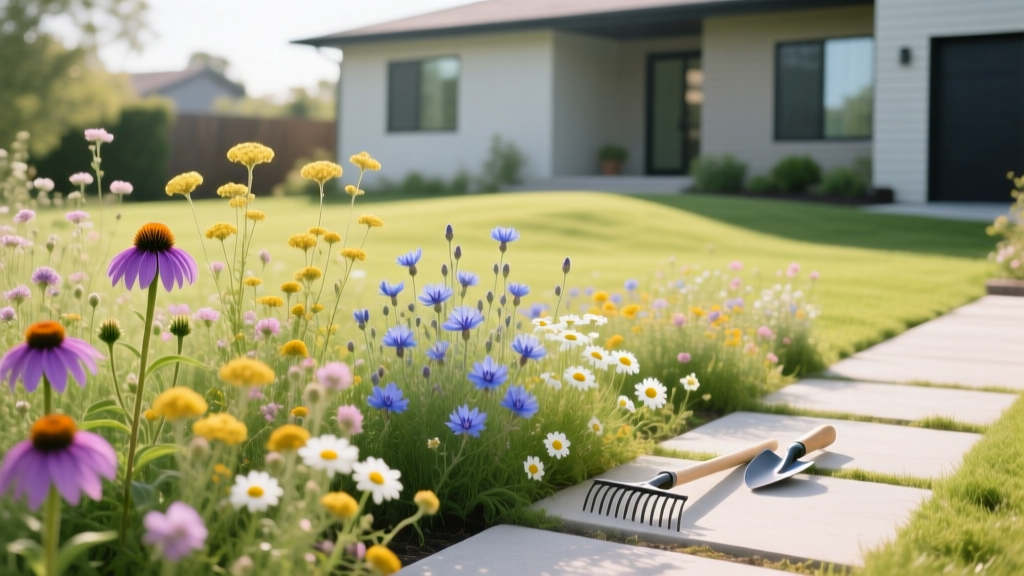
Front Yard Flower Meadow Conversion
The week after you mow, the front yard looks neat for about 48 hours—then the heat hits, the grass sulks, and you’re back out there again, pulling a cord or pushing a mower like it’s a part-time job. Meanwhile, the prettiest yards on the block seem to do the opposite: they relax. They move in the breeze. They hum. They look intentional, not “overgrown.” A front-yard flower meadow conversion is how you get that feeling—without turning your whole yard into a science project or a complaint magnet.
Let’s walk through a meadow-style layout the way a landscape designer would: start with a plan that reads tidy from the sidewalk, use a plant palette that can handle real conditions, and build in a maintenance rhythm that fits your life (and your lease, if you rent).
Design principles that make a meadow look intentional (not messy)
Start with “mown edges” and a clear frame
A meadow is wild in the middle, but it needs a crisp outline. This is the simplest trick to make neighbors (and HOAs) see “designed” instead of “neglected.” Plan a clean border that’s 18–24 inches wide along sidewalks, driveways, and the front edge. Keep it mulched, low, or regularly trimmed.
Good framing options:
- A mown strip: a 20-inch band you mow weekly during peak growth.
- Gravel ribbon: 12–18 inches wide; excellent for dry sites and reduces string trimming.
- Low hedge or clumping grass: something under 24 inches to define the edge without blocking sightlines.
Build a layout in layers: low, medium, tall
Front yards are viewed from two angles: from the street (eye level) and from your front windows (slightly above). Layering keeps the meadow readable. Use a simple height plan:
- Front band (0–18 inches tall): short bloomers and tidy clumps
- Middle band (18–36 inches): the main flower show
- Back band (36–60 inches): structural grasses and tall perennials
If your yard is visible at a corner, keep anything above 30 inches away from driveway sight triangles for safety and code compliance.
Think in “drifts,” not one-of-each
A meadow reads best when plants repeat. Instead of scattering single plants, group them in drifts of 3, 5, or 7 of the same species. For a typical front yard bed of 200 square feet, aim for 6–10 repeating species, not 25.
Match the meadow to your sun: count the hours
Meadow flowers are not magic—they’re sun-powered. Before you buy anything, do one clear-day check: note sun exposure at 9 a.m., noon, 3 p.m., and 6 p.m.
- Full sun meadow: 6+ hours direct sun
- Part sun meadow: 4–6 hours direct sun
- Bright shade: under 4 hours direct sun (choose a woodland-style planting instead)
Layout strategies for real front yards
A practical “starter meadow” footprint (with dimensions)
If you want a conversion that’s noticeable but not overwhelming, start with a defined island bed or a boulevard strip. A common beginner-friendly footprint is 10 ft × 12 ft (that’s 120 sq ft), set back 2 feet from the sidewalk inside a mown edge. Big enough for seasonal change, small enough to manage.
Suggested spacing rules (simple and reliable):
- Small perennials (12–18 inches wide): plant on 12-inch centers
- Medium perennials (18–24 inches wide): plant on 18-inch centers
- Large perennials/grasses (24–36 inches wide): plant on 24–30-inch centers
Use paths and “view windows” to keep it friendly
A meadow feels welcoming when you can step into it. Add one narrow access path—18–24 inches wide—using mulch, stepping stones, or mown grass. Even if it’s only 8 feet long, it signals care and makes deadheading and weeding easier.
Replace lawn in phases (especially for renters)
You don’t have to tear out the whole front yard. Convert in two phases:
- Phase 1: a framed meadow bed (120–200 sq ft) near the entry or along the walkway
- Phase 2: expand edges outward, connect beds, or replace remaining turf with low mow fescue or additional meadow blocks
Step-by-step setup (designer sequence that avoids rework)
- Mark the shape. Use a hose or marking paint; include a 20-inch tidy border zone.
- Decide on conversion method. For most homeowners, sheet-mulching is clean and low-labor; for fast results, sod cutting is immediate but more work.
- Remove or smother existing turf. Sheet mulch with cardboard + 3–4 inches of compost/wood chip blend; wait 6–10 weeks before planting plugs, or cut holes and plant immediately if watering is consistent.
- Lay out plants in pots first. Place drifts before digging; stand at the sidewalk and adjust for height and color balance.
- Plant and water in. Water each plant deeply; target 1 inch of water per week for the first 6–8 weeks if rain doesn’t deliver it.
- Mulch strategically. Use 1–2 inches of mulch around new plants to reduce weeds—avoid burying crowns.
- Add a sign or small cue of care. Even a simple “Pollinator Habitat” marker helps set expectations and reduces complaints.
Plant selection: specific varieties that behave well in front yards
The best front-yard meadow plants do three jobs: they stand upright without flopping, they repeat bloom or hold attractive seedheads, and they compete with weeds once established. Below are reliable performers with specific cultivars, plus why they work.
Full sun (6+ hours): dependable “meadow backbone”
- Echinacea purpurea ‘Magnus’ (coneflower): upright, long bloom window, strong stems; great mid-layer anchor.
- Rudbeckia fulgida var. sullivantii ‘Goldsturm’: high-impact late summer color; tidy clump; reads well from the street.
- Salvia nemorosa ‘Caradonna’: early summer spikes, repeat bloom if cut back; adds vertical punctuation without bulk.
- Achillea millefolium ‘Moonshine’ (yarrow): drought tolerant, soft foliage, long-lasting flowers; excellent for hot curb edges.
- Schizachyrium scoparium ‘Standing Ovation’ (little bluestem): strong fall color and winter structure; holds up without staking.
Part sun (4–6 hours): flexible bloom and foliage
- Amsonia hubrichtii (threadleaf bluestar): airy texture, spring flowers, outstanding fall color; a “designer plant” that still acts tough.
- Geranium ‘Rozanne’: long bloom season, fills gaps, edges well; great at the front band where you want continuity.
- Heuchera ‘Caramel’ (coral bells): dependable foliage color, tidy clumps; helps a meadow look intentional even when flowers pause.
- Deschampsia cespitosa ‘Goldtau’ (tufted hair grass): refined seedheads, early structure; works near paths and entry walks.
Seasonal “spark” plants (use sparingly for punch)
- Allium ‘Millenium’: mid-to-late summer purple globes, very tidy; excellent in drifts near the border.
- Monarda ‘Jacob Cline’ (bee balm): hummingbird magnet; use with airflow and spacing to reduce mildew.
- Solidago rugosa ‘Fireworks’ (goldenrod): arching late-season bloom; choose named cultivars to avoid overly aggressive spread.
Spacing note: For ‘Magnus’ coneflower and ‘Goldsturm’ black-eyed Susan, plan 18 inches between plants. For little bluestem ‘Standing Ovation,’ give 24 inches.
Seed vs plugs vs potted perennials: what you gain, what you risk
| Approach | Best for | Typical cost (USD) | Time to “looks finished” | Weed pressure risk |
|---|---|---|---|---|
| Seed mix | Large areas (300+ sq ft), patience, budget builds | $0.10–$0.50 per sq ft (seed only) | 12–24 months | High in year 1 |
| Plugs (small starter plants) | Reliable establishment with moderate cost | $2–$6 per plug | 6–12 months | Medium |
| 1-gallon perennials | Fast curb appeal, smaller beds | $10–$18 per plant | 3–8 months | Low to medium |
If you want the “it’s clearly a garden” look in the first season, use a hybrid: a backbone of 1-gallon perennials (for structure) plus plugs to fill in.
Budget planning (with real numbers you can use)
For a 120 sq ft starter meadow bed, here are three budget tiers. Prices vary by region, but these ranges are realistic for most U.S. garden centers.
- Lean DIY ($180–$350): sheet mulch using free cardboard, bulk wood chips, and mostly plugs (30–45 plugs at $3–$5 each).
- Balanced ($450–$750): mix of 12–18 one-gallon perennials plus 20–30 plugs; add a 10–12 ft stepping-stone path.
- Instant impact ($900–$1,500): mostly 1–2 gallon plants, decorative edging, and a professional-grade weed barrier strategy (not plastic fabric; think layered mulch and dense planting).
Cost control tip: Buy grasses small. A 2.5-inch little bluestem plug often catches up to a gallon pot by the second year if watered well the first 8 weeks.
Real-world scenarios (three front yards, three smart solutions)
Scenario 1: Hot, reflective curb strip (hellstrip) — 4 ft × 20 ft
This is the sun-baked strip between sidewalk and street. Soil is compacted, heat reflects off pavement, and snow salt can be an issue. For a 4 ft × 20 ft area (80 sq ft), use drought-tolerant, upright plants and keep the height under 30 inches near intersections.
Winning layout:
- Front edge: Allium ‘Millenium’ on 12–15 inch centers for tidy repetition
- Middle: Achillea ‘Moonshine’ + Salvia ‘Caradonna’ in alternating drifts
- Back edge (street side): little bluestem ‘Standing Ovation’ every 24 inches for structure
Maintenance reality: 15–25 minutes/week in the first summer (mostly watering and quick weeding), dropping to 10 minutes/week once plants knit together.
Scenario 2: Small urban front yard with a straight walkway — 12 ft × 15 ft
In compact yards, a meadow can swallow the entry if you don’t leave breathing room. Keep a crisp path-to-door experience: a 30–36 inch clear walkway edge and lower plants near the front steps.
Design move: make two mirrored meadow blocks on either side of the walk, each about 5 ft × 10 ft. Repeat the same 5–7 species in both blocks so the whole front reads calm, not chaotic.
Plant combo that looks good from indoors:
- Geranium ‘Rozanne’ at the front (long bloom, tidy edge)
- Echinacea ‘Magnus’ mid-bed (summer anchor)
- Deschampsia ‘Goldtau’ near the walk (soft movement without flopping)
- Amsonia hubrichtii at corners (year-round presence)
Budget trick: ask neighbors to split a flat of plugs. Buying 50 plugs together often drops the per-plant cost.
Scenario 3: Rental-friendly conversion using containers and a reversible edge
If you rent, you can still build a front-yard “meadow look” without digging up turf. The goal is visual massing and pollinator value—while keeping everything movable.
Plan:
- Place 5–7 large pots (at least 18-inch diameter) in a drift-like cluster near the entry.
- Use one narrow, temporary border: a 10 ft run of no-dig metal edging or even a clean mulch ribbon you can rake out later.
- Fill pots with long-flowering plants (salvia, coneflower, allium) and one grass per 2–3 pots for structure.
This approach can run $250–$600 depending on containers, but nearly all of it moves with you.
What science says about mowing less and planting more
Front-yard meadows aren’t only about aesthetics. Reduced mowing and increased flowering resources can support pollinators and reduce emissions from lawn equipment.
“Residential lawns collectively represent one of the largest irrigated ‘crops’ in the United States; reducing inputs and increasing plant diversity can yield meaningful environmental benefits.” — U.S. Environmental Protection Agency (EPA), 2013
For pollinator value, plant diversity matters. Research synthesizing pollinator responses consistently finds that flower-rich habitat increases pollinator abundance and diversity when compared to simplified vegetation. A widely cited review in Biological Conservation links wild pollinator presence to available floral resources and habitat quality (Potts et al., 2010).
Citations:
- Potts, S.G. et al. 2010. “Global pollinator declines: trends, impacts and drivers.” Biological Conservation.
- U.S. Environmental Protection Agency (EPA). 2013. Lawn and garden equipment emissions and best practices (EPA guidance and summaries).
Maintenance expectations (what you actually do, season by season)
A meadow-style front yard isn’t “no maintenance.” It’s different maintenance: fewer weekly mowings, more seasonal timing.
Weekly time estimate
- Year 1: plan for 30–60 minutes/week during late spring through summer (weeding, watering, edging).
- Year 2: typically 20–30 minutes/week.
- Year 3+: often 10–20 minutes/week, mostly edge trimming and occasional thinning.
Seasonal task list (simple and repeatable)
- Early spring: cut back stems to 6–8 inches; leave some hollow stems if you’re prioritizing beneficial insects, then tidy once temperatures stabilize.
- Late spring: weed blitz (this is your most important weeding window); top-dress with 1 inch compost in thin patches.
- Summer: deadhead select plants (salvia, yarrow) for rebloom; water deeply during drought—aim for 1 inch/week for new plantings.
- Fall: decide what to leave standing for winter structure; cut only what flops into paths.
- Winter: do nothing but enjoy seedheads and grasses; take notes on gaps for spring.
DIY alternatives that still look designed
If you want meadow vibes but need it cleaner or cheaper, use these designer shortcuts:
- “60/40 rule” planting: 60% grasses and tidy clumping perennials, 40% showy bloomers. It reads calmer from the street.
- Use a limited palette: pick 7 plants max and repeat them. Repetition is the fastest way to look professional.
- Swap seed for plugs: plugs cost more than seed, but they cut weeding time dramatically in year 1.
- Edge first, expand later: invest in a crisp border now; add plants as budget allows.
A sample “front-yard friendly” plant recipe (easy to shop)
For a 120 sq ft bed in full sun, this is a balanced, neighbor-friendly mix with long season interest. Quantities assume mature spacing and a layered layout:
- 6 Echinacea ‘Magnus’ (18-inch centers)
- 7 Rudbeckia ‘Goldsturm’ (18-inch centers)
- 7 Salvia ‘Caradonna’ (15–18-inch centers)
- 5 Achillea ‘Moonshine’ (18-inch centers)
- 5 Allium ‘Millenium’ (12–15-inch centers)
- 5 Schizachyrium ‘Standing Ovation’ (24-inch centers)
If your site is part sun, swap 2–3 of the sun-lovers for Amsonia hubrichtii and Deschampsia ‘Goldtau’ for structure that doesn’t collapse in lower light.
Common front-yard pitfalls (and how designers avoid them)
Pitfall: Planting too sparsely and mulching too much.
Fix: Meadows succeed with density. Use mulch only as a temporary tool; aim for plant coverage that shades soil by mid-season of year 2.
Pitfall: Choosing aggressive spreaders in a small front yard.
Fix: Favor clump-forming cultivars (‘Goldsturm,’ ‘Caradonna,’ ‘Standing Ovation’) over anything known to run.
Pitfall: No winter plan, resulting in a “dead” look.
Fix: Keep grasses and sturdy seedheads standing through winter; cut back in early spring to reset.
When the frame is crisp, the plant groups repeat, and the heights are planned, a front-yard meadow doesn’t read as a gamble. It reads as a choice—one that trades weekly mowing for a front yard that changes by the week, hosts life, and still looks like someone is paying attention. Start with a 10 ft × 12 ft block, keep the edges sharp, and by the second season you’ll have the kind of curb appeal that makes people slow down—not because it’s loud, but because it feels alive.