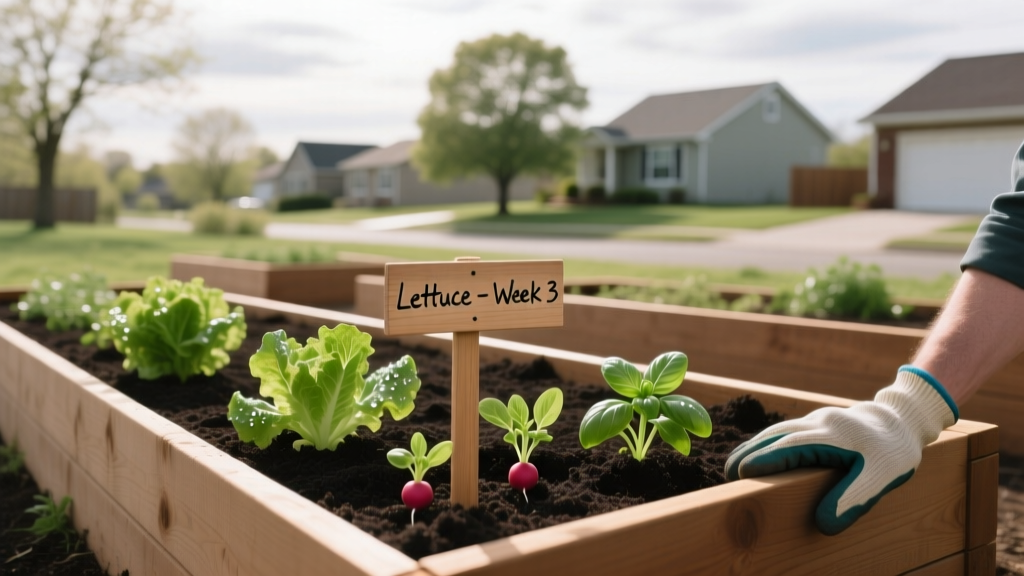
Community Garden Plot: Getting Started
You arrive at the community garden with a new key on your ring and a pocket full of seed packets. The plot is yours—at least on paper. In person it’s a rectangle of compacted soil with last year’s tomato cages leaning like tired scaffolding. Your neighbors are already harvesting kale. You’re trying to picture a salad, but all you can see is the sun swinging across the fence line and the spigot three plots away. This is the moment most gardeners either overplant in excitement or freeze in uncertainty.
Let’s treat your plot like a small landscape design project: read the site, set priorities, draw a simple plan, then build a system that makes weekly care feel manageable. You’ll leave with a layout that fits your actual sunlight, time, and budget—and a plant list that performs in tight quarters.
Start with a Site Read (10 Minutes That Save a Season)
Before you buy lumber or start sowing, do a quick “designer walk-through.” Bring a tape measure, a phone for photos, and a notepad. You’re looking for constraints you can’t compost away: sun, water access, wind, and the rules of the garden.
Measure the Plot and the Paths
Many community garden plots are either 4 ft × 8 ft (32 sq ft) or 10 ft × 10 ft (100 sq ft). Measure yours anyway—edges are rarely square. Also measure the path width outside your plot. If the path is only 18–24 inches wide, you’ll want plants that don’t flop out and block foot traffic.
Map the Sun (Not Just “Full Sun” or “Shade”)
Count how many hours of direct sun your plot gets in summer. Most fruiting crops need 6–8+ hours of direct sun to perform well. Leafy greens can produce with 4–6 hours, especially in hot climates where afternoon shade reduces bolting.
The easiest method: check the plot at three times—around 9 a.m., 1 p.m., and 5 p.m.—and note where shadows fall. If the garden has trees or a tall fence on the west side, your “full sun” plot may actually be a “morning sun” plot.
Confirm Water Logistics
Ask: can you bring a hose to your plot, or are you hauling watering cans? The distance to the spigot changes everything. If the spigot is 150 feet away and hoses are prohibited, you’ll want fewer thirsty crops and more mulching. If hoses are allowed, a soaker hose becomes your best labor-saving tool.
Check the Rules (They’re Design Constraints)
Common restrictions include maximum structure height (often 4–6 feet), bans on permanent edging, or required setbacks from paths. These rules guide trellis choices, compost bin options, and whether you can build raised beds.
Design Principles That Make Small Plots Feel Big
Good community-plot design is less about style and more about flow: you want easy access, continuous harvest, and plants placed so they don’t shade each other at the wrong time.
Keep Everything Within Reach
If you can’t reach it, you won’t weed it. A practical rule: beds should be no wider than 4 feet if you can access both sides, or 2 feet if accessible from one side only. Even in a flat plot, you can “pretend” you have beds by dedicating internal paths.
Plant Heights Go North (Most of the Time)
Place tall crops and trellises on the north side of the plot so they don’t shade shorter crops. This is a simple layout move that increases overall yield, especially in smaller plots. (If you’re in the Southern Hemisphere, reverse this.)
Design for Succession, Not a Single Moment
A plot planted all at once peaks all at once—then fizzles. Instead, design in “windows”:
- Cool-season window (early spring/fall): peas, lettuce, spinach, radishes
- Warm-season window (late spring/summer): tomatoes, peppers, basil, beans, cucumbers
- Late-season finish (late summer/fall): kale, carrots, cilantro, garlic (in mild climates)
For evidence that timing matters: University of Minnesota Extension notes that cool-season crops like lettuce and peas prefer cool weather, while warm-season crops like tomatoes and peppers require warm soil and air temperatures (University of Minnesota Extension, 2020).
Small Plots Need Vertical Structure
Vertical growing is the community-garden version of adding a second story. A simple trellis can turn 8 sq ft of ground into a full bean wall. Trellises also improve air flow, which can reduce disease pressure on cucurbits and tomatoes.
“The primary objective in a small garden is to use space efficiently without sacrificing access for maintenance—design is what prevents a productive bed from becoming an unmanageable thicket.” — Linda A. Chalker-Scott, PhD, horticulturist and author (principles echoed in her work on sustainable landscape practices; Washington State University Extension, 2019)
Three Layout Strategies You Can Copy This Weekend
Choose the layout that fits your plot size, rules, and how often you can visit. I’ll lay these out as if I’m sketching beside you at the garden gate.
Strategy 1: The Classic 4×8 with Two Reachable Zones
Best for: renters and first-timers, limited tools, quick setup.
Divide a 4 ft × 8 ft plot into two 2 ft × 8 ft planting zones with a narrow stepping path made of mulch or pavers you can lift later. Put the trellis at the north end.
Suggested map:
- North 2 feet: trellis for cucumbers or pole beans
- Middle: 2 tomato plants on stakes/cages, underplanted with basil
- South edge: low crops (lettuce, scallions, carrots)
Spacing anchors: tomatoes at 24 inches apart; basil at 10–12 inches; carrots thinned to 2–3 inches. These are standard home-garden spacings used broadly in Extension recommendations (e.g., Oregon State University Extension, 2021).
Strategy 2: The 10×10 “Four Rooms” Plan
Best for: gardeners who visit 2–3 times/week and want rotation.
Create a central cross path 18 inches wide, making four beds roughly 4 ft × 4 ft each (allowing for borders). Each “room” gets a crop family so rotation is easy next year: legumes, fruiting crops, roots/alliums, leafy greens.
This layout is friendly for shared plots too—each person can “own” a bed while sharing paths, tools, and irrigation.
Strategy 3: The “Water-Saver Strip” for Far Spigots
Best for: gardeners hauling water, hot climates, or strict hose rules.
Instead of planting everything, concentrate into one intensive bed and mulch the rest as a sitting/working lane. A single planted strip 3 ft × 10 ft with 3 inches of straw mulch will outproduce a larger, poorly watered area. Put drought-tolerant herbs (thyme, oregano) on the edges and reserve higher-water crops (tomatoes, cucumbers) for the center where you can water deeply.
Comparison: Which Layout Fits Your Life?
| Layout | Ideal Plot Size | Best For | Weekly Time | Biggest Advantage | Main Watch-Out |
|---|---|---|---|---|---|
| Classic 4×8 Two-Zone | 4×8 ft | First-time community gardeners | 45–75 min | Simple, high yield per square foot | Can get crowded if you oversow greens |
| 10×10 Four Rooms | 10×10 ft | Gardeners who want rotation + variety | 60–120 min | Easy crop-family organization | Paths reduce planting area slightly |
| Water-Saver Strip | Any (esp. 10×10) | Hauling water, hot summers | 30–60 min | Less stress, better watering efficiency | Fewer total crops unless you go vertical |
Step-by-Step Setup: From Bare Plot to Planting Day
Here’s the sequence I use when I’m helping someone turn a neglected plot into a tidy, productive space. You can do this in a single Saturday, or split it across two visits.
- Clear and triage (30–60 minutes): remove trash, old twine, and diseased plant debris. Leave healthy organic matter for compost if your garden allows it.
- Loosen soil (30 minutes for 32 sq ft; 60–90 for 100 sq ft): use a digging fork to loosen to 8–10 inches. Avoid working soil that’s soggy; it compacts easily.
- Add compost (10 minutes): spread 1–2 inches of finished compost over the growing area and rake it in. If you’re using bags, a 1.5 cu ft bag covers roughly 12 sq ft at 1.5 inches (approximate; check bag coverage).
- Install your “bones” (20–40 minutes): put in trellis stakes, tomato supports, and any edging allowed. It’s easier now than after planting.
- Set irrigation (15–30 minutes): if hoses are allowed, run a 25 ft soaker hose in loops. If not, stage two 2-gallon watering cans at the plot (if permitted) so you’re not hunting tools.
- Mulch paths and bare soil (15 minutes): aim for 2–3 inches of straw or shredded leaves around established plants (keep mulch an inch away from stems).
- Plant in layers (30–60 minutes): start with large transplants (tomatoes/peppers), then sow quick crops (radish, salad mix) in the gaps.
Plant Selection: Varieties That Earn Their Space
In a community garden, you’re balancing performance with predictability. You want varieties that crop heavily, tolerate a missed watering, and don’t require constant intervention.
Fruiting Crops (Sun Lovers That Justify the Real Estate)
Tomato (1–2 plants for 4×8; 2–4 for 10×10)
- ‘Sungold’ cherry tomato: prolific, early, and forgiving—excellent if you can only fit one tomato.
- ‘Celebrity’ (determinate/semi-determinate): dependable slicer type, generally manageable on a sturdy cage.
- Spacing: 24 inches between plants; stake or cage at planting to avoid root damage later.
Sweet pepper
- ‘Ace’ bell pepper: sets fruit better in cooler summers than some bells.
- ‘Lunchbox’ mini peppers: compact plants with sweet snacking fruit; great for tight plots.
- Spacing: 18 inches.
Cucumber (go vertical)
- ‘Diva’: thin-skinned, productive, and parthenocarpic (sets fruit without pollination), helpful if pollinator traffic is inconsistent.
- ‘Marketmore 76’: classic slicer with reliable yields.
- Spacing: 12 inches along a trellis.
Leafy Greens (Fast Payoff, Perfect for Succession)
- ‘Black Seeded Simpson’ lettuce: quick, dependable, cut-and-come-again.
- ‘Lacinato’ kale: handles heat better than many kales and keeps producing into fall.
- Spacing: lettuce thinned to 8–10 inches; kale at 12–18 inches.
For food safety in shared spaces, remember that composted manure must be properly treated. The USDA National Organic Program specifies waiting periods between raw manure application and harvest depending on crop contact with soil (USDA, 2023). Even if you’re not gardening organically, it’s a smart framework for community plots where inputs can be uncertain.
Roots and Alliums (Low Drama, High Value)
- ‘Napoli’ carrot: sweet, reliable, good for spring and fall sowings.
- ‘French Breakfast’ radish: ready in about a month; ideal as a “marker crop” for slower carrots.
- Scallions (‘Evergreen Hardy White’): long harvest window, small footprint.
- Spacing: carrots thinned to 2–3 inches; radishes to 2 inches; scallions to 2–3 inches.
Herbs (The Secret to a Plot That Feels Luxurious)
- Genovese basil: plant near tomatoes; harvest often to keep it bushy.
- Chives: perennial in many regions; check if perennials are allowed.
- Thyme or oregano: edges and corners; drought-tolerant once established.
Three Real-World Scenarios (And How the Design Changes)
Community gardens aren’t controlled environments. Here are three situations I see constantly—and the layout moves that solve them.
Scenario 1: The 4×8 Plot with Only Morning Sun
You get 4–5 hours of sun because a building shades the plot after lunch. The mistake here is insisting on tomatoes anyway and getting a plant that limps through summer.
Design response: shift toward greens, roots, and herbs. Use a small trellis for peas in spring, then replace with climbing beans if summer warmth is adequate. Try one cherry tomato only if you can put it on the sunniest corner and accept a lighter harvest.
Winning plant list: ‘Lacinato’ kale, ‘Black Seeded Simpson’ lettuce, ‘Napoli’ carrots, scallions, parsley, and spring peas on a 4-foot trellis.
Scenario 2: The 10×10 Plot You Can Visit Only Once a Week
Limited visits make watering and harvesting the pinch points. Cherry tomatoes split, zucchini turns into a bat, and weeds throw a party.
Design response: reduce high-maintenance crops and invest in mulch + irrigation. Use a soaker hose on a timer only if allowed; otherwise, focus on drought-tolerant crops and thick mulch.
Practical layout: the “Water-Saver Strip” inside your 10×10: one intensive 3×10 bed mulched, one trellis, and the rest as access and staging. Grow: peppers, thyme, oregano, chard, and bush beans instead of zucchini.
Scenario 3: Shared Plot with Two Gardeners and Different Tastes
One person wants salsa ingredients; the other wants salad greens and herbs. Shared plots fail when the plan lives only in someone’s head.
Design response: the “Four Rooms” plan. Assign two beds per person or split by season: one bed for spring greens, one for summer fruiting crops, one for roots, one for herbs/flowers.
Add a tiny shared “tool corner” at one edge: a bucket for pruners, twine, plant labels, and a notebook for watering notes. That notebook saves friendships.