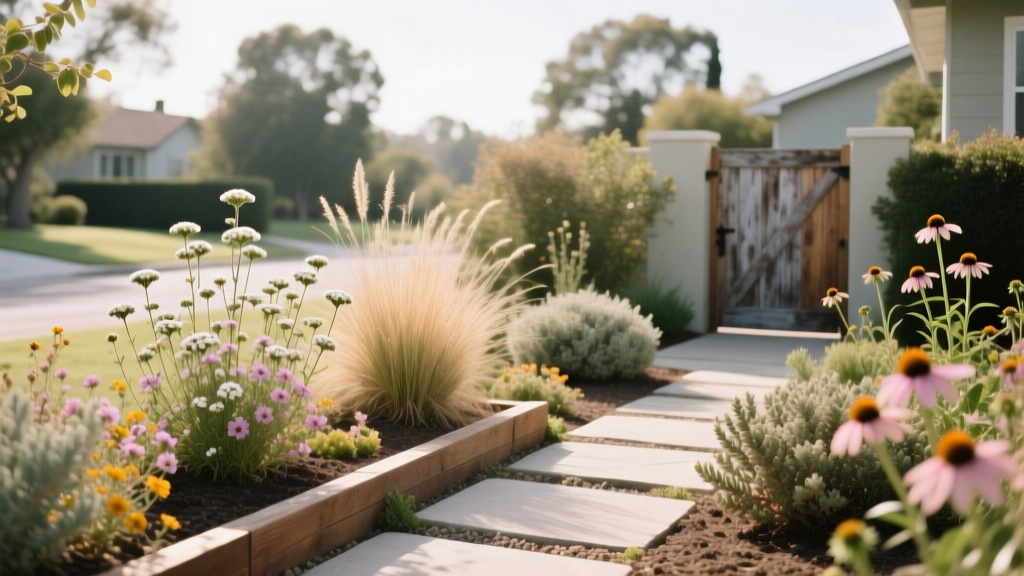
Front Yard Native Plant Garden
The complaint usually arrives in the same tone: “Our front yard looks… fine. But it’s boring.” You stand at the window and see a strip of lawn that guzzles water, a foundation bed of exhausted shrubs, and a sidewalk that turns into a summer frying pan. You want curb appeal, but you also want habitat, fewer weekend chores, and plants that don’t collapse the moment weather gets weird.
Let’s redesign the front yard the way a landscape designer would: start with how people move through the space, match plants to sun and soil (not wishful thinking), and build a layout that looks intentional from the street—every month of the year.
Start with the “view from the curb” and the “walk to the door”
Your front yard has two jobs: it’s a public-facing room and a functional entry corridor. Native plants can absolutely look polished, but they need structure. Think of the design as three layers: a clear edge, a strong backbone, and seasonal change inside that framework.
Measure first, then design (you’ll make better plant choices)
Grab a tape measure (or a phone measuring app) and map the hard lines. Here are the numbers that guide everything else:
- Sidewalk-to-house depth: common ranges are 15–30 ft.
- Typical foundation bed depth: plan at least 4 ft; 6–8 ft looks more natural and is easier to layer.
- Entry walk width: aim for 3–4 ft clear walking space.
- Sunlight hours: observe a weekday and a weekend day. Full sun is 6+ hours; part sun is 3–6 hours; shade is <3 hours.
Design tip: sketch the yard as simple rectangles and curves first. The plants come later.
Layout strategy: define three zones
Even small front yards feel composed when you give them zones with purpose:
- Entry Zone (high visibility, close-up viewing): tidy, lower plants; fewer tall seed heads flopping into the walk.
- Public Display Zone (street-facing): bolder drifts, repeating color blocks, taller structure for curb appeal.
- Buffer Zone (property line / driveway edge): tough natives that tolerate salt spray, heat, and compacted soil.
Design principles that make native plantings look “designed”
Principle 1: Repeat shapes, not just species
Native gardens look cohesive when the same plant forms appear in multiple places. Use repeating clumps of upright grasses, rounded mounding perennials, and a few vertical accents (small trees or shrubs). Repetition reads as intentional even when bloom times change.
Principle 2: Keep the edges crisp
A clean edge is the secret handshake between wild ecology and neat curb appeal. Choose one edge strategy and commit:
- Steel edging: typically 4–6 in tall; excellent for clean lines.
- Brick/stone soldier course: more traditional, visually weighty.
- Mulch edge (DIY): a sharp spade-cut trench 3–4 in deep, refreshed twice a year.
Principle 3: Layer heights from street to house
For most front yards, the best “reading” from curb to foundation is low-to-tall. Aim for:
- 0–18 in along walks and at the front edge
- 18–36 in in the middle zone
- 3–6 ft near the house or as focal points (only where they won’t block windows)
“Native plant communities are typically dominated by plants that fit the site conditions; the most resilient landscapes come from matching species to the environment rather than forcing the environment to fit the plant.” — U.S. Department of Agriculture, Natural Resources Conservation Service (USDA NRCS), 2019
Principle 4: Design for pollinators without sacrificing order
The Xerces Society emphasizes that diverse native flowering plants support pollinators across seasons (Xerces Society, 2023). Translation for your front yard: plan a bloom sequence so something is always happening—early, mid, and late season—while keeping the planting in readable drifts (not one of everything).
Three real-world front yard scenarios (and how to lay them out)
Scenario A: The small rectangle (20 ft x 30 ft) with a straight walk
You’ve got 600 sq ft total. If you keep some lawn for openness, cap it at about 150–250 sq ft and convert the rest into planting beds. A practical layout:
- Bed depth: 5 ft along the foundation, 4 ft along the sidewalk.
- Two repeating drifts: one warm-color drift (yellows/oranges) and one cool-color drift (purples/blues).
- One focal shrub: placed 6–8 ft from the front corner of the house to anchor the composition.
Best for homeowners who want “clean and classic” with native benefits.
Scenario B: The hellstrip and driveway edge (hot, dry, salty)
This is the space between sidewalk and street, or the strip along a driveway. It bakes. Snowmelt salt happens. Soil is compacted. Your layout goal is durability and visibility:
- Plant spacing: tighten to 12–18 in for quick coverage (less weed pressure).
- Mulch depth: 2–3 in shredded hardwood the first two seasons, then taper as plants fill in.
- Prioritize grasses and tough bloomers: they handle reflected heat and stabilize soil.
Scenario C: The shaded front yard under mature trees (2–4 hours sun)
Shade is not a design limitation—it’s a style. The key is choosing woodland natives with strong foliage texture and spring bloom. Layout approach:
- Keep the center open: a simple mulch path or a small seating spot 6 ft wide makes it feel intentional.
- Use “foliage masses”: repeat the same groundcover in broad sweeps for a calm look.
- Limit tall plants near the entry: shade plantings can feel messy if they spill into the walk.
A practical layout blueprint you can copy (with dimensions)
Here’s a designer-friendly template for a typical suburban front yard: 25 ft wide by 20 ft deep (about 500 sq ft), with a 3.5 ft wide walkway.
- Create a 6 ft deep foundation bed across the front of the house, leaving at least 18 in clearance from siding for airflow and maintenance access.
- Curve the bed line gently outward near the entry to make room for a focal grouping (a shrub + perennials). Keep curves wide—minimum radius about 6–8 ft—so it looks natural, not wiggly.
- Build a 4 ft deep street-side bed (or expand an existing one) to replace the hardest-to-mow strip of lawn.
- Connect the beds visually with two repeated plant “anchors” (for example, clumps of grass repeated 3 times), spaced about 5–7 ft apart.
- Plant in groups of 3, 5, or 7 per species so the drift reads from the curb. Singletons disappear visually and look accidental.
- Mulch and water deeply during the first season: aim for the equivalent of 1 inch/week of water (rain + irrigation) until plants establish.
Plant selection: specific native varieties that behave well in front yards
Native means “native to your region,” so confirm with your local extension office or native plant society. The plant list below includes widely used North American natives (and a few region-specific notes). The guiding idea: pick plants that stand up, stay put, and offer long bloom windows or strong structure.
Sunny front yards (6+ hours sun)
These are curb-appeal workhorses with strong stems and reliable form:
- Purple coneflower (Echinacea purpurea) — dependable mid-summer color, sturdy seed heads for winter. Space 18–24 in. Great for pollinators.
- Butterfly weed (Asclepias tuberosa) — tidy milkweed with orange blooms, less floppy than common milkweed. Space 18–24 in. Handles dry soil once established.
- Blazing star (Liatris spicata) — vertical purple spikes that “clean up” visually. Space 12–18 in. Excellent for drift planting.
- Little bluestem (Schizachyrium scoparium) — compact ornamental grass with copper fall color, holds form in winter. Space 18–24 in. Ideal for driveway edges.
- Black-eyed Susan (Rudbeckia hirta) — bold, long bloom; great first-year impact. Space 12–18 in. Often short-lived but reseeds politely.
Part sun / mixed exposure (3–6 hours sun)
- Virginia bluebells (Mertensia virginica) — spring standout, disappears by summer (pair with later-emerging plants). Space 12–18 in.
- Bee balm (Monarda fistulosa) — pollinator magnet; choose airy cultivars and give circulation to reduce mildew. Space 18–24 in.
- Smooth aster (Symphyotrichum laeve) — late-season color when front yards usually fade. Space 18–24 in.
Shade / woodland edges (<3 hours direct sun)
- Wild ginger (Asarum canadense) — dense groundcover, suppresses weeds, tidy texture. Space 12 in.
- Foamflower (Tiarella cordifolia) — spring bloom, attractive foliage, behaves well along paths. Space 12–18 in.
- Christmas fern (Polystichum acrostichoides) — evergreen structure, great for year-round order. Space 18–24 in.
Two “backbone” shrubs/small trees (for structure all year)
- Red twig dogwood (Cornus sericea) — winter stem color, tolerates moisture; best where it can spread. Space 5–8 ft.
- Serviceberry (Amelanchier canadensis or A. laevis) — spring flowers, edible berries, fall color; reads as “intentional landscaping” instantly. Typical spacing 10–15 ft from structures depending on cultivar.
Citation note: The National Wildlife Federation recommends prioritizing native plants as the base of habitat gardening and notes that they support local wildlife more effectively than many non-natives (National Wildlife Federation, 2020).
Comparison table: quick picks for common front yard challenges
| Front-yard challenge | Best native plant picks | Spacing | Why it works |
|---|---|---|---|
| Driveway heat + drought | Little bluestem, butterfly weed, prairie dropseed (Sporobolus heterolepis) | 18–24 in | Heat-tolerant, strong structure, minimal flop |
| Late-season color gap | Smooth aster, New England aster (Symphyotrichum novae-angliae), goldenrod (Solidago spp.) | 18–30 in | Extends bloom into fall when curb appeal often fades |
| Neat look near entry walk | Blazing star, coneflower, prairie smoke (Geum triflorum) | 12–24 in | Upright habits and clean forms that don’t spill into paths |
| Dry shade under trees | Christmas fern, foamflower, wild ginger | 12–24 in | Foliage-driven design that stays composed in shade |
Budget planning (with real numbers) and DIY alternatives
Native gardens can be very affordable, but the first year is where you’ll spend: plants, mulch, and edging. Here’s a realistic range for a 200 sq ft converted bed.
- Plants: 40–60 plugs in 2.5" pots at about $3–$6 each = $120–$360. (Plugs establish quickly and are budget-friendly.)
- Or gallon perennials: 20–30 at $10–$18 each = $200–$540 (instant impact, higher cost).
- Mulch: at 2 inches depth, 200 sq ft needs ~1.25 cubic yards. Delivered mulch often runs $35–$60 per yard = $45–$75 plus delivery.
- Edging: DIY spade edge is near $0; steel edging might run $2–$4 per linear foot. A 40 ft run = $80–$160.
- Watering gear (if needed): soaker hose + timer budget $35–$80.
DIY alternative: If your budget is tight, start with a “phase 1” bed of 50–80 sq ft near the entry where it’s most visible. Fill it with 3 species repeated in drifts, then expand next season. A small, strong design beats a large, thin one every time.
Step-by-step setup: from turf to thriving bed
- Call utility marking before digging (free in many areas). Plan this 3–7 days ahead.
- Remove turf the easy way: cut and lift sod (fast) or sheet-mulch with cardboard + 3–4 in compost/mulch (slower, less labor).
- Shape the bed line with a hose first, then cut a clean edge with a flat spade.
- Improve planting holes, not the entire bed if your soil is decent. Over-amending can create a “pot effect.” If soil is compacted, loosen to 8–10 in deep in each planting zone.
- Place plants in their pots before planting. Step back to the curb and adjust for rhythm and repetition.
- Plant at grade (don’t bury crowns), water in thoroughly, then mulch 2–3 in, keeping mulch off plant bases.
- Water schedule for year one: deep watering 1–2x/week during dry spells. Year two: taper. Year three: most natives only need water during extended drought.
Maintenance expectations (what you really sign up for)
A native front yard isn’t “no maintenance,” but it is typically predictable maintenance—especially after establishment.
- Year 1: plan on 30–60 minutes/week for watering checks and weeding.
- Year 2: typically 20–40 minutes/week, mostly weeding and a little editing (moving plants that are crowding).
- Year 3 and beyond: often 15–30 minutes/week in the growing season, plus seasonal cutback.
Seasonal task list (designer-style “keep it tidy” cues)
- Early spring: cut back last year’s stems to 6–10 in (or leave some standing longer if you like the look). Refresh edges.
- Late spring: weed patrol before weeds seed; re-mulch thin spots.
- Mid-summer: deadhead only where you want a cleaner look near the entry; leave seed heads deeper in beds for birds.
- Fall: optional partial cutback. Many designers leave structure for winter interest and wildlife cover.
- Winter: enjoy the architecture—grasses and seed heads are your “off-season design.”
Three mini case examples (what I’d plant, and why)
Case 1: Rental-friendly curb appeal (containers + a narrow bed)
If you rent or can’t dig much, build a native look with 3–5 large containers (at least 16–20 in wide). Use one grass (little bluestem), one long bloomer (coneflower), and one spiller/groundcover look (prairie smoke or a regional native sedge). Then create a narrow 18–24 in deep edge bed along the walk using plugs. You get pollinator value without a full yard overhaul.
Case 2: New-build front yard (poor soil, no shade, lots of reflected heat)
New construction soil is often compacted subsoil. I’d avoid fussy plants and build with tough prairie natives: little bluestem + prairie dropseed for structure, butterfly weed and black-eyed Susan for early impact, then asters for fall. Keep plant spacing tighter—15–18 in—to reduce weeds while the soil improves over time. Add 2 inches of mulch the first year and don’t over-fertilize; natives generally perform better without it.
Case 3: Mature neighborhood with big trees (dry shade + roots)
In rooty shade, digging is hard. I’d use smaller plants in plugs and let them knit together: foamflower and wild ginger as the carpet, Christmas fern for evergreen structure, and pockets of spring ephemerals like Virginia bluebells where you can water a bit in spring. Design-wise, I’d keep a crisp edge and repeat ferns in a steady rhythm to prevent the “random woodland” look.
Citations (real sources)
Native planting isn’t just a style choice; it’s supported by research and conservation guidance. For example, a widely cited study found that native plants support substantially more caterpillar biomass than non-native plants, which matters because caterpillars are a primary food source for many birds (Tallamy & Shropshire, 2009). Pollinator organizations also emphasize using diverse native blooms across seasons (Xerces Society, 2023).
- Tallamy, D.W., & Shropshire, K.J. (2009). “Ranking Lepidopteran Use of Native Versus Introduced Plants.” Conservation Biology.
- Xerces Society for Invertebrate Conservation (2023). Pollinator conservation resources and plant lists.
- National Wildlife Federation (2020). Native plant guidance for wildlife habitat gardening.
- USDA Natural Resources Conservation Service (2019). Guidance on site-appropriate plantings and conservation landscaping principles.
If you want your front yard to look designed—not like you stopped mowing—focus on structure first: crisp edges, repeated plant forms, and a simple bloom plan that carries from spring through fall. Start with one bed that’s easy to see from the street, plant it densely enough to shade out weeds, and give it one full season to settle. By next year, you’ll have a front yard that feels alive, local, and honestly easier to live with than turf ever was.