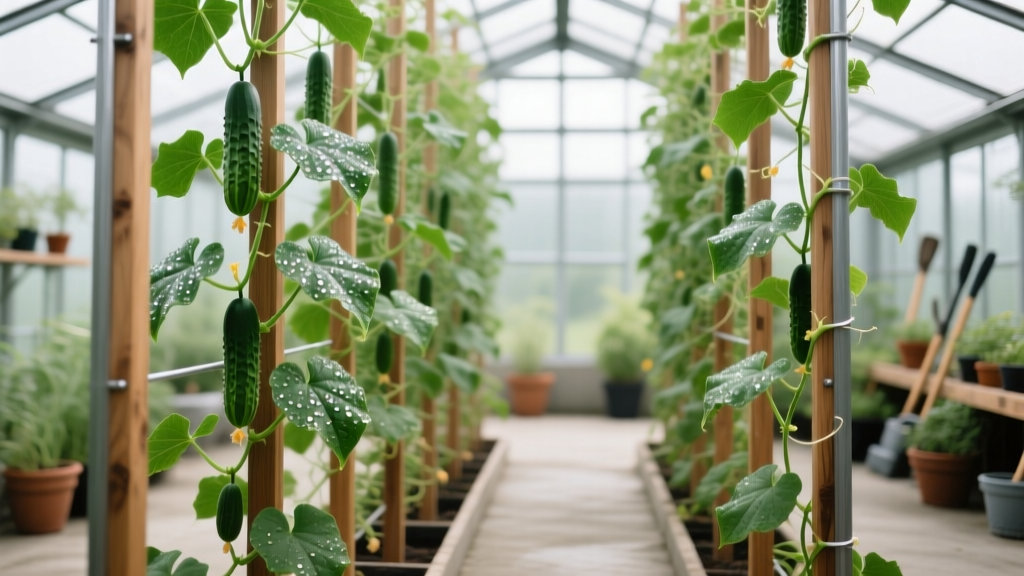
Greenhouse Vertical Cucumber Trellis
The cucumbers are doing that thing again—stretching sideways, grabbing the nearest neighbor, and turning your greenhouse aisle into a sticky obstacle course. You step in to water and come out wearing a vine. The fruit hides under broad leaves, and by the time you find it, it’s either a perfect picker or a surprise zucchini-sized club. If your greenhouse is productive but chaotic, a vertical cucumber trellis is the design move that gives you back your walkway, your light, and your sanity—without needing more square footage.
Think of this project like re-drawing the greenhouse floor plan: we’re going to treat cucumbers as a “living wall” instead of a sprawl. The goal is simple: keep vines up, fruit visible, air moving, and your daily work comfortable.
Design principles: turning vines into a vertical “room divider”
Start with circulation: protect the aisle first
Before you pick a trellis style, decide where you need to walk. In most hobby greenhouses, a 24–30 inch aisle is the difference between pleasant tending and constant contortions. If your aisle is currently less than 24 inches, make the trellis serve the aisle, not the other way around: run cucumbers along a bed edge so foliage stays inside a defined “vine plane.”
A practical layout rule: place trellised cucumbers so the vine canopy occupies no more than 12–18 inches of horizontal depth into the aisle. You’ll still get lush growth, but you won’t be shoulder-checking tendrils every time you carry a watering can.
Light is the real currency inside a greenhouse
Cucumbers are sun-lovers, but in a greenhouse, light can be stolen by poor geometry. Position your trellis so it doesn’t shade shorter crops for most of the day. If your greenhouse ridge runs east–west, a north-side trellis often reduces shading on the rest of the bed. If the ridge runs north–south, you can place cucumbers on either side, but keep the trellis line tight and vertical.
Aim for 8+ hours of bright light (direct or strong diffused) for best fruiting. In many home greenhouses, that means avoiding a trellis that leans and casts a wide shadow.
Airflow and leaf-dry time: design to prevent disease
Vertical training improves airflow, which matters because cucumbers are prone to powdery mildew and other leaf diseases when humidity is high and leaves stay wet. The trellis should encourage a single plane of growth, not a tangled thicket.
“Managing the canopy—spacing, pruning, and trellising—is one of the most effective cultural strategies to reduce humidity around leaves and lower disease pressure in cucurbits.”
—University extension greenhouse guidance (Cornell University, 2021)
That’s designer language for: give the plant a clear structure, keep it from laying on itself, and you’ll spend less time fighting problems later.
Layout strategies that fit real greenhouses (and renters)
Strategy 1: The single-wire overhead trellis (cleanest for tight spaces)
This is the classic greenhouse method: a strong wire (or cable) runs above the bed, and each plant gets its own hanging twine. It creates a tidy vertical curtain of vines and keeps the floor totally clear.
Best for: narrow greenhouses, renters who want a reversible system, and gardeners who want the easiest harvest visibility.
Suggested dimensions: run the overhead wire at 7–8 feet high if your structure allows. Keep plants 12–18 inches apart in-row. If you’re working with a bed that’s 24–30 inches wide, a single row is usually perfect.
Strategy 2: A-frame trellis (stable, high capacity, great for dual rows)
An A-frame trellis makes a strong, freestanding “vine tent.” Two rows of cucumbers can climb up each side, meeting near the top. It’s excellent when you have a wider bed and want maximum yield per square foot without relying on greenhouse framing.
Suggested dimensions: build the A-frame so it spans a bed about 36–48 inches wide, with the top ridge at 6–7 feet. Leave at least 24 inches aisle space on one or both sides so you can reach in for pruning and harvest.
Strategy 3: The wall trellis (turn unused vertical space into production)
If your greenhouse has a clear sidewall with good light, treat it like a vertical garden panel. A wall trellis uses eye bolts, a frame, or a cattle panel attached to studs or baseboards. This works beautifully for renters if you attach to a freestanding frame that sits against the wall instead of screwing into the greenhouse.
Suggested dimensions: keep plants 12–18 inches apart and train them flat like espalier. Keep the trellis surface 4–6 inches off the wall so air can move behind the leaves.
Choosing a trellis system: cost, strength, and maintenance
Not all trellises feel the same to live with. Some are fast to install but fussy later; others take an hour more upfront and save you time every week.
| Trellis system | Typical materials | Approx. cost (DIY) | Strength & longevity | Best fit |
|---|---|---|---|---|
| Overhead wire + twine | 12–14 gauge wire/cable, turnbuckles, clips, tomato twine | $25–$70 | High if anchored well; replace twine yearly | Small aisles, clean layout |
| A-frame | 1x2 or 2x2 lumber, screws, netting/cattle panel | $40–$120 | Very high; re-usable for years | Wide beds, maximum yield |
| Cattle panel arch | 16 ft cattle panel, T-posts or wood bases | $35–$90 | Extremely strong; takes space | Walk-through “tunnel” style |
| Wall trellis frame | Freestanding wood frame + netting | $30–$90 | High; easy to disassemble | Renters, sidewall use |
Budget note: cucumber trellising doesn’t need fancy kits. The expensive part is usually the anchors (turnbuckles, eye bolts) and the panel (cattle panel or heavy net). If you’re keeping it renter-friendly, put money into a freestanding frame and use removable fasteners.
Plant selection: cucumber varieties that love vertical life
Vertical trellising works best with greenhouse-friendly, disease-tolerant varieties—especially parthenocarpic cucumbers (they set fruit without pollination), which are ideal under cover. Many greenhouse growers prefer these because you don’t have to worry about bees getting inside or hand pollinating.
Top picks for greenhouse trellising
‘Diva’ (slicer): A reliable, tender-skinned cucumber with good disease resistance. It performs well on a single leader system and is friendly for home harvest timing.
‘Socrates’ (greenhouse slicer): Known for consistent fruiting in protected culture, especially when trained vertically. It’s a strong choice when you want steady production and uniform fruit.
‘Tyria’ (European/English type): A greenhouse-standard style cucumber—long, smooth fruit and excellent performance on trellises. It appreciates steady moisture and regular feeding.
‘Mini Munch’ (snacking): Compact fruit size means you’ll harvest frequently (which keeps the plant pumping). Great for renters or small spaces where you want a high snack-to-square-foot ratio.
‘Marketmore 76’ (slicer, adaptable): Not strictly greenhouse-only, but dependable and tolerant. If your greenhouse runs a bit cooler or you like a classic garden cucumber, it trains well and forgives small mistakes.
Spacing and training expectations by type
In a greenhouse, plan for 12 inches spacing for compact/mini types and 15–18 inches for vigorous slicers and European types. Rows should ideally be 24–36 inches apart (or one row per bed in very tight houses). Keep the trellis line close to the stem so vines don’t lean into pathways.
For fruit quality, greenhouse cucumbers prefer warmth and steady moisture. Many extension sources place cucumbers in the warm-season crop category, with growth strongly influenced by temperature and consistent irrigation (University of Minnesota Extension, 2020).
Step-by-step: build an overhead wire + twine trellis (clean, renter-friendly)
This setup is the closest thing to “professional greenhouse style” you can do at home, and it scales from 2 plants to 20.
- Map your line. Mark where the plants will sit in the bed. For most homes, start with 4 plants spaced 15 inches apart in one row.
- Set two anchor points. Use sturdy end posts, greenhouse frame members, or freestanding uprights. The wire will be under tension—don’t attach to flimsy PVC hoops unless reinforced.
- Run the wire/cable. Install a turnbuckle on one end so you can tighten. Target height: 7 feet above the bed if possible.
- Add hang points. Use clips, carabiners, or simple loops every 12–18 inches so each plant has its own drop line.
- Attach trellis twine. Use tomato twine or greenhouse twine. Tie the top securely; at the base, loop loosely around the stem (never cinch tight).
- Train weekly. Wrap the vine around the twine as it grows (usually 1–2 wraps per week). If it flops, add a soft clip.
- Prune for a single leader. Remove side shoots up to about 12–18 inches from the soil to improve airflow, then manage laterals based on your space and variety vigor.
DIY alternative: if wire hardware feels like too much, you can use a 1-inch EMT conduit bar on freestanding uprights and zip-tie it in place. It’s not as elegant, but it’s removable and sturdy.
Three real-world layouts (with numbers you can copy)
Scenario 1: The renter with a 6' x 8' greenhouse and one narrow bed
Your constraint is aisle width. With a 6' x 8' footprint, you might have one 24-inch bed along one side and a 24-inch aisle. Here, the overhead wire + twine system shines.
Layout: single row of 4 cucumbers spaced 15 inches apart. Trellis line at 7 feet. Keep the canopy trimmed so it stays within 12 inches of the bed edge.
Plant choice: ‘Mini Munch’ or ‘Diva’—both produce heavily without taking over the room, and you’ll actually be able to reach everything.
Budget: $25–$50 if you already have something solid to anchor to; $50–$90 if you build a freestanding frame.
Scenario 2: The homeowner with a 10' x 12' greenhouse and two beds
This is where you can design for comfort and volume. Two beds, each 30–36 inches wide, with a central aisle of 30 inches, feels luxurious compared to a tight setup.
Layout: Put cucumbers on the north bed edge (or whichever side shades least), using an A-frame on a 36–48 inch bed. Plant 6–8 plants total (3–4 per side), spaced 18 inches.
Plant choice: ‘Socrates’ or ‘Tyria’ for steady greenhouse production and clean fruit. These reward consistent feeding and pruning.
Budget: $60–$120 depending on whether you use lumber and netting or a cattle panel.
Scenario 3: The balcony greenhouse (pop-up or lean-to) with limited headroom
If you’ve got a small lean-to or pop-up greenhouse where the highest point is only 5–6 feet, you can still go vertical—you just shift to a wall trellis or short A-frame and plan to “top” and retrain.
Layout: a wall trellis panel 2 feet wide and 5 feet tall, with 2–3 plants spaced 12–15 inches. As vines reach the top, pinch the growing tip and let laterals fill sideways along the netting, keeping a flat plane.
Plant choice: ‘Diva’ or ‘Marketmore 76’ (if temperatures fluctuate more). The key here is forgiving growth and manageable vigor.
Budget: $30–$70 with a simple freestanding frame and plastic trellis netting.
Details that make it feel designed (not improvised)
Use a “service zone” for watering and feeding
Leave a clear strip—about 6 inches along the bed edge or one corner—for watering access, a small bucket, or a hose wand. When vines take over, you’ll be glad you planned a spot where your hands can reach the soil without wrestling leaves.
Pair cucumbers with compatible understory plants
Vertical cucumbers create dappled shade at the base. Use that microclimate instead of fighting it.
Good companions inside the same bed edge: basil (fragrant, easy), lettuce (quick cycles), and dill (if you like pickles and can manage its height). Keep companions at least 8–10 inches away from cucumber stems so airflow stays good.
Plan for weight: fruit load adds up
A vigorous cucumber vine can carry a surprising load. Use twine rated for greenhouse crops, and avoid bargain netting that snaps in midsummer. If you’re using a cattle panel, you’re already safe; if you’re using plastic netting, support it with a rigid frame.
Maintenance expectations (so it stays beautiful in August)
If you design the trellis well, cucumber care becomes a rhythm instead of a rescue mission.
Weekly time: plan on 20–40 minutes per week for 4–8 plants. That includes training vines, light pruning, checking ties, and harvesting. During peak production, add a few minutes every other day for picking.
Weekly checklist
- Train vines: wrap or clip new growth to the twine/net.
- Prune for airflow: remove yellowing lower leaves; thin congested laterals.
- Harvest on time: frequent picking keeps fruit quality high and prevents the plant from slowing down.
- Check tension and anchors: tighten wire if it sags; replace fraying twine.
Seasonal tasks
- Early season: disinfect clips (if reusing), check anchors, and pre-tension overhead wires.
- Midseason: watch humidity—ventilate to reduce leaf wetness duration. Powdery mildew pressure often rises as canopies thicken.
- Late season: remove vines promptly, clean trellis materials, and solarize or refresh topsoil/compost if disease was present.
Sanitation matters in greenhouses because problems can carry over. The general principle of removing crop debris and cleaning structures to reduce disease inoculum is widely recommended in protected culture management (Cornell University, 2021).
Budget-minded upgrades and smart DIY swaps
If you want the “designer greenhouse” feel without designer prices, spend where it prevents future hassle.
Spend on: strong anchors, turnbuckles, and a reliable trellis line. A $10 turnbuckle can save a season of sagging wire.
Save on: the vertical element itself. Instead of specialty trellis netting, you can use:
- Cotton tomato twine (replace each season)
- Jute twine (compostable, but weaker when wet)
- Repurposed nylon string (durable, but remove at season’s end to avoid plastic shedding)
Approximate costs to keep in mind: a cattle panel is often $30–$50, a roll of trellis netting $10–$25, and a small hardware set (eye bolts, turnbuckle, clips) $15–$40, depending on region and quality. If you’re building a wooden A-frame, expect $20–$60 in lumber for a basic build.
Small design choices that improve harvest (and reduce missed fruit)
Train cucumbers so fruit hangs inward toward your reach zone—usually toward the aisle. It sounds minor, but it changes how harvesting feels. When fruit hangs on the “wrong side,” you’ll tug vines, snap tendrils, and miss cucumbers until they’re overgrown.
Also, keep your trellis vertical and your stems aligned under their support points. Vines that angle sideways become stressed at the base and tend to kink when fruit load increases.
When everything is set up well, the greenhouse feels different: the aisle stays open, leaves dry faster, and cucumbers hang like ornaments where you can see them. You’ll start stepping inside with a plan instead of a machete—and the project pays you back every time you harvest a perfect cucumber without crawling under a vine canopy.
Sources: Cornell University greenhouse/extension guidance on canopy management and disease reduction in protected cropping (2021); University of Minnesota Extension guidance on cucumber growth needs and warm-season management (2020).