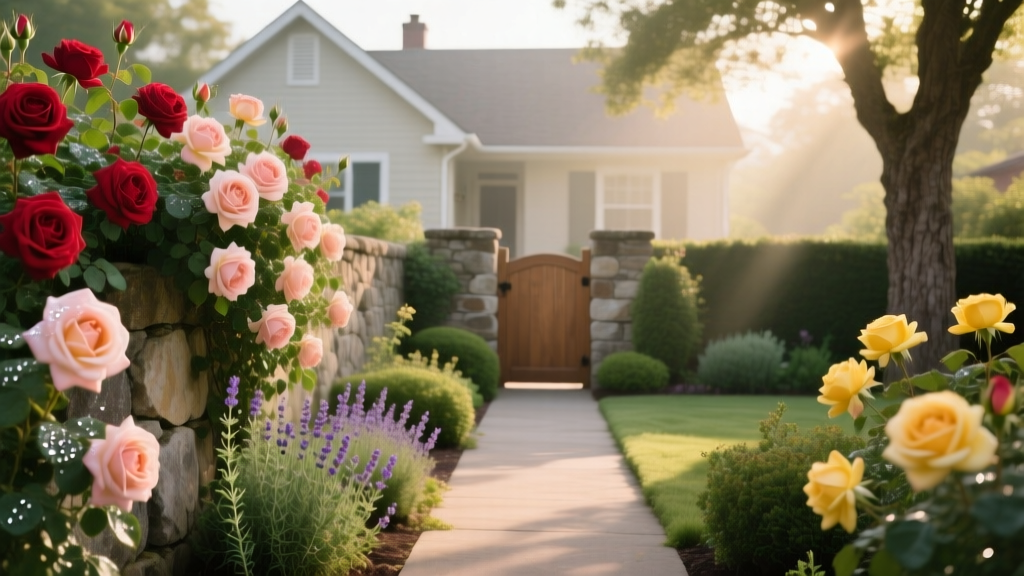
Front Yard Heritage Rose Garden
The front walk is doing that thing again: a narrow strip of turf struggling in the heat, a mailbox post surrounded by weeds, and a porch view that feels more “placeholder” than “welcome.” You want roses—real roses with fragrance and history—but you also want to see out the window, keep a clear path for deliveries, and avoid turning your weekends into a pruning marathon. A front-yard heritage rose garden can do all of that, if it’s laid out like a small, elegant room rather than a scattered collection of plants.
What follows is the way I’d design it if I were standing in your driveway with a tape measure and a notepad: a plan that respects sightlines, sun, and the daily realities of dragging trash bins and parking cars—while still delivering that old-rose perfume when you open the front door.
Design principles that make heritage roses work in the front yard
Start with circulation: keep the “daily route” easy
Before choosing a single rose, trace the paths you use every day: front door to sidewalk, driveway to gate, steps to mailbox. Give your main path a minimum clear width of 42 inches so two people can pass comfortably; if you’re squeezing a narrow side, 36 inches is workable but tight when shrubs fill in. Keep rose canes at least 18 inches back from the path edge so thorns don’t snag sleeves and shopping bags.
Heritage roses are often fuller than modern hybrid teas, which is part of their charm. That fullness needs space and a predictable geometry—so the garden looks intentional even in winter.
Use “structure first, flowers second”
A front yard needs year-round bones. Think in three layers:
- Low edge (8–18 inches): keeps soil in place and reads clean from the street.
- Mid layer (24–48 inches): most shrub roses and companions live here.
- Vertical moments (6–10 feet): one climber on an entry arbor or a pillar to draw the eye to the door.
This approach prevents the common “rose island” problem—where roses float in mulch with no framing and look bare when not blooming.
Sunlight math: place the roses where they’ll actually flower
Most roses bloom best with 6–8 hours of direct sun. Many heritage types tolerate a little less, but bloom quantity and disease resistance generally improve with more light and better airflow. If your front yard is partially shaded by street trees or your own roofline, reserve the sunniest patch for the most bloom-dependent varieties (repeat bloomers) and use tough once-blooming antiques where light is a bit compromised.
For disease management, space roses so air can move through: plan on 30–48 inches between shrub roses depending on the variety’s mature width, and don’t crowd them tight against a solid fence.
Soil prep is the hidden layout
Front yards often have compacted soil from construction and foot traffic. Good rose design includes the part you can’t see: a planting bed that drains, holds nutrients, and supports deep roots. Aim for a bed depth of 12–18 inches of improved soil (existing soil loosened plus compost worked in). The American Rose Society notes that roses prefer full sun and well-drained soil, emphasizing sunlight and air circulation as key cultural factors (American Rose Society, 2020).
“The most sustainable landscapes are designed to match plants to the conditions—sun, soil, and water—rather than forcing conditions to match plants.” — Association of Professional Landscape Designers (APLD), 2021
Three layout strategies (choose the one that fits your frontage)
Layout A: The classic foundation border (best for typical suburban fronts)
Ideal for: a house with 20–40 feet of front foundation and a straight walk.
Design a continuous bed that’s 6 feet deep along the foundation and wraps toward the walk. Place the tallest shrubs toward the house, mid-height roses in the middle, and a crisp low edge near the lawn or sidewalk.
Key move: keep plants below your window sills if you want visibility. For many homes, that means keeping most shrubs at 36–42 inches and using one or two taller accents at corners.
Layout B: The entry “rose court” (best for small yards and townhomes)
Ideal for: a short front walk (or a few steps) where you want maximum fragrance right at the door.
Create two mirrored beds flanking the walk, each roughly 4 feet wide and 8–10 feet long. Anchor each bed with one well-shaped shrub rose, then underplant with catmint, lavender, or hardy geraniums to soften the base and reduce splash-back (a common source of blackspot).
Key move: add an arbor or simple metal trellis at the entry and train one climber. It turns a small space into a moment.
Layout C: The renter-friendly “big pots + narrow strip” plan
Ideal for: rentals, HOAs, or any front yard where you can’t dig extensively.
Use two to four large containers (18–24 inches wide) for roses near the porch, then a narrow in-ground strip (24–30 inches wide) along the walk with low perennials and bulbs. Containers let you take the roses with you, and they read as intentional architecture.
Key move: choose compact shrub roses or short climbers and commit to consistent watering.
Plant selection: heritage roses that earn their keep
Heritage roses (often referring to old garden roses and historically important cultivars) vary widely in growth habit. In a front yard, I prioritize: fragrance, repeat bloom (if possible), disease resistance, and a shape that won’t sprawl into paths.
Core heritage rose picks (with spacing and placement)
- ‘Madame Isaac Pereire’ (Bourbon): deep magenta, famously fragrant. Best as a focal shrub near the entry where you’ll smell it. Give it 4–5 feet of width and avoid tight corners—it can be vigorous.
- ‘Gertrude Jekyll’ (English rose, heritage style): classic old-rose scent, strong repeat bloom. Works well in Layout A or B as a main shrub. Space at 3.5–4 feet.
- ‘Zéphirine Drouhin’ (Bourbon climber): nearly thornless and fragrant—excellent near a gate or arbor. Allow 8–10 feet of horizontal training space. Great where people brush past.
- ‘Madame Hardy’ (Damask): luminous white with a green eye, once-blooming but breathtaking. Place where it can be the star for a few weeks—pair it with later-blooming companions. Space 4 feet.
- ‘Jacques Cartier’ (Portland): compact, repeat bloom, nicely behaved for smaller beds. Space 3 feet; ideal near walks.
If you’re in a disease-prone climate (humid summers, overhead irrigation nearby), favor the more resilient shrub forms and give them room. The Royal Horticultural Society emphasizes that many rose diseases are reduced with good hygiene and airflow, and avoiding wet foliage when possible (RHS, 2023).
Companion plants that make roses look designed (and reduce labor)
The best companions do three jobs: cover bare soil, support pollinators, and visually “cool” the strong color of roses.
- Nepeta ‘Walker’s Low’ (catmint): soft purple haze, long bloom; helps knit shrubs together. Plant 18–24 inches apart along edges.
- Salvia nemorosa ‘Caradonna’: upright purple spires that echo rose stems; good for modern homes. Space 16–18 inches.
- Lavandula angustifolia ‘Hidcote’: tidy mound, fragrance; best in well-drained soil. Space 18–24 inches.
- Geranium ‘Rozanne’: long-blooming groundcover effect; hides rose ankles. Space 24–30 inches.
- Spring bulbs (alliums, narcissus): seasonal lift before roses peak. Plant narcissus 6 inches deep in drifts between shrubs.
A quick comparison table: pick roses that match your maintenance tolerance
| Rose type / example | Bloom pattern | Typical size | Fragrance | Best front-yard use |
|---|---|---|---|---|
| Bourbon shrub (‘Madame Isaac Pereire’) | Repeat (flushes) | 5–7 ft tall, 4–6 ft wide | Very strong | Entry focal point; allow room |
| Portland (‘Jacques Cartier’) | Repeat | 3–4 ft tall, 3–4 ft wide | Strong | Walkside planting; small beds |
| Damask (‘Madame Hardy’) | Once-blooming | 4–5 ft tall, 3–4 ft wide | Strong | Seasonal showpiece; pair with perennials |
| Climber (‘Zéphirine Drouhin’) | Repeat | 8–12 ft canes | Strong | Arbors, porch posts, gate moments |
Step-by-step setup: from blank lawn to rose-ready beds
This is the build sequence I use to keep the project tidy and avoid rework.
- Measure and mark: Use marking paint or a hose to outline beds. For Layout A, start with a 6-foot deep bed; for Layout B, mark two beds 4 x 10 feet.
- Check sun: Over two days, note when sun hits the bed. If you’re under 6 hours, prioritize the toughest varieties and widen spacing for airflow.
- Remove turf cleanly: Rent a sod cutter for larger areas (often $80–$120 per day) or sheet-mulch with cardboard for budget DIY.
- Loosen and amend: Loosen soil to 12–18 inches. Mix in 2–3 inches of compost. If drainage is poor, consider a raised edge of 6–8 inches.
- Place plants (still in pots): Set roses at final spacing—typically 36–48 inches apart. Step back to the curb to check proportions.
- Install support: Put in arbors/trellises before planting so you don’t stab root balls later. A sturdy metal arbor often runs $150–$300; a DIY cattle-panel arch can be under $60.
- Plant roses: Dig holes about 2x the pot width, same depth. Water in thoroughly.
- Mulch: Apply 2–3 inches of mulch, keeping it a couple inches away from rose crowns. Mulch suppresses weeds and reduces soil splash.
- Water plan: For in-ground roses, consider drip irrigation. A basic front-bed drip kit often costs $40–$90 and saves hours over hand watering.
Budget reality: what this typically costs (and where to save)
Costs vary by region, but here are planning numbers that keep surprises down:
- Roses: expect $35–$60 per shrub rose in a 2–3 gallon pot; own-root heritage roses can be similar or slightly higher depending on supplier.
- Compost: a 1 cubic yard delivery commonly runs $40–$70 plus delivery; bagged compost is pricier but manageable for small beds.
- Mulch: $35–$55 per cubic yard bulk; bagged mulch is convenient for renters or small installs.
- Edging: steel edging for a crisp line is often $2–$4 per linear foot; a shovel-cut “V” edge is free and looks sharp when maintained.
- Soaker/drip: $40–$90 for a starter kit, plus fittings.
DIY alternatives that still look professional: Use a shovel-cut edge instead of brick; swap expensive hardscape for a simple 3-foot wide gravel strip with metal edging; choose fewer roses and repeat them (three of the same variety reads more designed than six different single plants).
Three real-world scenarios (and how I’d solve each)
Scenario 1: The narrow strip between sidewalk and porch (8 feet deep)
You have an 8-foot deep front yard from porch to sidewalk, and you need a clear path. Go with Layout B’s symmetry in miniature: a 36-inch wide walk, with two 30-inch deep beds on either side. Choose compact roses like ‘Jacques Cartier’ at 3 feet spacing, then edge with catmint at 18 inches. Add one slender obelisk trellis (even in a pot) for a climber if you want height without width.
Scenario 2: Corner lot with wind and road salt splash
Corner exposure can dry roses quickly and stress them in winter. Set the bed back from the curb by 2–3 feet and use a low evergreen or ornamental grass buffer (kept at 18–24 inches) to break wind and catch spray. Pick vigorous, resilient roses and keep them slightly taller (don’t shear into tight balls). Mulch generously and water deeply in summer—wind increases transpiration more than people expect.
Scenario 3: Rental or HOA—no digging, but you want roses now
Use Layout C: two 20–24 inch pots near the entry with a compact, repeat-blooming rose like ‘Gertrude Jekyll’ if you can keep it pruned, or a smaller heritage-style shrub if space is tight. Underplant with trailing thyme or annual alyssum. Add a narrow bed of bulbs and perennials only if permitted. The look is immediate, portable, and easy to scale up later.
Making it feel like a heritage garden (not a modern shrub bed)
Color palette: pick one main rose color and one supporting tone
Heritage gardens feel calm when the palette is limited. Choose one main rose family—blush pinks, deep crimsons, or creamy whites—and one supporting tone (lavender is a classic). Repeat those colors across companions. This keeps the front yard from looking like a sample rack.
Repeat shapes: mounds + spires
Old roses are mounded and generous; pair them with spiky salvias or foxgloves (where climate allows) to create a classic contrast. Keep the tallest spires toward the back or near the door so you don’t block sightlines from windows or the street.
Fragrance placement: put the best scent where you’ll pass
One of the great joys of heritage roses is perfume. Place your most fragrant rose within 6–10 feet of the front door or along the path you use daily. A rose blooming at the far corner of the yard doesn’t do much for your day-to-day life.
Maintenance expectations: what it takes to keep it beautiful
Plan on 30–60 minutes per week in peak season for a modest front-yard rose garden (say, 4–6 roses plus companions). That includes checking water, deadheading repeat bloomers, and quick pest/disease scouting.
Weekly rhythm (spring through early fall)
- Deadhead: 10–20 minutes. Clip spent blooms back to a strong leaf to encourage repeat flowering.
- Water: Deep watering 1–2 times weekly depending on heat; drip makes this nearly automatic.
- Inspect foliage: 5 minutes. Catch blackspot early; remove affected leaves from the garden (don’t compost if disease is active).
Seasonal tasks
- Late winter/early spring: Structural pruning to open the center and remove dead wood. Refresh mulch to 2–3 inches.
- After the first big flush: Light shaping prune and feed if you fertilize; water well after feeding.
- Fall: Stop heavy fertilizing to let plants harden off; clean up fallen leaves to reduce disease carryover.
If you prefer a lighter-touch approach, choose fewer, better-sited roses, give them proper spacing, and let companions fill in. The “low labor” secret isn’t a magical product—it’s design that prevents problems.
When your layout respects the path you walk every day, your roses get the sun they need, and your bed edges are crisp, the front yard changes tone. It stops being a strip you maintain and becomes a place that greets you—fragrant at the gate, orderly from the curb, and alive at eye level when you pause at the door key. That’s a heritage rose garden doing its real job: making home feel like home, right at the threshold.