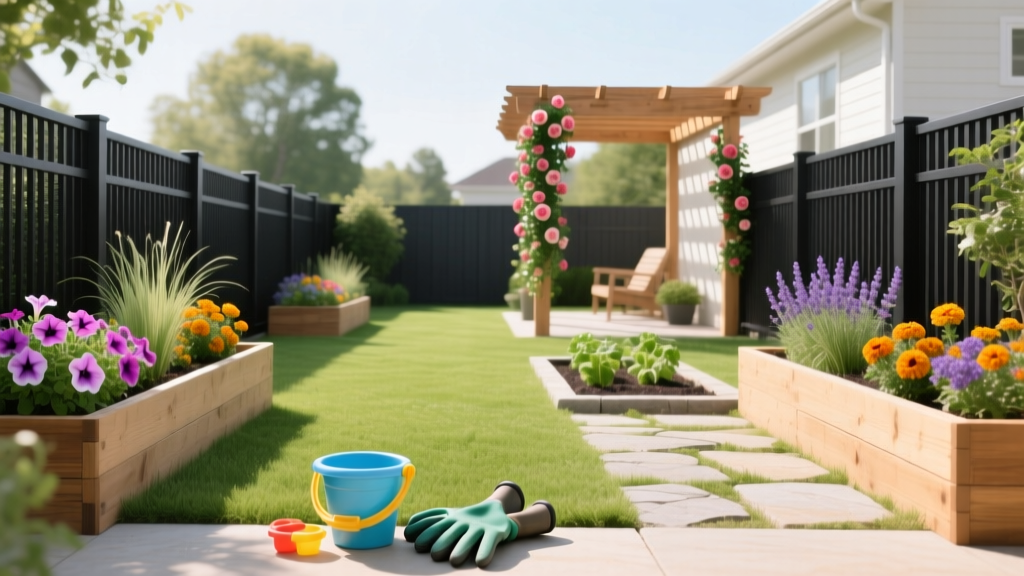
Fenced Yard Garden Ideas for Families
The gate clicks shut behind you, and for a moment everything feels possible. Then reality shows up: a narrow strip of grass, a tired fence line, a trampoline that “has to stay,” and a dog that runs figure-eights until the lawn is dust. If you’ve ever stood in a fenced yard with kids asking for a play space and adults hoping for a garden that doesn’t become another chore, you’re in the right place. The good news: a fence is already a design asset. It creates enclosure, safety, and vertical real estate—three things family gardens crave.
Let’s design this like a landscape designer would: start with how you live, map circulation, give every feature a job, then choose plants that behave well around children, pets, and weekend schedules.
Start With the “Family Triangle”: Play, Grow, Gather
Most fenced yards succeed when you deliberately balance three zones: a play zone (durable and open), a grow zone (edibles and pollinators), and a gather zone (seating, grilling, shade). The fence becomes the backdrop that lets these zones feel intentional instead of cluttered.
Rule of thumb dimensions (so it functions daily)
Use these practical minimums as you sketch:
- Main path width: 36 in (90 cm) so two people can pass or you can wheel a stroller.
- Secondary path width: 24 in (60 cm) for quick access to beds and gates.
- Raised bed width: 4 ft (1.2 m) max so kids and adults can reach the center from either side.
- Mulched play buffer: 3 ft (0.9 m) between a play feature and plantings to reduce trampling.
- Sun target for vegetables: 6–8+ hours/day for fruiting crops (tomatoes, peppers).
For a typical suburban fenced yard around 30 ft x 40 ft (1,200 sq ft), a balanced starting layout is: 450–600 sq ft open play lawn/soft surface, 200–350 sq ft garden beds, and 120–200 sq ft patio or seating. Adjust up or down based on your family’s priorities.
Layout Strategies That Make a Fenced Yard Feel Bigger (and Easier)
1) Put the “messy productivity” on the perimeter
Compost bins, rain barrels, potting shelves, and tall trellises belong along the fence line. This keeps the center open and reduces visual clutter. If your yard is small, treat the perimeter like a continuous “working border”: 2–3 ft deep in some places, 4–5 ft deep where you add raised beds or shrubs.
2) Use a loop path to stop foot traffic through beds
Families don’t walk in straight lines. A loop path gives kids a “track,” keeps access clear, and prevents the classic shortcut across your lettuce.
DIY material costs (ballpark):
- Mulch path: $35–$60 per cubic yard (covers ~81 sq ft at 4 in deep).
- Decomposed granite: often $50–$90 per ton plus delivery (varies by region).
- Concrete pavers: commonly $2–$6 per sq ft for materials.
3) Design sightlines for supervision
In a family yard, beauty includes visibility. Keep taller elements (trellises, fruit trees, privacy screens) toward corners and fence runs, and keep the center low. If you’re adding a seating area, aim it toward the play zone so adults can relax without constantly standing up to check.
“Visual access is a safety feature. If caregivers can easily see play areas from key points like the kitchen door or patio, you reduce conflicts between ‘garden time’ and ‘kid time’.” — Adapted from childcare outdoor environment guidance emphasizing supervision through sightlines (NAEYC, 2022)
Three Real-World Layout Scenarios (With Working Dimensions)
Scenario A: The Narrow Side Yard Turned Family Garden (8 ft x 40 ft)
This is the “corridor yard” common in townhomes and rentals. The fence creates a tunnel effect—so we break it up with vertical planting and a slim loop (really a there-and-back route with passing bays).
Layout: A 24 in main path down the center; on the sunny side, a continuous 18–24 in deep planting strip with trellises; on the shadier side, pockets of containers and a fold-down bench.
Key move: Install two “passing pads” with pavers (each 3 ft x 3 ft) so kids can step aside or park scooters without crushing plants.
Scenario B: The Classic Suburban Rectangle (30 ft x 40 ft) With Kids + Dog
Here, we protect the garden from zoomies and soccer balls. The simplest answer is a low interior fence or hedge that creates a dedicated grow zone without making the yard feel divided.
Layout: Keep a 18 ft x 25 ft open play area centered. Along the back fence: three raised beds 4 ft x 8 ft each, plus a berry strip. Add a 10 ft x 12 ft patio near the house for supervision and meals.
Dog-proofing detail: Use 36–42 in tall wire mesh panels or a simple split-rail with welded wire to separate beds. Materials for a 20 ft run of welded wire fence can land around $80–$200 depending on posts and hardware.
Scenario C: The Shared Rental Yard With Limited Digging (20 ft x 25 ft)
Renters often can’t sink posts, remove turf, or build permanent structures. The fence still helps: we treat it like a wall and build a container “stage set.”
Layout: Containers and grow bags along two fence sides; a pop-up shade sail; a lightweight bistro set; a kid-friendly sensory strip (pots of herbs to touch and smell).
Budget reality: A strong setup can be done for $250–$600 using grow bags, salvaged containers, and one stock tank or raised bed kit.
Step-by-Step: A Practical Setup Plan You Can Do Over Two Weekends
Here’s a clean sequence that prevents rework and keeps the yard usable throughout.
- Measure and map: Sketch the yard with fence lines, gates, utilities, and the sunniest zone. Note where you get 6+ hours of sun in summer.
- Pick your zones: Decide the play/grow/gather proportions. Mark them with a hose or string.
- Build the path first: Lay out a 36 in main route from door to gate, then a loop or spur to beds. Put cardboard down and add 4 in mulch for a fast DIY path.
- Add the “fence line infrastructure”: Install trellis panels, hook rails for tools, or a narrow shelf for seed trays. For renters, use freestanding trellises that lean on the fence without fasteners.
- Install beds/containers: Place raised beds or grow bags where they get the best sun. Keep 24–30 in working room between beds and fence.
- Soil and irrigation: Fill beds with a raised-bed mix; set a simple drip line or soaker hose. Even a $30 timer can prevent missed waterings.
- Plant in layers: Tall plants to the fence, medium in the middle, edging plants along paths (so kids naturally stay on the path).
- Add a “kid anchor” feature: A mud kitchen, chalkboard panel, sand box, or a small digging bed for kids prevents them from “helping” in your seedlings.
Plant Selection: Family-Ready Varieties That Behave Well
In family yards, I prioritize plants that are tough, non-fussy, and rewarding quickly. I also avoid anything with aggressive thorns in high-traffic areas (some roses and blackberries belong in the back corner, not beside the path).
Edibles that earn their space (with spacing)
- Cherry tomato: ‘Sungold’ or ‘Sweet Million’ — high yield and kid-friendly snacking. Space 18–24 in; give a 6 ft trellis.
- Snap peas: ‘Sugar Snap’ — fast, sweet, climbs fences. Space 2 in along a trellis; great spring/fall crop.
- Strawberries: ‘Albion’ (day-neutral) — long harvest window. Space 12–18 in; ideal in a dedicated bed edge.
- Blueberries: ‘Sunshine Blue’ (compact) or ‘Jersey’ (larger) — attractive shrubs plus fruit. Space 3–5 ft; needs acidic soil (container-friendly).
- Zucchini: ‘Bush Baby’ — compact habit for smaller beds. Space 2–3 ft; teach kids to look under leaves for fruit.
- Herbs for touch-and-smell: basil ‘Genovese’, mint (in pots only), chives — strong sensory payoff and forgiving care. Basil spacing 10–12 in.
Pollinator plants that also look “designed”
- Lavender: ‘Hidcote’ — neat mounds, drought-tolerant once established, great edging. Space 18–24 in; full sun.
- Salvia: ‘Caradonna’ — vertical purple spikes, long bloom, tough. Space 18 in.
- Coneflower: Echinacea ‘PowWow Wild Berry’ — sturdy stems and reliable summer color. Space 18 in.
- Yarrow: Achillea ‘Moonshine’ — soft foliage, heat tolerant. Space 18–24 in.
Fence-friendly climbers (safe, useful, and space-smart)
- Thornless blackberry: ‘Triple Crown’ — place along a back fence with a trellis; big reward, fewer kid hazards than thorny types. Space 4–5 ft.
- Grapes: ‘Reliance’ (seedless) — excellent for an arbor or fence trellis; creates shade and snack value. Space 6–8 ft.
- Scarlet runner bean: (annual) — quick coverage and hummingbird magnet; edible beans if harvested young. Space 6 in.
Safety note: If you have toddlers or pets that chew plants, cross-check toxicity for ornamentals before planting. ASPCA’s toxic/non-toxic plant lists are a helpful reference (ASPCA, 2024).
A Comparison Table: Layout Approaches for Different Family Needs
| Approach | Best for | Typical footprint | Upfront cost (DIY) | Maintenance |
|---|---|---|---|---|
| Perimeter beds + open center | Kids’ play + easy supervision | 2–4 ft deep beds around edges | $300–$1,200 | 1–2 hrs/week in growing season |
| Raised-bed “garden room” with small inner fence | Dogs, ball games, organized food growing | 200–400 sq ft garden zone | $600–$2,500 | 1.5–3 hrs/week |
| Container garden along fence (renter-friendly) | Rentals, patios, minimal digging | 20–80 sq ft of containers | $250–$900 | 1–2.5 hrs/week (more watering) |
| Kid sensory garden + pollinator border | Preschoolers, learning-by-touch gardens | 40–120 sq ft | $150–$700 | 1–2 hrs/week |
Design Details That Make a Fence Work Harder
Turn the fence into vertical storage and shade
If your fence is sturdy and you’re allowed to attach to it, mount a slim tool rack or hang planters at adult height. For privacy and cooler seating, consider a shade sail anchored to posts (not the fence itself unless engineered). A well-placed sail can drop perceived heat on a patio area and make afternoon use realistic.
Create “soft landings” at gates and doors
The most trampled spots are the back door and gate. Put down pavers or a small gravel pad sized at least 4 ft x 6 ft. This is where muddy shoes happen, and it protects your lawn edge from turning to a rut.
Respect fence microclimates
Fences create wind shadows and heat pockets. A south- or west-facing wood fence can behave like a radiator in summer, helping heat-loving plants (peppers, basil) but stressing shade-lovers. A north-facing fence often stays cooler and can suit greens on hot days.
For water planning, reference local drought guidance and aim for efficient irrigation. The U.S. EPA notes that household leaks can waste large amounts of water and that irrigation efficiency matters—especially during hot months (EPA, 2023). A simple hose timer and drip system is often the easiest family upgrade.
Budget-Smart Choices and DIY Alternatives
You don’t have to install everything at once. I like a phased build that delivers quick wins.
Phase 1 (Weekend 1): Define and protect the layout
- Cardboard + mulch paths (fast, kid-safe)
- One raised bed or 6–10 grow bags
- A simple seating spot (even two chairs and a small table)
Estimated cost: $150–$500 depending on bed choice and mulch delivery.
Phase 2 (Weekend 2): Add vertical growing and a kid feature
- Fence trellis panels or cattle panel arch (freestanding if renting)
- Kid digging bed: a 2 ft x 4 ft box filled with sand/soil blend and a few durable tools
Estimated cost: $100–$400.
Where to splurge vs. save
- Splurge: Soil and irrigation. Good soil reduces frustration, and consistent watering keeps plants alive when family life gets busy.
- Save: Edging and decor. Use salvaged bricks, logs, or a clean spade edge. Keep it simple until the garden proves how you use it.
Maintenance Expectations: What It Really Takes
A family garden succeeds when maintenance is predictable. Here’s the realistic rhythm for a mixed ornamental-edible fenced yard.
Weekly (spring through early fall)
- Time: plan on 60–120 minutes/week for a moderate setup (2–3 beds + borders).
- Check irrigation or hand-water containers (containers may need water 3–5x/week in hot spells).
- Harvest and deadhead (harvesting is maintenance that kids actually enjoy).
- Quick weed pass: 10 minutes if you mulch consistently.
Monthly
- Add mulch where it’s thinning (paths and beds).
- Inspect fence-line trellises and ties for safety—kids will tug and climb.
- Fertilize heavy feeders (tomatoes, containers) according to product label.
Seasonal
- Spring: refresh compost, plant cool-season crops, check drip lines.
- Summer: prune tomatoes, keep up with harvesting, watch for pests.
- Fall: plant garlic, clean up diseased foliage, add leaves as mulch.
- Winter: plan changes, sharpen pruners, protect tender perennials if needed.
Small Touches That Make Kids Feel Included (Without Sacrificing Design)
The most harmonious family gardens give children a clear “yes” space. That might be a tiny bed just for them, or a predictable routine like picking strawberries after school.
- Plant “fast reward” crops: radishes (often ready in ~25–35 days), peas, nasturtiums (edible flowers).
- Use obvious edging: a low border of lavender or dwarf mondo grass helps little feet understand boundaries better than verbal reminders.
- Include a rinse station: a simple hose sprayer by the gate or patio reduces indoor mess and keeps harvest handling easy.
If you want your fenced yard to feel calm, treat the center like shared breathing room and let the fence edges do the heavy lifting: growing, screening, storing, and supporting vertical plants. Once the zones are clear, the rest becomes a series of small upgrades—one bed, one trellis, one season at a time—until the garden fits your family as naturally as that familiar click of the gate.
Sources: National Association for the Education of Young Children (NAEYC), 2022; American Society for the Prevention of Cruelty to Animals (ASPCA) plant toxicity resources, 2024; U.S. Environmental Protection Agency (EPA) water efficiency resources, 2023.