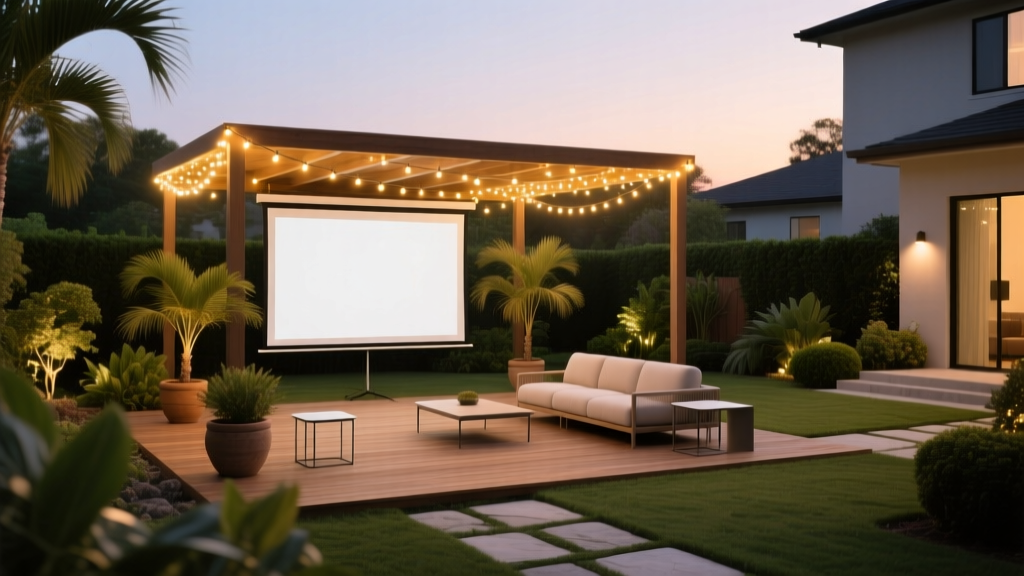
Patio Outdoor Movie Night Garden Lighting
The sun drops behind the fence, your projector finally finds focus on the screen, and then—right when the opening scene starts—someone trips over the hose, the snack table disappears into shadow, and the “cozy” vibe turns into a game of avoid-the-dark. Outdoor movie nights fail for the same reason most patios do after dusk: lighting wasn’t planned as part of the layout. The good news is you don’t need stadium brightness. You need a layered, glare-controlled lighting plan that protects the screen image, guides feet safely, and makes the garden feel intentional.
I’m going to walk you through a patio movie-night lighting design the way I would on a client site: start with the viewing geometry, build light in zones, then soften it with plants so it looks like a garden—not a parking lot. Along the way, you’ll see three real-world layouts (tiny rental balcony, standard suburban patio, and a larger mixed garden) with dimensions, costs, and plant palettes that behave well at night.
Start with the movie screen first: layout rules that protect picture quality
Rule 1: Keep light out of the projector beam
Any light aimed toward the screen washes out contrast. Place your brightest fixtures behind the audience, not beside the screen. If you have to light near the screen, use shielded, downward-facing fixtures and keep them low (think step lights, not wall sconces).
Rule 2: Use three lighting zones (not one big light)
Outdoor movie nights work when lighting is layered:
- Zone A — Task light (snack prep, grilling, cooler area): brighter, controlled, aimed down.
- Zone B — Circulation light (paths, steps, thresholds): low-level guidance lighting so no one trips.
- Zone C — Atmosphere light (plants, perimeter, canopy): warm, dim, and indirect—this is the “garden magic.”
Rule 3: Choose warm color temperature
For movie nights, warm-white light (around 2700K) feels comfortable and reduces harsh glare. Many landscape LEDs list this clearly on packaging.
Also note that if you’re trying to be kinder to nocturnal wildlife, the International Dark-Sky Association recommends warm color temperatures and good shielding to reduce skyglow and light trespass (International Dark-Sky Association, 2023).
Rule 4: Keep it dimmable and use timers
A dimmer turns your patio from “setup mode” to “screen mode” in seconds. A timer or smart plug prevents the classic post-movie moment: everyone tired, lights still blazing.
Practical dimensions: screen, seating, and walkways
Before you buy a single string light, sketch a quick plan with measurements. These numbers are reliable starting points for comfort and safety:
- Walkway clearance: aim for 36 inches minimum for the main route from door to seating; 24 inches can work for secondary garden paths.
- Seat-to-screen distance: for a common 100-inch diagonal screen, plan roughly 10–12 feet from the first row of seats (adjust to taste and projector brightness).
- Snack station footprint: allow a 24" x 48" table or cart plus 36 inches standing space in front.
- Uplight spacing for shrubs: place fixtures about 24–36 inches from the plant base to avoid scorching highlights.
- Path light spacing: a typical rhythm is 6–8 feet apart, staggered, rather than opposite each other (which can look like a runway).
For plant performance, most of the options below prefer 6+ hours of sun, while a few tolerate 3–4 hours for shadier patios.
Lighting strategy by layer (so it looks designed, not random)
Layer 1: Low, shielded circulation lighting
If your patio has any step, threshold, or change in grade, prioritize it. Trips happen in the first 10 minutes when people are carrying drinks. Use:
- Step lights (recessed or surface-mounted) aimed down.
- Solar path lights in low-traffic areas (fine for ambiance, less reliable for safety).
- LED tape under bench edges for a clean “floating” look.
Cost reality: simple solar path lights can be $3–$8 each, but consistent, warm, long-lasting units are often $10–$25 each. Wired low-voltage fixtures typically run more but look better and perform more consistently.
Layer 2: Soft perimeter lighting to define the “room”
This is where string lights and lanterns shine—literally. The trick is placement: keep them above eye level (7–9 feet high) and off to the sides so they frame the space rather than compete with the screen.
If your patio is exposed, anchor string lights to a pergola, fence posts, or tall planters with sturdy poles (for renters, weighted bases are your friend). Use warm LEDs and avoid bare bulbs in direct sightlines to the screen.
Layer 3: Plant-focused accent lighting (the secret sauce)
A single uplight on the right plant can make the whole garden feel intentional. Aim for lighting that hits texture: ornamental grasses, big-leaf evergreens, or a small multi-stem tree.
Use a narrow beam for a trunk or columnar plant, and a wider beam for a shrub mass. Keep accents subtle—your eyes should still favor the movie.
“Good landscape lighting is about controlling brightness and directing light only where it’s needed—glare is the enemy of comfort.” — Illuminating Engineering Society (IES) guidance summarized in their outdoor lighting recommendations (IES, 2020)
For technical grounding on glare and light pollution impacts, the American Medical Association also noted concerns with high-intensity blue-rich LED lighting and encouraged lower color temperatures for outdoor use (American Medical Association, 2016).
A quick comparison: common patio movie-night lighting options
| Lighting type | Best use | Typical cost | Strength | Watch-outs |
|---|---|---|---|---|
| Warm LED string lights (plug-in) | Perimeter glow, overhead “ceiling” | $25–$60 per 48 ft | Fast atmosphere, renter-friendly | Can glare if hung too low or in screen sightline |
| Low-voltage path lights (wired) | Safety lighting for routes | $20–$60 per fixture + transformer | Reliable, clean look | Install time; avoid runway symmetry |
| Solar path lights | Secondary paths, low-stakes ambiance | $3–$25 per light | No wiring | Performance varies; shade reduces charge |
| LED candles/lanterns | Tables, corners, kid-safe glow | $10–$40 | Portable, flexible | Easy to overdo; keep away from projector area |
| Directional uplights (low-voltage) | Feature plants, trunks, focal points | $35–$120 per fixture | High design impact | Bad aiming causes harsh hotspots or screen wash |
Three real-world layouts (steal these and adapt)
Scenario 1: Rental balcony or micro-patio (6' x 10')
The challenge: no staking, limited outlets, neighbors nearby, and you don’t want to blind anyone. The goal is a “movie nook” that packs away.
Layout: mount a small screen or hang a white sheet on the wall. Place two chairs at about 6–8 feet from the screen. Keep a 24-inch clear strip from the door to seating.
Lighting plan:
- One 16–33 ft warm LED string along the railing (below eye level but not facing the screen).
- Two LED lanterns on the floor behind seating for indirect glow.
- One clip-on warm reading light for the snack surface (turn it off during the movie).
Budget: Typically $45–$120 depending on lantern quality and whether you already own a smart plug.
Planting: Use planters to soften hard edges without taking floor space.
- Lavandula angustifolia ‘Hidcote’ (English lavender): fragrant, compact, handles sun; looks great edged with low light. Space about 12–18 inches in a trough planter.
- Heuchera ‘Obsidian’ (coral bells): deep leaves read well at night; tolerates part shade (3–4 hours sun). Space 12 inches.
- Carex oshimensis ‘Evergold’: arching variegated blades catch tiny highlights; space 12–15 inches in pots.
Scenario 2: Standard suburban patio (12' x 16') with a small lawn edge
The challenge: you want real atmosphere, but the patio needs to work for weeknights too. There’s usually one glaring wall light that ruins the screen.
Layout: place the screen at the short end (12' side) so seating can spread across the 16' depth. Keep the main circulation route along one side at 36 inches wide so late arrivals don’t cross in front of the projector.
Lighting plan:
- Replace/disable the harsh wall light and add a warm, shielded sconce on a dimmer (or use a plug-in wall lantern on a smart dimmer).
- Install 4–6 low-voltage path lights along the route from door to lawn at 6–8 feet spacing.
- Add two uplights aimed at plants behind or beside seating (not toward the screen).
- One string-light run at 8 feet high across the patio perimeter.
Budget: A basic low-voltage kit with transformer and 6 lights often lands around $180–$350, plus $25–$60 for string lights. DIY-friendly, but plan an afternoon for install and aiming.
Planting: Choose plants that look good in daylight and gain presence under warm light.
- Hydrangea paniculata ‘Bobo’: compact blooms that glow softly; handles sun/part sun (aim for 4–6 hours). Space 3 feet.
- Pennisetum alopecuroides ‘Hameln’ (dwarf fountain grass): catches uplight beautifully; space 24–30 inches. (Check local guidance—some ornamental grasses can be invasive in certain regions.)
- Buxus microphylla ‘Winter Gem’ (boxwood): evergreen structure for year-round lighting effects; space 2–3 feet.
- Salvia nemorosa ‘Caradonna’: upright stems, long bloom season, pollinator-friendly; space 18 inches.
Scenario 3: Mixed garden with a pergola and planting beds (20' x 30')
The challenge: larger space can feel disconnected at night—bright near the house, pitch-black at the back. Your goal is to create a clear “outdoor room” for viewing, with gentle cues that the garden continues.
Layout: put the screen under the pergola or at its edge, and place seating in a loose arc. Add a defined snack zone (a cart or small table) to one side so traffic stays out of the projector beam. Create a perimeter loop path with low lighting to keep guests exploring without stepping into beds.
Lighting plan:
- Pergola: dimmable string lights on the outer beams only (avoid the center line over the viewing axis).
- Circulation: 8–10 path lights at 7 feet spacing around the loop.
- Accent: 3 uplights—one for a small tree, one for a tall grass cluster, one for a textured evergreen.
- Task: one downward-facing light at the snack zone, on a separate switch.
Budget: With higher fixture counts, expect $450–$1,200 depending on fixture quality and whether you trench wiring yourself. The “big win” is focusing on just a few accents rather than lighting everything.
Planting: Use layered height so lighting has something to sculpt.
- Amelanchier lamarckii (serviceberry): multi-season interest; delicate branching looks striking when up-lit. Plant about 10–15 feet from the screen so it’s a backdrop, not a distraction.
- Ilex crenata ‘Sky Pencil’ (Japanese holly): narrow evergreen column for tight spaces; space 2–3 feet.
- Hakonechloa macra ‘Aureola’ (Japanese forest grass): luminous color in part shade; space 18–24 inches.
- Nepeta ‘Walker’s Low’ (catmint): soft mound that reads well in low light; space 18–24 inches.
Step-by-step: set up your movie-night lighting like a pro
- Turn off competing lights. Switch off any bright flood or cool-white security light during viewing. If needed for safety, keep it on a motion sensor aimed away from the screen.
- Mark the projector beam. At dusk, run the projector and visually note the cone of light. That’s your “no-glare zone.”
- Place circulation lights first. Light the path from the door to seating and the bathroom route. Keep fixtures low and aimed down.
- Add task lighting at the snack zone. Put it on a separate plug or switch so you can dim/turn off once everyone’s settled.
- Frame the space with warm ambient light. Hang string lights or place lanterns behind seating and along the perimeter—never in the direct viewing line to the screen.
- Pick one “hero” plant and aim an uplight. Start subtle. Step back to the seating area, then adjust the angle until the plant looks dimensional without glaring.
- Do a sit-test. Sit where guests will sit. If you can see the LED source directly, shield it, move it, or dim it.
- Lock in with timers. Set ambient lights to run for 4–6 hours and path lights for 6–8 hours so you’re not thinking about it at the end of the night.
Plant selection: varieties that make night lighting look expensive
When you’re choosing plants specifically for evening use, prioritize texture, structure, and light-colored blooms or variegation. Under warm LEDs, pale surfaces glow; glossy leaves reflect; fine grasses shimmer.
Best performers for uplighting and moonlighting
- Hydrangea paniculata ‘Limelight’: larger than ‘Bobo’ (more space needed), but the blooms hold presence after dark. Space roughly 6 feet.
- Miscanthus sinensis ‘Morning Light’: fine blades that catch tiny highlights; place as a screen-side “curtain” only if it won’t sway into the projector beam. Space 3–4 feet.
- Hosta ‘Sum and Substance’: huge leaves that read well in shade lighting; great for north-facing patios with 3–4 hours sun. Space 4–5 feet (it gets big).
- Pittosporum tobira ‘Variegata’: evergreen, reflective foliage, works in mild-winter climates; space 4–6 feet.
Fragrance near seating (keep it subtle, keep it close)
- Jasminum officinale (common jasmine): train on a trellis near the patio; fragrant evenings. Give it a support panel about 6 feet tall.
- Nicotiana alata (flowering tobacco): evening fragrance, seasonal color. Plant 12 inches apart in pots or beds.
- Dianthus ‘Firewitch’: spicy-sweet scent, compact, good edging; space 12 inches.
Budget and DIY alternatives (without sacrificing design)
If you’re keeping costs tight, put money where it shows: one dependable circulation route and one good accent light. Everything else can be flexible and portable.
- DIY renter poles: Set 8-foot 2x2s into large planters filled with gravel and soil. Add hooks for string lights. Total cost can be $25–$60 per pole depending on planter size.
- “Moonlight” without wiring: Clamp a warm LED work light high on a fence post, aimed down through foliage. Add a simple metal shade to cut glare.
- Portable path lighting: If you can’t stake lights, line a path with LED lanterns or mason-jar solar lids spaced about 4 feet apart for a guided edge.
- Smart plug control: A single outdoor-rated smart plug ($15–$30) can automate string lights and lanterns together.
Maintenance expectations: keep it looking good with minimal effort
Plan on 20–40 minutes per week during the main season to keep the movie zone guest-ready: quick sweep, wipe the snack table, deadhead flowers in pots, and check that path lights are upright and clean.
Monthly (10–20 minutes): wipe lenses on uplights and path lights—dust and pollen can cut output noticeably. Re-aim any fixtures that got bumped by a hose or a soccer ball.
Seasonal tasks:
- Spring: prune winter damage, refresh mulch in lit beds (a 2-inch mulch layer reduces weeds and helps the lighting read cleaner).
- Summer: trim plants away from fixtures so leaves don’t block beams; check irrigation so it’s not spraying onto lights.
- Fall: cut back ornamental grasses if you prefer tidy winter lines, or leave them for winter sparkle and just tie them loosely.
- Winter: store portable lanterns; check cable connections after freezes; consider swapping to a “winter mode” with fewer, warmer lights for cozy evenings.
If your patio movie night is a monthly ritual, the design goal is simple: guests should be able to walk in, find a seat, and relax without anyone thinking about the lighting at all. When the screen is crisp, the path is obvious, and a few plants glow gently at the edges, the garden becomes part of the experience—the outdoor room your home deserves after dark.
Sources: International Dark-Sky Association (2023), guidance on responsible outdoor lighting and warm color temperatures; American Medical Association (2016), report on LED outdoor lighting and blue-rich light concerns; Illuminating Engineering Society (IES) outdoor lighting recommendations summarized from IES publications (2020).