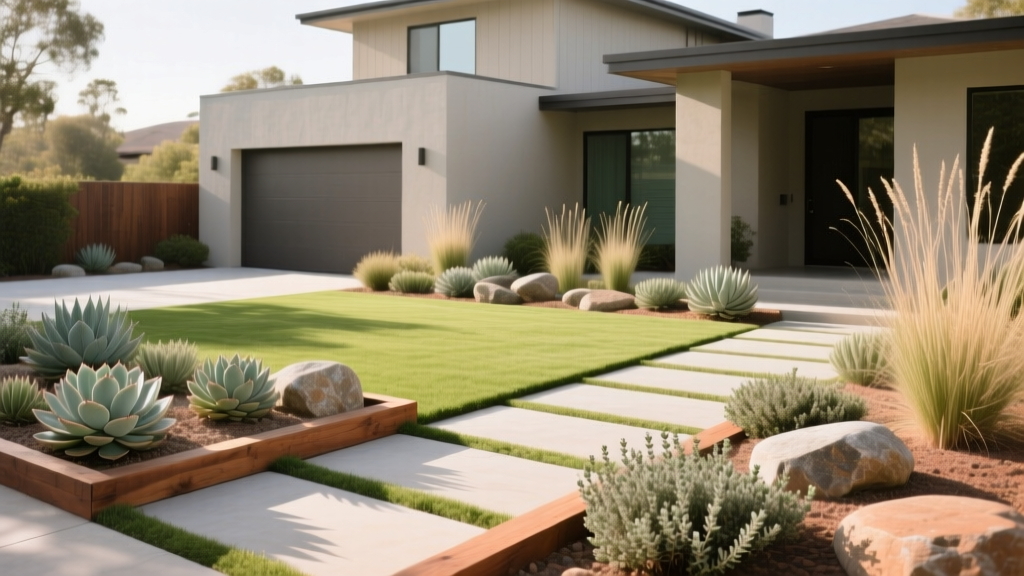
Front Yard Low-Maintenance Lawn Alternative
It’s 6:45 p.m. on a Tuesday, and the front yard is quietly judging you. The grass looks uneven, the edges are frayed, and the sun-baked patches near the sidewalk won’t green up no matter how many “revive your lawn” products you’ve tried. You can hear the sprinkler clicking on—again—watering mostly concrete. If you’ve ever stood at your window thinking, “Why am I spending time and money maintaining something I don’t even use?” you’re ready for a front-yard lawn alternative that looks intentional and stays tidy with far less work.
I’m going to walk you through a designer-style layout that fits real life: small spaces, HOA expectations, renters who need reversible changes, and homeowners who want fewer weekend chores. We’ll focus on clean lines, durable plants, and a plan you can install in phases without tearing up your whole yard at once.
Start with the “view from the street” and design backward
The front yard is public-facing. That means your best investment isn’t a perfect carpet of green—it’s clarity. When people (and delivery drivers) glance at your home, they read the space in seconds: where to walk, what’s intentional, and whether it’s cared for.
Design principle #1: Keep a simple structure (paths + planting zones)
Even the most drought-tolerant, wildlife-friendly yard can look messy if it’s one continuous bed. Divide the area into three legible zones:
- Arrival zone: the walkway, porch steps, mailbox area.
- Foundation zone: planting along the house (softens walls, hides utilities).
- Street/curb zone: what you see from the road (needs strong shapes, repetition).
If you’re replacing lawn, think like a designer: you’re not “getting rid of grass,” you’re creating rooms in miniature with edges that communicate care.
Design principle #2: Use repetition, not collections
A common DIY mistake is buying one of everything: one lavender, one sedum, one ornamental grass. It looks like a sampler platter. Instead, pick 5–7 core plants and repeat them in drifts. A drift can be as small as 3 plants in a triangle, repeated every 6–10 feet for rhythm.
Design principle #3: Edges are 80% of “low maintenance”
A crisp border does more than look good—it reduces weed creep and keeps mulch or gravel from spilling onto sidewalks. Use steel edging, brick, or a shallow trench edge. For a typical 30 ft x 20 ft front yard (~600 sq ft), plan on roughly 60–90 linear feet of edging depending on layout.
Three layout strategies that replace lawn without looking “bare”
Below are three designer-tested layouts. Each can be scaled to a tiny townhouse strip or a larger suburban yard.
Layout A: The planted “carpet” (groundcovers + stepping path)
This is the closest visual substitute for a lawn, but with far less mowing. Think creeping thyme, sedums, or low water clover alternatives—paired with a stepping-stone path so you can cross the yard without trampling plants.
Best for: sunny front yards with 6+ hours of direct sun.
Key dimension tip: set stepping stones 18–24 inches apart (center-to-center) for comfortable walking. Standard steppers are often 18 inches wide; you’ll want a path width of 30–36 inches so it feels like a real entry route.
Layout B: The “island beds” approach (keep a small green patch or none at all)
If your neighborhood expects “some lawn,” you can keep a small rectangle of turf (or a no-mow fescue) and surround it with planting islands. The islands handle the heavy lifting visually, and the remaining lawn is small enough to trim quickly.
Best for: HOA areas or anyone easing into change.
Key dimension tip: keep any remaining turf area under 150 sq ft (for example, 10 ft x 15 ft). That’s a five-minute mow, not a Saturday project.
Layout C: The gravel garden with planted pockets (modern, clean, tough)
This is my go-to for hot, dry exposures and for homeowners who travel. A gravel surface reads neat from the street, drains well, and lets you plant drought-tolerant shrubs and perennials in grouped pockets.
Best for: full sun, poor soil, minimal irrigation, and modern architecture.
Key dimension tip: plan gravel at 2–3 inches deep over a stabilized base (landscape fabric optional depending on weed pressure and soil). Keep plants in pockets of amended soil, each pocket about 24–36 inches across for perennials, larger for shrubs.
Plant palette: specific varieties that behave in front yards
Low maintenance doesn’t mean “no care.” It means plants that stay in bounds, handle stress, and look good without constant grooming. I’ll give you reliable options and why they work, with spacing so you can estimate quantities.
Sunny front yard (6–8 hours sun): tough, tidy, drought-smart
- Lavandula angustifolia ‘Hidcote’ (English lavender): compact, holds a rounded shape, great curb appeal. Spacing: 18–24 inches. Why it works: drought-tolerant once established; strong scent deters browsing in many areas.
- Nepeta x faassenii ‘Walker’s Low’ (catmint): long bloom, softens edges, reliable. Spacing: 24–30 inches. Why it works: rebounds after shearing; pollinator magnet.
- Salvia nemorosa ‘Caradonna’: upright purple spikes, stays relatively narrow. Spacing: 18–24 inches. Why it works: strong structure; repeat bloom with a mid-season cutback.
- Perovskia atriplicifolia ‘Little Spire’ (Russian sage): airy but structured, excellent heat tolerance. Spacing: 24–36 inches. Why it works: thrives in lean soils; great with gravel layouts.
- Festuca glauca ‘Elijah Blue’ (blue fescue): tidy clumps, year-round form. Spacing: 12 inches. Why it works: acts like living “dots” that keep a design crisp.
- Thymus serpyllum ‘Elfin’ (creeping thyme): low, walk-tolerant in light traffic. Spacing: 8–12 inches. Why it works: forms a living mat; flowers bring pollinators.
Part sun (3–6 hours): reliable groundcovers and foundation plants
- Carex oshimensis ‘Evergold’ (sedge): clean, arching foliage, evergreen in mild climates. Spacing: 18 inches. Why it works: looks manicured without trimming.
- Heuchera ‘Caramel’ or ‘Palace Purple’ (coral bells): colorful foliage, neat mounds. Spacing: 12–18 inches. Why it works: color without relying on blooms; great near porches.
- Geranium macrorrhizum ‘Ingwersen’s Variety’ (hardy geranium): weed-suppressing groundcover. Spacing: 18 inches. Why it works: handles dry shade better than many options; spreads politely.
Foundation shrubs that don’t eat your windows
- Buxus microphylla ‘Winter Gem’ (boxwood): classic structure in many regions. Spacing: 24–36 inches. Why it works: holds shape; pairs well with any style. (Note: check local boxwood blight pressure.)
- Ilex glabra ‘Gem Box’ (inkberry holly): boxwood look-alike, native in parts of the U.S. Spacing: 24–36 inches. Why it works: evergreen structure; less shearing than larger hollies.
- Spiraea japonica ‘Magic Carpet’: compact, colorful foliage. Spacing: 24–30 inches. Why it works: durable, easy to prune once a year.
“In residential landscapes, simplicity and repetition are not aesthetic constraints—they’re maintenance strategies. Fewer plant types, repeated in groups, are easier to care for and read as intentional.” — Thomas Rainer, landscape architect, quoted in his planting design guidance for layered, repeatable plant communities (Rainer & West, 2015)
Comparison table: three lawn alternatives at a glance
| Option | Best Sun | Typical Install Cost (DIY materials) | Weeding Expectation | Street-Curb Look |
|---|---|---|---|---|
| Living groundcover “carpet” (thyme/sedum/clover mix) | 6+ hours | $2–$6 per sq ft | Moderate first year, low after fill-in | Soft, green, approachable |
| Island beds + small turf patch | 4–8 hours | $1.50–$5 per sq ft (depends on bed size) | Low–moderate, concentrated in beds | Traditional, HOA-friendly |
| Gravel garden + planted pockets | 6–10 hours | $3–$10 per sq ft | Low if edged well; occasional seedlings | Modern, crisp, drought-smart |
Real-world scenarios: choose the plan that fits your life
Let’s map this to real front yards—because the “best” design is the one you can actually maintain.
Scenario 1: The tiny townhouse strip (12 ft x 8 ft) with heat-reflecting sidewalk
This is a classic problem: intense sun, compacted soil, and no room for a mower. Go with Layout A (planted carpet) plus a micro-path.
Suggested layout:
- A 30-inch stepping-stone path from sidewalk to door.
- Creeping thyme (or sedum in colder regions) as the main green layer.
- Two vertical accents near the door: 2 pots (14–18 inches wide) with dwarf grasses or rosemary (if hardy in your zone).
Plant quantities: For ~96 sq ft, thyme at 10-inch spacing takes roughly 140–150 plugs. If that feels like a lot, plant at 12 inches (about 90–100 plants) and let it fill in over 1–2 seasons.
Scenario 2: The suburban front yard (30 ft x 20 ft) where you want “polished” with less water
This is where Layout B shines. Keep a small, intentional turf rectangle near the center (or skip turf entirely and use sedge/groundcover), then design two mirrored beds on each side for a balanced, classic look.
Suggested layout dimensions:
- Central open area: 10 ft x 15 ft (150 sq ft) of low-input turf or no-mow fescue.
- Two side beds: each about 8 ft x 15 ft.
- Foundation planting strip: 3–4 ft deep along the house.
Budget snapshot (DIY): If you convert 450 sq ft of lawn to beds and groundcover at an average of $4/sq ft in materials, you’re around $1,800. Spread that across two weekends and two planting phases, and it becomes manageable.
Scenario 3: The rental or “I might move” yard (permission-limited, needs reversibility)
You can still replace the lawn feeling without ripping anything out. Think: contained changes that look like upgrades and can move with you.
- Use 3–5 large planters (18–24 inches wide) to create structure.
- Add a 3 ft x 6 ft gravel pad under planters (contained with edging) for a designed look.
- Overseed with microclover in existing turf to reduce mowing and watering (check local guidance and landlord rules).
This approach also helps you test plant choices—if a plant scorches in afternoon sun, you can move it rather than replace it.
Step-by-step: install a low-maintenance front yard in a weekend (or two)
Here’s a practical sequence that keeps the project clean and avoids the common “half-finished yard” look.
- Measure and sketch. Mark property lines, existing trees, utilities, and the path. For accuracy, use a tape measure and draw to scale (1 inch = 2 feet works well for small yards).
- Decide your circulation. Your primary path should be 30–36 inches wide. If you already have a straight walk, echo that line with beds that run parallel for a calm look.
- Kill or remove turf. For DIY, sheet-mulching works well: lay cardboard (overlap 6 inches), water it, then add 3–4 inches of compost/mulch. If you need faster results, sod-cut and remove.
- Install edging early. This sets the geometry and keeps materials where they belong. Aim for at least 60 linear feet of edge in a mid-size yard for clear definition.
- Place hardscape (steppers or gravel areas). Set stepping stones on compacted base so they don’t wobble. For gravel, aim for 2–3 inches depth.
- Plant big to small. Start with shrubs (structure), then perennials (seasonal color), then groundcovers (weed suppression). Keep plants back from sidewalks by 6–12 inches to avoid overhang.
- Mulch or top-dress. Use 2 inches of mulch around plants (not piled against stems). In gravel gardens, top-dress planting pockets with a thin layer of gravel for a cohesive look.
- Water in and set a short-term schedule. For most new plantings, plan on deep watering 2–3 times per week for the first few weeks, then taper as roots establish (adjust for climate and rainfall).
Cost planning: where the money goes (and where to save)
A lawn alternative can be surprisingly affordable if you avoid two traps: buying too many different plants, and overbuilding hardscape.
Concrete numbers to anchor your budget:
- Edging: steel edging often runs roughly $2–$4 per linear foot.
- Mulch: a common target is 2 inches deep. For 300 sq ft, that’s about 1.85 cubic yards of mulch.
- Gravel: at 2 inches depth, 100 sq ft takes ~0.62 cubic yards.
- Perennials: 1-gallon pots often space at 18–24 inches; a 100 sq ft bed typically takes 20–35 plants depending on spacing.
- DIY install range: many front yards land around $1,200–$3,500 depending on plant size, edging, and how much gravel/stone you use.
DIY alternatives that still look designed:
- Use smaller plants (plugs or 4-inch pots) for groundcovers; they cost less but need patience.
- Skip fancy pavers: use irregular flagstone steppers set in gravel for a relaxed, high-end feel.
- Phase the project: build the path and edges first, then plant one bed this season and the second next season.
Water use and sustainability: smart choices that reduce inputs
Replacing turf can reduce water demand significantly, especially in dry regions. The U.S. Environmental Protection Agency notes that outdoor water use can account for a large share of household consumption, and landscaping is a major driver (EPA WaterSense, 2023). A design that uses drought-adapted plants and efficient irrigation (or none after establishment) cuts both cost and hassle.
Also, if you’re reducing lawn to improve resilience, you’re aligned with broader research on turfgrass water needs. The National Academies report on urban water conservation identifies landscape irrigation as a key opportunity area for savings (National Academies of Sciences, Engineering, and Medicine, 2016).
Maintenance expectations: what “low maintenance” really looks like
A well-designed lawn alternative should feel like a quick check-in, not a weekly project. Here’s a realistic maintenance rhythm for a planted front yard once established (after the first growing season):
- Weekly (growing season): 15–30 minutes for a quick weed patrol and deadheading a few blooms near the entry.
- Monthly: 30–45 minutes to edge check (keep lines crisp), trim anything leaning into paths, and look for irrigation issues if you use drip.
- Spring: cut back perennials, refresh mulch/gravel where thin, and divide any clumps that outgrew their spot.
- Summer: deep water only during prolonged dry spells; shear catmint or salvias once for rebloom.
- Fall: light cleanup—leave some seedheads if you like winter interest, but keep the front edge tidy for a cared-for look.
The first year is always the most hands-on because you’re helping plants establish and staying ahead of weeds. After plants fill in, the work drops sharply—especially if you’ve used groundcovers and tight spacing.
Small design moves that make it look intentional (and neighborhood-friendly)
If you’re worried a lawn alternative will read as “unfinished,” these details solve it:
- One clear path. People need an obvious place to walk. A 36-inch width feels welcoming.
- One evergreen anchor. A pair of dwarf evergreens by the porch or mailbox creates year-round structure.
- Repeat two plants. For example: drifts of ‘Walker’s Low’ catmint + ‘Elijah Blue’ fescue. Repetition reads as design, not chaos.
- Keep the curb edge clean. A crisp border along the sidewalk is the difference between “wild” and “well-designed.”
If you stand back at the sidewalk and the yard reads as three calm shapes—path, planted area, and a focal point near the door—you’ve succeeded. The best part is that a front yard like this doesn’t nag you every weekend. It quietly holds its shape, greets you warmly, and lets you spend your time on plants you actually enjoy.
Citations: U.S. Environmental Protection Agency, WaterSense program materials on outdoor water use (2023); National Academies of Sciences, Engineering, and Medicine, Using Graywater and Stormwater to Enhance Local Water Supplies (2016); Rainer, T. & West, C., planting design principles and repetition guidance from Planting in a Post-Wild World (2015).