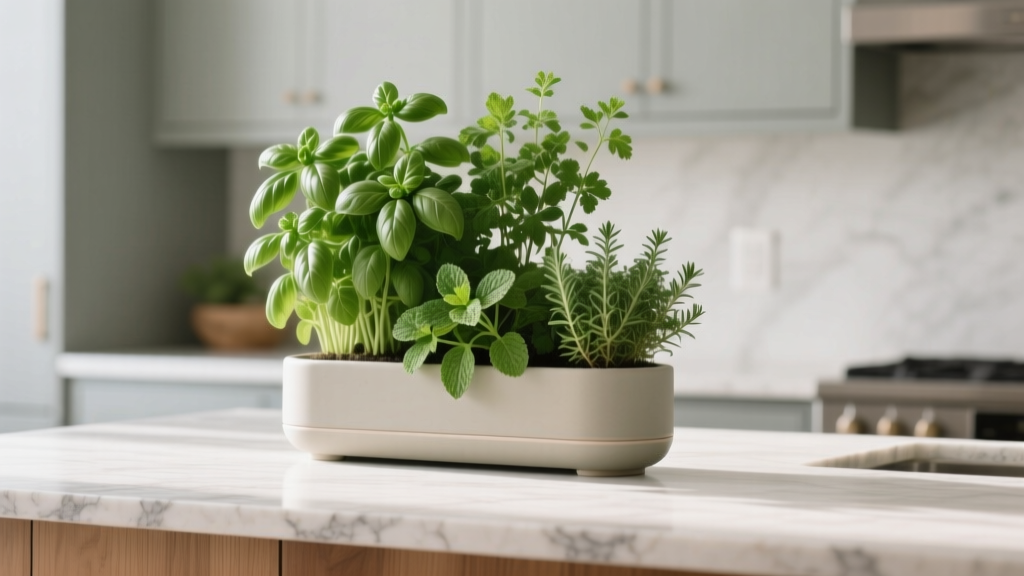
Kitchen Countertop Herb Garden Setup
It usually starts at 6:17 p.m.: pasta water boiling, a pan warming, and you realize the basil in the fridge has turned to green lace. You can almost taste how much better dinner would be with a few just-pinched leaves—bright, alive, not the limp clamshell leftovers. A countertop herb garden fixes that problem, but it has to be designed like a real micro-landscape, not a random collection of pots fighting for light next to the toaster.
Think of your counter as a tiny jobsite with constraints: splash zones, heat vents, window angles, and your actual habits. My goal here is to walk you through a setup that looks intentional, performs consistently, and stays easy enough that you keep it for years—even if you rent, even if your “garden space” is a 24-inch patch of laminate.
Design the counter like a mini site plan
Start with a measured footprint (and protect your work surface)
Before you buy anything, measure the usable rectangle you can truly spare. A very workable standard is 24 in wide x 10 in deep (about the space between a corner and a sink). If you can give it 30 in x 12 in, you’ll have room for a small tray plus a watering can without feeling crowded.
Plan for water. Even careful watering will drip, and herbs hate sitting in a swamp. Use a waterproof tray that’s at least 1 inch deep and slightly larger than your pots. A boot tray, cafeteria tray, or a plant tray works. Expect $8–$20 for a tray, or DIY it with a shallow baking sheet lined with a silicone mat.
Map your light: hours matter more than “bright kitchen” vibes
Most culinary herbs are happiest with 6–8 hours of direct sun from a south or west window. If your window only provides 2–4 hours, you can still grow herbs, but you’ll want either (a) shade-tolerant choices or (b) a compact grow light.
For indoor edible plants, light intensity is the make-or-break variable. University Extension resources consistently emphasize that many herbs require bright light indoors for compact growth and good flavor. For example, the University of Minnesota Extension notes that herbs generally need a sunny window and that insufficient light leads to weak, leggy plants (University of Minnesota Extension, 2020).
Keep herbs away from stress zones (heat, drafts, and soap spray)
Three countertop hazards sabotage indoor herbs:
- Heat bursts from ovens, air fryers, and ranges: leaves dry out fast, and pots can overheat.
- Cold drafts from leaky windows: basil and cilantro sulk below about 50–55°F indoors.
- Sink splash and soap aerosols: wet foliage invites mildew; detergent residue can stress leaves.
If the only good light is near the sink, place your herb tray at least 12 inches away from the faucet line and use taller back-row plants as a “splash buffer.”
Layout strategies that make a countertop garden feel designed
The “three-tier” arrangement: tallest to shortest (back to front)
This is the easiest way to make the garden look curated while improving light distribution. Put taller, upright herbs in the back, mounding or trailing plants mid-row, and compact plants in front. On a 10–12 inch deep counter, you can usually fit two rows comfortably if your pots are modest.
Recommended spacing: aim for 3–4 inches between pot rims to allow airflow and make pruning easy. Crowded herbs are more likely to develop fungus gnats and mildew.
Work in odd numbers and repeat materials
Three, five, or seven pots look intentional. Mix-and-match containers can work, but repeat one element—same color, same height, or same material—so it reads as a set. A clean trick: use identical outer cachepots and keep herbs in standard nursery pots inside for easy lifting and drainage checks.
Use a single “utility zone” for tools and watering
Countertop gardens fail when watering becomes annoying. Reserve a 6-inch section of the tray for a small watering bottle or a narrow-spout can. If you don’t have that space, mount a slim grow light and store watering tools elsewhere—just don’t force yourself to move five things every time you water.
Drainage is non-negotiable: choose pots with holes
Herbs want moist soil, not standing water. Use containers with drainage holes and a tray. If you fall in love with a pot with no holes, treat it as a cachepot only—keep the herb in a plastic pot inside.
“Form follows function—that has never been more true than with living systems. If the drainage and light aren’t designed first, the styling won’t survive.” — Claudia West, landscape designer and co-author focused on ecological planting design (West, 2017)
Pick the right system: window-only or grow-light supported
| Setup Type | Best For | Typical Footprint | Upfront Cost | Expected Results |
|---|---|---|---|---|
| Sunny window (no grow light) | South/west window with 6–8 hrs sun | 24 in x 10–12 in | $35–$90 | Compact, flavorful herbs if watered well |
| Window + clip-on LED grow light | 2–5 hrs sun, winter support | 24 in x 10–12 in | $60–$140 | Stronger growth, less legginess year-round |
| Grow light only (no direct sun) | Apartments with shaded windows | 18–24 in x 10–12 in | $80–$180 | Reliable harvests; requires timed lighting |
For grow lights, aim for a simple LED bar or gooseneck positioned 6–12 inches above the plant tops. Run it 12–14 hours/day on a timer. That single timer is the difference between a hobby and a system you don’t have to think about.
Plant selection: varieties that behave on a countertop
The best countertop herbs share three traits: they tolerate container life, they rebound after frequent harvesting, and they don’t demand a huge root run. Below are favorites I specify for indoor edible planters, with particular varieties that perform reliably.
Top performers for most kitchens
- Sweet basil (‘Genovese’): Classic flavor, fast regrowth. Keep it warm and pinch tips weekly to prevent legginess. Basil is a light-hungry herb—plan on 6+ hours direct sun or supplemental light.
- Chives (‘Common’ or garlic chives): Extremely forgiving, upright form, clean edges in a design. Tolerates slightly lower light than basil. Great for renters because it’s resilient.
- Parsley (‘Italian Flat Leaf’): Dense foliage, high utility. Parsley does well in a deeper pot; give it at least 6 inches of soil depth.
- Thyme (‘German Winter’): Compact, woody, and drought-tolerant once established. Good front-row plant in the three-tier layout.
- Mint (‘Spearmint’ in its own pot): Vigorous, aromatic, and forgiving—just isolate it. Mint spreads aggressively and will overtake a mixed planter.
Great choices for lower-light windows (2–4 hours sun)
- Mint (‘Moroccan’): Handles indoor life well; keep evenly moist.
- Chives: Still upright and usable with moderate light.
- Lemon balm: Similar to mint; bright flavor and tolerates indoor conditions. Also best in its own pot.
Herbs that can be finicky indoors (choose them with intent)
- Cilantro (‘Slow Bolt’): Wants cooler temps and can decline quickly indoors; grow in succession every 3–4 weeks.
- Rosemary (‘Arp’): Possible indoors, but needs very bright light and careful watering. If your kitchen runs dry in winter, consider rosemary a “high-light specimen” rather than a guaranteed workhorse.
- Dill (‘Bouquet’): Can get tall and floppy; use a deeper pot and place it at the back.
One practical note: grocery-store “living herb” pots are often multiple seedlings crammed into one container. They look lush, then crash. If you buy one, gently split it into 2–4 smaller pots within a week.
Three real-world layout scenarios (and exactly what to build)
Scenario 1: The renter with one bright window and 2 feet of counter
Site conditions: South-facing window, about 7 hours of sun in summer, 4–5 hours in winter. Limited counter: 24 in x 10 in.
Design: A five-pot lineup in a tray, two rows (3 in back, 2 in front). Use matching 4.5–5 inch pots.
Planting plan: Back row: basil, parsley, chives. Front row: thyme, oregano (‘Greek’). Keep mint out of this mix to avoid crowding and constant moisture demands.
Budget: Pots and tray $35–$60, soil $8–$12, seedlings $3–$6 each (total around $55–$95).
Scenario 2: The dim apartment kitchen that needs a grow light
Site conditions: North-facing window, 1–2 hours of weak direct sun. Counter space: 18 in x 12 in beside the coffee station.
Design: A compact “light shelf” setup: three 6-inch pots in a single row with a slim LED bar mounted under a cabinet or on a stand. Light height: 8 inches above foliage, on a timer for 13 hours/day.
Planting plan: Basil (‘Genovese’) + chives + parsley. These give maximum culinary payoff per square inch.
Budget: LED light with timer $30–$60, three pots $15–$30, tray $10–$15, soil $10, plants/seeds $10–$18. Total: roughly $75–$135.
Scenario 3: The busy cook who wants “snip-and-go” herbs with minimal fuss
Site conditions: West window, strong afternoon sun, but the owner forgets to water. Counter space is generous: 30 in x 12 in.
Design: Fewer pots, bigger soil volume for moisture buffering: three 7–8 inch pots spaced widely, plus one separate mint pot. Use a deep tray and add a pebble layer under pots (not inside them) to keep bases from sitting in runoff.
Planting plan: Rosemary (if light is truly strong), thyme, oregano, plus mint in its own container. These tolerate slight drying better than basil.
Budget: Larger pots cost more—expect $12–$25 each. Total system often lands around $80–$160, but you’ll replace plants less often.
Step-by-step: build the countertop herb garden (designer’s sequence)
- Measure your footprint (aim for at least 18 in x 10 in) and choose a tray that fits with 1–2 inches to spare on each side.
- Confirm light: track sun for one day. If you get less than 4 hours direct sun, plan on a grow light.
- Select containers: choose pots with drainage holes. For most herbs, a 5–6 inch diameter pot works; parsley and dill appreciate 6–8 inches depth.
- Choose a soil mix: use a quality indoor potting mix (not garden soil). For better drainage, blend in 20–30% perlite if your mix feels heavy.
- Pot up correctly: plant so the crown sits at the same level it was growing before. Firm lightly—don’t pack hard.
- Water to settle: water until you see runoff, then empty the tray after 10 minutes. This prevents soggy roots and fungus gnat issues.
- Place and rotate: set tallest plants at the back. Rotate each pot a quarter turn every 3–4 days for even growth.
- Set your harvesting rule: never remove more than about 1/3 of a plant at once. Pinch basil above a leaf node to force branching.
- If using a grow light: set the lamp 6–12 inches above the plants and put it on a timer for 12–14 hours/day.
Maintenance expectations (what it really takes)
If the layout is right, upkeep is pleasantly small. Plan on 15–25 minutes per week for watering checks, quick pruning, and rotating pots. Add another 10 minutes every couple of weeks for cleanup (dead leaves, tray wipe-down).
Weekly rhythm
- Water check 2–3 times/week: most herbs prefer the top 1 inch of soil to dry slightly before watering again. Basil likes more consistent moisture; thyme likes a drier cycle.
- Harvest/pinch once/week: this is both cooking and pruning. It keeps plants compact and prevents flowering (which can reduce leaf quality for some herbs).
- Rotate pots for balanced growth, especially at windows.
Seasonal tasks (yes, indoor gardens have seasons)
- Winter: expect slower growth; increase light support. Many homes have drier air—grouping plants on a tray helps slightly, but avoid misting leaves constantly (it can encourage fungal issues).
- Spring: repot if roots circle the pot bottom. Many herbs appreciate fresh soil every 6–12 months.
- Summer: watch heat spikes near sunny windows; soil dries faster. Water in the morning so foliage dries by evening.
For food safety, wash harvested herbs before use. If you use any pest control indoors, stick to methods labeled for edibles and follow instructions carefully. If pests show up (common ones are aphids and fungus gnats), address the cause—often overwatering or poor airflow.
Budget-minded design choices and DIY alternatives
A countertop herb garden can be as polished or as scrappy as you want—as long as the functional basics are right. Here are practical ways to keep costs down without sacrificing performance.
Where to spend
- Light (if needed): a reliable LED and timer prevents repeated plant replacement.
- Soil: good potting mix reduces pests and improves root health.
Where to save
- Tray: thrift a cafeteria tray or use a baking sheet. Add felt pads under it to prevent counter scratches.
- Containers: reuse nursery pots inside thrifted cachepots. Just keep drainage functional.
- Propagation: mint, oregano, and thyme can be rooted from cuttings, reducing the need to buy new plants.
If you’re renting and avoiding wall holes, choose a clamp-style grow light, or use a freestanding shelf that straddles the tray. You can also tuck a slim light under an upper cabinet with removable adhesive strips rated for the fixture weight—test first and follow the manufacturer’s guidance.
Planting details that keep herbs flavorful (not just alive)
Flavor is a design outcome. When herbs stretch toward light, leaves get thinner and less aromatic. When roots sit wet, growth turns soft and bland. To keep that “just-picked” punch, aim for steady growth: bright light, consistent but not excessive watering, and frequent tip pinching.
Research and extension guidance often emphasize that indoor herbs need high light for quality growth. The National Gardening Association notes that most herbs require strong light indoors and that a sunny window or supplemental lighting is often necessary for robust plants (National Gardening Association, 2021).
Also: harvest like a chef, prune like a gardener. Basil should be pinched above a node to branch. Parsley is best harvested by taking outer stems near the base, leaving the center to keep producing. Thyme can be snipped as sprigs, but avoid cutting deep into leafless woody stems.
The best moment is a week after setup, when you’ve watered twice and pinched once, and the plants stop reading as “new purchases” and start reading as part of your kitchen. You’ll know the layout works when it fades into your daily routine: the tray catches drips, the tallest pot doesn’t shade the rest, and you can reach in with one hand, snip what you need, and keep cooking.
Sources: University of Minnesota Extension (2020); Claudia West (2017); National Gardening Association (2021).