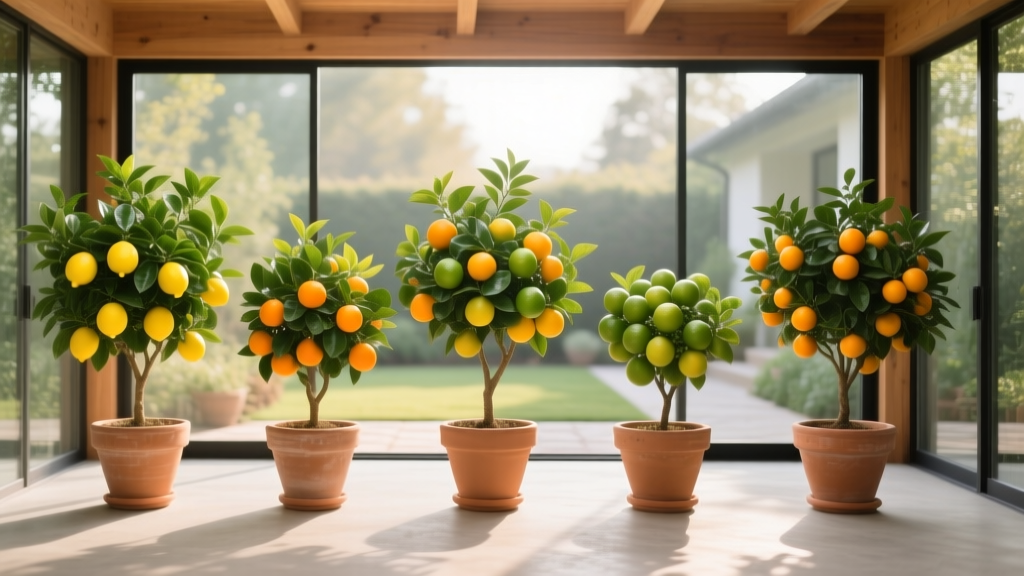
Sunroom Citrus Indoor Orchard
It usually starts the same way: you’re standing in your sunroom on a gray February morning, coffee in hand, staring at a tangle of houseplants that look… fine. Alive, technically. But the room feels like it’s waiting for something. Outside, winter has shut the garden down. Inside, the light is gorgeous—4, 5, sometimes 6 hours of sun slanting across the floor—and it feels like a missed opportunity.
This is where an indoor citrus orchard earns its keep. Not a single lemon tree in the corner as a novelty, but a designed layout: trees placed for light, airflow, and access; containers chosen so you can actually move them; a watering plan that doesn’t ruin your flooring; and varieties that fruit reliably in the conditions a sunroom can offer. Think of it like designing a tiny, edible conservatory—only it’s your house, not an estate greenhouse.
Design principles that make citrus thrive indoors
Start with light mapping, not plant shopping
Before you buy anything, map your sun. Citrus wants strong light—ideally 6–8 hours of direct sun for best flowering and fruiting. Many sunrooms deliver 4–6 hours depending on season and orientation, which can still work if you choose varieties wisely and supplement in winter.
Do this quick check for three days: mark where direct sun hits at 10 a.m., 1 p.m., and 4 p.m. Use painter’s tape on the floor. You’ll end up with a “high-sun runway” that becomes your primary orchard strip. Everything else is secondary planting.
“Light is the limiting factor indoors; you can compensate for many things, but not for chronic low light without adding fixtures.” — Dr. Roberto Lopez, floriculture and controlled environment specialist, Purdue University (Lopez, 2018)
Design for access: citrus is hands-on
Indoor trees need regular rotation, leaf checks, pruning, and watering. If you can’t reach a pot without scraping a wall, you’ll skip tasks—and pests love skipped tasks.
A practical rule: keep a 24-inch clear path in front of the orchard line. If your sunroom is narrow, design a single row along the glass and keep the interior open. If it’s wide, go for a U-shape with a small working zone in the center.
Think in “orchard modules”: one tree + its footprint
In container form, most dwarf citrus needs a comfortable footprint of about 24–30 inches wide once you account for the pot, drip tray, and a little air space around the canopy. That means a row of three trees wants roughly 7–8 feet of linear window wall.
Spacing matters indoors for airflow. Poor airflow is a fast track to scale insects and sooty mold. Aim for 18–24 inches between pot rims, and prune to keep canopies from touching.
Water containment is part of the layout
If you only take one design detail from a professional install, take this: build the orchard on a water-safe base. Citrus likes deep watering, which means occasional runoff.
Use one of these approaches:
- Boot tray line: Place each pot on a heavy-duty boot tray (common size 30 x 15 inches).
- Bench system: A slatted bench with a waterproof mat beneath it, so air moves under pots and you can slide trays out.
- Rolling saucers: Best for renters—each pot gets a rolling plant caddy with a deep saucer insert.
Layout strategies for real sunrooms
Layout A: The “window wall orchard” (best for narrow rooms)
If your sunroom is roughly 6–8 feet wide, keep the design simple: a single row of dwarf citrus along the brightest glazing. Place the tallest tree at one end (not in the middle) so it doesn’t cast shade across the lineup.
Suggested dimensions: For a 10-foot window wall, plan for 3 trees with 24 inches between pots and a 24-inch walkway.
Layout B: The “U-shaped micro-orchard” (best for wide, bright rooms)
In a larger sunroom—say 10 x 12 feet—a U-shape gives you more trees without crowding. Put the thirstiest tree closest to your water source (a door to the kitchen, a nearby sink, or an easy hose route), because convenience reduces neglect.
Tip from installation practice: Keep the open side of the U facing the entry so you get a welcoming “orchard view” instead of walking into the backs of pots and trays.
Layout C: The “mixed-height orchard with a light shelf” (for low winter sun)
If winter light is your issue, create height tiers. Place shorter trees on a sturdy bench (16–18 inches tall) so their canopies sit closer to the glass. Put taller specimens on the floor. This keeps leaves in the bright zone and reduces the need to over-prune.
Plant selection: citrus varieties that actually perform indoors
Indoor citrus success is mostly about matching vigor to your space. You want varieties that flower young, tolerate containers, and don’t demand greenhouse-level light. Most will perform best grafted onto dwarfing rootstock (often trifoliate orange or similar), which keeps them compact and earlier-bearing.
Best “first trees” for an indoor orchard
- Meyer lemon (Citrus x meyeri): Reliable flowering, fragrant blooms, and forgiving indoor performance. Fruit is sweeter than standard lemons, which makes it useful even when harvests are modest.
- Calamondin (Citrus × microcarpa): One of the most dependable indoor citrus. It flowers and fruits readily, even in slightly lower light. Great for marmalade and drinks.
- Bearss/Persian lime (Citrus × latifolia) on dwarf rootstock: Excellent flavor, less thorny than some limes, and productive with strong light.
Compact, container-friendly mandarins and oranges
- ‘Owari’ Satsuma mandarin: Naturally less fussy and more cold-tolerant than many citrus (helpful near glass in winter). It can be slower indoors, but worth it if you have strong sun.
- Kishu mandarin: Small, sweet fruit; manageable growth habit; great “snack citrus” when you want something different from lemons.
- ‘Trovita’ orange: A solid home citrus with good indoor potential when light is strong.
Specialty citrus for fragrance and conversation
- Kaffir/Makrut lime (Citrus hystrix): Grown more for leaves than fruit—an indoor win because you can harvest year-round for cooking.
- Finger lime (Citrus australasica): Gorgeous, but needs brighter light and careful watering. Consider it your “fourth tree,” not your first.
Comparison table: choose based on light and patience
| Variety | Indoor Light Tolerance | Typical Container Size | Primary Use | Best Fit For |
|---|---|---|---|---|
| Meyer lemon | Medium-High (prefers 6+ hours) | 14–20 inch pot | Fruit + fragrance | Most sunrooms; first-time indoor orchard |
| Calamondin | Medium (handles 4–6 hours better) | 12–16 inch pot | Marmalade, drinks, ornamental | Renters; smaller spaces; reliable fruiting |
| Persian lime (dwarf) | High (wants strong sun) | 16–20 inch pot | Juice, cooking | Bright southern exposure; serious harvest goals |
| Satsuma ‘Owari’ | Medium-High | 18–24 inch pot | Easy-peel fruit | Wide sunrooms; patient growers |
| Makrut lime | Medium | 12–18 inch pot | Leaves for cooking | Food-focused growers; frequent harvest without waiting for fruit |
Three real-world orchard scenarios (and how I’d design each)
Scenario 1: The renter with a 7 x 9 foot sunroom and strict floor rules
You can’t drill, you can’t stain, and the landlord cares deeply about water marks. Perfect. We’ll make a modular orchard that moves out in an afternoon.
Plan: Two trees only, both on rolling caddies with deep saucers. Place them 2 feet apart along the brightest glass. Add one slim grow light for winter evenings if your sun drops below 5 hours.
Varieties: Calamondin + Meyer lemon. This gives you fruiting redundancy—if one sulks, the other usually performs.
Budget snapshot: Two dwarf citrus at $60–$120 each, caddies $25 each, boot trays $15 each. Total typical spend: $200–$350 depending on tree size.
Scenario 2: The homeowner with a 12 x 14 foot sunroom and dreams of “real harvests”
This is where the U-shaped micro-orchard shines. You have room for four to six trees without turning the room into a jungle.
Plan: Five trees in a U, each with 24 inches between pot rims. Add a narrow potting bench at the open end for tools and a small fan for airflow.
Varieties: Meyer lemon, Persian lime, Satsuma ‘Owari’, Kishu mandarin, and Makrut lime for leaf harvests.
Note on pollination: Many citrus are self-fertile, but indoor air is still. I hand-pollinate with a small paintbrush during bloom for better fruit set. It takes 3 minutes per tree, every few days while flowers are open.
Scenario 3: The cloudy-climate sunroom (bright summer, dim winter)
If you live where winter sun is weak or days are short, your orchard design is really a lighting design with plants attached.
Plan: Keep three trees max. Install a quality LED grow light bar system and treat it like your “winter sun extension.” Most indoor citrus does well with a total of 12–14 hours of light when relying on LEDs to make up the difference, especially if your natural direct sun falls under 4 hours.
Varieties: Calamondin, Meyer lemon, and Makrut lime. They’ll reward you even when conditions aren’t perfect.
Cost reality: A solid grow light setup often runs $120–$300. It’s not the cheapest line item, but it’s the one that prevents “my tree won’t flower” frustration.
Step-by-step: setting up your indoor orchard (designer’s order of operations)
- Measure the bright zone. Note window-wall length and depth. Mark a 24-inch walking path.
- Choose your tree count. Start with 2–3 trees. You can add later once you learn your room’s rhythm.
- Buy containers with intent. For most dwarf citrus, start with a 14–18 inch diameter pot with drainage holes. Avoid jumping straight to oversized pots; they stay wet too long indoors.
- Build water protection. Place each pot on a tray/caddy. If you have wood or laminate floors, add a waterproof mat under the orchard line.
- Use a citrus-appropriate mix. Choose a fast-draining medium (often a bark-based or chunky mix). Standard peat-heavy houseplant soil can stay wet too long for citrus roots.
- Place trees and set spacing. Aim for 18–24 inches between pots; keep leaves from pressing against glass.
- Add airflow. A small oscillating fan on low, running a few hours a day, dramatically reduces pest and fungus pressure.
- Establish your watering routine. Water thoroughly until a little drains, then empty trays after 15–30 minutes so roots don’t sit in water.
- Plan a winter light strategy. If you’re under 6 hours of direct sun, decide now whether you’ll add LEDs—waiting until leaf drop starts is harder on the plant.
Budgets and DIY alternatives (without cutting the wrong corners)
A designer’s trick is to spend where failure is expensive and save where failure is harmless.
- Spend on: healthy grafted trees, drainage-ready pots, and a decent light if your sun is marginal.
- Save on: benches (DIY with sealed lumber), humidity trays (use boot trays + pebbles), and caddies (repurpose sturdy furniture dollies with a waterproof insert).
Ballpark costs (common ranges): dwarf citrus trees $60–$150 each; quality pot $25–$80; potting mix and amendments $25–$50 for a small orchard; clip-on fan $20–$40; grow light $120–$300.
If you’re building slowly, buy the best tree first, then outfit it properly. A thriving Meyer lemon in a well-chosen pot will teach you more than three struggling bargain trees.
Maintenance expectations (what you’re signing up for)
Indoor citrus is not difficult, but it is regular. Plan on 30–60 minutes per week for a small orchard of 2–4 trees. During bloom and peak growth, you may spend a bit more time checking moisture and pests.
Weekly rhythm
- Water check (10–20 minutes): Feel the top 2 inches of mix. Water when it’s dry at that depth.
- Leaf inspection (5 minutes): Check undersides for scale, mites, and sticky residue.
- Rotate pots (5 minutes): Turn each tree quarter-turn so growth stays balanced.
- Quick prune (optional, 5–10 minutes): Remove crossing shoots and any vigorous vertical “water sprouts.”
Seasonal tasks
- Late winter/early spring: Structural pruning before heavy bloom; refresh top 1–2 inches of potting mix if compacted.
- Spring through summer: Fertilize regularly with a citrus formulation; monitor for aphids during flushes of new growth.
- Autumn: Reduce fertilizer as growth slows; plan light supplementation if days shorten.
- Winter: Keep trees away from cold drafts; watch for dry indoor air and spider mites. Maintain steady moisture—less frequent than summer, but never bone dry for long.
Citations that inform the design choices
Two references I lean on when advising clients are university extension guidance on indoor citrus care and research-based lighting education. The light requirement and indoor performance notes align with extension recommendations, which emphasize high light, careful watering, and pest monitoring for citrus grown inside.
- University of Minnesota Extension. “Growing citrus indoors.” (2020).
- Purdue University (Roberto G. Lopez). “Managing Light in Controlled Environments.” (2018).
- University of Florida IFAS Extension. “Citrus Culture in the Home Landscape.” (2019).
Designer finishing touches: making it feel like an orchard, not a plant shelf
Once the layout works, give it a visual identity. Repeat pots (same color or material) so the canopy and fruit become the stars. Underplant with low, shallow-rooted companions only if you’re disciplined about airflow—think small pots of thyme or a dish garden of gravel and stones to reflect light up into the canopy.
And add one practical luxury: a small watering can that lives in the sunroom. When tools are within arm’s reach, care becomes automatic instead of aspirational.
The reward arrives in small moments first: a flush of glossy new leaves, then buds that smell like orange blossom perfume, then the first ripe fruit you pick while it’s raining outside. Your sunroom stops being a holding zone for plants and becomes a working little orchard—designed, intentional, and generous through the months when the outdoor garden is resting.