Kitchen regrowing grocery scraps guide
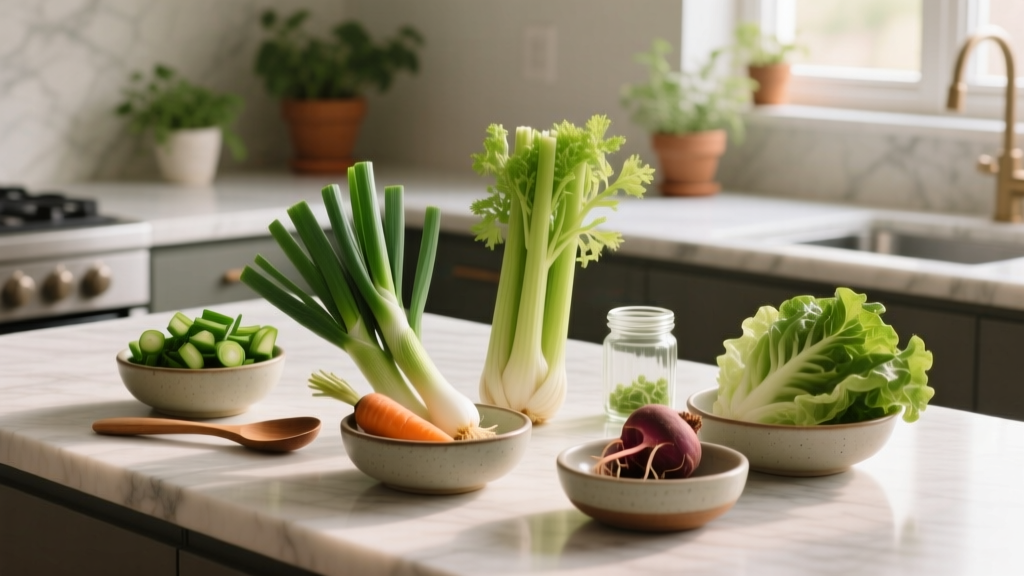
The cutting board is covered in ends: a pale nub of romaine, the last inch of green onions, a carrot top, a garlic clove that sprouted in the pantry. You toss them into the compost… or you pause and picture a small, good-looking “scrap nursery” right where you can see it—on a windowsill, a balcony shelf, or a bright corner of the yard—quietly turning kitchen leftovers into fresh herbs and greens. This is that project: part garden design, part household system, built for real spaces and real schedules.
Regrowing scraps isn’t a gimmick if you treat it like a layout problem. Some scraps want water first, some want soil right away, and almost all want consistent light and a plan for where they’ll graduate next. The design goal: a tidy, repeatable pipeline that fits your home and produces a reliable trickle of harvests.
Start with the “scrap pipeline”: a layout that works like a kitchen workflow
Think like a designer: reduce friction, make the next step obvious, and keep the mess contained. A scrap-regrow setup works best as three linked zones—each with its own container style and maintenance rhythm.
Zone 1: The Water-Start Station (days 1–10)
This is where you root scraps in water before potting up. It should be the easiest to access because you’ll change water often.
- Best location: bright window (east or south), or under a small grow light.
- Container style: short jars, ramekins, or recycled glass yogurt jars.
- Footprint guideline: a tray about 18 in x 6 in holds 6–8 small jars without looking cluttered.
Zone 2: The Pot-Up Nursery (weeks 2–6)
Once roots appear, you’ll move scraps into soil. This zone needs drainage and a bit more space.
- Best location: sunniest window, balcony, patio, or a shelf under lights.
- Containers: 4-inch nursery pots, upcycled food containers with drainage holes, or a shallow window box.
- Spacing rule of thumb: keep pots 2–3 inches apart for airflow and easy watering.
Zone 3: The Harvest Beds (ongoing)
This is where regrown plants live longer-term: a balcony railing planter, a small raised bed, a community garden plot, or a single deep container. It’s also where your design instincts show—repeat shapes, consistent materials, and a deliberate plant palette.
- Minimum productive footprint: one 24-inch window box or one 10-gallon container can meaningfully supplement herbs and green onion tops.
- Sunlight target: 6+ hours is ideal for most regrown crops, though several tolerate 3–4 hours with slower growth.
Design principles that keep scraps tidy, not chaotic
Principle 1: Contain the wet work
Water-start jars are charming—until they leave rings on your sill. Put them on a single waterproof tray. A simple boot tray or cafeteria tray (often $8–$15) keeps the whole station lift-and-carry easy when you need to clean.
Principle 2: Repeat containers for a calm look
Design trick: repetition reads as intentional. Choose one jar type and one pot type when possible. Even if they’re reused, matching heights and shapes makes a scrap setup feel like decor, not clutter.
Principle 3: Give every plant a “next home”
Most scraps decline if they live forever in water. The layout should include nursery soil pots and a larger finishing container. You’re not just regrowing; you’re staging a succession of homes.
Principle 4: Match plants to light, then match containers to plants
Leafy regrows (lettuce hearts, celery bases) tolerate moderate light; fruiting plants don’t. If your brightest spot is only 3–4 hours, lean hard into green onions, herbs, and lettuces. If you have 6–8 hours, you can support stronger regrowth and longer-term vigor.
Step-by-step setup (a weekend project with a designer’s logic)
- Measure your available strip of light. Mark out at least 18 in x 6 in for jars and 24 in x 8 in for small pots (a single shelf works).
- Pick your tray and containers. Aim for 6–10 jars plus 6–10 small pots. If buying new: a set of 10 small nursery pots is often $6–$12; jars can be free from your recycling.
- Set a light plan. If you don’t have a bright window, add a simple LED grow light strip. Budget $20–$40 for an entry-level light; run it 12–14 hours/day for steady regrowth.
- Choose a potting mix that drains. A basic indoor potting mix works, but add perlite if it feels dense. Good drainage prevents rot when roots are young.
- Create a labeling system. Painter’s tape on jars is enough. Note the start date so you know when to pot up (usually within 7–14 days for fast rooters like green onions).
- Assign a weekly maintenance time. Put it on your calendar: 20–40 minutes/week is realistic for a small station, including water changes and pot checks.
Plant selection: the scraps that actually earn their space
Some grocery scraps regrow reliably; others limp along. Below are choices that work because they either re-sprout from a basal plate, root quickly, or tolerate container life. For each, I’ll note the best container and the design reason to include it.
Green onions (scallions): ‘Evergreen Hardy White’ as the upgrade
Why scraps work: The white base with roots re-sprouts quickly in water, then thrives in soil.
- Water-start: stand bases in 1/2 inch of water; change every 2 days.
- Pot-up spacing: plant 1 inch apart in a window box for a dense “edible border.”
- Variety tip: After you enjoy scrap regrowth, plant seed of ‘Evergreen Hardy White’—it’s productive and cold-tolerant, so your “free scallions” become a designed, ongoing patch.
Romaine/leaf lettuce hearts: ‘Parris Island Cos’ for container heft
Why scraps work: Lettuce hearts can re-sprout leaves from the base, especially in cool conditions.
- Light: aim for 4–6 hours of sun (or bright light indoors).
- Pot size: at least a 6-inch pot if you want more than a few leaves.
- Variety tip: ‘Parris Island Cos’ has strong structure outdoors; use scrap hearts as a short-term boost, then shift to seed-grown plants for fuller heads.
Celery bases: ‘Tall Utah’ for the long game
Why scraps work: Celery bases can push new inner leaves; it’s satisfying but slower.
- Water-start duration: often 7–10 days before potting, once roots show.
- Container: a 10–12 inch pot for steadier moisture.
- Design note: Celery reads as a bold texture plant—great at the back of a container arrangement where the leaves can arch.
Basil cuttings: ‘Genovese’ for fast, fragrant payoff
Why scraps work: Basil roots readily from stem cuttings (not from the grocery “base” like onions). If you buy a bunch with stems, you can root several.
- Method: strip lower leaves, place stems in water; pot up when roots are 1–2 inches long.
- Sun: happiest with 6+ hours of sun or strong indoor light.
- Variety tip: ‘Genovese’ stays classic for cooking and performs well in containers.
Garlic cloves and sprouted onions: use as greens, not bulbs
Why scraps work: Sprouted alliums are eager to grow, but indoors they typically won’t form full bulbs. Treat them as a “green garnish crop.”
- Spacing: plant cloves 3–4 inches apart in a deeper pot.
- Design role: upright, grassy texture that makes the whole container look intentional.
A quick comparison table: what to regrow, where it fits, what to expect
| Scrap | Best start (water/soil) | Light needs | Container & spacing | Best use |
|---|---|---|---|---|
| Green onion base | Water 5–10 days | 3–6 hours | Window box; 1 in apart | Ongoing snips |
| Romaine/leaf lettuce heart | Water 3–7 days, then soil | 4–6 hours | 6-in pot; 6–8 in apart | Small leaf harvests |
| Celery base | Water 7–10 days, then soil | 4–6 hours | 10–12 in pot; 8–10 in apart | Flavorful inner stalks/leaves |
| Basil stems (cuttings) | Water 7–14 days, then soil | 6–8 hours | 8–10 in pot; 6–8 in apart | Leafy herb harvest |
| Garlic clove (sprouted) | Soil (skip water) | 4–6 hours | Deep pot; 3–4 in apart | Garlic greens |
Designing for three real spaces (with layouts you can actually copy)
Scenario 1: The renter’s windowsill (no outdoor space, limited mess tolerance)
Space profile: A single kitchen window ledge, about 36 inches wide, with a radiator nearby that dries air in winter.
Layout move: Build a two-tier “narrow bar” system: jars on a tray at the back, 4-inch pots in front. Keep the profile low so you can still open blinds and clean easily.
Plant palette: green onions, lettuce hearts, basil cuttings (if you can give strong light), and garlic greens.
Details that matter: Use a tray with a lip at least 1/2 inch high to contain spills. If the window is drafty, keep lettuce/celery farther from the cold glass.
Budget: DIY version can be under $25 using recycled jars, a thrifted tray, and potting mix. Add a grow light and you’re closer to $50–$70, but it stabilizes results when winter light is thin.
Scenario 2: The balcony rail (sunny, windy, and you want it to look designed)
Space profile: A 6 ft x 3 ft balcony with 6–8 hours of sun and steady breeze.
Layout move: Use a single long railing planter (or two 24-inch planters) as the “harvest bed,” plus a small shelf unit against the wall for jars and nursery pots. Keep water-start jars inside the door for easy changes; wind accelerates evaporation.
Plant palette: green onions as the edging, basil in a deeper pot, and celery as a textural anchor if you can keep moisture consistent.
Spacing/design: In a 24-inch planter, you can fit roughly 18–24 scallion bases at 1 inch spacing for a lush look. Pair with one separate 10-gallon pot for basil so it doesn’t get crowded.
Cost reality: Two sturdy planters plus potting mix can run $40–$120 depending on materials. DIY alternative: food-grade buckets (drilled for drainage) and a cedar offcut shelf.
Scenario 3: The small backyard corner (you want a system that feeds a household habit)
Space profile: A side-yard strip, maybe 4 ft x 8 ft, with morning sun and afternoon shade.
Layout move: Build one simple raised bed or use two large containers. The key is to place a small “pot-up bench” nearby so scraps can transition quickly. Even a narrow potting table 36 inches long is enough.
Plant palette: use scraps as starters, then reinforce with seed-grown plants: ‘Evergreen Hardy White’ scallions, ‘Parris Island Cos’ lettuce, ‘Tall Utah’ celery, plus a basil plant from cuttings.
Maintenance advantage: Outdoors, plants stabilize and can regrow longer than indoor jars. This is where the scrap pipeline turns into a genuine edible landscape feature.
What the research says (and what designers already know)
Regrowing scraps succeeds when you support roots, light, and sanitation. Extension educators repeatedly emphasize that many kitchen-scrap regrows are best treated as short-term leaf production unless you transition plants to soil and proper growing conditions.
“Good design is making a system so clear you don’t have to think about it—just move from one step to the next.” — a principle echoed in landscape workflow planning, and especially true for small-space edible gardens where daily habits matter as much as plant choice.
For food safety and practical expectations, it’s worth grounding this in science-based guidance. The University of California Agriculture and Natural Resources notes that growing edible plants indoors requires attention to sanitation and safe handling, especially with shared kitchen surfaces (UC ANR, 2020). Iowa State University Extension also emphasizes that regrowing vegetables from scraps varies by crop, and many are best for greens rather than full-size produce unless grown on properly (Iowa State University Extension and Outreach, 2019).
Citations: UC Agriculture and Natural Resources (UC ANR), 2020. Iowa State University Extension and Outreach, 2019. (Both provide research-based home horticulture guidance relevant to indoor edible regrowth and safe practices.)
Maintenance expectations (so this stays fun)
Plan for 20–40 minutes per week for a modest setup: water changes, quick rinses, checking for rot, and watering potted starts. If you’re running grow lights, add 2 minutes to wipe dust and confirm timers.
Weekly rhythm
- 2x/week: change water in jars (cloudy water is your cue). Rinse jar walls to discourage biofilm.
- 1x/week: rotate pots a quarter turn for even growth; check soil moisture.
- As needed: trim herbs and onion greens—frequent light harvests encourage new growth.
Seasonal tasks
- Winter: expect slower regrowth without supplemental light; run LEDs 12–14 hours/day if you want consistency.
- Spring: “graduate” the best performers outdoors for thicker growth and fewer pest issues indoors.
- Summer: watch for heat stress on windowsills; move jars back from hot glass and increase airflow.
- Fall: reset the station—scrub trays, sanitize jars, refresh potting mix in long-term containers.
Common failure points—and the design fixes
Rotting bases: Usually too much water and not enough airflow. Keep only the root end submerged (often about 1/2 inch). Use clean jars and refresh water frequently.
Leggy, pale growth: Light is insufficient. Move to a brighter window or add a $20–$40 grow light. Also rotate plants weekly.
Moldy soil surface: Overwatering plus stagnant air. Switch to a better-draining mix, water less often, and space pots 2–3 inches apart.
Disappointment with “full regrowth”: Some scraps are best as a bridge, not a lifetime plant. Treat scrap regrowth like propagation—then transition to seed or transplants for big yields.
Budget-conscious design: good-looking, low-cost, and renter-friendly
If you want this to feel like part of your home, spend money where it shows and save where it doesn’t.
- Spend: one attractive tray and one or two matching planters that live in plain sight (these anchor the look).
- Save: reuse jars, deli containers (add drainage holes), and nursery pots. A heated nail or drill makes clean drainage holes in plastic.
- Soil cost control: buy one medium bag and stretch it with perlite or coco coir if needed, instead of multiple specialty mixes.
A practical starter budget often lands around $25–$70 depending on whether you add a grow light and whether you already have containers. The payoff is less about replacing grocery shopping and more about turning waste into a steady garnish garden—and making your kitchen feel alive.
One last design touch: make it visible, make it habitual
The most successful scrap setups aren’t hidden. Place the water-start tray where you naturally stand—near the sink or coffee maker—so water changes happen without effort. Keep a small pair of snips nearby. Let the green onion tops arch over the edge of a planter like an ornamental grass. When your regrow station looks intentional, you’ll maintain it like you maintain the rest of your home: little and often.
Tomorrow, when the cutting board fills up again, you won’t be deciding what to do with scraps. You’ll already have a place for them—jars ready, soil pots waiting, and a designed path from kitchen to harvest.