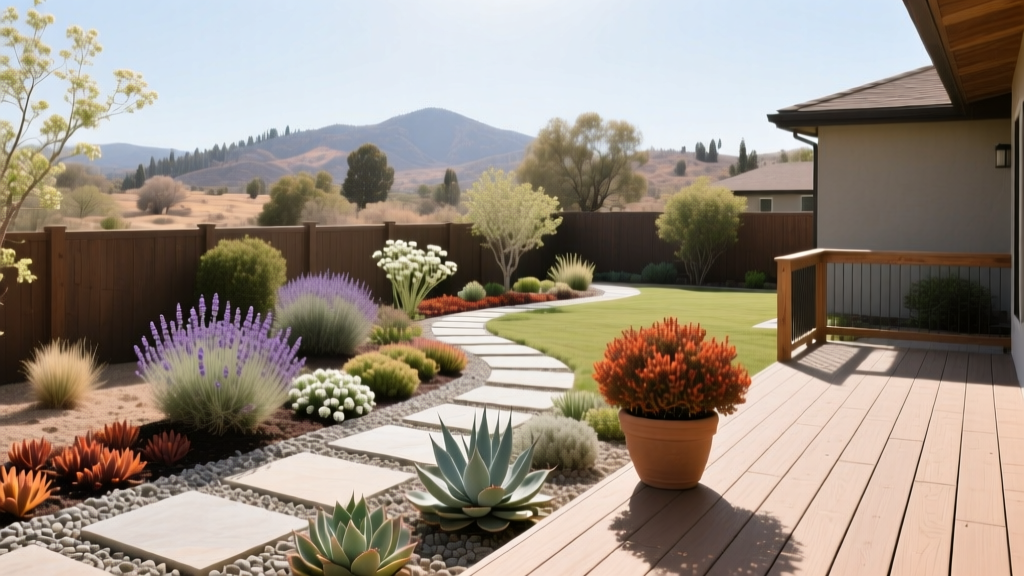
Deck Firewise Landscaping Tips
The wind picks up at dinner time—just enough to rattle the umbrella and push dry maple leaves into the corners of your deck. You notice what you’ve been stepping over for weeks: a crunchy mat of debris under the railing, a cute little juniper in a pot that’s turned into a wick, and mulch piled right up against the stairs like kindling. It’s not a dramatic “wildfire story” moment. It’s an everyday yard moment—the exact kind of setup that can turn one stray ember, grill flare-up, or neighbor’s firepit spark into a very bad night.
Firewise landscaping around a deck isn’t about making your space barren or ugly. It’s about designing a layout that slows fire down, reduces ignition points, and gives you defensible space—while still feeling like a garden you want to live in. I’ll walk you through a practical deck-perimeter plan, plant choices that behave better in heat, and the small layout decisions that make a big safety difference.
Start with the deck as a “home ignition zone”
Think of your deck area as the place where embers love to land and hide: corners, under stairs, between boards, inside planters, behind storage bins. Firewise design starts by tightening up this immediate zone first, then working outward.
“The principal threats to a home during a wildfire are from embers and small flames.” — National Fire Protection Association (NFPA), Firewise USA guidance (2023)
NFPA recommends treating the closest zone around your home with special care, focusing on ember resistance and reducing fuel near structures. Their Firewise USA program emphasizes practical steps homeowners can take to reduce risk (NFPA, 2023). CAL FIRE’s defensible space guidance also stresses managing vegetation and combustibles near structures (CAL FIRE, 2023).
Three working zones around a deck (simple, buildable)
For most decks, I like a three-zone layout that’s easy to visualize and measure. You can apply this whether you own the home or rent it (renters can focus on containers and movable hardscape).
- Zone 0: 0–5 ft from the deck edge and all structural supports (posts, stairs, skirting). Prioritize noncombustible surfaces and “nothing that easily ignites.”
- Zone 1: 5–30 ft from the deck. Use low, well-spaced plants; keep pathways and breaks; maintain moisture and reduce dead material.
- Zone 2: 30–100 ft (if you have it). Focus on thinning, spacing trees, and maintaining groundcovers. If your lot is small, your “Zone 2” might just be the far fence line.
Concrete numbers to plan with: aim for a minimum 5 ft noncombustible strip around the deck perimeter, keep shrubs spaced at least 3–5 ft apart (depending on mature width), and avoid tree branches within 10 ft of the deck roofline or overhanging the deck.
Layout strategies that reduce ignition—without sacrificing style
1) Build a noncombustible “apron” at the deck edge
If you do one upgrade, do this: create a noncombustible band right where embers collect. Think of it as a clean border that’s also a design feature.
Materials that work: decomposed granite, gravel (3/8" or 1/4" minus), pavers, stone, or poured concrete. Keep it clean of leaves and needles.
Recommended dimension: a 5 ft wide apron around the deck and under stairs where possible. If you can only afford a smaller change, target at least 3 ft at the stairs and grill area.
DIY cost snapshot:
- Gravel apron: about $1.50–$4.00 per sq ft installed DIY (material costs vary widely by region).
- Paver border: often $6–$12 per sq ft DIY depending on paver choice and base materials.
2) Use “fuel breaks” as pathways and seating pads
Fuel breaks don’t have to look like emergency infrastructure. A stepping-stone path, a pea-gravel sitting nook, or a small paver pad for a bistro set all function as firewise breaks while making the garden feel intentional.
Plan at least one route that’s 36 inches wide (comfortable for carrying a watering can, moving a grill, or guiding kids and pets). If you’re placing a bench or chair group, a pad of 6 ft x 6 ft gives enough room for two chairs and a small table without crowding plants against the deck.
3) Keep the “ladder fuels” out of your deck views
Ladder fuels are the plants and branches that let fire climb: dry grass into a shrub into a tree canopy. Around decks, this often looks like tall ornamental grasses planted right beside a shrub or a low shrub planted under a small tree.
Design rule: separate vertical layers. If you want a tree near the deck for shade, keep the area under it lean—stone, low succulents, or widely spaced perennials, not a dense shrub bed.
4) Rethink under-deck storage and corners
Those cozy corners under stairs are ember traps. Avoid storing firewood, cardboard, extra lumber, or patio cushions beneath a deck. If you need storage, use a tight-sealing metal deck box and keep it on a noncombustible pad.
Budget-friendly improvement: add 1/8-inch metal mesh screening to vents and gaps (where appropriate for local code and ventilation needs). This is often an affordable weekend upgrade that reduces ember entry points.
A step-by-step deck firewise layout you can actually build
Use this as a template, then customize to your sunlight and space. Most deck-adjacent planting areas I design are in the 80–300 sq ft range—big enough to feel lush, small enough to maintain.
- Measure the deck footprint and mark 0–5 ft outward with marking paint or string. This is your noncombustible zone.
- Choose your apron material (gravel or pavers). Install landscape edging to keep it crisp and prevent gravel migration.
- Create one primary path at least 36 inches wide from deck stairs to the yard gate or driveway. Use gravel with paver “landings” if budget is tight.
- Locate your “heat sources” (grill, smoker, firepit if permitted). Place them on a hard surface pad and keep a clear radius of 3–5 ft free of pots, cushions, and dry plant material.
- Place plants in islands, not continuous beds in Zone 1. Leave breaks of gravel or stone between groupings to slow fire spread.
- Match plants to sun exposure. Most deck edges get either 6–8 hours of sun (south/west exposure) or 3–5 hours (east/north). Pick plants that won’t struggle and dry out.
- Finish with a maintenance plan: weekly sweep/blow debris off the deck and apron; seasonal prune and thin plantings.
Plant selection: what to plant near a deck (and what to move farther out)
No plant is “fireproof,” and plant behavior changes with drought stress, wind, and maintenance. The goal is to choose plants that tend to hold more moisture, don’t accumulate a lot of dead material, and are easy to keep tidy. Also: put your highest-risk plants farther from the deck, not necessarily banned from the entire yard.
Firewise-friendly deck-adjacent plants (with varieties and why they work)
These are commonly used, widely available plants that can fit into attractive designs while being easier to maintain in a firewise way. Always check local guidance and invasive species lists for your area.
- Lavender (Lavandula angustifolia ‘Hidcote’ or ‘Munstead’): drought-tolerant and tidy when pruned; use in Zone 1 rather than right at the deck edge. Spacing: 18–24 inches. Note: remove spent blooms and avoid letting it get woody.
- Salvia (Salvia nemorosa ‘Caradonna’): upright structure, minimal litter, easy cutback. Spacing: 18 inches. Great for 6+ sun hours.
- Daylily (Hemerocallis ‘Stella de Oro’): fleshy leaves, easy maintenance, good massing plant in islands. Spacing: 18–24 inches.
- Red hot poker (Kniphofia ‘Poco Red’): architectural accent with manageable clumps. Spacing: 18–24 inches. Remove dry leaves seasonally.
- Ice plant (Delosperma cooperi): succulent groundcover that stays low and can function as a “green mulch” in sunny areas. Spacing: 12–18 inches.
- Stonecrop sedum (Hylotelephium ‘Autumn Joy’): sturdy, drought-tolerant, easy to cut down in late winter. Spacing: 18–24 inches.
- Yarrow (Achillea ‘Moonshine’): reliable, low-water, good filler; deadhead to reduce dry seedheads. Spacing: 18 inches.
- Rosemary (Salvia rosmarinus ‘Arp’): useful, evergreen structure; keep it clipped and avoid placing right against the deck if it gets large. Spacing: 3 ft from other shrubs.
Plants to treat cautiously near decks (often better in Zone 2)
These plants can be beautiful, but they tend to accumulate dry material, have resinous foliage, or create dense fuel. If you love them, use them farther from the deck and commit to stricter maintenance.
- Junipers (Juniperus spp.): resinous and can burn intensely; avoid near decks and stairs.
- Ornamental grasses (especially if not cut back): dead blades become tinder; keep well away from structures or cut back hard before fire season.
- Dense conifer shrubs: can trap embers and hide dead interior branches.
- Mulch piled deep against supports: any organic mulch can ignite; keep it out of Zone 0.
Comparison table: deck-edge materials and how they behave
| Material | Best use near decks | Typical DIY cost | Maintenance | Firewise notes |
|---|---|---|---|---|
| 3/8" gravel | 5 ft apron, pathways, seating pads | $1.50–$4.00 / sq ft | Rake, top-up every 1–2 years | Noncombustible; can collect leaves—blow/sweep regularly |
| Concrete pavers | High-traffic paths, grill pad | $6–$12 / sq ft | Weed joints, occasional leveling | Excellent ember resistance; creates strong fuel breaks |
| Decomposed granite (DG) | Soft-look apron and paths | $2.50–$6.00 / sq ft | Compaction touch-ups | Noncombustible; use stabilizer for less tracking |
| Wood mulch | Zone 1–2 planting beds only | $0.15–$0.60 / sq ft | Refresh annually | Avoid in Zone 0; keep thin and irrigated, and away from posts/stairs |
Three real-world layouts (so you can picture your own)
Scenario 1: Small rental deck with container plants (no digging allowed)
Space: a 10 ft x 12 ft deck with a 3 ft strip of soil at the edge that the landlord doesn’t want disturbed.
Design move: Treat the edge as a clean, noncombustible frame. Roll out a removable gravel tray system using edging and landscape fabric (confirm with landlord), or place pavers dry-laid on sand as a reversible solution.
Planting plan: use ceramic or metal containers (more ember-resistant than plastic) and keep them 2–3 ft from the grill. Choose plants that stay tidy: Salvia ‘Caradonna’, Hylotelephium ‘Autumn Joy’, and a low succulent bowl with Delosperma cooperi.
Budget: a renter-friendly setup can land around $200–$450 total: a few bags of gravel, 6–8 pavers, and 3–5 quality containers you can take with you.
Scenario 2: Suburban family deck with kids’ traffic and a dog run
Space: a 16 ft x 20 ft deck, lawn beyond, and a side gate path everyone uses.
Design move: Make the path the hero. Install a 42-inch wide gravel-and-paver path from stairs to gate. It functions as a daily convenience and a fuel break.
Planting plan: Create two “plant islands” (each roughly 6 ft x 8 ft) in Zone 1, separated by gravel. Mass one island with daylilies (‘Stella de Oro’) at 18-inch spacing and add Achillea ‘Moonshine’ as a light, airy filler. Keep plants clipped off the path edge so kids aren’t brushing through dry seedheads.
Practical safety habit: set a calendar reminder to blow leaves off the deck and apron weekly during dry season. This takes 10–15 minutes and is one of the highest-impact routines you can adopt.
Scenario 3: Hillside or WUI home with wind exposure and limited access
Space: a deck perched above a slope—beautiful views, but wind funnels up the hillside. This is where embers travel.
Design move: Go heavier on noncombustible surfacing in Zone 0 and keep plantings low and separated. If there are stairs down the slope, make the landing zone noncombustible and wide enough for safe movement: 4 ft x 4 ft minimum landing pads.
Planting plan: Use low succulents and widely spaced perennials closest to the deck, then step up to small, well-maintained shrubs in Zone 1. Consider Lavandula ‘Hidcote’ (kept pruned), Salvia, and Delosperma. Avoid resinous shrubs right below the deck line.
Maintenance reality: windy sites fill with debris faster. Plan on 30–45 minutes per week in peak dry season for blowing out corners, checking under deck edges, and removing dead plant material.
Sunlight, irrigation, and spacing: the unglamorous details that prevent problems
Most deck gardens fail into “crispy fuel” because the plants aren’t matched to sun and water. A drought-stressed plant is far more likely to hold dead material and become combustible.
Sunlight targets
- Full sun: 6–8 hours of direct sun. Use drought-tolerant perennials and succulents (salvia, yarrow, sedum, delosperma).
- Part sun: 3–5 hours. Choose plants that stay lush without constant water; daylilies perform well, and some salvias do fine with morning sun.
Spacing that stays safe as plants mature
When in doubt, plant for mature size—not the cute nursery pot. A good rule for deck-adjacent Zone 1: keep shrubs at least 3 ft apart edge-to-edge, and keep any shrub mass at least 5 ft from the deck if you can. For perennials, 18–24 inches on center usually creates a full look without turning into a continuous fuel mat.
Budget-smart choices and DIY alternatives
You don’t need a full hardscape renovation to get meaningful firewise results. Spend money where it changes ignition risk the most: the first 5 feet and the debris traps.
High-impact, lower-cost upgrades
- Gravel apron (3–5 ft wide): often the best cost-to-impact move.
- Metal mesh screening: reduce ember entry where appropriate; check local building requirements.
- Swap plastic pots for ceramic/metal: especially near grills and deck edges.
- Replace flammable decor: dried wreaths, coconut coir liners, and stored cardboard near the deck.
If your budget is tighter this year
Do a “phase 1” weekend: clean and clear. Pull organic mulch back 5 ft from the deck, relocate the most resinous container plants away from stairs, and install a simple gravel strip just at the highest-risk side (often where the wind hits and where you grill). Even a 3 ft x 20 ft gravel run is a meaningful start.
Maintenance expectations (this is what keeps the design firewise)
A firewise deck landscape is won or lost in maintenance. The best layout in the world won’t help if the apron turns into a leaf pile and shrubs are allowed to fill with dead interior twigs.
Weekly (dry season): plan on 20–30 minutes per week for:
- Blowing/sweeping leaves off the deck, stairs, and apron
- Checking corners and under railings for trapped debris
- Deadheading perennials that form dry seedheads (yarrow, lavender)
Monthly: 30–60 minutes for:
- Pruning to maintain spacing (keep plants from touching)
- Removing dead wood inside shrubs
- Inspecting irrigation so plants aren’t stress-drying
Seasonal tasks:
- Spring: cut back sedum and salvias; refresh gravel edges; check for winter debris under the deck.
- Early summer: thin plants before peak heat; set reminders for weekly deck sweep.
- Late summer/fall (before local fire season peaks): remove dry grass blades, prune woody herbs, and keep gutters and nearby rooflines clear.
- Winter: evaluate what became “too dense” and relocate or divide in the dormant season.
Designing for how you actually live on the deck
Firewise design works best when it supports your routines instead of fighting them. If you always grill on the west corner, that corner should be the easiest place to keep clear—hard surface underfoot, no pots tucked beside it, no overgrown herbs brushing the railing. If kids run from stairs to lawn, give them a wide, clean path so they don’t trample plantings into brittle messes. If you love a lush look, build it with plant islands separated by gravel—not a continuous bed right up to the deck.
Finally, treat the deck edge like a picture frame: clean line, noncombustible base, and carefully spaced plants that read as intentional. You’ll end up with a space that feels sharper and more usable—and one that’s working quietly in the background to reduce risk.
Sources: National Fire Protection Association (NFPA), Firewise USA program guidance (2023); CAL FIRE, Defensible Space guidance (2023).