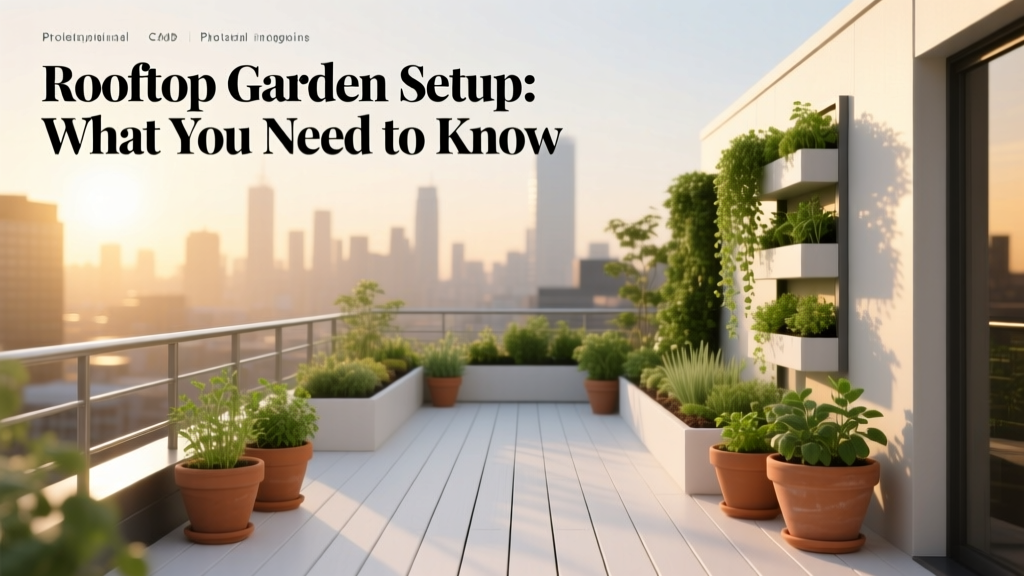
Rooftop Garden Setup: What You Need to Know
The elevator doors open, you step onto the roof, and the wind hits first—stronger than you expected. The surface underfoot is a flat expanse of membrane and gravel, a couple of vents humming, and that one corner where puddles always collect after rain. You can already picture herbs by the door for quick snips, a small table for morning coffee, and something tall and green that makes the skyline feel less hard-edged. Then the practical voice cuts in: Can this roof actually hold soil? Where does the water go? And why is it always so much hotter up here?
Designing a rooftop garden is part landscape design, part logistics. You’re working with sun intensity, wind shear, weight limits, and access constraints—yet the payoff is enormous: usable outdoor space with better views, better light, and often fewer pests than ground-level beds. The trick is to treat the roof like a project site: measure, map, plan loads, then build in layers.
Start With Reality: Structure, Weight, and Rules
Before you buy a single pot, confirm the roof can carry the load. Rooftop garden failures rarely come from “bad plant choices”—they come from too much weight in the wrong place, poor drainage, or violating building rules.
Know your load limits (and why water is the surprise)
Roofs are engineered for specific “live loads” (people, movable items) and “dead loads” (permanent materials). A saturated container is dramatically heavier than a dry one. As a reference point, the International Green Roof Association notes that extensive green roofs generally run about 60–150 kg/m² and intensive systems 180–500+ kg/m², depending on depth and design (IGRA, 2021). Even if you’re not building a full green roof, containers filled with wet mix behave the same way.
Practical move: ask your building manager or a structural engineer for the roof’s allowable live load. If you’re renting, request it in writing. If that’s not available, design conservatively: keep heavy planters near structural supports (often along beams/columns and perimeter walls) and use lighter planters elsewhere.
Confirm waterproofing and drainage pathways
A rooftop garden should never trap water against the membrane. The American Society of Landscape Architects emphasizes that successful green roof assemblies depend on waterproofing, drainage, and root barriers working together (ASLA, 2023). Your version—containers and raised beds—still must respect drains and scuppers.
Rule of thumb: keep a 18–24 inch clear zone around roof drains, scuppers, and mechanical equipment for access and water flow. If you’re tempted to “hide” a drain under planters, don’t; instead, frame the area with lighter pots you can move easily.
Don’t skip permissions (even for renters)
Many rooftops have strict rules about penetrations (no bolting into the roof), open flames (no charcoal grills), and safety railing heights. If there’s no guardrail or it’s below code, your first “garden feature” may need to be a compliant barrier or a move to container-only gardening on a balcony instead.
Layout Strategies That Make Rooftops Feel Intentional
Rooftops can feel like empty stages. A good layout gives you comfort and clarity: where you walk, where you sit, where you grow, and where you store. Think in zones, then build a simple circulation path so the space feels designed—not accidental.
Design principle #1: Create a windbreak before you chase lushness
Wind is the rooftop’s signature challenge. It snaps tender stems, dries containers faster, and makes seating miserable. Start your plan by deciding where the “calm pocket” will be.
Options that work without roof penetrations: freestanding trellis panels with weighted bases, tall rectangular planters planted with dense shrubs, or a line of sturdy ornamental grasses. Place windbreaks perpendicular to prevailing winds, then set seating and delicate crops (like basil) in the lee.
“Microclimate is the rooftop designer’s first material—wind, heat, and sun exposure define what will thrive long before plant labels do.” — Dr. Nigel Dunnett, green roof researcher and planting designer (Dunnett, 2015)
Design principle #2: Plan circulation like a small deck
A rooftop garden works best when it’s easy to move through with a watering can or harvest basket. For most home rooftops, a 30–36 inch path is comfortable. If you expect two people to pass, aim for 42 inches.
Use deck tiles, pavers on pedestals, or rubber pavers to define the main route. This keeps feet cleaner and visually “anchors” the design. A straight path from door to seating, with beds and pots tucked along the edges, usually feels calmer than a scattered layout.
Design principle #3: Put the heaviest elements where the roof is strongest
Even without engineering drawings, you can make safer decisions: cluster heavy planters along parapet walls or above known supports and keep the center field lighter. Avoid placing multiple large planters where water already ponds—standing water indicates drainage issues that should be fixed, not covered.
Design principle #4: Design in layers (low, mid, tall)
Rooftops can feel flat. Layering creates depth and helps with wind: low groundcovers or trailing plants at the edges of pots, mid-height herbs and perennials, and a few tall structural plants to shape the skyline.
For a balanced look in a small area, try the “3-2-1” approach in a single cluster: three low plants, two mid, one tall focal plant. Repeat the rhythm across the roof so the space feels cohesive.
Container vs. Raised Bed vs. Modular Green Roof: What Fits Your Roof?
Your setup choice affects cost, weight, and maintenance. Most homeowners and renters start with containers, then add one or two raised beds once they understand wind and watering patterns.
| System | Typical soil depth | Weight range (approx.) | Best for | Budget (starter) |
|---|---|---|---|---|
| Containers (pots, troughs) | 10–18 inches | Varies widely; a 20-gal pot can exceed 100 lb when saturated | Renters, flexible layouts, herbs/peppers | $150–$600 |
| Raised beds (freestanding) | 12–24 inches | High; concentrated loads | Vegetables, deep-root crops, tidy production zones | $300–$1,200 |
| Modular green roof trays | 3–6 inches (often) | Often 60–150 kg/m² (system-dependent) | Low-maintenance coverage, cooling, habitat | $20–$45 per sq ft installed |
DIY note: If you’re renting, containers are safest because they’re reversible. If you own and want coverage, modular trays can deliver a “carpet” of sedums without building full beds—just verify waterproofing and drainage layers are compatible with your roof system.
Step-by-Step Rooftop Garden Setup (Designer’s Order of Operations)
This sequence keeps you from doing expensive work twice—especially around drainage, wind, and irrigation.
- Measure and map the roof. Sketch the roof with dimensions (even a rough plan). Mark door swing, vents, drains, hose bibs, and sunny/shady zones. Note parapet height and any no-go areas.
- Track sun for a week. Most edible plants want 6–8 hours of direct sun. Leafy greens tolerate 4–6 hours. Use your phone to note where shade falls from neighboring buildings.
- Identify wind direction and “blast zones.” Stand outside on two breezy days. Corners and roof edges are typically harsh. Plan windbreak planters first.
- Protect the roof surface. Use pot feet, trays that don’t trap water, and a sacrificial layer like deck tiles or pavers under high-traffic areas.
- Install irrigation (or at least a watering strategy). Drip irrigation on a timer is ideal. If hand-watering, cluster thirsty pots near the door/hose for convenience.
- Place big planters and beds empty. Confirm spacing and pathways before filling with soil. Aim for 30–36 inches clear walking space.
- Fill with lightweight rooftop-friendly mix. Avoid heavy garden soil. Use a high-quality potting mix and add compost sparingly for nutrition.
- Plant in functional zones. Put herbs near the door, high-maintenance crops near water access, and tough, drought-tolerant plants on exposed edges.
- Mulch and secure. Top containers with 1–2 inches of mulch to reduce evaporation. Stake tall plants early, not after wind damage.
Plant Selection: Varieties That Actually Behave on Roofs
Rooftop plants need three qualities: wind tolerance, heat tolerance, and a root system that can thrive in containers. Below are designer-favorite varieties that perform reliably and look good doing it.
Edibles that love sun and containers
Cherry tomato ‘Sungold’ (indeterminate): Sweet, productive, and forgiving—just give it a sturdy trellis and a 15–20 gallon container. Space tomatoes about 24 inches apart (one per large pot). Rooftops are warmer, which tomatoes love; the key is consistent watering to prevent blossom end rot.
Peppers ‘Shishito’ and ‘Jalapeño’: Handle heat well and don’t mind wind if staked. Use a 5–7 gallon pot per plant, or a long trough with 12–14 inches spacing. Expect better yields with 6+ hours of sun.
Eggplant ‘Patio Baby’: A compact producer suited to containers. One plant in a 10-gallon pot is a clean, architectural look—great near seating because the foliage reads lush.
Strawberry ‘Albion’ (day-neutral): Excellent for planters and hanging pockets; produces over a long season. Space crowns about 10–12 inches apart. On a roof, strawberries benefit from afternoon shade if summer heat is intense.
Herbs that thrive with a bit of rooftop toughness
Rosemary ‘Arp’: Cold-hardy as rosemary goes, drought-tolerant once established, and naturally wind resistant. Use a 12–16 inch diameter pot and keep soil on the lean side (don’t overcompost).
Thyme ‘Creeping’ and Oregano ‘Greek’: These are the unsung heroes for rooftop edges—aromatic, low, and tolerant of drying winds. They also soften hard container lines.
Chives: One of the easiest rooftop herbs; tolerant of sun and container life. Plant clumps in 8–10 inch pots and divide every couple years.
Ornamental plants that make the space feel designed (and survive)
Feather reed grass ‘Karl Foerster’ (Calamagrostis): Upright, wind-friendly, and looks sharp year-round. Great in tall planters as a windbreak component. Space 18–24 inches apart in large troughs.
Lavender ‘Hidcote’: Loves sun, reflects heat well, and brings pollinators. Needs sharp drainage; use a gritty mix and avoid overwatering.
Sedum ‘Autumn Joy’ (Hylotelephium): Succulent leaves handle heat and missed waterings. A reliable choice for exposed perimeters where more delicate plants struggle.
Dwarf conifer ‘Mugo Pine’ (compact varieties): For year-round structure in a large, heavy pot placed near a strong structural zone. Choose compact cultivars and plan for long-term size.
Three Real-World Rooftop Scenarios (and How I’d Lay Them Out)
Scenario 1: The renter’s 8' x 12' roof corner with strict rules
You’ve got a small section, no drilling allowed, and you need to keep it move-out friendly. I’d design it like a “portable courtyard.”
Layout: a 36-inch central path (deck tiles) from the access door to a bistro chair. Two tall rectangular planters (roughly 12" x 36" x 24") form a windbreak behind seating. Along the sunny edge: five 12–16 inch pots for herbs and peppers.
Planting: rosemary, thyme, ‘Shishito’ peppers, ‘Albion’ strawberries in a trough, and ‘Karl Foerster’ for height. The goal is resilience and a tidy silhouette that doesn’t look chaotic midseason.
Budget: plan $250–$500 if you thrift containers and buy plants small. DIY alternative: use food-safe 5-gallon buckets with drainage holes and simple saucers to reduce cost.
Scenario 2: The homeowner’s 20' x 30' roof with a hose bib (production + lounge)
This is where we can make it feel like an outdoor room with a kitchen garden attached. I’d split it into two zones: a lounge zone and a grow zone, connected by a straight service path.
Layout: dedicate roughly 10' x 12' for seating and shade (a freestanding umbrella base—no penetrations). Then place two raised beds, each 2' x 8', parallel to each other with a 42-inch walkway between. Put the beds close to the hose bib to keep watering painless.
Planting: tomatoes (‘Sungold’), basil (in its own pot so you can move it), eggplant ‘Patio Baby’, peppers, and a perimeter of lavender and sedum for drought tolerance. Add one dwarf conifer in a large pot as a year-round anchor.
Costs: two quality raised beds can run $200–$500 each depending on material; a basic drip kit and timer often lands around $60–$150. Expect soil and amendments to add another $100–$250, especially for large beds.
Scenario 3: The windy high-rise roof with intense sun and reflected heat
Here the “plant palette” shifts: fewer tender annuals, more structural grasses, succulents, and tough perennials. The win is a low-fuss roofscape that still looks intentional.
Layout: create a U-shaped windbreak using three or four tall planters (placed empty first, then filled). In the protected center, you can still grow edibles in smaller pots, but I’d avoid sprawling crops that shred in wind.
Planting: ‘Karl Foerster’ grass, sedum ‘Autumn Joy’, lavender ‘Hidcote’, thyme as a spiller, and a few compact peppers in the sheltered pocket. If you want trees, go slow: one large container specimen only, and secure it properly.
Maintenance: plan to water more frequently—rooftops can require 3–5 watering sessions per week in midsummer without drip, because wind accelerates evaporation.
Budget Planning and Smart DIY Swaps
Rooftop gardens can be surprisingly affordable if you treat “structure” as your main investment and keep the rest modular. Here’s how I’d allocate money:
Spend on: sturdy planters that won’t crack, safe pot feet or risers, a simple irrigation timer if you have a spigot, and a lightweight, high-quality potting mix.
Save on: starting plants from small sizes (they catch up), using DIY trellises (conduit + netting), and repurposed containers—only if they’re food-safe for edibles.
DIY alternatives that work well on roofs:
- Windbreak on a budget: A freestanding lattice panel zip-tied to two heavy planters. Add grasses or dense shrubs in the planters to stop wind at the root level.
- Cheap but effective drip: A basic 1/2" mainline with 1/4" drip lines to pots; use emitters matched to pot size (for example, 1–2 GPH emitters for larger containers).
- Thrifted containers: Large ceramic pots are heavy; choose resin, fiberglass, or fabric grow bags to cut weight and cost.
Maintenance Expectations: What It Takes to Keep a Rooftop Garden Happy
A rooftop garden rewards consistency more than intensity. The biggest ongoing task is water management—too little in heat waves, too much in rainy spells if drainage is poor.
Weekly time: plan on about 45–90 minutes per week during the growing season for watering checks, deadheading, harvesting, and pest scouting. In peak summer, add quick midweek check-ins (5–10 minutes) to catch dry pots before they crash.
Seasonal task list (what I’d put on your calendar)
- Spring (1–2 afternoons): check drains and clear debris; refresh 1–2 inches of compost in containers; test irrigation; prune winter damage on lavender and grasses.
- Summer (weekly rhythm): stake tomatoes early; mulch to slow evaporation; fertilize heavy feeders (tomatoes/peppers) every 2–4 weeks depending on your fertilizer choice.
- Fall (half day): remove spent annuals; cut back perennials as needed; store lightweight furniture; reduce irrigation frequency.
- Winter (30 minutes monthly): check that pots aren’t sitting in ice-blocked saucers; protect tender plants with burlap screens in extreme wind; keep access paths safe.
If you travel often, automate watering. A timer and drip lines can be the difference between “thriving rooftop” and “crispy pots” after a long weekend in July.
Small Details That Make a Rooftop Garden Feel Like a Place
After the plants are in, the finishing touches are what make you use the space. Add lighting that doesn’t glare into neighbors’ windows, choose furniture that can handle gusts, and include a small storage bench for tools and a coiled hose.
One designer trick: repeat materials. If your planters are matte black, echo that in a small side table or lanterns. If you use warm wood deck tiles, repeat wood tones in a trellis frame. Rooftop gardens look best when the hardscape and plants feel like they were chosen together.
When you step back from a finished rooftop, you should see three things immediately: a clear path, a protected seat, and plants that match the microclimate. Get those right, and the rest—tomatoes, lavender, the soft sway of grasses against the skyline—falls into place with a kind of inevitability. And that empty roof that felt too exposed at first starts to feel like the most personal room you have, outdoors and entirely your own.
Sources: International Green Roof Association (IGRA), 2021. American Society of Landscape Architects (ASLA), 2023. Dunnett, N., 2015 (published commentary and design research on planting design and green roof microclimates).