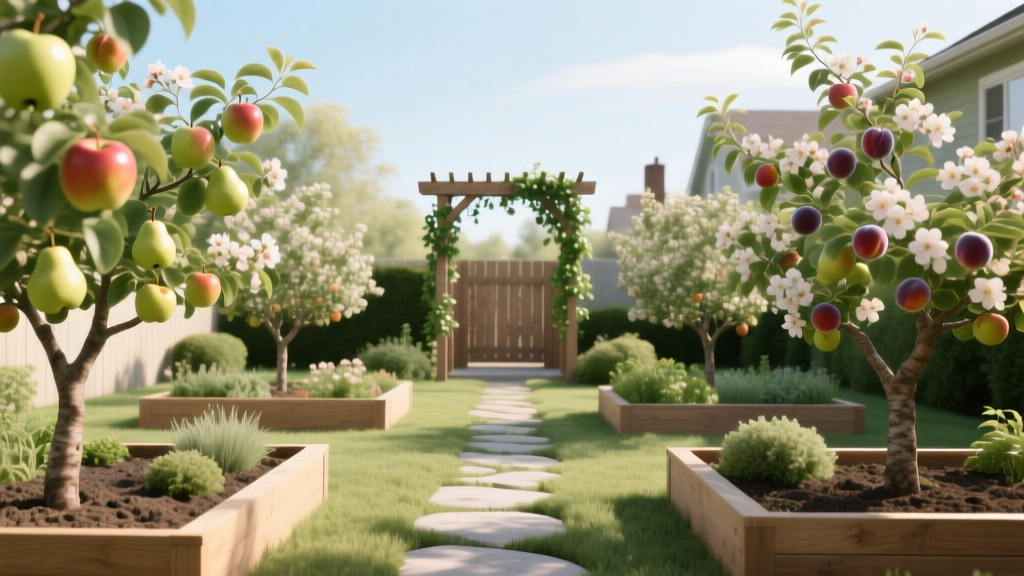
Suburban Backyard Orchard Planning
The fence line is already spoken for: one side gets baked by afternoon sun, another stays cool and shadowed, and right in the middle sits that patch of lawn you keep mowing even though you’d rather be harvesting something. You want fruit—real fruit, not a single decorative apple tree that drops golf balls of disappointment once a year. But you also want the yard to stay livable: room for a chair, a kid, a dog, a grill, or just the feeling that you can breathe out there.
Let’s design a suburban backyard orchard the way a landscape designer would: by reading your site, choosing a layout that makes maintenance easy, and selecting varieties that actually perform in small spaces. You’ll end up with an orchard that feels intentional—like it belongs in your yard—without turning weekends into unpaid farm labor.
Start with the site: sun, wind, water, and the “no surprises” map
Sunlight: design around hours, not hopes
Most fruit trees need 6–8 hours of direct sun for reliable bloom, fruit set, and sweetness. If you’re working with 4–6 hours, you can still grow fruit, but you’ll want to prioritize varieties that tolerate partial sun (some plums, sour cherries, figs in warm climates) and keep canopies tight. Track sun for a weekend: morning, midday, late afternoon. Notice where shade falls from the house, garage, mature trees, or your neighbor’s maples.
Know your hardiness zone and chill hours
Fruit trees are picky about winter cold and the number of chilling hours they receive (hours between roughly 32–45°F). If your winters are too warm, apples may bloom poorly; if too cold, peaches can suffer dieback. The USDA Plant Hardiness Zone Map (USDA, 2023) is the baseline for matching trees to your climate.
Soil and drainage: one quick test saves years
Fruit trees hate “wet feet.” Dig a hole about 12 inches wide and 12 inches deep, fill it with water, and see how fast it drains. If water is still standing after 24 hours, plan on raised mounds/berms or choose species that handle heavier soil. For soil pH, many fruit trees perform best around pH 6.0–7.0, but local extension guidance should steer your amendments.
Sketch the immovable constraints
Before thinking about varieties, draw a simple map with fixed elements: house footprint, driveway, patios, utility lines, septic fields, and easements. Then add “soft constraints” like where snow is piled, where the dog runs, and where you want privacy. If you’re a renter, mark what you can’t alter (permanent fences, major digging zones) and what’s portable (large containers, raised beds, trellis panels).
Orchard layout strategies that fit suburban life
Principle 1: Put the tallest trees on the north side
This classic orchard rule keeps your trees from shading each other. In most suburban backyards, the sun’s arc means anything tall on the south side throws shade across your planting zone. If you’re using dwarf trees (often 8–12 feet at maturity), the shading issue is smaller, but still worth respecting—especially in narrow yards.
Principle 2: Make maintenance a straight line, not an obstacle course
Harvest and pruning are easier when you can walk a clear path. Plan for at least 36 inches of walkway clearance; 48 inches feels generous if you’re hauling a ladder or a harvest basket. A simple mulched path, decomposed granite, or stepping stones in wood chips can turn a cramped corner into a functional orchard room.
Principle 3: Keep trees small on purpose
Backyard orchards succeed when you commit to size control—dwarfing rootstocks, summer pruning, and training systems. Cornell Cooperative Extension notes that rootstock selection strongly influences tree size and early bearing (Cornell Cooperative Extension, 2020). In practice, small trees mean easier netting, less spraying (if any), and harvest without heroics.
“The best small orchard is the one you can reach—pruning cuts, thinning, and harvest should be doable from the ground or a short step stool.” — Adapted from common recommendations in university extension pruning systems for home orchards (e.g., Cornell Cooperative Extension, 2020)
Layout option A: The “hedgerow orchard” (best for narrow yards)
Think of fruit trees as a living wall. Plant trees 3–5 feet apart (depending on rootstock and training) and train them to a flat plane (espalier) or narrow canopy. This works beautifully along fences where you want privacy without losing usable space. A hedgerow orchard is also renter-friendly if you use large trough planters or fabric beds for smaller fruit like figs, blueberries, and dwarf citrus (in appropriate climates).
Layout option B: The “orchard square” (best for wider yards)
If you have a central open area, a grid of dwarf trees spaced 8–10 feet apart creates a neat, walkable structure. Add a mulched ring under each canopy and keep turf out of the drip line to reduce competition. The square layout makes irrigation simple: one loop line with emitters at each tree.
Layout option C: The “edible mixed border” (best if you want it to look like landscaping)
Instead of “rows,” tuck fruit into ornamental beds: a multi-stem serviceberry, a dwarf plum as a spring-flowering focal point, blueberries as a hedge, strawberries as a groundcover edge. This is ideal when HOA expectations (or landlord preferences) push you toward traditional garden aesthetics.
Spacing, training, and a few numbers you can design with
Here are practical spacing targets for suburban planning:
- Dwarf apple/pear (on dwarf rootstock): 8–10 feet apart; mature height often 8–12 feet with pruning.
- Stone fruit (peach/nectarine/plum): 10–12 feet apart for semi-dwarf; keep to 8–10 feet if committed to annual pruning and open-center training.
- Espalier along a fence: plant at 4–6 feet spacing; keep branches tied to wires at 18–24 inch vertical intervals.
- Blueberries: 3–4 feet apart; they appreciate an acidic bed and consistent moisture.
- Raspberries (trellised): plants 2 feet apart; rows 6 feet apart if you have them, but a single row can hug a fence.
If you only remember one thing: smaller spacing requires more pruning discipline. If you’d rather prune less, give trees more room.
Plant selection that works in real backyards (with specific varieties)
Apples: reliable, forgiving, and easy to store
Apples are the backbone of many small orchards, especially if you choose disease-resistant cultivars and compatible pollination partners.
- ‘Liberty’ apple: Great for home growers because it has strong resistance to apple scab and good flavor. Useful when you want fewer spray decisions.
- ‘Enterprise’ apple: Productive and stores well into winter; excellent if you want a late-season apple that earns its space.
- ‘Honeycrisp’ apple: Incredible eating quality, but can be more finicky; place it in your sunniest, best-drained spot and keep up with thinning for size.
Pollination note: Most apples need a second variety that blooms around the same time. In a small yard, you can plant two different dwarf apples 8–10 feet apart, or use a crabapple nearby as a pollinator if your neighborhood already has them.
Pears: elegant trees, often low-spray
- ‘Harrow Sweet’ pear: Bred with disease resistance in mind; a good choice where fire blight is a concern.
- ‘Bartlett’ pear: Classic flavor and productivity, but can be susceptible to fire blight; choose only if your area isn’t a hotspot and you’re comfortable pruning out strikes quickly.
Pears can grow upright—great for tighter spaces—especially if you train them early.
Peaches and nectarines: high reward, higher attention
- ‘Reliance’ peach: Cold-hardy and a common recommendation for challenging climates; good if late frosts are an issue.
- ‘Redhaven’ peach: A widely planted standard with dependable crops in many regions; ideal if you want a proven performer.
Peaches demand sun and airflow. Plan for 10–12 feet unless you’re committed to annual size control.
Plums and cherries: strong spring show, good for mixed borders
- ‘Methley’ plum: Early, sweet, and often productive; useful in warm-summer areas and can be easier than peaches.
- ‘Santa Rosa’ plum: Classic backyard plum with great flavor; give it sun and watch for overcrowding in the canopy.
- ‘Montmorency’ sour cherry: One of the best choices for home growers because it’s self-fertile and great for pies; stays more manageable than many sweet cherries.
Small fruits that “fill the gaps” (and keep renters in the game)
- Blueberry ‘Duke’ (early) + ‘Bluecrop’ (mid): Two-season spread and cross-pollination benefits; plant in a prepared acidic bed or large containers.
- Raspberry ‘Heritage’ (everbearing): Gives a reliable late-summer/fall crop; trellis keeps it tidy along a fence.
- Strawberry ‘Seascape’ (day-neutral): Long harvest window; perfect as an edging plant in front of dwarf trees.
Comparison table: choose a “backyard fruit team” that matches your time and space
| Fruit | Typical spacing (dwarf/backyard) | Sun needed | Pollination | Maintenance level | Why it fits suburban yards |
|---|---|---|---|---|---|
| Apple (dwarf) | 8–10 ft | 6–8+ hrs | Usually needs 2 varieties | Medium | Long-lived, stores well, many disease-resistant cultivars |
| Pear (semi-dwarf) | 10–12 ft | 6–8+ hrs | Often needs 2 varieties | Low–Medium | Upright habit, can be lower spray with good cultivar choice |
| Peach | 10–12 ft (can be kept smaller) | 8+ hrs ideal | Usually self-fertile | High | Fast fruiting, incredible flavor—best where you can prune yearly |
| Sour cherry | 8–12 ft | 6–8+ hrs | Often self-fertile | Medium | Compact, productive, great culinary fruit |
| Blueberry | 3–4 ft | 6+ hrs | Better with 2 varieties | Low | Works as hedge, container-friendly, easy harvest |
Three real-world backyard scenarios (with layouts you can borrow)
Scenario 1: The narrow side yard (12 ft x 40 ft) that feels wasted
You’ve got a side run between the house and fence—often dismissed as “utility space.” This is hedgerow-orchard territory. Keep it tight, walkable, and bright.
Plan: Install a simple espalier wire system on the fence: galvanized wire at 24 inches, 48 inches, and 72 inches high. Plant 6 dwarf apples at 5-foot spacing, alternating varieties for pollination. Underplant with strawberries as a living mulch edge, keeping a clear 36-inch path for access.
Why it works: You convert a corridor into a productive “fruit wall” without sacrificing the main yard. Pruning becomes a quick trim rather than ladder work.
Scenario 2: The typical fenced backyard (50 ft x 60 ft) with a patio and lawn
This yard can handle an orchard square without feeling crowded—if you keep the center open and push production to the perimeter.
Plan: Place 4 dwarf trees (apple, pear, plum, peach) in a gentle arc 10 feet off the back fence, spaced 10 feet apart. Add 6 blueberry bushes along a sunnier side fence at 3.5 feet spacing. Reserve a 20 ft x 20 ft open lawn/patio view corridor.
Why it works: The trees frame the yard like a garden room. You get blossoms, shade, and harvest without the “mini-farm” look.
Scenario 3: Renter-friendly orchard on a patio and small lawn (10 ft x 20 ft usable area)
No permanent planting? You can still build an orchard rhythm using containers and movable structures.
Plan: Use 3–5 containers in the 15–25 gallon range: one dwarf apple, one fig (if climate allows), and two blueberries in acidic mix, plus a compact citrus where winters permit. Add a freestanding trellis for an everbearing raspberry in a fabric bed you can take with you.
Why it works: Portability protects your investment. You’re building skills—pruning, watering, feeding—that transfer to a future yard.
Budget and DIY: what it costs, and where to save
A backyard orchard can be surprisingly affordable if you prioritize young trees and simple infrastructure.
- Dwarf fruit tree: typically $35–$75 each at nurseries (more for specialty multi-grafts).
- Blueberry shrubs: often $15–$40 each depending on size.
- Drip irrigation kit: roughly $50–$150 for a small-yard setup.
- Mulch: $35–$60 per cubic yard delivered in many areas (or cheaper if you pick up).
- Espalier hardware (wire, eye bolts, turnbuckles): about $30–$80 for a fence run, depending on length.
DIY alternatives that work: Use arborist wood chips (often free from local tree services) for deep mulch, and build a trellis from EMT conduit or reclaimed lumber. If deer pressure is real, prioritize protection early: a simple 7–8 foot fence is expensive, but individual tree cages can be built from welded wire.
Step-by-step setup: from blank lawn to planted orchard
- Mark sun and shade. Over two days, note where you get at least 6 hours of direct sun. Place flags for future trees.
- Call before you dig. Locate utilities and map no-go zones.
- Decide your training system. Espalier/hedgerow for narrow spaces; open-center for peaches; central leader for apples/pears if you prefer classic form.
- Lay out spacing with a tape. Use the numbers you chose (ex: 10 feet between dwarf trees, 4 feet between blueberries). Walk the path lines; make sure a wheelbarrow fits.
- Prepare planting areas, not the whole yard. Remove turf in circles 3–4 feet wide per tree. Mulch heavily rather than tilling everything.
- Install irrigation before planting. Run dripline with emitters at each tree; it’s cleaner and you won’t damage roots later.
- Plant at the correct depth. Keep the graft union (the knobby bump on many fruit trees) above soil level.
- Mulch and protect trunks. Apply 3–4 inches of mulch, pulled back from the trunk. Use trunk guards where rodents or string trimmers are a risk.
- Prune immediately for structure. This is the moment you set height, scaffolds, and future ease of harvest.
Maintenance expectations: what you’re signing up for
If the orchard is designed well, maintenance is steady and predictable—not overwhelming.
Weekly time: Plan on 30–60 minutes per week during the growing season for watering checks, quick pest scouting, and tying/training shoots (especially on espalier). In peak season (fruit thinning and harvest), it may bump to 60–90 minutes.
Seasonal task rhythm
- Late winter: Structural pruning for apples/pears; remove dead or crossing wood. Clean up fallen fruit if you had pest issues last year.
- Spring: Watch blooms and pollinator activity; thin fruit after set (especially apples and peaches) to improve size and reduce branch breakage.
- Summer: Light pruning to control size; maintain mulch; keep irrigation consistent during heat waves.
- Fall: Harvest, then sanitize—remove mummified fruit and rake leaves if disease pressure is high. Refresh mulch heading into winter.
If you want the lowest-effort orchard, emphasize apples/pears with disease-resistant cultivars and add blueberries and raspberries for easy, high-yield harvests. If you want the most summer flavor, add peaches—just be honest about pruning and thinning.
Small-space design details that make the orchard feel intentional
A backyard orchard shouldn’t look like an afterthought. Borrow a few landscape tricks:
- Repeat materials: Use the same mulch and edging style for all tree circles so the orchard reads as one design move.
- Frame a view: Place your most ornamental tree (plum, cherry, or a well-trained espalier) where you see it from the kitchen window.
- Layer heights: Trees in back, shrubs (blueberries, currants) in front, and groundcovers (strawberries, thyme) at the edge. This hides bare stems and feels lush.
- Keep a “clean zone”: A small paved or gravel pad near the orchard becomes your pruning/harvest staging area—basket, snips, twine—so you’re not trekking back and forth.
And if you’re worried about mess: design for it. Put the heaviest droppers (some plums, mulberries if you ever grow them) away from patios and walkways. Give yourself a mulched catch zone where fallen fruit is easy to pick up.
Once the layout is set and the first trees go in, the yard changes quickly. Spring blossoms soften the fence line. Summer growth creates privacy in the places you actually sit. And the first real harvest—maybe a handful the first year, then more—turns mowing into something you do around the orchard, not instead of it. That’s when a backyard stops being generic space and starts feeling like a place you built on purpose.
Sources: USDA Plant Hardiness Zone Map (USDA, 2023); Cornell Cooperative Extension resources on apple rootstocks and home orchard training/pruning (Cornell Cooperative Extension, 2020).