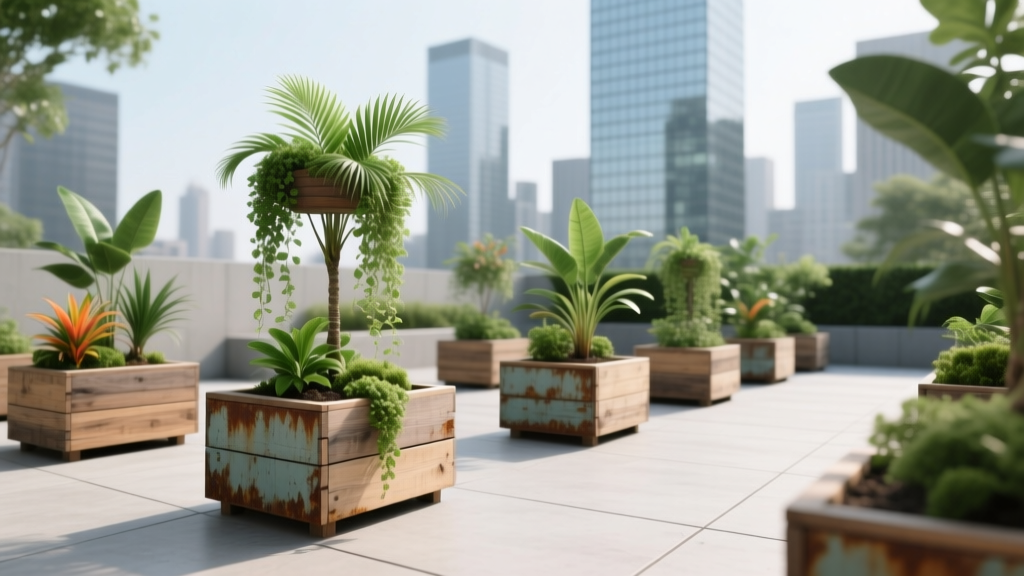
Deck Container Orchard in Pots
The first time you notice it is usually mid-summer: the deck is the best “room” in the house, yet it’s doing none of the work. Sun pours onto bare boards, the railing frames a view you don’t use, and the only thing growing is your wish for a peach you can pick without driving to an orchard. If you’ve got a deck, balcony, stoop, or patio that gets decent light, you can build a small orchard in pots—fruiting trees, berries, and herbs—laid out like a designed space, not a random collection of containers.
This project reads like a landscape plan because that’s how it behaves. You’ll be dealing with sun patterns, wind, weight, spacing, and irrigation—just in containers. Done well, a deck container orchard becomes an edible privacy screen, a scent garden, and a snack bar that fits in 6–8 square feet per tree.
Design principles for a deck orchard that feels intentional
Start with sunlight mapping (and be honest)
Fruit needs sun. Most fruiting plants produce best with 6–8+ hours of direct sun; some tolerate less but won’t perform like orchard trees in open ground. Before you buy a single pot, track sun for a weekend: morning, noon, late afternoon. If you’re seeing 4–5 hours of sun, focus on berries, figs, and herbs; if you get 8+ hours, you can run apples, peaches, and citrus (with winter protection where needed).
Research backs the basics: the Oregon State University Extension notes that most fruit crops require full sun for best yield and quality (OSU Extension, 2021). That’s not a scare tactic—just a design constraint, like choosing shade perennials for the north side of a house.
Plan by “canopy zones,” not by pots
Think in layers the way a landscape designer would:
- Upper layer (vertical structure): dwarf or columnar fruit trees in large containers.
- Mid layer (filler): berries, compact figs, dwarf citrus, or a second small tree.
- Lower layer (edging/utility): strawberries, thyme, chives, nasturtiums to attract pollinators and soften pot edges.
This approach prevents the “yard sale of pots” look. Your deck orchard becomes a composition: tall anchors, medium mass, low finish.
Use the railing as a trellis line
Railings are underused real estate. If your deck allows it, run a simple trellis system for grapes, hardy kiwi (where appropriate), or espaliered apples/pears in narrow containers. A wire trellis set 12–18 inches off the railing gives you airflow (less mildew) and a clean, architectural line.
“Espalier isn’t just a pruning method—it’s a space-planning tool. You’re turning a fruit tree into a living fence.” — Royal Horticultural Society guidance on training fruit (RHS, 2020)
Design for wind: the hidden deck problem
Decks and balconies are windier than ground-level gardens. Wind dries containers fast and can topple narrow pots. Two fixes:
- Go wider than tall for your largest containers (stability).
- Cluster pots so they shelter each other, leaving 3–6 inches between containers for airflow.
If your deck is exposed, plan a “windward buffer” using sturdy, dense plants (a potted bay laurel, a tall rosemary in mild climates, or even a decorative screen). It’s less romantic than choosing a peach variety, but it’s what keeps your peach alive.
Weight and waterproofing: design with the structure in mind
A container orchard is heavy. A 20-gallon pot can weigh 80–140 lb when saturated, depending on soil mix and container material. If you’re on a balcony or rooftop deck, check building rules and load ratings. Use pot feet or risers plus saucers to keep water from rotting decking; aim for 1/2 inch of lift so boards can dry.
Layout strategies: three deck plans that work in real life
Strategy 1: The “corner orchard” (best for small decks)
Ideal footprint: 4 ft x 6 ft corner. Place two dwarf trees diagonally (back corner and front corner) to create depth. Add a third mid-layer plant between them (blueberry or fig), then edge with strawberries or herbs.
Spacing rule: keep tree containers 24–30 inches apart rim-to-rim so you can prune, rotate, and water without scraping bark.
Strategy 2: The “rail orchard” (privacy + fruit)
Ideal footprint: a 10–12 ft run of railing. Place columnar apples or narrow citrus in a line. The rhythm is what makes it look designed: repeat the same pot style, same mulch topdress, same spacing.
Recommended spacing: 30–36 inches between large pots. If you’re using true columnar apples, you can tighten to 24–30 inches depending on cultivar and pruning.
Strategy 3: The “door-to-grill aisle” plan (best for entertaining decks)
This layout protects your traffic flow. Keep a clear walkway of 36 inches from door to grill/seating. Place your tallest trees at the outer corners, medium plants along the edge, and low edibles near seating where guests can snack (strawberries, alpine strawberries, mint in a contained pot).
The design trick: containers can act as furniture. Two matching 20–25 gallon planters flanking a bench make the orchard feel like a finished outdoor room.
Container specs, soil, and irrigation—numbers that matter
Choose the right pot size for long-term performance
If you want fruit (not just blossoms), size matters. Use this as a baseline:
- Dwarf apple/pear/peach: 15–25 gallons (minimum 18 inches wide; better at 22–26 inches).
- Blueberries: 10–15 gallons per plant.
- Figs: 15–20 gallons.
- Strawberries: 2–5 gallons (or a strawberry tower/railing planter).
Smaller pots are tempting for cost and weight, but they heat up and dry out quickly—yield suffers first.
Soil mix: lighten it, don’t cheap out
Use a high-quality potting mix (not garden soil). For fruit trees, blend:
- 60% premium potting mix
- 20% pine bark fines or orchid bark (air space)
- 20% compost
For blueberries, go acidic: a peat or coco-based acid mix plus pine bark. Penn State Extension notes blueberries require acidic soil around pH 4.5–5.5 for nutrient uptake (Penn State Extension, 2022).
Irrigation: the difference between “cute” and productive
Hand-watering works, but it becomes a chore in heat. A simple drip kit is the most practical upgrade you can make. Budget $35–$80 for a small deck drip system with a timer. In summer, containers may need water 3–6 times per week (or daily in hot, windy exposures).
Target: water until you see runoff, then stop. Salt buildup happens faster in pots; a deep soak helps flush excess.
Plant selection: reliable varieties that behave well in containers
Pick varieties like you’d pick furniture: right scale, right function, proven durability. For containers, prioritize dwarf rootstocks, self-fertile options when possible, and varieties known for disease resistance.
Dwarf and columnar apples
- ‘Northpole’ columnar apple: Narrow habit for rail layouts; easier to prune into a vertical accent.
- ‘Honeycrisp’ on M27 or M9 rootstock: Great fruit quality; dwarfs stay manageable with pruning and a 20–25 gallon pot.
- ‘Liberty’ (disease-resistant): Strong choice where apple scab is a problem; less spraying.
Why they work: apples adapt well to training (espalier/columnar), and dwarf rootstocks are made for size control. Expect best production with 8+ sun hours and consistent moisture.
Patio peaches and nectarines
- ‘Bonanza’ patio peach: Naturally compact; good for a 15–20 gallon container.
- ‘Necta Zee’ nectarine: Dwarf habit and good container performance with regular feeding.
Why they work: peaches fruit young and make the deck feel like a vacation. Keep airflow high—peach leaf curl pressure increases in damp, crowded placements.
Figs (the deck superstar)
- ‘Chicago Hardy’: Cold-tolerant compared to many figs; reliable for containers that may face winter stress.
- ‘Brown Turkey’: Forgiving and productive; great for beginners who want results.
Why they work: figs tolerate container life, handle heat, and can be pruned hard to fit. They’re also less fussy about pollination.
Blueberries (acid lovers that earn their footprint)
- ‘Sunshine Blue’: Compact, semi-evergreen in mild climates; good for pots.
- ‘Top Hat’: True dwarf; great for small decks and mixed containers.
Why they work: blueberries are ornamental—bells in spring, berries in summer, red fall color—plus they make an elegant “shrub layer” between trees. Plant two varieties for better pollination and yield if space allows.
Citrus for warm zones or movable pots
- ‘Improved Meyer’ lemon: Productive, fragrant, and one of the most container-friendly lemons.
- Calamondin orange: Compact, heavy bloomer; great if you like ornamental fruit.
Why they work: citrus turns the deck into a sensory garden. If winters drop below freezing, plan to wheel pots indoors; choose containers with casters or use plant dollies.
A quick comparison: which fruit earns its space on a deck?
| Plant | Recommended pot size | Sun need | Pollination | Best layout role |
|---|---|---|---|---|
| Columnar apple (‘Northpole’) | 15–20 gal | 8+ hours | Often needs a second apple nearby | Railing screen / vertical accent |
| Patio peach (‘Bonanza’) | 15–20 gal | 8+ hours | Usually self-fertile | Feature tree near seating |
| Fig (‘Chicago Hardy’) | 15–20 gal | 6–8 hours | Self-fruitful | Mid-layer mass / heat wall companion |
| Blueberry (‘Top Hat’) | 10–15 gal | 6+ hours | Better with two varieties | Shrub layer / pot grouping |
| Strawberries (everbearing) | 2–5 gal | 6+ hours | Self-fertile | Edging / spiller / snack zone |
Step-by-step setup: build a deck orchard that looks designed
- Measure your usable footprint. Mark a walkway at least 36 inches wide. Everything else is orchard territory.
- Map sun and wind. Choose your “sun spine” (the brightest edge) for fruiting trees. Put wind buffers on the exposed side.
- Choose 2–4 anchor containers. Start with 20–25 gallon pots for dwarf trees. Use matching containers for a cohesive look.
- Add saucers/risers. Lift pots 1/2 inch off the deck for drainage and board health.
- Install drip irrigation (optional but recommended). A basic kit with timer typically runs $35–$80. Set it before pots get crowded.
- Plant trees at the right height. Keep the graft union above soil level. Water deeply after planting.
- Topdress and finish. Add 1–2 inches of compost or fine bark mulch to reduce evaporation and make pots look unified.
- Place “softening plants.” Tuck in thyme, strawberries, or nasturtiums around pot edges (in separate small pots if competition is a concern).
- Label varieties and dates. This saves you from mystery pruning later.
Real-world scenarios: three deck orchards, three different priorities
Scenario 1: Rental balcony with strict rules (no drilling, minimal mess)
The brief: A renter has a 5 ft x 10 ft balcony, 6 hours of sun, and cannot attach anything to the railing.
The plan: Two large anchors—1 fig (‘Brown Turkey’) in a 20-gallon resin pot and 1 blueberry (‘Sunshine Blue’) in a 15-gallon pot—plus strawberries in a trough. Use a freestanding obelisk trellis in one pot for a compact vine (or skip vines if wind is intense).
Budget note: Lightweight resin pots and a plant dolly keep the landlord happy and make seasonal moving possible. Expect $220–$450 total depending on plant sizes and pot quality.
Scenario 2: Suburban deck used for entertaining (fruit without clutter)
The brief: A homeowner has a 12 ft x 14 ft deck, full sun, and wants fruit but needs clear flow from kitchen to grill.
The plan: Maintain a 36-inch traffic lane. Add two matching 25-gallon planters flanking a bench with columnar apples for a “green wall” effect. Put a patio peach (‘Bonanza’) as a feature near seating (not near the grill—heat stress). Edge with culinary herbs in smaller pots for fragrance and quick harvesting.
Design win: This reads like a styled outdoor room; the orchard is integrated, not scattered.
Scenario 3: Shady-ish deck with morning sun only (maximize yield anyway)
The brief: A townhouse deck receives 4–5 hours of sun, mostly morning, plus reflected light off a neighboring wall.
The plan: Skip apples/peaches. Use fig (often more forgiving), blueberries (may still fruit with reduced yield), and prioritize alpine strawberries and herbs. Use light-colored pots to brighten the space and a reflective panel (a pale trellis or decorative screen) behind plants to bounce light.
Expectation setting: You’ll still get harvests, just not orchard-level yields. The success metric here is “fresh fruit at arm’s reach,” not boxes for canning.
Budget and DIY alternatives (without sacrificing the look)
A deck orchard can be done on a tight budget, but allocate money where it counts: container size, potting mix, and healthy plants.
- Cost snapshot (typical ranges): dwarf fruit tree $35–$90; 20–25 gallon pot $25–$120; potting mix/compost for one large pot $18–$45; drip kit $35–$80; plant dolly $12–$30.
- DIY pot option: Use food-grade barrels cut in half (often $20–$40 each). Drill drainage holes and elevate on pot feet.
- DIY trellis option: Two tall bamboo stakes and garden wire can create a clean espalier line for under $15.
If you’re trying to keep the whole project under $300, start with one dwarf tree, one blueberry, and strawberries—then add the second tree next season once you’ve learned your deck’s watering rhythm.
Maintenance expectations: what it takes to keep it productive
Container orchards are not “plant and forget.” The payoff is real, but so is the schedule. Plan on 30–60 minutes per week during the growing season for watering checks, quick pruning, and pest scouting. In extreme heat, watering time can jump to 10 minutes daily if you’re hand-watering.
Weekly rhythm (growing season)
- Water: check moisture 3–6x/week (daily in heat/wind).
- Feed: apply a fruit-tree fertilizer or slow-release product as directed (often every 6–8 weeks for granular, or weekly/biweekly for liquid at lower dose).
- Inspect: look under leaves for aphids/mites; remove damaged fruit promptly.
Seasonal tasks that keep pots from declining
- Late winter/early spring: structural pruning for apples/peaches; remove crossing branches and keep an open center (peaches) or central leader/espalier form (apples).
- Spring bloom: if pollinators are scarce, hand-pollinate with a soft brush for better set—especially on sheltered balconies.
- Early summer: thin fruit (apples/peaches) to reduce limb stress and improve size. Aim for roughly 4–6 inches between fruits on small trees.
- Fall: reduce feeding, continue watering until dormancy; clean up leaf litter to reduce disease carryover.
- Every 2–3 years: root prune and refresh soil on vigorous trees, or up-pot if the tree is still in a smaller container.
Winter is the make-or-break detail in cold climates. Containers expose roots to lower temperatures than in-ground trees. Group pots together against the warmest wall, wrap containers with burlap, or move tender plants into an unheated garage where temps stay above severe lows.
Once your layout settles in, the orchard starts to feel like it belongs there—fruit hanging at eye level, herbs brushing your ankles, the railing softened by leaves instead of empty air. The best part is how quickly it changes the way you use the space: morning coffee becomes a pruning check, dinner becomes a handful of strawberries, and your deck stops being a platform and starts being a place that feeds you.
Sources: Oregon State University Extension, “Growing Tree Fruits and Nuts in the Home Orchard” (OSU Extension, 2021). Penn State Extension, “Growing Blueberries in the Home Garden” (Penn State Extension, 2022). Royal Horticultural Society (RHS), fruit training/espalier guidance (RHS, 2020).