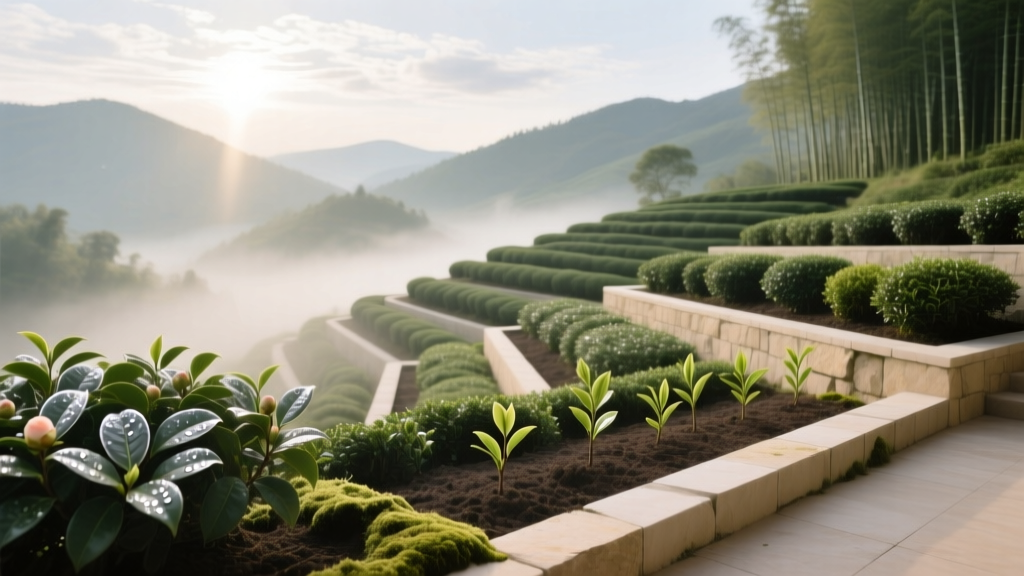
Terrace Tea Garden Plant Selection
The kettle’s on, you’ve got ten quiet minutes, and you step outside—only to find a hot, echoing terrace with a couple of mismatched pots and nowhere comfortable to set a mug. The good news: a terrace can become a tea garden faster than you think. The tricky part is that a tea garden isn’t just “pretty plants.” It needs fragrance at nose level, a little shade at the chair, calm visuals, and plants that won’t sulk in wind, reflected heat, or limited soil. Let’s design it the way a landscape designer would: with circulation first, then structure, then plant selection that earns its space.
For the purposes of this project, “tea garden” means a terrace designed for daily use—herbal picking, a restful seat, and sensory planting (scent, texture, sound) in a compact footprint. You don’t need a yard. You need a plan.
Start with the ritual: seat, set-down space, and a green edge
Before choosing a single plant, decide how you’ll actually drink tea out there. Most terraces fail because plants arrive first and the chair arrives later—then nothing fits.
Pick a practical footprint (with real dimensions)
Here’s a layout that works on many terraces and balconies: a two-person bistro set plus a planted perimeter. Aim for a clear “tea zone” of 5 ft x 7 ft (about 35 sq ft) so you can pull chairs without scraping pots. If your terrace is larger, scale up the planted edge, not the clutter.
- Minimum clear walkway: 30–36 inches (comfortable passing and watering access).
- Chair pull-back space: allow 24 inches behind each chair.
- Planter depth for perennials: 12–16 inches of soil is the sweet spot for many herbs and compact shrubs.
Think in layers: low, mid, and “screen”
A tea terrace feels calm when it has three heights:
Low layer (0–12 in): spillers and edging herbs (thyme, alpines, strawberries).
Mid layer (12–30 in): the bulk of your fragrance (lavender, sages, dwarf roses, flowering herbs).
Screen layer (30–72 in): privacy and wind buffering (clumping grasses, compact bamboo alternatives, narrow evergreens in containers).
This is also where renters win: the “screen layer” can be entirely in pots—no construction required.
Layout strategies that make small terraces feel intentional
Strategy 1: The “U-shaped” planter border
Place planters along three sides of the seating area (a U), leaving the open side as your access point. This creates a garden “room” and frames the view from your chair. On a terrace that’s 8 ft x 12 ft, you can typically fit:
- Two narrow trough planters: 36 in L x 10–12 in W
- Two medium pots: 16–20 in diameter
- One tall screen planter: 12–16 in W x 36–48 in H
Leave at least 36 inches of clear path from the door to the chair. Your future self carrying a tray will thank you.
Strategy 2: One strong vertical element (and no more)
On terraces, vertical gardening is tempting—trellises, shelves, hanging pots, wall pockets. The result can feel busy. Use one vertical feature: a trellis panel behind the seat, or a single ladder shelf at the far end. Keep it consistent, and let the plants do the softening.
“Good planting design is not about more plants; it’s about the right plants in the right places, repeated with intention.” — Nigel Dunnett, planting designer and author (Dunnett, 2016)
Strategy 3: Control heat and wind with placement, not gadgets
Terraces run hotter than ground-level gardens due to reflected heat from paving and walls. If you get 6–8 hours of sun, treat it like a “hot border” and choose Mediterranean herbs and tough flowering plants. If you get 3–5 hours, lean into part-sun performers and fragrance plants that tolerate brighter shade (mint in pots, lemon balm, some hydrangeas, ferns).
Wind is the other invisible problem. Put your tallest containers on the windward side as a buffer. Even a clump-forming grass can reduce leaf shred and drying.
Soil, containers, and irrigation: the invisible design that keeps plants alive
Container sizing and spacing that prevents constant watering
Small pots look charming and dry out twice as fast. For a tea garden that won’t punish you, use fewer, larger containers.
- Herbs (mint, lemon balm, chives): minimum 10–12 inch pot each; space pots 6–10 inches apart for airflow.
- Lavender/rosemary: minimum 14–16 inch pot; one plant per pot for best shape.
- Small shrub (dwarf hydrangea, compact evergreen): 18–24 inch pot for multi-year performance.
A practical mix is 2 parts high-quality potting soil + 1 part compost, plus a handful of slow-release fertilizer. Avoid “garden soil” in pots; it compacts and suffocates roots.
Costs: a realistic starter budget
Costs vary by region, but these numbers help you plan without guessing:
- 16-inch terracotta or resin pot: typically $25–$60 each
- 36-inch trough planter: often $45–$120
- Premium potting mix (2 cu ft): about $12–$20
- Young herb plant (4-inch pot): about $4–$8
- Simple drip kit for containers: commonly $35–$80
DIY alternative: use food-safe buckets or storage tubs (with drainage holes) and dress them up with a single color of exterior paint. Put them on saucers or risers to protect decking.
Plant selection for a terrace tea garden: varieties that earn their keep
The best tea garden plants do at least two jobs: fragrance + drought tolerance, or edible + ornamental, or evergreen structure + pollinator support. Below are reliable choices that perform well in containers.
Fragrance and floral “tea garden” anchors
Lavender (Lavandula angustifolia ‘Hidcote’ or ‘Munstead’)
Why it works: compact, drought-tolerant once established, and the scent reads from a seated height. Plant one per 16-inch pot; give it 6+ hours of sun. Avoid overwatering.
Rosemary (Salvia rosmarinus ‘Arp’ or ‘Tuscan Blue’)
Why it works: evergreen structure, culinary harvest, and a clean resinous fragrance. ‘Arp’ is known for better cold tolerance in many climates. One plant per 14–18 inch pot. Full sun is ideal.
Rose (Rosa ‘Kew Gardens’ or Rosa ‘Desdemona’ by David Austin)
Why it works: a tea garden feels like a tea garden when there’s at least one fragrant rose. Choose a variety bred for scent and repeat bloom. Put it in an 18–24 inch pot with consistent moisture. Morning sun is best; aim for 5–6 hours.
Jasmine for containers (Trachelospermum jasminoides, “star jasmine”)
Why it works: glossy leaves, summer fragrance, and it takes to trellises beautifully. Give it a trellis and a 16–20 inch pot. Great for screening without bulk.
Herbal tea essentials (and how to keep them from taking over)
Mint (Mentha spicata ‘Moroccan’ or Mentha x piperita)
Why it works: unbeatable for fresh tea, and forgiving in part sun. Keep it contained—always in its own pot (minimum 10–12 inches). Harvest hard to keep it lush.
Lemon balm (Melissa officinalis)
Why it works: bright citrus scent, easy growth, excellent for beginners. Like mint, it can spread—containerize it. Part sun is fine (4–5 hours).
German chamomile (Matricaria chamomilla)
Why it works: actual tea flowers in a small footprint. It’s an annual in many climates, but that’s an advantage on terraces—you can re-sow and refresh. Space plants about 8–10 inches apart in a trough.
Thyme (Thymus vulgaris ‘English’ or Thymus serpyllum ‘Coccineus’)
Why it works: a low, tidy spiller that smells incredible when brushed. Perfect at the edge of a planter where your hand naturally grazes it.
Calming structure: plants that make the space feel finished
Dwarf hydrangea (Hydrangea paniculata ‘Bobo’)
Why it works: soft, cloud-like blooms without needing a huge footprint. Does well in containers if watered consistently. Best with 4–6 hours of sun (morning sun, afternoon shade in hot zones).
Clumping grass (Calamagrostis x acutiflora ‘Karl Foerster’)
Why it works: vertical, narrow, wind-tough, and provides gentle sound. One plant in a tall pot can act as a screen. Cut back in late winter.
Evergreen option (Ilex crenata ‘Sky Pencil’)
Why it works: a tight vertical column for year-round structure—excellent when you want privacy without a wide planter. Use an 18-inch pot and don’t let it dry completely.
A quick comparison: choose plants by sun and container needs
| Plant (Variety) | Best Sun | Container Size | Spacing / Notes | Tea / Use |
|---|---|---|---|---|
| Lavender (‘Hidcote’) | 6–8 hrs | 16" pot | 1 per pot; fast drainage | Fragrance, sachets |
| Mint (‘Moroccan’) | 4–6 hrs | 10–12" pot | Keep isolated; cut often | Fresh tea leaves |
| Chamomile (German) | 6 hrs ideal | 36" trough | 8–10" apart; reseeds | Flower tea |
| Star jasmine | 5–7 hrs | 16–20" pot | Add trellis; protect from harsh wind | Scent + screen |
| Hydrangea (‘Bobo’) | 4–6 hrs | 18–24" pot | Even moisture; mulch surface | Soft blooms, calming mass |
Three real-world terrace scenarios (and what I’d plant)
Let’s apply this like a designer: same tea ritual, different constraints.
Scenario 1: A hot, sunny rooftop terrace (wind + reflected heat)
Typical conditions: 7–9 hours of sun, strong wind, pots dry quickly. The goal is a tea corner that doesn’t require watering twice a day.
Layout move: place a tall screen planter on the windward side, and group pots tightly (they shade each other’s soil).
Planting palette:
Lavender ‘Hidcote’ (2 pots), rosemary ‘Arp’ (1), thyme (edge spiller), star jasmine on a trellis (1), plus a clumping grass ‘Karl Foerster’ (1 tall pot). Add one bowl planter of strawberries for a snack-with-tea bonus.
Why it works: Mediterranean plants thrive in sun and lean soil, and the grass + jasmine buffer wind without heavy construction.
Scenario 2: A shaded apartment balcony (bright shade, limited direct sun)
Typical conditions: 2–4 hours of direct sun or dappled light. Many “tea herbs” stretch and weaken here unless chosen carefully.
Layout move: keep the center open and use a single ladder shelf against the wall for smaller pots—easy access, no crowding.
Planting palette:
Mint ‘Moroccan’ (1), lemon balm (1), chives (1), dwarf hydrangea ‘Bobo’ (1 large pot if you get some sun), plus shade-tolerant texture like ferns or heuchera in a trough. If you want flowers for tea, try chamomile only if you truly get 4+ hours of sun; otherwise, treat it as a seasonal experiment.
Why it works: mint-family plants tolerate part shade better than lavender/rosemary, and hydrangea brings that soft “garden” feeling even without blazing sun.
Scenario 3: A renter’s terrace with strict rules (no drilling, minimal mess)
Typical conditions: you can’t attach trellises to walls, and you need everything movable. You also want a setup you can take with you.
Layout move: create a U-shape with matching lightweight resin planters and use a freestanding trellis (inserted into a large pot).
Planting palette:
Star jasmine on a freestanding trellis (1), lavender ‘Munstead’ (1–2), mint (1 pot), chamomile in a trough (1), and one compact rose (‘Desdemona’ if you can give it sun and water).
Why it works: everything is modular and portable; the jasmine + rose deliver that “tea garden” romance without altering the building.
Step-by-step setup (designer workflow you can copy)
- Measure the terrace and sketch a simple rectangle. Mark the door swing and the main walking line. Reserve a 30–36 inch clear path.
- Place the seating first. Put down the bistro set and test chair movement with 24 inches behind each chair.
- Mark planter zones with painter’s tape or cardboard. Aim for a U-shape border and one tall element for privacy/wind.
- Choose container sizes based on plant longevity: herbs in 10–12 inch pots, woody plants in 16–24 inch pots.
- Add pot feet or risers so water drains cleanly and doesn’t stain decking. This also reduces root rot.
- Fill with soil: potting mix + compost. Water once to settle, then top up so soil ends about 1 inch below the rim.
- Plant by height: screen plants first, then mid-layer, then spillers. Rotate pots so the best-looking side faces the chair.
- Mulch the surface with fine bark or compost (about 1 inch layer) to slow evaporation.
- Set up watering: at minimum a watering can and a schedule; ideally a basic drip kit if you travel.
Maintenance expectations: what it really takes
Most terrace tea gardens are easy—until summer hits. Plan for a steady, light rhythm rather than occasional heavy work.
Weekly time: budget 30–60 minutes per week in peak season (less in spring/fall, more during heat waves). If you hand-water daily in summer, it’s often 5–10 minutes per day.
Seasonal tasks (simple, but important)
Spring (1–2 hours total): refresh top 2 inches of potting mix, add slow-release fertilizer, prune lavender lightly (don’t cut into old wood), and check irrigation.
Summer (ongoing): deadhead roses, harvest herbs weekly (mint and lemon balm especially), and watch for containers drying on windy days. If you get 90°F+ stretches, move the most sensitive pots (hydrangea) into afternoon shade.
Fall (1 hour): reduce feeding, tidy spent annuals (chamomile), and consider wrapping pots if your winters freeze hard—roots are more exposed in containers.
Winter (30 minutes): protect tender rosemary in cold climates near a wall, water evergreens lightly during dry spells, and cut ornamental grasses back in late winter before new growth.
Budget-smart choices and DIY upgrades
If you’re building this on a careful budget, spend on what you can’t “DIY” later: large containers and healthy woody plants (rosemary, rose, jasmine). Save on annuals and accents.
- DIY self-watering insert: place an upside-down nursery pot in the bottom of a large container to create a small reservoir zone (still drill drainage holes—never let roots sit in stagnant water).
- Cheap wind buffer: one tall grass in a sturdy pot often works better than a flimsy screen.
- Propagate mint and lemon balm: both root readily from cuttings in water—an easy way to fill more pots over time.
Notes you can trust: safety and plant performance
When you’re growing plants specifically for tea, clean harvesting matters. The University of California Agriculture and Natural Resources notes that herbs should be harvested and handled carefully to maintain quality and reduce contamination risk (UC ANR, 2020). That means clean snips, rinsing if needed, and avoiding pesticide use on edible leaves unless it’s explicitly labeled for edibles and used correctly.
Also, container plantings dry faster and can accumulate salts from fertilizer. The Royal Horticultural Society recommends refreshing compost and managing watering carefully for container-grown plants (RHS, 2023). Practically, that looks like thorough watering until it runs from the bottom, then letting the top inch dry before watering again for drought-tolerant herbs.
Three planting “recipes” you can copy (scaled to your space)
Recipe A: The Sunny Scent Corner (about 6 containers)
1 lavender ‘Hidcote’ (16" pot), 1 rosemary ‘Arp’ (16" pot), 1 star jasmine (18" pot + trellis), 1 thyme spiller (10–12" pot), 1 chamomile trough (36"), 1 ‘Sky Pencil’ holly (18" pot). This is a strong all-season framework with fragrance from spring through late summer.
Recipe B: The Part-Sun Tea Picker (about 5 containers)
1 mint ‘Moroccan’ (12"), 1 lemon balm (12"), 1 chives (10"), 1 hydrangea ‘Bobo’ (20"), 1 mixed trough of heuchera + fern for texture (36"). You’ll get reliable leaves for tea without fighting the light.
Recipe C: The Romantic Tea Seat (about 7 containers)
1 fragrant rose (20–24"), 1 lavender ‘Munstead’ (16"), 1 star jasmine (18" + trellis), 1 mint (12"), 1 chamomile trough (36"), 1 thyme spiller (10"), 1 clumping grass (tall pot). This is the “sit down and exhale” version—high scent, soft movement, and a view worth keeping tidy.
Once you’ve built the structure—clear chair space, a planted U-shape, and one vertical screen—the plant selection becomes the fun part: choosing which scents you want closest to your hands and face. Set the chair where you’ll actually use it, put mint within arm’s reach, and let lavender and jasmine do the atmospheric work. When you step out with a mug and your terrace meets you with fragrance instead of clutter, you’ll know you designed it right.
Sources: University of California Agriculture and Natural Resources (UC ANR), 2020; Royal Horticultural Society (RHS), 2023; Dunnett, N., 2016.