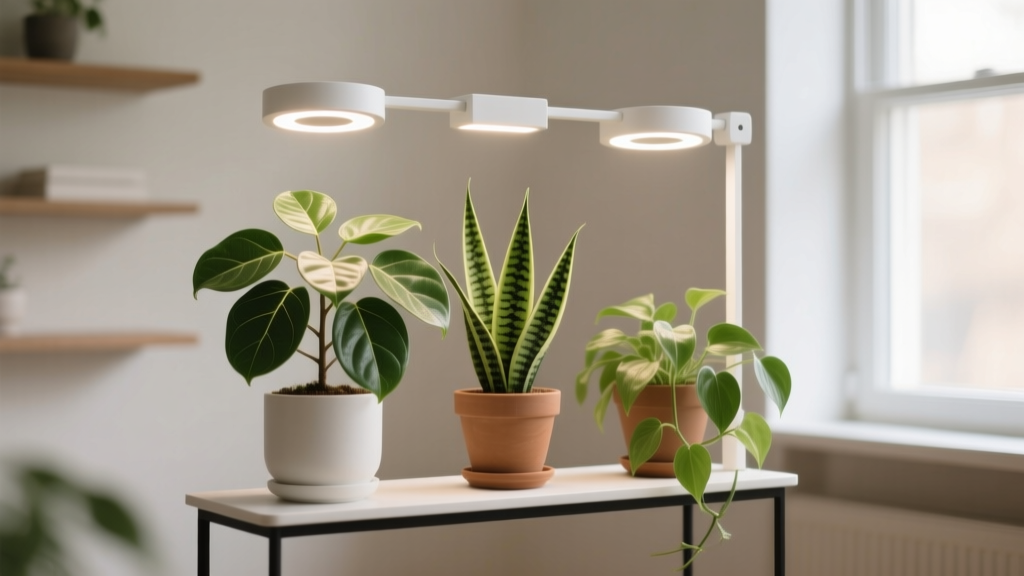
Indoor Plant Lighting Setup Guide
The pothos on your bookshelf is growing long, pale internodes like it’s reaching for a lifeline. Your basil looks fine for a week, then stalls. And the “bright room” your rental listing promised turns out to be bright only from 11:00 to 2:00—on sunny days. If this sounds familiar, you don’t need a bigger window. You need a lighting layout that treats your indoor plants like a small landscape: layered, measured, and designed around how light actually moves through your space.
This guide walks you through building an indoor plant lighting setup the way a designer would: start with constraints, map the zones, choose fixtures that match the plants, then refine the height, spacing, and schedule until the whole “room garden” looks intentional—and grows like it.
Start With a Lighting Plan: Think in Zones, Not Fixtures
Indoor plant lighting works best when you stop thinking “one lamp per plant” and start thinking “one light zone per plant group.” Lighting zones reduce clutter, simplify timers, and prevent the common mistake of blasting shade plants while under-lighting edible crops.
Step 1: Measure your plant footprint and vertical clearance
Before you buy anything, grab a tape measure. You need two numbers: the footprint (how wide your plant grouping is) and the clearance (how much height you have to hang or mount a light).
- Small shelf zone: 24 in wide × 10–12 in deep is common for bookcases.
- Counter zone: 36 in wide × 18–24 in deep often fits under upper cabinets.
- Floor zone: 24–48 in wide is typical near a window wall.
As a starting point, plan for 6–18 inches between the light and the top of the plant canopy, depending on fixture strength and plant type. Stronger lights generally hang higher; weaker lights need to sit closer.
Step 2: Match plant goals to “light hours” (photoperiod)
Most indoor plant lighting succeeds or fails on consistency. A simple timer is the difference between steady growth and a plant that endlessly “treads water.”
- Low-to-medium light houseplants: aim for 10–12 hours/day of supplemental light.
- High-light tropicals (many aroids, ficus): 12–14 hours/day.
- Seedlings and herbs: typically 14–16 hours/day to stay compact and productive.
Research commonly references plant growth under photosynthetically active radiation (PAR) in the 400–700 nm range. The framework is well established: PAR is the portion plants use for photosynthesis (McCree, 1972).
Core Design Principles for Indoor Lighting Layouts
Layer light like a garden: canopy, understory, accent
Think of your indoor plants as a tiny woodland. Your tallest plant is the canopy, mid-height plants form the understory, and trailing plants soften edges like groundcover.
- Canopy (24–72 in tall): Use a taller floor lamp with a strong bulb or a hanging pendant-style grow light.
- Understory (10–24 in): Use a shelf bar or under-cabinet strip lighting.
- Accent/edge (trailing): Place at the perimeter where light spills; rotate weekly so one side doesn’t thin.
Prioritize even coverage over intense “spot hits”
Plants respond better to a consistent field of light than to harsh hotspots and dark corners. A practical layout trick: if your plant grouping is 36 inches wide, use a light that’s 24–36 inches long (or two 18-inch bars) so the ends aren’t starved.
Use reflective surfaces strategically
A white wall or a simple foam-board reflector can noticeably boost usable light in tight spaces. If your plant zone sits against a dark wall, consider adding a removable white panel behind it (renter-friendly) to reduce “light loss.”
“Light is not just intensity—it’s distribution. Uniformity across the canopy is what keeps growth balanced and reduces leggy stretch.” — Dr. Marc van Iersel, horticulture researcher (University of Georgia), quoted in discussions on controlled environment lighting and canopy management (van Iersel et al., 2017)
Choosing Fixtures: Practical Options and What They’re Best At
You’ll see “grow lights” marketed with dramatic claims. Instead, choose by form factor, coverage, and controllability (dimming/timers). Below is a quick comparison you can actually design with.
| Fixture type | Best for | Typical mounting height | Coverage you can expect | Typical cost (USD) |
|---|---|---|---|---|
| LED bar/strip (shelf light) | Herbs, seedlings, shelf plants | 6–12 in above canopy | 1–2 ft shelf depth per bar | $25–$80 per 2–4 ft bar |
| Clamp lamp + LED grow bulb | Single specimen plant, small clusters | 8–18 in above canopy | ~1–2 ft diameter usable circle | $15–$35 clamp + $15–$45 bulb |
| Panel-style LED (compact) | Small indoor “garden station” | 12–24 in above canopy | 2×2 ft to 3×3 ft area (model dependent) | $60–$180 |
| Track/ceiling pendant grow light | Design-forward living room installs | 18–36 in above canopy | Varies; good for highlighting zones | $80–$250+ |
For many homeowners and renters, the sweet spot is a 2-foot or 4-foot LED bar for shelves plus a single clamp lamp to boost a favorite floor plant.
A note on efficiency and heat
LEDs are popular because they’re efficient and relatively cool. The U.S. Department of Energy notes that LED lighting can use at least 75% less energy and last up to 25 times longer than incandescent lighting (U.S. Department of Energy, 2023). That matters indoors: less wasted heat near leaves, and lower ongoing cost.
Step-by-Step Setup: A Designer’s Install Order
Use this order to avoid re-hanging lights three times. You’re building a system, not just plugging in a lamp.
- Sketch your zones: draw your shelf/counter/floor plant groupings and write their dimensions (example: “shelf zone: 30 in wide × 12 in deep”).
- Assign plant groups to zones: herbs together, low-light foliage together, succulents together. Mixing needs creates constant compromise.
- Choose fixtures by coverage: match bar length to shelf width; reserve clamp lamps for accents and corners.
- Mount lights securely: use screw-in brackets if allowed; otherwise use heavy-duty adhesive strips rated for the fixture’s weight (check packaging load limits).
- Set initial height: start at 12 inches above canopy for bars/panels and 16 inches for bulbs, then adjust after a week.
- Add a timer: set 12 hours/day for foliage, 14–16 hours/day for herbs/seedlings.
- Observe and refine: if plants stretch, lower the light by 2–4 inches or extend photoperiod by 1 hour. If leaves bleach, raise the light by 2–6 inches or reduce hours.
Plant Selection: Varieties That Actually Perform Under Indoor Lights
A lighting setup feels “successful” when plants grow predictably. Choose varieties that match the light intensity you can realistically provide.
Reliable foliage plants for mixed-light homes
These handle typical shelf and corner lighting well, especially with 10–12 hours of LED supplementation.
- Epipremnum aureum ‘Golden Pothos’: fast recovery from low light; trails beautifully from shelves; easy to prune and propagate.
- Philodendron hederaceum ‘Brasil’: bright variegation holds better under consistent supplemental light; great for layered “understory” design.
- Sansevieria (Dracaena trifasciata) ‘Moonshine’: tolerates lower light and missed waterings; upright form anchors a plant vignette.
- Zamioculcas zamiifolia (ZZ plant): slow but steady; excellent for renters who want low maintenance with a polished look.
- Spathiphyllum ‘Sensation’ (peace lily): communicates clearly (slight droop when thirsty); performs better and blooms more reliably with steady light.
High-reward herbs and edibles for bright shelves
Edibles are where lighting pays you back. Under 14–16 hours/day of strong, close lighting, these can be genuinely productive.
- Basil ‘Genovese’: loves strong light; pinch weekly to keep it bushy; excellent in a 6–8 inch pot.
- Mint ‘Spearmint’: vigorous and forgiving; keep in its own pot to prevent takeover; tolerates slightly lower light than basil.
- Parsley ‘Italian Flat Leaf’: slower to start but steady; benefits from consistent photoperiod and moderate feeding.
- Lettuce ‘Black Seeded Simpson’: one of the easiest salad greens indoors; harvest outer leaves continuously.
- Microgreens (radish, broccoli, pea shoots): quick cycles (often 7–14 days); ideal for shallow trays under a bar light.
Succulents and cacti that stay compact with enough light
If you can’t provide strong light, skip succulents—they’ll stretch. But if you can keep a light close (often 6–10 inches above), these behave well:
- Haworthia attenuata (zebra haworthia): tolerates indoor conditions better than many; great for desktops.
- Echeveria ‘Perle von Nürnberg’: gorgeous color under strong light; needs careful watering and strong intensity to prevent elongation.
- Crassula ovata (jade plant): classic, forgiving, and architectural; thickens nicely with consistent supplemental light.
Three Real-World Lighting Layout Scenarios (With Numbers)
Scenario 1: The renter’s bookshelf jungle (no drilling)
Space: 60-inch wide bookcase, shelves 10–11 inches deep. The room gets weak daylight, maybe 2–3 hours of indirect brightness.
Layout strategy: Create two plant “bands” instead of trying to light every shelf. Use one shelf for trailing and mid-size foliage, and one shelf for propagation and smaller pots.
- Lighting: Two 2-foot LED bars mounted under the shelf above, centered.
- Mounting: Adhesive mounting clips (renter-friendly) + cable clips for tidy lines.
- Height: Keep 8–10 inches from bar to canopy.
- Schedule: 12 hours/day on a timer.
- Budget: Bars ($60–$120 total), timer ($10–$15), adhesive/cable management ($10). Rough total: $80–$145.
Plant picks: Pothos ‘Golden’, Philodendron ‘Brasil’, ZZ plant (lower shelf edge), and a peace lily where spill light reaches. These tolerate minor unevenness and still look lush.
Scenario 2: The kitchen counter herb line (tight depth, lots of use)
Space: 36-inch counter run with upper cabinets. You can mount lights under the cabinet; depth is often 18–24 inches, but your herbs will occupy a 6–8 inch strip near the backsplash.
Layout strategy: Treat it like a linear border planting: repeating pots, consistent heights, easy access for harvesting. Keep foliage away from the stove’s heat plume if possible.
- Lighting: One 24–36 inch under-cabinet LED grow strip placed 2–4 inches behind the cabinet front edge to wash light down evenly.
- Height: Typically 10–14 inches above canopy (depending on cabinet clearance); raise pots on a 1–2 inch riser if needed.
- Schedule: 14–16 hours/day.
- Budget: Strip light ($30–$90), timer ($10–$15), matching pots/saucers ($5–$12 each). For 5 pots, plan $25–$60 just for containers.
Plant picks: Basil ‘Genovese’ (center), parsley ‘Italian Flat Leaf’ (cooler end), mint ‘Spearmint’ (in its own pot), chives, and thyme. Basil gets the prime spot because it’s the most light-hungry and the most rewarding to harvest weekly.
Scenario 3: The living room statement plant that keeps sulking
Space: A 4–6 foot tall plant (like a fiddle-leaf fig) placed 6–10 feet from a window. Natural light looks bright to us, but the plant disagrees.
Layout strategy: Create a “spotlit” canopy zone with a floor lamp or a pendant grow light that looks like decor. The goal is to add consistent, directional light without turning the living room into a lab.
- Lighting: One clamp or floor lamp with a quality LED grow bulb aimed at the canopy (not the trunk).
- Height: Start at 16–24 inches from the top leaves; adjust after 7–10 days based on response.
- Schedule: 12–14 hours/day.
- Budget: Lamp ($25–$120), bulb ($20–$45), timer ($10–$15). Rough total: $55–$180.
Plant picks: Ficus lyrata (fiddle-leaf fig) responds well to consistent supplemental light; Ficus elastica ‘Burgundy’ is even more forgiving and keeps a strong silhouette; Monstera deliciosa appreciates the boost and will fenestrate more reliably when light is steady.
Spacing and Placement: Small Adjustments That Prevent Big Problems
Indoor lighting magnifies small layout mistakes. Give plants breathing room so light reaches more than just the top leaves.
- Pot-to-pot spacing: leave 2–4 inches between small pots; 6–10 inches between larger foliage plants to reduce pest pressure and improve airflow.
- Rotate weekly: a quick quarter-turn keeps growth symmetrical, especially under single-direction lamps.
- Keep leaves off bulbs/fixtures: even cooler LEDs can stress leaves if pressed directly against a light source.
Budget-Conscious Moves and DIY Alternatives
Design doesn’t require expensive fixtures—it requires a clean plan. If you’re building your first setup, spend money where it matters: consistent coverage and a timer.
- DIY reflector: white foam board or matte white poster board behind a shelf zone can increase usable light without increasing wattage.
- Riser platforms: flip a shallow tray or use a sturdy box to bring shorter plants closer to the light instead of lowering the fixture.
- One timer, multiple zones: use a power strip controlled by a single timer for plants with the same schedule.
- Staggered upgrades: start with one well-lit “hero zone” (like herbs), then expand once you see results.
As a practical operating cost example, a 40-watt LED running 14 hours/day uses about 0.56 kWh/day. At $0.15/kWh, that’s roughly $2.50/month. Your actual rate varies, but this is a helpful planning number for renters watching utility bills.
Maintenance Expectations: Keep the System Looking Designed (and Working)
A lighting setup is part garden, part small appliance. Plan for light housekeeping so it stays attractive and effective.
Weekly time: expect about 20–40 minutes/week for a 10–20 plant indoor collection: watering checks, a quick rotate, and a glance at new growth.
- Wipe fixtures monthly: dust reduces output; a dry microfiber cloth is usually enough (unplug first).
- Prune and pinch every 1–2 weeks: especially basil and trailing plants—this keeps the silhouette dense and prevents shading lower leaves.
- Seasonal timer tweaks: if you rely on a mix of window light and LEDs, adjust schedules in winter (often +1 hour) and reassess in summer.
- Check for pests: warm, still indoor corners invite spider mites. Good airflow and not overcrowding your canopy helps.
If you notice algae on soil or fungus gnats, it’s usually not the light—it’s moisture staying too long. Increase airflow, let the top inch dry for many foliage plants, and avoid oversized pots.
Two Smart “Designer” Finishes That Make It Feel Intentional
1) Hide cords like you mean it. Use cable clips to run cords along the back edge of shelves and down one “spine” to a power strip. One neat cord path looks designed; five dangling ones look temporary.
2) Repeat containers and heights. In landscape design we repeat forms for calm. Indoors, matching 6-inch pots in two or three colors reads cohesive, even with a diverse plant palette. Use one taller plant as a focal point, then step down heights like a planted border.
When your light zones are measured, your fixtures are placed for even coverage, and your plants are chosen for the conditions you can actually provide, the whole setup shifts from “plant rescue mission” to an indoor garden that holds its shape. The best part is how quickly the room changes: leaves turn toward the light within days, new growth tightens up within a couple of weeks, and suddenly your shelf looks like it belongs in that sunny listing photo—even if the weather outside doesn’t cooperate.
Sources: McCree, K.J. (1972). “The action spectrum, absorptance and quantum yield of photosynthesis in crop plants.” Agricultural Meteorology. U.S. Department of Energy (2023). “LED Lighting.” van Iersel, M. et al. (2017). Research on canopy lighting strategies and controlled environment horticulture (University of Georgia/peer-reviewed publications).