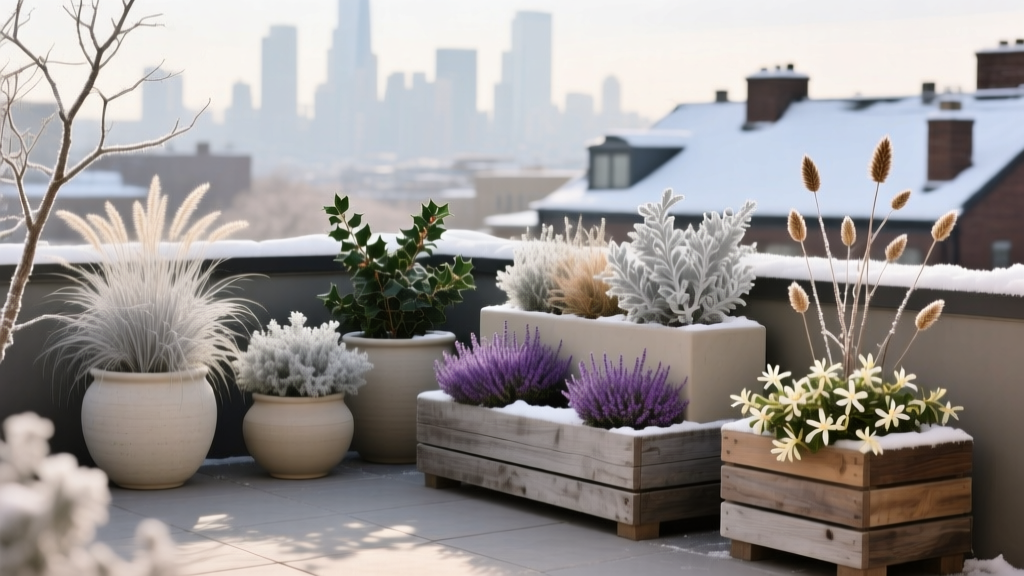
Terrace Winter Interest Container Plan
The first frost always has a way of making a terrace feel like it’s been “switched off.” You step outside with a mug of tea, and where you had color and movement in summer, you’re left with damp pots, bare compost, and a view that feels a little too honest. The good news: winter is not a season to endure on a terrace—it’s a season you can design for. With the right containers, structure-first planting, and a few strategic lights, your outdoor space can look intentional from November through March, even on the grey days.
This plan is written like I’d walk you through a client install: we’ll measure, choose a layout that fits how you use the terrace, and build containers that hold their shape all winter. The goal isn’t “flowers in the snow.” The goal is strong silhouettes, evergreen volume, interesting bark and stems, and a small rotation of seasonal accents you can swap without redoing everything.
Start With the View, Not the Plants
Before buying anything, stand at your most common indoor viewpoint (usually the kitchen sink or living room window) and identify the sightline you want to improve. On terraces, winter containers work best when they’re placed where you’ll actually see them daily. If you only enjoy them when you’re outside, you’ll forget to water on mild weeks, and winter wind will do the rest.
Pick a “Hero Zone” and Two Supporting Zones
A reliable terrace layout uses three layers of attention:
- Hero zone (most visible): a pair of tall containers or one oversized trough with strong evergreens and lights.
- Supporting zone (secondary view): mid-height pots clustered near seating or along a wall.
- Detail zone (up close): small pots by the door with scent or texture—where your hands can brush foliage as you pass.
If you’re working with a typical rental terrace of 3 m x 4 m (about 10 ft x 13 ft), a clean starting layout is: two tall pots flanking the door or balcony opening, three mid-height containers grouped in a triangle near the seating corner, and two small pots near the threshold.
Layout Strategies That Make Winter Containers Look Designed (Not Random)
Use Repetition for Calm in a Messy Season
Winter is visually busy—bare branches, wet surfaces, and low light create “noise.” Repeating shapes and materials is the easiest way to make a terrace look composed. Choose one container material (matte black, lead-effect, or dark terracotta) and repeat it at least 3 times. If you love mixed pots, keep the palette to two finishes and repeat each finish.
Scale Up: Winter Needs Bigger Forms
Small pots disappear in winter, especially against railings and brick. As a rule of thumb:
- Hero containers: 45–60 cm diameter and 50–70 cm tall.
- Mid containers: 35–45 cm diameter and 35–50 cm tall.
- Detail pots: 25–30 cm diameter.
These sizes also resist tipping in wind. If your terrace is exposed (top floor, coastal, or corner building), plan to weight each tall pot with 3–5 kg of gravel in the bottom—especially if you’re using lightweight fiberglass.
Design for Sunlight Hours You Actually Get
Most terraces are “part sun” in winter whether you like it or not. Use these guidelines:
- Full sun: 6+ hours (rare in winter on urban terraces).
- Part sun/bright shade: 3–5 hours (common with neighboring buildings).
- Shade: 0–2 hours (north-facing or heavily screened).
Match plants to winter light, not summer light. Evergreens in deep shade may survive but look thin and tired by February.
Container Engineering: Drainage, Soil, and Windproofing
Drainage That Won’t Freeze Into a Problem
Winter container failure is usually water management. Frozen, saturated compost leads to root loss. Aim for fast drainage while still holding moisture.
- Add a mesh screen over drainage holes (prevents compost loss while keeping flow).
- Place 3–5 cm of gravel at the base (more in very tall pots).
- Use a peat-free potting mix blended with 20–30% horticultural grit or perlite for air.
- Keep containers on pot feet so water can escape (especially on tiled terraces).
The RHS notes that good drainage is essential for winter containers because waterlogging is a major cause of plant loss in cold weather (Royal Horticultural Society, 2023).
Soil Volume Matters More Than You Think
In winter, bigger soil volume buffers roots from temperature swings. For a small evergreen shrub, treat 30–40 liters of compost as a minimum. If you only have space for small pots, choose smaller, tighter plants (dwarf conifers, compact hebes, skimmias) rather than forcing a big plant into a tiny container.
Wind: The Hidden Design Brief
Wind is both a plant stressor and a visual opportunity. Use evergreens as windbreak structure and let grasses provide motion on calmer terraces. If your terrace is exposed, prioritize stiff, resilient forms (box substitutes, yew, juniper) over large-leaved evergreens that shred.
“Winter design is about structure first—plant shape, bark, and persistence—then accents.” — Ellie Johnson, garden designer, in the RHS podcast on winter gardens (2022)
The Planting Palette: Varieties That Hold Their Looks in Cold Months
This container plan uses a simple formula: 1 evergreen anchor + 1–2 structural companions + 2–4 seasonal accents per large container. Accents can be swapped monthly (cut stems, cyclamen, ornamental cabbage, small bulbs) while the anchors stay put for years.
Evergreen Anchors (Choose 1 per hero pot)
- Ilex crenata ‘Dark Green’ (Japanese holly): A boxwood look without the same susceptibility to box blight. Dense, clip-friendly, and tidy in containers. Works best in 3–5 hours of sun.
- Taxus baccata (yew), small trained cone or column: Deep green, very wind-tolerant, excellent structure. Slow-growing, so it stays proportional. Give it a container at least 45 cm wide.
- Juniperus squamata ‘Blue Star’: Compact, steel-blue winter color. Great in sunnier terraces (aim for 4–6 hours).
- Skimmia japonica ‘Rubella’: Red buds through winter, shade-tolerant, and compact. Excellent for north-facing terraces with 0–2 hours sun.
Structural Companions (Choose 1–2 per container)
- Cornus alba ‘Sibirica’ (red dogwood), grown as a small container stool: Electric red stems in winter. Best in larger containers; cut back hard in early spring to encourage new colored stems.
- Sarcococca confusa (sweet box): Evergreen and winter-scented flowers. Perfect near doors where fragrance matters; tolerates shade well.
- Heuchera ‘Obsidian’ or ‘Caramel’: Reliable foliage color through mild winters; choose darker leaves for contrast against pale paving.
- Carex oshimensis ‘Evergold’: Variegated grass-like evergreen that brightens dark corners and softens hard edges.
Seasonal Accents (Swap as needed)
- Cyclamen coum: Winter flowers in bright shade; compact and long-lasting in cool conditions.
- Brassica oleracea (ornamental cabbage/kale): Bold rosettes that look better after frost. Choose purple or cream forms for high contrast.
- Helleborus x hybridus (Lenten rose): Flowers late winter/early spring; place near seating so you see blooms up close.
- Gaultheria procumbens (wintergreen): Red berries, evergreen leaves, and a festive look in small pots.
- Cut stems: Eucalyptus, birch twigs, curly willow, and pine stems for instant height without stressing roots.
For berries and wildlife value, note that many winter-fruiting plants are more productive with pollination partners; for example, hollies often require male and female plants for heavy berry set (Royal Horticultural Society, 2020).
A Practical Layout Plan You Can Copy (With Measurements)
Here’s a straightforward plan for a 3 m x 4 m terrace, with a door opening on one side and railing on the other. Adjust spacing, but keep the proportions.
Placement Map (Readable Rules)
- 2 hero containers: place 60–90 cm from the doorway edges (one on each side), leaving a clear path at least 90 cm wide.
- 3 mid containers: group in a triangle near the seating corner, with 30–40 cm gaps between pots for airflow and easy watering.
- 2 detail pots: near the threshold, but not where they’ll be kicked—leave 20 cm from the door swing.
Spacing Inside Each Container
For a 50 cm diameter pot:
- 1 evergreen anchor centered.
- 2 companions placed at roughly “10 o’clock” and “2 o’clock,” 15–20 cm from the anchor.
- 3–5 accents around the edge, spaced 10–12 cm apart.
Comparison Table: Choose Containers That Survive Winter (and Look Good Doing It)
| Container type | Typical cost (per 45–60 cm pot) | Winter performance | Best for | DIY-friendly? |
|---|---|---|---|---|
| Frost-proof terracotta | $70–$160 | Good if truly frost-proof; heavy and stable | Windy terraces, classic style | Moderate (heavy to move) |
| Fiberglass/resin composite | $60–$180 | Excellent freeze-thaw resistance; lightweight but can tip | Renters, rooftops with weight limits | High (easy handling) |
| Wooden trough (lined) | $90–$220 | Good insulation; needs drainage + liner management | Long rail edges, privacy planting | High (buildable with basic tools) |
| Glazed ceramic | $80–$250 | Variable; can crack if not frost-rated | Sheltered terraces with style focus | Low (riskier investment) |
Step-by-Step Setup (A Weekend Project)
- Measure and mark: Use painter’s tape to mark pot footprints. Walk the path—aim for 90 cm clear walkway.
- Stage empty pots: Place containers first and view them from indoors and from seating. Adjust until the layout feels balanced.
- Prepare drainage: Mesh over holes, pot feet underneath, gravel layer 3–5 cm.
- Mix compost: Peat-free mix + 20–30% grit/perlite. (If budgets are tight, use coarse sand plus pine bark fines, but keep it airy.)
- Plant anchors: Set evergreen anchors at the correct height—top of rootball should sit about 2–3 cm below the rim for watering space.
- Add companions: Place them before backfilling so you can rotate for best faces.
- Finish with accents: Tuck cyclamen, heuchera, and wintergreen at edges; firm gently.
- Mulch and top-dress: Add a 2 cm layer of fine bark or gravel to reduce splash and stabilize compost.
- Water in: One deep watering to settle compost—then let the pot drain fully.
- Add lighting: Wrap warm-white outdoor micro-lights around the anchor or weave through dogwood stems. For a 60 cm pot, a 5 m string usually reads well without looking tangled.
Budget Planning (and Smart DIY Swaps)
You can do this elegantly on multiple budgets. The key is spending where permanence matters: containers and evergreen anchors. Accents can be inexpensive and replaceable.
Three Budget Levels for a 7-Container Terrace Plan
- Lean budget: $250–$450 — reuse existing pots, buy smaller anchors (2–3L nursery size), rely on cut stems, pinecones, and lights for impact.
- Mid budget: $600–$1,000 — invest in two matching hero pots, better soil, and one premium topiary form.
- High-end: $1,200–$2,000 — large frost-proof containers, specimen evergreens, integrated lighting, and coordinated materials.
Concrete numbers that help you plan: a quality evergreen in a 5L pot often runs $25–$60, while a trained topiary cone in 10–15L may cost $120–$250. A bag of peat-free compost (about 50L) is typically $10–$18, and grit/perlite add $8–$15 depending on bag size and brand.
DIY Alternatives That Still Look Designed
- Make a wooden trough: Build a simple box from exterior-grade timber, line with pond liner, and drill drainage holes. It reads custom at a fraction of the cost.
- Use “branch architecture”: Insert birch poles or curly willow into soil for height instead of buying tall shrubs.
- Cluster small pots: Three smaller pots grouped tightly can visually behave like one large container—use the same pot style to make it intentional.
Three Real-World Scenarios (So You Can See Yourself in the Plan)
Scenario 1: Windy High-Rise Terrace (Full Exposure)
Problem: pots tip, foliage browns, and winter looks harsh. Strategy: heavy containers, minimal “flappy” leaves, and strong geometry.
Use two 60 cm diameter frost-proof terracotta pots with Taxus baccata cones as anchors. Underplant with Carex ‘Evergold’ (motion without collapse) and Gaultheria procumbens for berries. Add 4–5 kg gravel ballast per pot. Keep accents low-profile (cyclamen, small heuchera) so wind can pass over rather than catch.
Scenario 2: North-Facing Rental Terrace (Low Light, Limited Drilling Allowed)
Problem: shade, chilly dampness, and you can’t mount hooks or trellis. Strategy: shade-tolerant evergreens, scent near the door, and freestanding screens made from plants.
Choose Skimmia japonica ‘Rubella’ and Sarcococca confusa as the backbone. Put sarcococca in the detail zone by the door so the fragrance catches you on mild winter days. For privacy, use a long wooden trough (100 cm long) along the railing with compact evergreens spaced about 35–40 cm apart. Lights can be battery-powered and wrapped directly on stems—no drilling needed.
Scenario 3: Family Terrace With a Small Seating Set (You Need Floor Space)
Problem: you want winter interest, but containers can’t steal circulation space. Strategy: vertical emphasis in fewer pots, and “corner loading.”
Instead of seven pots, do four: two hero pots and two mid pots. Keep the center open. Use one hero pot as a living sculpture (juniper + dogwood stems), and the other as a deep-green anchor (ilex crenata) with pale accents like variegated carex. Tuck the mid pots into corners, each with a small skimmia and cyclamen. The terrace still reads planted, but you preserve a clean 90–100 cm route from door to seating.
Maintenance Expectations (Realistic Time and Seasonal Tasks)
Winter containers are not no-maintenance, but they’re not demanding. Expect about 10–20 minutes per week in most climates, mainly checking moisture and tidying storm damage.
Weekly (10–20 minutes)
- Check moisture by finger test 5 cm down; water only if dry at that depth.
- Remove fallen leaves that sit on evergreen crowns (prevents rot and algae buildup).
- Re-seat any plants lifted by freeze-thaw; firm compost gently.
Monthly (20–30 minutes)
- Swap tired accents (ornamental cabbage that’s gone soft, faded cyclamen blooms).
- Clean lights and re-wrap after storms.
- Inspect for vine weevil damage in susceptible plants (heuchera and some evergreens).
Late Winter / Early Spring (1–2 hours total)
- Cut dogwood back hard to 10–20 cm above soil to regenerate vivid new stems.
- Top-dress containers with 2–3 cm fresh compost and slow-release feed as growth begins.
- Refresh the layout: move the hero pots 10–20 cm if you need a new sightline for spring bulbs.
One practical note: in prolonged freezes, avoid watering late in the day. Water in late morning so excess can drain before temperatures drop again.
Finishing Touches That Make It Feel Like a Winter Room
Design isn’t only plants. Add one non-plant element that signals “we use this space in winter.” A weatherproof lantern, a small outdoor rug, or a simple bench cushion in a dark, winter-friendly color can make the terrace feel intentional. If you add lights, choose warm white and keep it restrained; two focal points beat a scattered sparkle.
If you build your winter containers around anchors you genuinely like—ilex, yew, skimmia, or juniper—everything else becomes flexible. You’ll be able to dress the pots up for the holidays with berries and lights, then strip them back to clean structure in January, and finally tuck in early bulbs as days stretch. The terrace won’t “switch off” after frost; it will simply change its outfit.
Sources: Royal Horticultural Society (RHS), winter container and holly cultivation guidance (2020, 2023); RHS podcast discussion on winter garden structure and persistence (2022).