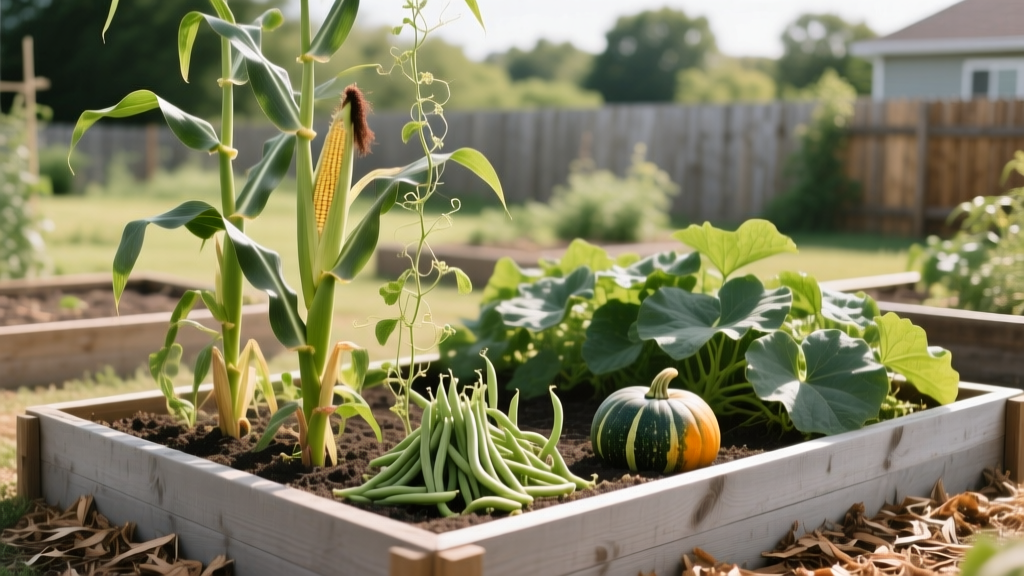
Community Plot Three Sisters Garden
The community garden gate squeaks open and you spot it immediately: a tired 4' x 8' bed with last year’s tomato cages leaning like coat hangers, a few volunteer marigolds, and soil that looks more like potting mix dust than earth. Your plot neighbor waves. “I’ve got two weeks before I travel—can you water if it gets hot?” Another gardener has already staked out the sunniest corner with sunflowers. You’re standing there with a classic community-plot puzzle: limited space, shared sunlight, variable watering, and the desire to grow something that’s productive and beautiful without turning the bed into a high-maintenance project.
This is where the Three Sisters garden shines—corn, beans, and squash grown together in a mutually supportive layout first developed by Indigenous growers in North America. In a community plot, it’s not nostalgia; it’s smart design: vertical yield, living trellises, shaded soil, and a planting scheme that looks intentional even when you miss a weeding week.
Start with the site: light, wind, and community-plot realities
A Three Sisters bed fails most often for one reason: not enough sun for corn. Plan for at least 6–8 hours of direct sun (8+ is ideal). If your plot gets morning shade from a fence but full afternoon sun, that can still work—corn loves heat once established. Notice prevailing wind, too: tall corn in an exposed garden can lodge (fall over) during storms, especially in raised beds that dry quickly.
Before you design anything, do a quick assessment on a single visit:
- Sun check: note sun at 9 a.m., noon, and 3 p.m.
- Water access: how far to the spigot? Will you be hauling a watering can 200 feet?
- Soil texture: squeeze a damp handful. If it stays in a tight ball and feels slick, it’s clay-heavy; if it falls apart instantly, it’s sandy/compost-heavy and will need more frequent watering.
Three Sisters is built on companion planting principles. Cornell University describes companion planting as grouping plants that “benefit one another” through nutrient support, pest reduction, or efficient space use (Cornell Cooperative Extension, 2021). That’s the goal here—but with community-garden constraints: paths must stay clear, vines can’t invade neighbors, and your bed must look cared-for even if you only visit twice a week.
Design principles for a community-plot Three Sisters bed
Design Principle 1: Build a “center of gravity” to keep the bed tidy
Instead of a random mix, treat the bed like a small landscape installation: a tall, stable center (corn), a mid-layer that climbs (beans), and a ground layer that drapes but stays inside bounds (squash or a more compact substitute). This layering creates a readable structure—a huge advantage in community spaces where “messy” plantings can attract side-eye.
Design Principle 2: Make pathways part of the design
If your plot is 4' x 8', you should be able to reach the center from either side. Keep plants inside the bed footprint by training vines inward and pruning selectively. If you’re working a larger plot (like 10' x 10'), incorporate a stepping-stone or mulch “service lane” so you can harvest without trampling soil.
Design Principle 3: Use mounds or clusters to stabilize corn pollination
Corn is wind-pollinated; a single row is rarely productive. Plant in blocks or clusters to improve pollination. The classic approach is hills/mounds spaced evenly. It’s not just tradition—it’s function.
“Corn planted in blocks rather than long single rows increases pollen distribution and kernel set.” — University of Minnesota Extension (2019)
(This matters in community gardens where beds are narrow and surrounded by taller plantings that can interfere with airflow.)
Layout strategies (with dimensions you can actually measure)
Option A: The 4' x 8' community bed (most common)
This layout is designed to maximize pollination and keep squash from taking over the path.
- Bed size: 4' x 8' (32 sq ft)
- Corn block: 12 corn plants in a 3 x 4 grid
- Corn spacing: 12" apart in all directions
- Bean planting: 1 bean plant per corn stalk (or 2 if using a lighter climber)
- Squash planting: 2 plants, placed at opposite corners and trained inward
How it fits: Place the corn block slightly offset toward the north side of the bed (so it doesn’t shade everything else). Corn at maturity can reach 6–8 feet depending on variety and fertility. The beans wrap up the stalks; the squash drapes across open soil between plants. In community plots, I like to “aim” squash vines toward the interior and pinch tips if they threaten to wander.
Option B: The 3' x 6' renter bed (small but doable)
If you only have 18 sq ft, use a dwarf corn variety and swap squash for a compact vine or bush-type.
- Bed size: 3' x 6'
- Corn block: 9 plants (3 x 3 grid)
- Spacing: 10–12"
- Beans: 9 plants
- Ground layer: 1 compact squash (or 1 cucumber trained on a short trellis at the bed edge)
This is a “mini Three Sisters” and won’t yield like a larger block, but it still offers a strong vertical/groundcover pairing and a cohesive look.
Option C: The 10' x 10' shared-family plot (design it like a room)
With 100 sq ft, you can create a design that’s both productive and social: a central Three Sisters patch with border plantings that draw pollinators and visually frame the bed.
- Three Sisters core: 6' x 6' (36 sq ft) centered
- Surrounding border: 2' wide on two sides for herbs/flowers
- Service lane: 18" mulch path on one side for access
In larger plots, border plants aren’t decoration—they’re management. A ring of basil, dill, calendula, and nasturtium makes the bed read “intentional,” which is helpful when vines sprawl late season.
Step-by-step setup (so the timing works)
Three Sisters succeeds when planting follows a sequence. Corn must be established before beans climb, and squash goes in once the canopy can handle it.
- Week 0 (prep day): Add 2–3 inches of compost across the bed and mix into the top 6–8 inches. If your community garden allows it, incorporate an organic slow-release fertilizer per label rates.
- Week 1 (plant corn): Sow corn seeds 1" deep, 12" apart in a block. Water in thoroughly.
- Week 3 (beans): When corn is 6–8 inches tall, sow pole beans 1" deep, 3–4" from each corn stalk.
- Week 4–5 (squash): Plant squash starts (or direct sow) once nights are reliably warm and corn is sturdy. Aim for 2 plants in a 4' x 8' bed.
- Week 6 onward (training & tidying): Mulch open soil, guide squash vines inward, and thin corn if germination was heavy.
Timing note: corn is sensitive to cold soil. Many extensions recommend waiting until soil is around 60°F for planting sweet corn (University of Illinois Extension, 2020). In cooler community gardens, this often means planting a week or two later than your peas and greens.
Plant selection: varieties that behave well in shared spaces
In a community plot, your best varieties are the ones that stand upright, mature reliably, and don’t sprawl into your neighbor’s aisle. Here are designer-tested picks that balance yield and manners.
Corn (the “pole” of the system)
- ‘Golden Bantam’ (heirloom sweet corn): Classic flavor, typically 5–6 feet, and matures in roughly 78–85 days depending on conditions. Shorter stature is helpful in windy gardens.
- ‘Silver Queen’ (white sweet corn): Vigorous and productive, but can hit 7–8 feet. Best for plots with full sun and decent fertility.
- ‘Painted Mountain’ (flint corn): Tougher in variable weather; great if you want ornamental harvest plus grain. Strong stalks for supporting beans.
Beans (choose climbers with good twining habits)
- ‘Kentucky Wonder’ (pole bean): Reliable twiner, strong yield, and climbs without being too aggressive. Great for the classic Three Sisters structure.
- ‘Scarlet Runner’ (runner bean): Adds red flowers that draw pollinators and looks stunning against corn. It can get vigorous—use in beds where you can monitor growth.
- ‘Blue Lake Pole’: A tidy, high-quality eating bean that climbs well and doesn’t require constant harvesting to stay tender (though frequent picking still helps).
Squash (pick your “ground layer” based on space and social boundaries)
- ‘Bush Delicata’: A more compact habit than sprawling winter squash; excellent for keeping vines inside a 4' x 8'.
- ‘Tromboncino’ (vining summer squash): If your community rules allow a trellis, this can be trained upward to save space and reduce mildew pressure by improving airflow.
- ‘Honey Bear’ acorn squash: Semi-compact, good yields, and fruits are manageable in small storage spaces.
If squash vine borers are common in your area, consider swapping the squash for ‘Table Queen’ acorn (still susceptible, but faster) or using a trellised cucumber as the “third sister” in very tight beds. It’s not traditional, but it keeps the design principle: canopy + climber + ground cover.
Comparison table: pick a layout that fits your life
| Scenario | Recommended Bed Size | Corn Plants | Squash Plants | Best Variety Choices | Weekly Maintenance Time |
|---|---|---|---|---|---|
| Standard community plot | 4' x 8' | 12 (3 x 4 block) | 2 | ‘Golden Bantam’ + ‘Kentucky Wonder’ + ‘Bush Delicata’ | 45–60 minutes |
| Small renter bed | 3' x 6' | 9 (3 x 3 block) | 1 | Dwarf/short corn + ‘Blue Lake Pole’ + compact squash or trellised cucumber | 30–45 minutes |
| Family/shared plot with borders | 10' x 10' (6' x 6' core) | 16–25 (4 x 4 or 5 x 5) | 3–4 | ‘Painted Mountain’ + ‘Scarlet Runner’ + ‘Honey Bear’ with herb/flower frame | 60–90 minutes |
Three real-world scenarios (and how I’d design each one)
Scenario 1: You can only visit twice a week. This is common for renters and busy families. The design move here is to reduce “urgent” tasks. Choose a compact squash (‘Bush Delicata’) and avoid ultra-fast pole beans that turn woody if missed. Mulch heavily—2 inches of straw or shredded leaves—so weeds don’t explode between visits. Install a simple soaker hose if allowed.
Scenario 2: Your plot is windy and exposed. Community gardens often sit in open lots. Corn can topple in storms, especially if soil is over-fertilized with nitrogen (tall, lush, weak stalks). Use a shorter corn (‘Golden Bantam’) and plant in a tight block. Add a low windbreak on the windward side: a row of calendula or bush basil won’t block sun but reduces ground-level gusts and helps keep mulch from flying.
Scenario 3: Your neighbor’s vines keep creeping into your bed. The best defense is a strong edge. I like a 12-inch-wide “clean border” inside your bed perimeter: a strip of mulch or low herbs (thyme, compact basil). It signals where your planting ends and gives you a place to redirect vines. Train your squash inward early; once vines lignify (get stiff), they snap easily.
Scenario 4: You’re gardening with kids and want it to feel magical. Make the Three Sisters core the “fort” and surround it with a sensory ring: nasturtiums, dill, and sunflowers at the north edge (if allowed). Choose ‘Scarlet Runner’ beans for flowers kids can spot from the path. Add a small sign that explains the Three Sisters story—community gardens are as much about sharing knowledge as harvests.
Budget planning and DIY alternatives
Three Sisters can be done on a shoestring, but community-plot success often comes down to soil and water consistency. Here’s a realistic budget range for a 4' x 8' bed:
- Compost: 4–6 cu ft bagged compost at $6–$10 each = $24–$60 (or bring municipal compost if available)
- Seeds: corn + beans + squash = $9–$18
- Mulch: one straw bale or leaf mulch = $8–$15
- Soaker hose (optional): 25' = $12–$25
- Stakes/twine (optional for training): $5–$12
DIY swaps: Use shredded leaves instead of straw. Ask your garden coordinator if wood chips are available for paths. For supports, you usually don’t need trellises—corn is the trellis—but a few reclaimed bamboo stakes at corners can help guide vines inward like subtle “fence posts.”
Maintenance expectations (the honest version)
Plan on 45–60 minutes per week for a 4' x 8' bed during peak growth (June–August). Early season is lighter; harvest season can add time.
Weekly rhythm
- Watering: 1–2 deep waterings weekly depending on rainfall. Raised beds may need more during heat waves.
- Weeding: 10–15 minutes, especially until squash leaves shade the soil.
- Training: tuck squash vines back into bounds; gently rewrap beans that slip.
- Harvesting: pick beans every few days when producing to keep plants flowering.
Seasonal tasks
- Early season: thin corn to proper spacing; repair mulch after storms.
- Midsummer: side-dress with compost (a thin ring around corn) if growth stalls; watch for corn earworms and squash pests.
- Late season: cut corn stalks at the base (leave roots to decompose), pull spent bean vines, and compost healthy residue if your garden allows.
One practical note: corn is a heavier feeder than many vegetables. If your bed has been gardened hard for years, you’ll get better stalks with consistent soil organic matter. The USDA notes that building soil organic matter improves soil structure and water holding capacity (USDA NRCS, 2020). In community plots that dry quickly, that water-holding improvement shows up immediately in plant resilience.
Small design details that make the bed look “intentional” all season
Edge control is everything. A neat edge reads as cared-for even when the center is lush and wild. Keep a visible border: a line of mulch, a tight planting of basil, or a simple string line while plants are small.
Add one signature plant. In a community garden full of standard veggies, a Three Sisters bed becomes a showpiece with a single accent: a row of calendula on the south edge, or ‘Scarlet Runner’ beans for flowers. It’s not fluff—it’s wayfinding. You’ll find your bed faster, and it invites conversation (and community gardens thrive on that).
Plan your harvest access. Leave yourself a hand’s-width of space around squash crowns so you can see developing fruits. And don’t bury the bed in too many sisters; you’re designing a system you can manage.
By midsummer, when the corn starts to throw tassels and the beans begin to climb in spirals, the bed looks less like a veggie patch and more like a living structure. Neighbors will ask what you planted, and you’ll be able to answer with confidence because the layout is deliberate: a stable center, a restrained sprawl, and a planting sequence that matches real life—shared paths, summer travel, and the simple joy of harvesting dinner from a small rectangle of soil.
Sources: Cornell Cooperative Extension (2021); University of Minnesota Extension (2019); University of Illinois Extension (2020); USDA NRCS (2020).