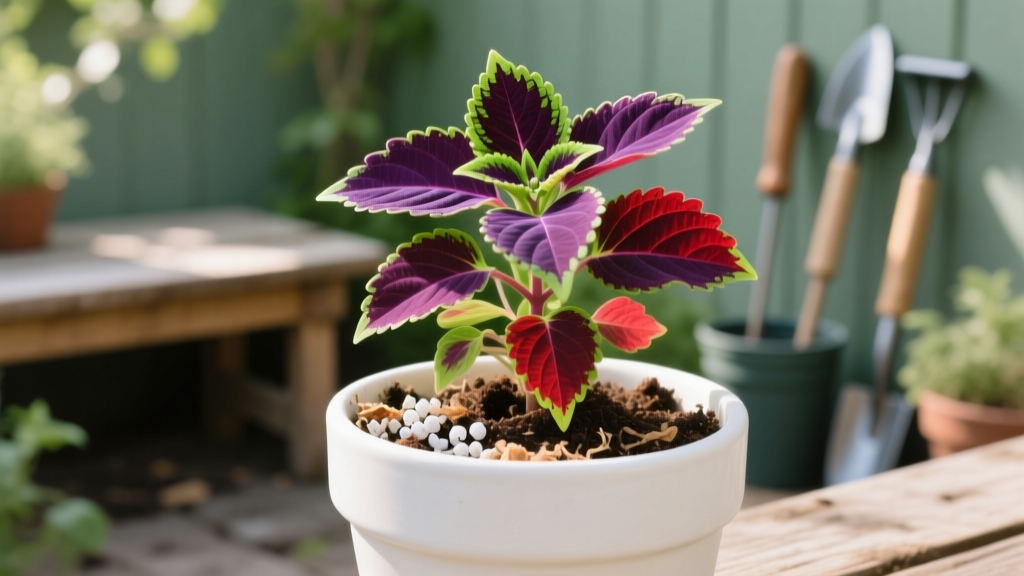
Best Potting Mix for Coleus
You bring home a coleus with carnival-color leaves, pot it up, and it looks great for about 10 days. Then the leaves start drooping at noon, the color dulls, and the soil stays wet on top but somehow the plant still wilts. Sound familiar? That “mystery” is almost always the potting mix—either it’s holding water like a sponge, or it’s collapsing and starving roots of oxygen. Coleus isn’t fussy about much, but it is picky about root conditions.
I’ve grown coleus in porch pots, hanging baskets, in-ground beds, and as houseplants under lights. The difference between a coleus that sulks and one that explodes with growth usually comes down to one thing: a mix that stays evenly moist but drains fast enough to keep roots breathing.
What coleus roots actually want (and why most mixes miss it)
Coleus (Plectranthus scutellarioides) grows fast. Fast growth means fast water use, fast nutrient demand, and a root system that needs both moisture and oxygen. If you use a heavy, fine-textured mix, the air pockets disappear after a few waterings. If you use something too coarse and dry, the plant bounces between “bone dry” and “flooded,” which triggers leaf drop and limp stems.
A practical target is a mix that:
- Drains freely within 30–60 seconds after watering
- Stays lightly moist (not wet) for 2–4 days in warm weather
- Doesn’t shrink away from the pot walls as it dries
- Has enough nutrition for the first 2–4 weeks, then accepts regular feeding without salt buildup
For container plants, oxygen in the root zone is the whole game. University extension guidance on container media consistently stresses balancing water-holding capacity with air-filled pore space for healthy roots (University of Maryland Extension, 2020). That balance is exactly what coleus rewards.
“Most container plant problems start with the root environment—usually too much water and too little air. Good drainage is less about the hole and more about the mix.” — University of Minnesota Extension (2022)
Best potting mix recipe for coleus (my go-to blend)
If you want one dependable mix for coleus in pots and baskets, use this. It’s forgiving, drains well, and holds enough moisture for summer heat.
Master gardener blend (for 1 gallon of mix)
- 2 parts high-quality peat-based or coir-based potting mix (no garden soil)
- 1 part perlite (or pumice if you prefer heavier pots)
- 1 part fine pine bark fines (often sold as “orchid bark” but choose small pieces, roughly 1/8–1/4 inch)
- Optional: 1 tablespoon worm castings or a small handful of compost (keep compost under 10% of total volume so it doesn’t turn heavy)
Why this works: the base mix holds moisture, perlite increases air space and speeds drainage, and bark fines prevent the “collapse” that peat-heavy mixes can get mid-season. Bark also creates durable structure so the mix stays springy instead of turning into muck.
Two easy tweaks depending on your situation
If you’re a chronic over-waterer:
- Use 1.5 parts perlite instead of 1 part
- Skip compost entirely
If your coleus dries out too fast (hot deck, windy balcony):
- Use 0.5 part perlite (instead of 1 part)
- Add 10–15% coconut coir or fine-grade composted bark to improve moisture retention
Comparison: three potting mixes side-by-side (with real performance numbers)
Here’s a practical comparison based on how long pots tend to stay evenly moist in summer and how quickly they drain after a full watering. These are typical outcomes for a 10-inch pot outdoors at 75–85°F with a mature coleus—your results vary with wind, sun, and pot material, but the pattern is consistent.
| Mix option | Drain time after watering | “Evenly moist” window (summer) | Risk level | Best use case |
|---|---|---|---|---|
| Store-bought potting mix only (peat/coir-heavy) | 60–180 seconds (often slows over time) | 3–6 days (can stay too wet) | Medium–High (root rot, fungus gnats) | Indoor coleus in bright light with careful watering |
| Master gardener blend (2 base : 1 perlite : 1 bark) | 30–60 seconds | 2–4 days | Low | Most pots, baskets, porch containers |
| Cactus/succulent mix (very gritty) | 10–30 seconds | 1–2 days | Medium (under-watering, nutrient leaching) | Very humid climates or heavy rain exposure |
Method A vs. Method B (actual outcome you’ll notice): If you switch from “potting mix only” to the 2:1:1 blend, most gardeners go from watering every 4–5 days (but still seeing wilt from root stress) to watering every 2–3 days with noticeably perkier plants and faster growth. It’s not just frequency; it’s that roots aren’t suffocating between waterings.
Pot size, drainage holes, and why “more holes” isn’t the fix
Coleus likes room, but oversizing the pot is a classic mistake. A small plant dropped into a big pot of wet mix sits in a swamp for weeks.
- Step up pot sizes in 1–2 inch increments.
- For a 4-inch nursery coleus, start with a 6-inch pot.
- For a full, branching coleus, a 10–12 inch pot is a sweet spot.
Make sure there’s at least 1 drainage hole, but don’t rely on holes to fix a dense mix. Water needs pathways through the media, not just an exit at the bottom.
Watering coleus in the right mix (simple rules that prevent 90% of issues)
Coleus wants consistent moisture. In a well-aerated mix, you can water thoroughly without fear—because excess drains and air replaces it.
The finger test + lift test (takes 10 seconds)
- Stick a finger in the soil to the second knuckle (about 2 inches).
- If it’s dry at that depth, water.
- If it’s cool and damp, wait 24 hours and check again.
- Lift the pot: light means water soon; heavy means it’s still holding plenty.
How to water (so roots grow deep, not lazy)
- Water until you see a steady stream from the bottom for 5–10 seconds.
- Empty saucers after 10 minutes indoors—coleus hates “wet feet.”
- In outdoor containers, expect watering every 1–2 days during heat waves above 90°F, especially in terracotta.
Extension guidance commonly emphasizes watering thoroughly, then allowing the mix to partially dry before watering again (Clemson Cooperative Extension, 2023). Coleus responds beautifully to that rhythm.
Light: matching potting mix to sun exposure
Light changes everything: how fast the mix dries, how much the plant drinks, and how much fertilizer it can use.
- Bright shade / morning sun: easiest for most varieties; mix stays evenly moist.
- Full sun: many modern coleus tolerate it, but pots dry fast; increase moisture retention slightly (reduce perlite a touch or add coir).
- Indoors: lower evaporation means higher risk of staying too wet—keep extra perlite in the mix and be stingy with watering.
Temperature matters too. Coleus slows down when nights drop below about 55°F, and a slow plant in wet soil is a recipe for rot. When temperatures cool, let the top couple inches dry more between waterings.
Feeding coleus: the potting mix sets the pace
Coleus is a leafy plant. Leafy plants are hungry. A fast-draining mix leaches nutrients faster, so you feed lightly but regularly.
Easy fertilizing schedule (containers)
- Weeks 1–3 after potting: no fertilizer if your base mix contains starter charge
- After week 3: liquid feed at 1/4 to 1/2 strength every 7–14 days
- Alternative: slow-release fertilizer sprinkled on the surface at label rate, typically lasting 8–12 weeks (then reapply)
If you see crispy leaf edges and the soil surface looks white or crusty, that’s often fertilizer salts—especially indoors. Flush the pot with plain water equal to about 2–3 times the pot volume (for a 1-gallon pot, run 2–3 gallons through). Let it drain completely.
Common potting mix mistakes (and what to do instead)
Mistake 1: Using garden soil in pots
Garden soil compacts, drains poorly, and carries pathogens. Coleus roots suffocate. Use potting mix components designed for containers.
Mistake 2: Too much compost
Compost sounds “natural,” but in containers it can turn dense, hold too much water, and invite fungus gnats. Keep compost under 10% of the blend.
Mistake 3: Adding gravel at the bottom
This doesn’t improve drainage; it can create a perched water table where water hangs above the gravel. Use a better mix throughout and a pot with drainage.
Troubleshooting: symptoms, causes, and fixes you can do today
Symptom: Plant wilts at midday, but soil still feels damp
- Likely cause: roots are oxygen-starved from a heavy mix; early root rot can mimic drought stress.
- Fix: unpot and check roots. Healthy roots are light-colored and firm. Brown/mushy roots mean rot.
- Do this:
- Trim rotten roots with clean scissors.
- Repot into the 2:1:1 mix.
- Hold fertilizer for 10–14 days.
- Water only when top 2 inches dry.
Symptom: Yellowing lower leaves, slow growth, soil stays wet for days
- Likely cause: mix holds too much water; pot too large; low light indoors.
- Fix: increase aeration (add perlite/bark), move to brighter light, and downsize pot if necessary.
- Quick check: if the mix is still wet on day 5 after watering, it’s too dense for indoor coleus.
Symptom: Crispy edges, curling leaves, soil dries fast
- Likely cause: mix too gritty or pot is in hot sun/wind; inconsistent watering; fertilizer salts can also scorch edges.
- Fix: add moisture-holding components (more base mix/coir), water deeply, and mulch the soil surface with a thin layer (1/2 inch) of fine bark.
- If salts suspected: flush with 2–3x pot volume of water.
Symptom: Fungus gnats (tiny flies), especially indoors
- Likely cause: constantly moist top layer; too much compost; poor airflow.
- Fix: let the top 1 inch dry between waterings, top-dress with a thin layer of coarse sand or fine gravel (1/4 inch), and use sticky traps.
Three real-world scenarios (and the mix tweaks that solve them)
Scenario 1: The “porch pot” that gets afternoon sun and bakes at 4 p.m.
You’ve got a 12-inch pot on concrete, and the coleus droops daily in July. Use the 2:1:1 mix, but reduce perlite slightly (to about 3/4 part) and add 10% coir. Water in the morning until it drains freely. If temperatures are above 90°F, plan on watering every day. This is one place a self-watering insert can help, but only if the mix remains airy.
Scenario 2: Indoor coleus by a bright window that “randomly” collapses
Indoors, evaporation is slow. If you’re using a peat-heavy mix, it can stay wet for a week, and roots decline quietly. Add more perlite (up to 1.5 parts) and keep bark fines in the blend. Water only when the pot feels light and the top 2 inches are dry. Keep room temps around 65–75°F for steady growth.
Scenario 3: Hanging basket coleus that dries out in wind
Baskets dry from all sides. Use the standard 2:1:1 but choose coir-based potting mix for better re-wetting. Add a thin mulch layer and water until runoff for 10 seconds. Feed lightly every 7 days at 1/4 strength—hanging baskets leach nutrients faster than patio pots.
Step-by-step: mixing and potting coleus the way pros do it
- Moisten your base mix first. Aim for “wrung-out sponge” damp—when squeezed, it holds shape but doesn’t drip.
- Measure by volume. For example, in a bucket: 2 scoops potting mix + 1 scoop perlite + 1 scoop bark fines.
- Blend thoroughly. You don’t want layers; roots hate sudden texture changes.
- Choose the right pot size. Go up 1–2 inches wider than the nursery pot.
- Plant at the same depth. Don’t bury stems deeper than they were growing.
- Water in fully. Let it drain; don’t leave it sitting in runoff.
- Pinch tips after a week. When established, pinch the top 1/2 inch to encourage branching (more tips = more color).
Common problems not caused by potting mix (but often blamed on it)
Not every coleus issue is soil. A few repeat offenders:
- Flower spikes: coleus can lose leaf vigor when allowed to flower. Pinch flower spikes as soon as you see them.
- Cold shock: a sudden dip below 50–55°F can stall growth and trigger leaf drop.
- Sun scorch: moving a shade-grown coleus into full sun without acclimating can bleach leaves in 48 hours. Increase sun gradually over 7–10 days.
If you get the potting mix right—airy, structured, and evenly moist—coleus becomes one of the most generous plants you can grow. It forgives missed pinches, it rebounds after a hard cutback, and it colors up fast. Start with the 2:1:1 blend, tweak it to match your light and watering habits, and you’ll spend the season enjoying the leaves instead of arguing with the soil.
Sources: University of Maryland Extension (2020) container media and drainage guidance; University of Minnesota Extension (2022) container watering and root health principles; Clemson Cooperative Extension (2023) container watering practices and fertilizer management.