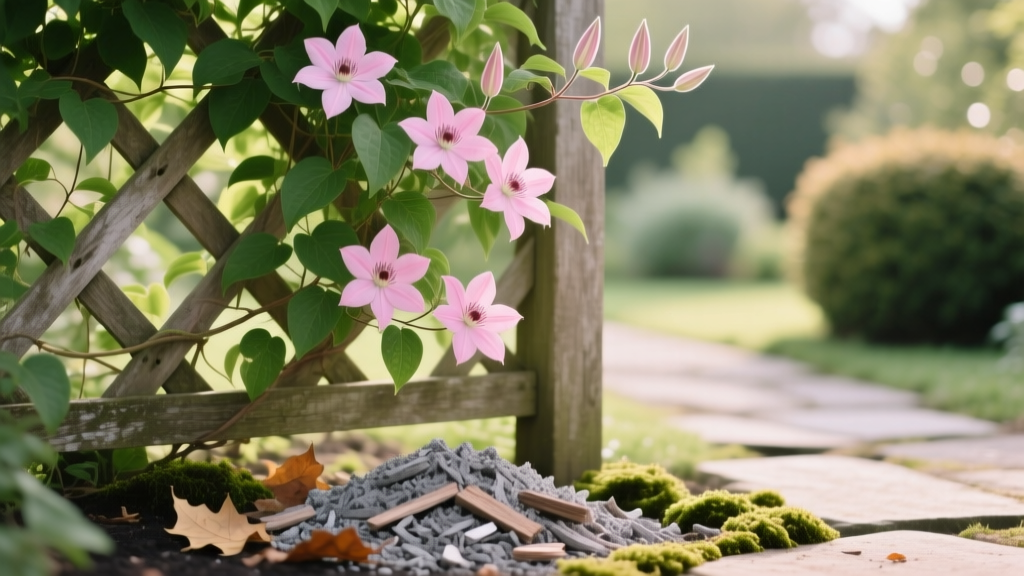
How to Use Wood Ash Around Clematis
The first time I saw wood ash “help” a clematis, it was in a neighbor’s yard: a lovely vine that had bloomed well for years suddenly turned pale, grew weak shoots, and produced more leaves than flowers. The only change? He’d been sprinkling fireplace ash around the base every weekend, assuming it was a gentle, natural fertilizer. He wasn’t wrong that wood ash can be useful—but around clematis, it’s a tool you use with measurements, timing, and restraint, not a casual handful.
Wood ash is powerful because it changes soil chemistry fast. It raises pH (makes soil less acidic), and it adds potassium (K) and calcium (Ca), both of which matter for flowering vines. But it contains little to no nitrogen (N), and too much ash can lock up nutrients like iron and manganese—leading to yellow leaves, stalled growth, and poor bloom.
This guide is how I use wood ash around clematis in real gardens: when it helps, when it backfires, and how to apply it so your vine gets the benefit without the “mystery decline.”
Before You Sprinkle: Know What Wood Ash Really Does
Wood ash is not compost, and it’s not a balanced fertilizer. Think of it more like a fast-acting lime-plus-potash amendment. Typical hardwood ash contains a high percentage of calcium compounds (liming effect) and meaningful potassium, with small amounts of phosphorus and trace minerals. The exact analysis varies depending on species and burn conditions.
“Wood ash acts much like limestone in the garden, raising soil pH and supplying calcium. Use only where soil tests indicate a need, and apply lightly.” — University of Minnesota Extension (2023)
Two practical takeaways:
- Ash changes pH quickly, especially in sandy soils and raised beds.
- Ash is best used to correct a deficiency (low pH, low potassium), not as a routine “tonic.”
Source note: University guidance consistently treats ash as a liming agent and cautions against overuse. See University of Minnesota Extension (2023) and Michigan State University Extension (2020) for application cautions and pH impacts.
Soil First: When Wood Ash Helps Clematis (and When It Doesn’t)
Clematis generally grows best in fertile, moisture-retentive but well-drained soil, often performing well around a slightly acidic to neutral pH. Most garden clematis are happy roughly in the pH 6.0–7.0 range. Wood ash can be helpful if your soil is trending too acidic (common in high rainfall areas, under conifers, or in beds repeatedly mulched with pine bark).
Use wood ash around clematis if:
- Your soil test shows pH below 6.0, especially 5.0–5.8.
- Your soil test shows low potassium.
- You’re managing naturally acidic conditions (heavy rainfall, lots of acidic organic inputs).
Avoid wood ash (or pause it) if:
- Your soil pH is already 6.8–7.5.
- You have alkaline soil (common in arid regions or soils with free lime/chalk).
- Your clematis shows symptoms consistent with micronutrient lockout (more on this in troubleshooting).
- You’re also applying lime—ash plus lime is a common one-two punch that pushes pH too high.
Best practice: do a soil test every 2–3 years if you plan to use wood ash. University recommendations emphasize testing because ash can overshoot pH quickly (Michigan State University Extension, 2020).
How Much Wood Ash to Use Around Clematis (Real Numbers)
If you only remember one thing, make it this: wood ash is a “dusting,” not a “layer.” I see people apply it like mulch; that’s where trouble starts.
Safe starting rates for home gardens
- Light maintenance dose: 1/4 cup (about 4 tablespoons) scattered in a ring 12–18 inches away from the crown, once in spring.
- Corrective dose (acidic soil confirmed by test): up to 1/2 cup per established plant, applied once, then reassess next season.
- Annual maximum (practical cap): 1 cup per mature plant per year, split into two applications (spring and early summer), only if soil test supports it.
For bed-scale applications, a common extension guideline for wood ash is to apply no more than about 10–20 pounds per 1,000 square feet per year (varies by soil type and current pH). That translates to “lightly and broadly,” not thickly. (University of Minnesota Extension, 2023).
Where to place it (this matters)
Never dump ash directly against the clematis crown. Clematis crowns are sensitive—especially in winter-wet soils and during spring thaw. Place ash in a wide ring where feeder roots are active:
- Measure 12–18 inches out from the main stems.
- Sprinkle the measured ash evenly in a circle.
- Gently scratch it into the top 1 inch of soil (or let rain do it if you don’t want to disturb roots).
- Water in with 1–2 gallons to reduce drift and start moving minerals into the root zone.
Timing: When to Apply Wood Ash Around Clematis
Wood ash behaves differently depending on season. Apply when plants can actually use the potassium and calcium, and when you can control where the ash goes.
- Best window: early spring as buds swell, or just after the first flush of growth.
- Second (optional) window: early summer, no later than about 6–8 weeks before your typical first frost date.
- Avoid windy days: ash drifts—into eyes, onto leaves, onto patios.
- Avoid applying to frozen ground or right before heavy rain; you’ll lose nutrients to runoff.
If you’re trying to improve flowering, timing matters: potassium supports bloom and overall plant function, but it’s most helpful when the vine is actively building buds and flowering stems—not after it’s winding down for the season.
Watering: How Ash Changes Your Water Routine
Wood ash itself doesn’t “dry out” soil in the way sand does, but it can encourage a crust on the surface if applied too thickly, especially in clay soils. That crust can shed water and make the root zone harder to wet evenly.
Practical watering rules when using ash
- After applying ash, water the area with 1–2 gallons per plant to settle it.
- For established clematis, aim for roughly 1 inch of water per week from rain/irrigation during active growth (more in hot, windy weather).
- In heat waves above 85°F, check soil moisture at 4 inches deep; if dry, water deeply rather than sprinkling the surface.
Ash can raise pH at the soil surface first. Deep watering helps move those soluble compounds down where feeder roots are. It also prevents concentrated salts from sitting in one spot.
Light and Placement: Don’t Let Ash Distract You From the Real Needs
Clematis performance is still mostly driven by light and root comfort. Most large-flowered clematis want their tops in sun and their roots cool. Wood ash won’t fix a vine struggling in deep shade or baking against a south-facing wall with dry soil.
- Sun: Many clematis bloom best with 6+ hours of sun, though some varieties tolerate part shade.
- Cool roots: Use 2–3 inches of mulch or plant a low groundcover to shade the root zone. Apply ash under the mulch only if you can keep it from clumping—otherwise apply first, water in, then remulch.
Feeding: Wood Ash vs Other Options (and When to Choose Each)
If your goal is better flowering, ash is only one lever. A clematis that’s hungry for nitrogen in spring will not be “fixed” by ash; it may get even more imbalanced. Here’s how I compare common feeding approaches.
| Feeding method | Main nutrients delivered | Effect on soil pH | Best use case | Risk if overused |
|---|---|---|---|---|
| Wood ash (1/4–1/2 cup/plant) | High K, Ca; low N | Raises pH (fast) | Acidic soil + low K; boost for flowering support | High pH, micronutrient lockout, salt concentration |
| Balanced granular fertilizer (e.g., 10-10-10 at label rate) | N-P-K balanced | Usually neutral to slight acidifying | General vigor when soil fertility is low | Excess leafy growth, burn if overapplied |
| Compost (1–2 inch topdress) | Low but broad nutrients + organic matter | Typically mild/neutral | Long-term soil building, moisture retention | Rare; can bury crown if piled |
| Garden lime (per soil test) | Ca (sometimes Mg) | Raises pH (slower than ash) | Correcting low pH with measured, predictable change | Over-liming; nutrient lockout |
Comparison analysis with real garden math
Say you have a clematis bed that’s 50 sq ft and you want a light ash application equivalent to 10 lb per 1,000 sq ft (a conservative extension-style ceiling for many gardens). The math:
- 10 lb / 1,000 sq ft = 0.01 lb per sq ft
- 0.01 lb × 50 sq ft = 0.5 lb of ash total for the bed
Half a pound doesn’t look like much—and that’s the point. If you’re applying several pounds to a small bed, you’re not “feeding,” you’re changing soil chemistry aggressively.
Three Real-World Scenarios (What I’d Do in Each)
Scenario 1: Acidic garden, lush leaves, weak blooms
You’re in a rainy region, you mulch with bark every year, and your clematis grows but doesn’t flower much. A soil test comes back at pH 5.5 with low potassium.
- Apply 1/2 cup screened hardwood ash in a wide ring 12–18 inches from the crown in early spring.
- Water in with 1–2 gallons.
- Follow with a nitrogen source if growth is weak: for example, a spring application of a balanced fertilizer at label rate, or compost plus a small amount of blood meal (if you use organics).
- Re-test in 12 months before repeating.
Scenario 2: Neutral soil, but you want “more blooms”
Your pH is 6.7, the plant is healthy, and you just want more flowers. This is where ash often gets misused.
- Skip ash. You’re already in a good pH range.
- Focus on consistent moisture and feeding timing: a balanced feed in spring, then a lower-nitrogen option as buds form.
- Make sure it’s getting enough sun (many varieties need 6 hours or more).
Scenario 3: Alkaline soil and yellow leaves between veins
Your soil is pH 7.6. Leaves are yellowing, but veins stay green (classic interveinal chlorosis). You’ve been adding ash because it “adds minerals.”
- Stop ash immediately.
- Apply compost and consider an acidifying mulch (pine fines can help gently over time).
- Use a chelated iron product if chlorosis is severe, following label directions, and water deeply.
- Long-term: choose fertilizers that don’t raise pH and avoid lime/ash entirely.
Common Problems When Using Wood Ash Around Clematis
Most ash-related issues aren’t dramatic overnight failures. They’re slow shifts: pH creeps up, certain nutrients become unavailable, and the vine starts underperforming.
Problem: Yellowing leaves (especially new growth)
What you see: New leaves are pale or yellow; veins may remain greener than the rest of the leaf.
Likely cause: pH too high causing iron/manganese availability problems—often triggered or worsened by repeated ash applications.
What to do:
- Stop ash for at least 12 months.
- Check soil pH; if above 7.2, focus on organic matter additions and avoid liming inputs.
- Use chelated iron if needed for quick correction (especially in containers).
Problem: White crust on soil surface, water beads and runs off
What you see: A light gray/white layer forms; irrigation runs off instead of soaking in.
Likely cause: Ash applied too thickly; salts and fine particles crusting the surface.
What to do:
- Gently rake the top 1/2 inch of soil to break the crust (avoid damaging roots).
- Water slowly and deeply.
- Mulch with 2 inches of compost or shredded leaf mold to restore a more open surface.
Problem: Clematis wilts suddenly (entire vine or sections collapse)
What you see: Shoots look fine one day, limp the next.
Likely cause: This is usually clematis wilt (a fungal issue) or stem damage—not typically wood ash. But heavy ash around the crown can contribute to stress and crown issues in wet soils.
What to do:
- Cut affected stems down to healthy tissue and dispose (don’t compost diseased stems).
- Keep the crown area clean and avoid piling amendments against it.
- Water at soil level; avoid wetting foliage late in the day.
Problem: Lots of growth, few flowers
What you see: Long vines and leaves, but sparse blooms.
Likely causes:
- Too much nitrogen (not ash itself, but often paired with rich feeding)
- Not enough light (less than 5–6 hours)
- Wrong pruning group timing
- Potassium is low (this is where ash can help if pH allows)
What to do:
- Confirm pruning group and prune at the right time.
- If soil test shows low K and pH below 6.5, apply 1/4–1/2 cup ash in spring once.
- Otherwise use a bloom-support fertilizer (lower N relative to K) per label instructions.
How to Handle Wood Ash Safely (For You and the Plant)
Ash is fine, dusty, and alkaline. Treat it with the same respect you’d give any garden amendment that can irritate skin and eyes.
- Use only clean wood ash from untreated, unpainted wood.
- Avoid ash from coal, charcoal briquettes, or fire starters.
- Wear gloves and avoid breathing dust on windy days.
- Store ash dry in a lidded metal container; wet ash becomes caustic and messy.
Wood Ash with Other Inputs: What Mixes, What Clashes
Ash plays well with some amendments and fights with others.
Good pairings
- Compost: Apply ash lightly, water in, then topdress compost to buffer and feed biology.
- Leaf mold or shredded leaves: Helps prevent crusting and improves water infiltration.
Pairings to avoid
- Ash + lime: Both raise pH; together they overshoot fast.
- Ash + high-ammonium fertilizers: Don’t mix directly; high pH can increase nitrogen loss as ammonia gas. Keep applications separated by at least 2–3 weeks and water well. (This caution aligns with general extension guidance on alkaline amendments and nitrogen volatility; see Michigan State University Extension, 2020.)
A Simple Seasonal Routine I Trust
If you want a practical rhythm that won’t get you into trouble, here’s the routine I use when wood ash is actually needed.
- Late winter / early spring: Soil test if you haven’t in the last 2–3 years.
- Early spring: If pH is below 6.0–6.2 and potassium is low, apply 1/4–1/2 cup ash per plant, wide ring, water in.
- After first growth flush: Feed with compost or a balanced fertilizer at label rate.
- Summer: Mulch to keep roots cool and maintain about 1 inch of weekly moisture.
- Fall: Skip ash. Let the plant harden off; clean up leaves and keep the crown from staying soggy.
Used this way, wood ash becomes what it should be in a clematis bed: an occasional, measured correction—not a weekly habit. If you’re careful with doses, apply it away from the crown, and let soil tests call the shots, you can get the potassium and calcium benefits without pushing your clematis into that frustrating cycle of yellow leaves and disappointing blooms.
Sources: University of Minnesota Extension (2023) guidance on wood ash use and pH effects; Michigan State University Extension (2020) cautions on overapplication and soil chemistry impacts.