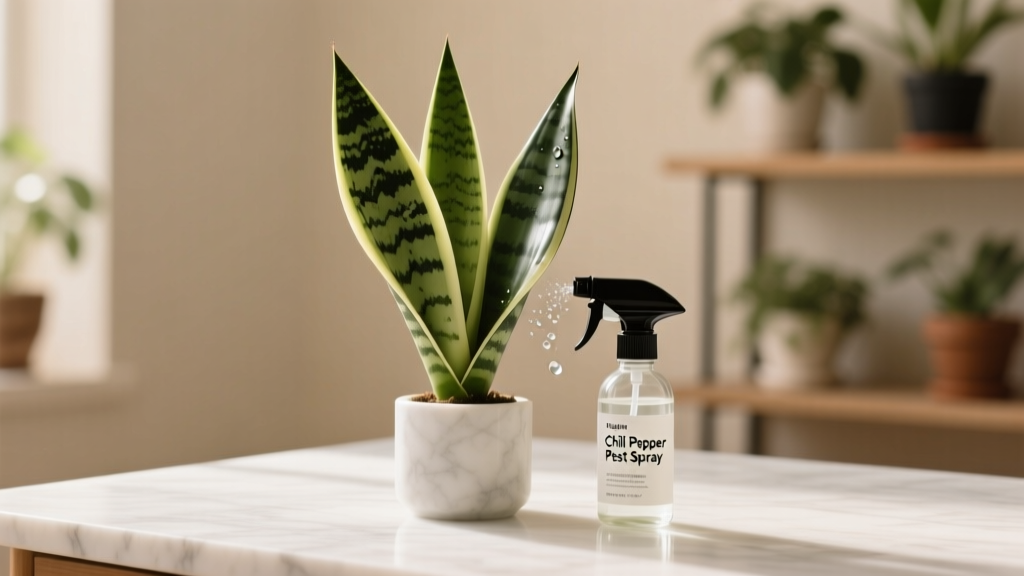
Chili Pepper Spray for Snake Plants Pests
The first time I saw a snake plant (Sansevieria/Dracaena trifasciata) get knocked back by pests, it wasn’t dramatic—no collapsing leaves, no obvious rot. It was just a dull, tired look. New growth stalled, the leaf edges lost their crispness, and the plant felt “dusty” no matter how often it was wiped. Under a bright lamp, the giveaway showed up: tiny specks moving along the leaf crease and a few sticky spots that caught lint. That’s the moment many home gardeners reach for a DIY remedy like chili pepper spray. Sometimes it helps. Sometimes it burns the plant, makes the pest problem worse, or just masks the real issue—watering, light, or stress.
This article is how I approach chili pepper spray on snake plants in real homes: when it’s worth trying, how to make it safer, how it compares to soap, alcohol, and horticultural oils, and how to fix the growing conditions that invited pests in the first place.
First, identify what you’re fighting (because chili doesn’t hit every pest)
Snake plants most often deal with a short list of indoor pests. Chili spray is a repellent/irritant, not a magic bullet. It works best as part of a plan—especially against soft-bodied pests—while you correct care issues.
Common snake plant pests and what you’ll see
- Mealybugs: white “cotton” clusters in leaf axils and at the soil line; sticky honeydew; sooty mold.
- Scale insects: tan/brown bumps stuck to leaves; leaf yellowing; sticky residue.
- Spider mites: fine webbing, stippled/speckled leaves, dusty look—often worse in dry heated air.
- Fungus gnats: tiny black flies near soil; larvae thrive in consistently wet potting mix.
- Thrips (less common indoors): silvery streaks, tiny black specks (frass), distorted new growth.
Before spraying anything, do a 60-second check: pull the plant into bright light, inspect the leaf bases, and run a white tissue along the leaf underside. If you see reddish smears (mites) or sticky spots (honeydew), you’ve got targets.
Chili pepper spray: what it is, what it does, and what it can damage
DIY chili sprays usually rely on capsaicin (the heat compound in hot peppers). Capsaicin can irritate insects and deter feeding, but it can also irritate your skin, eyes, and lungs. On plants, strong or frequent applications can cause leaf spotting—especially on thick-leaved houseplants like snake plant where droplets sit and dry slowly.
“Pepper-based sprays are primarily repellents; they tend to work best when used preventively and reapplied, but they can also cause phytotoxicity if mixed too strong or applied in full sun.” — University of California Statewide IPM Program guidance on home garden sprays (UC ANR, 2021)
That warning matters indoors too: a plant under a grow light can “sunburn” from sprays the same way it can near a sunny window.
When chili spray can make sense
- Light pest pressure (early mealybugs/mites) and you’re also wiping leaves regularly.
- You need a short-term deterrent while you isolate the plant and start a proper regimen.
- You can test on a small area first and you’re okay reapplying weekly.
When I skip chili spray
- Heavy mealybug or scale infestations: you’ll get better results with alcohol spot treatments + insecticidal soap/oil.
- Plants already stressed (recent repot, cold shock, root issues). Stress + sprays often equals leaf scarring.
- Any plant sitting in strong direct sun or under intense grow lights within 12 inches of foliage.
How to make a safer chili pepper spray for snake plants
If you’re going to use chili spray indoors, keep it mild, strain it well (clogged sprayers lead to big droplets), and add a tiny bit of soap only as a surfactant so it spreads. Strong soap mixes can strip leaf wax and cause spotting.
Recipe (mild, indoor-friendly)
This is a conservative formula designed to reduce leaf burn risk:
- In a jar, mix 1 teaspoon (about 5 mL) cayenne pepper (or hot pepper powder) with 1 quart (0.95 L) warm water.
- Add 1/4 teaspoon (about 1.25 mL) mild liquid soap (unscented castile or a gentle dish soap). Don’t overdo it.
- Let sit 30–60 minutes, then strain through a coffee filter or fine cloth.
- Pour into a clean spray bottle and label it.
Optional: If you’re using fresh peppers, start with 1 small hot pepper blended into 1 quart of water, then strain very thoroughly. Fresh mixes spoil; refrigerate and discard after 7 days.
Spot test first (non-negotiable)
Spray a 2-inch section on one outer leaf and wait 24–48 hours. If you see gray patches, sunken spots, or a bleached area, don’t use it on the rest of the plant.
Application timing and technique
- Spray in the evening or when the plant is out of direct sun/grow lights.
- Hold the sprayer 8–12 inches from the leaf.
- Lightly mist—don’t drench to the point of runoff into the soil.
- Focus on leaf axils, bases, and undersides where pests hide.
- Repeat every 5–7 days for 3 rounds (pest life cycles require repeat hits).
Wear gloves, avoid touching your face, and don’t spray in a closed bathroom with the fan off. Capsaicin aerosol is no joke.
Comparison: chili spray vs other pest methods (with practical data)
Here’s how chili spray stacks up against the tools that usually perform better on snake plants. The “time to visible improvement” assumes a light-to-moderate infestation and consistent weekly treatment.
| Method | Best for | Typical mix / dose | Time to visible improvement | Risk to snake plant leaves | Notes |
|---|---|---|---|---|---|
| Chili pepper spray (capsaicin) | Deterrence; mild mites/soft pests | 1 tsp cayenne per 1 qt water + 1/4 tsp soap | 7–14 days | Medium | Repellent; must reapply; spot-test to prevent leaf spotting. |
| 70% isopropyl alcohol (spot treatment) | Mealybugs, some scale crawlers | Use 70% on cotton swab; or dilute 1:1 for light spray | 1–7 days | Medium | Great for targeted kills; can dull leaves if overused. |
| Insecticidal soap | Mealybugs, mites, thrips (contact) | Follow label (often 2–5 tbsp/gal) | 7–10 days | Low–Medium | Needs thorough coverage; repeat weekly. Avoid on stressed plants. |
| Horticultural oil / neem oil | Scale, mites, mealybugs (smothering) | Often 1–2 tbsp/gal (label-specific) | 10–21 days | Medium | Effective but can spot leaves indoors; never apply in hot sun. |
For reference, insecticidal soaps and horticultural oils are commonly recommended as lower-toxicity options when used according to label directions. The UC Statewide IPM Program provides home-use guidance on soap and oil sprays and emphasizes correct coverage and repeat applications (UC ANR, 2021). For indoor plant pest management principles (inspection, isolation, mechanical removal), university extension resources consistently stress integrated tactics over single “miracle” sprays (University of Minnesota Extension, 2023).
Real-world scenarios: when chili spray helped, and when it backfired
Scenario 1: Spider mites after winter heating
A snake plant sitting near a heat vent at 72–75°F with very dry air developed stippling and a dusty look. Chili spray alone didn’t solve it, but it helped as a repellent while the owner added a better routine: leaf-wiping every 3–4 days, a gentle shower rinse, and moving the plant 6 feet away from the vent. Within 2 weeks, new damage stopped. The key change wasn’t the chili—it was reducing stress and physically removing mites.
Scenario 2: Mealybugs hidden at the soil line
Mealybugs clustered where leaves meet the potting mix. Chili spray made the plant look worse (tiny tan spots) and didn’t penetrate the crevices. The fix: isolate the plant, remove the worst leaf, swab remaining clusters with 70% isopropyl alcohol, then follow with insecticidal soap weekly for 3 weeks. A top-dress removal (first 1 inch of mix) also helped reduce hiding places.
Scenario 3: Fungus gnats from overwatering
Chili spray did nothing because the “pest” was in the soil: gnat larvae feeding on algae and decaying matter in constantly damp mix. The solution was cultural: let the pot dry, correct drainage, and use BTI dunks/granules if needed. Within 10–14 days, adults dropped sharply.
Watering: the pest prevention lever most people ignore
Snake plants tolerate drought far better than soggy roots. Overwatering doesn’t just risk rot—it also invites pests by keeping the plant in a constant low-level stress state and encouraging fungus gnats.
A practical watering routine (indoors)
- Water only when the pot is dry at least 2–3 inches down (or nearly fully dry in winter).
- In many homes, that’s every 14–28 days depending on light and temperature.
- Water thoroughly until you get runoff, then empty the saucer within 10 minutes.
Symptoms of watering issues that look like “pests”
- Wrinkled leaves: usually underwatering or roots compromised by past overwatering.
- Yellowing at the base: often too much water, low light, or a pot that stays wet.
- Mushy lower leaf tissue: rot—stop spraying anything and address roots immediately.
Soil and potting: set the plant up so pests can’t take advantage
A snake plant in dense, water-holding mix is a slow-motion problem. Use a fast-draining blend and a pot with drainage.
My go-to snake plant mix
- 2 parts cactus/succulent mix
- 1 part perlite or pumice
- 1 part fine orchid bark (optional, but excellent for airflow)
Repot only when needed (tight root mass, tipping, or mix that stays wet too long). If you repot, give the plant 5–7 days before watering to let damaged roots callus.
Light: more light = stronger plant = fewer pests
Snake plants survive low light, but survival is not the same as thriving. In low light, growth slows and pests like mealybugs can linger because the plant can’t outgrow minor damage.
Light targets that work in real homes
- Bright, indirect light near an east or filtered south/west window is ideal.
- If using a grow light, aim for 10–12 hours per day and keep the fixture far enough away to avoid heat and spray-related spotting (often 12–18 inches, depending on intensity).
If you’re treating pests with any spray (chili, soap, oil), keep the plant out of direct sun for at least 12 hours after application to reduce leaf burn risk.
Feeding: don’t over-fertilize a pest problem
Overfeeding can push soft, tender growth that pests love—and excess salts can stress roots. I feed snake plants lightly.
- Use a balanced houseplant fertilizer at 1/4 to 1/2 strength.
- Feed every 4–6 weeks in spring and summer.
- Skip feeding in winter unless the plant is under strong grow lights and actively growing.
If you see white crust on the soil or pot rim, flush the pot with clean water (run 2–3 times the pot volume through it) and let it drain fully.
How to use chili spray as part of an integrated pest plan
If you rely on chili spray alone, you’ll usually be disappointed. Here’s the routine that makes it more likely to work.
Step-by-step: a 14-day pest reset
- Isolate the snake plant for 14 days (pests spread by contact).
- Mechanical removal: wipe leaves with a damp microfiber cloth; use cotton swabs for crevices.
- Rinse (if practical): a lukewarm shower knocks down mites and crawlers. Let the plant drip-dry.
- Spot treat visible mealybugs/scale crawlers with 70% isopropyl alcohol on a swab.
- Apply chili spray lightly to leaf bases and undersides (after spot-testing).
- Reapply chili spray every 5–7 days for 3 applications.
- Monitor twice weekly with a flashlight and tissue test.
This approach follows the same core principle repeated in extension guidance: start with inspection, sanitation, and physical removal, then use the least-risk chemical options when needed (University of Minnesota Extension, 2023).
Troubleshooting: symptoms, likely causes, and what to do
Symptom: Brown or bleached spots after spraying
- Likely cause: spray too strong, soap too heavy, droplets dried under bright light, or plant was stressed.
- Fix:
- Stop spraying for 2 weeks.
- Move plant to bright indirect light (no hot sun).
- Wipe leaves with plain water to remove residues.
- Resume with insecticidal soap at label rate if pests persist—after a spot test.
Symptom: Sticky leaves but no obvious insects
- Likely cause: honeydew from scale/mealybugs hiding deep in leaf axils, or residue from sprays.
- Fix:
- Use a flashlight and inspect the tight leaf bases.
- Wipe sticky areas with a damp cloth + a drop of mild soap, then wipe again with clean water.
- If you find scale bumps, scrape gently with a fingernail and follow with alcohol swabs weekly for 2–3 weeks.
Symptom: Tiny flying gnats around the pot
- Likely cause: wet mix and organic buildup feeding larvae.
- Fix:
- Let the pot dry much further between waterings.
- Top-dress with 1/2 inch of coarse sand or fine pumice (optional, helps deter egg-laying).
- Use yellow sticky cards to catch adults.
- If severe, apply BTI according to label directions for 2 watering cycles.
Symptom: Pests keep returning after treatment
- Likely cause: missed eggs/crawlers, reinfestation from a nearby plant, or low light/overwatering stress.
- Fix:
- Extend isolation to 21–28 days.
- Treat all nearby plants at the same time (at least inspect and wipe).
- Improve light and correct watering so the plant can recover and resist.
Common problems that look like pests (but aren’t)
Before you blame insects, rule out these usual suspects:
- Leaf scarring: old mechanical damage doesn’t heal; new growth is your progress marker.
- Mineral spotting: hard water can leave pale marks. Wipe with distilled water; consider switching water source.
- Cold damage: temperatures below 50°F (10°C) can cause mushy patches and collapse. Keep snake plants warmer and away from drafty windows.
My best advice if you want chili spray to work
Think of chili spray as a supporting actor. The starring roles are: strong light, dry-down between waterings, and consistent leaf cleaning. If you do those, pests have a harder time getting established—and when you do spray, you’re not spraying a struggling plant.
Keep the mix mild (that 1 teaspoon per quart rate), apply at the right time, and commit to repeat applications on a schedule. If you’re on week two and pests are still thriving, don’t keep escalating the pepper until the plant burns—switch tactics to alcohol spot treatments and a labeled insecticidal soap or horticultural oil, and keep isolating the plant until you’ve gone at least 14 days without seeing new activity.
A healthy snake plant is one of the toughest houseplants you can grow. Get the basics right, use chili spray carefully, and you’ll usually win the pest battle without turning your living room into a chemistry experiment.
Sources: University of California Agriculture and Natural Resources, Statewide IPM Program (2021); University of Minnesota Extension, indoor plant pest management resources (2023).