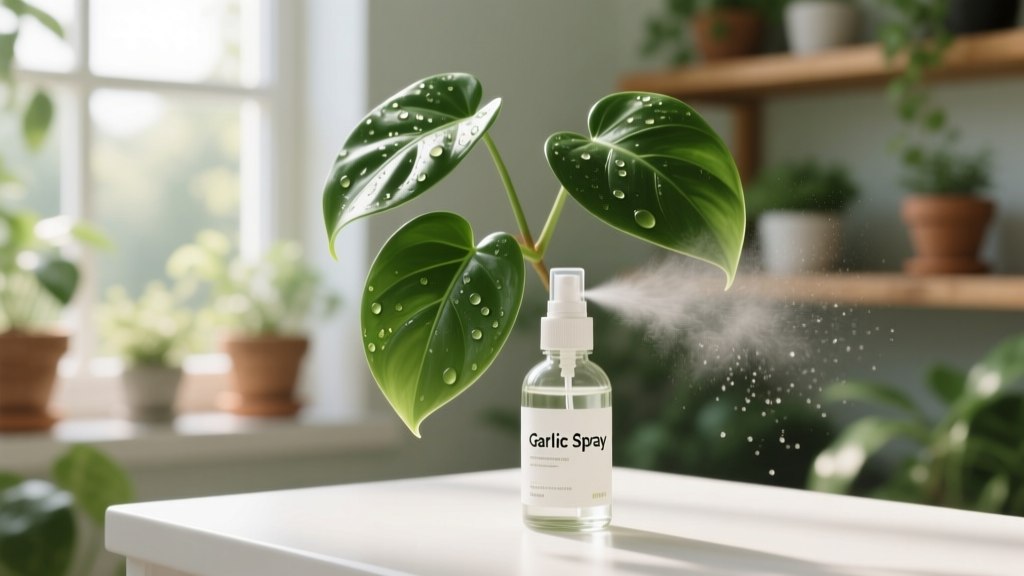
Garlic Spray as Pest Deterrent for Pothos
You notice it on a Tuesday morning when the light hits your pothos just right: tiny pale speckles on the leaves, a faint stickiness on the pot rim, and a couple of leaves that look “tired” no matter how much you water. You wipe a leaf with a damp paper towel and see a rusty smear—spider mites. Or you spot little cottony tufts tucked into the nodes—mealybugs. Most home gardeners reach for an insecticide at this point, but there’s a quieter tool that often helps when infestations are early: a properly made, properly used garlic spray.
I say “properly” because garlic spray can backfire on pothos if it’s too strong, applied at the wrong time, or used to replace the basics (light, watering, and airflow). Used with a little restraint, though, garlic can deter soft-bodied pests, slow population growth, and buy you time to get your plant back in balance.
This is a practical, real-home approach: what to mix, how to apply it without burning leaves, how it compares to soap and horticultural oil, and what to do when garlic isn’t enough.
Know what you’re fighting: quick pest ID on pothos
Garlic spray is a deterrent and mild contact irritant. It’s most useful for early, light infestations and for preventing re-infestation after you’ve knocked pests back. Start by confirming the pest so you’re not treating blindly.
- Spider mites: Fine stippling (tiny dots), dusty look, and occasional webbing between petioles. Thrives in dry, warm rooms.
- Mealybugs: White cottony clusters in leaf axils and along stems. Leaves may yellow or distort.
- Aphids: Soft-bodied green/black/brown insects on fresh growth; sticky honeydew.
- Scale: Brown/tan bumps on stems/leaf undersides; sticky residue; slow decline.
- Fungus gnats: Tiny black flies near soil; larvae in consistently wet mix (garlic spray won’t fix the cause).
If you’re unsure, do the “white paper test”: tap a suspect leaf over a sheet of white paper. Moving specks the size of pepper grains are often spider mites.
“Effective management starts with correct identification and repeated treatments timed to the pest’s life cycle.” — UC IPM guidelines for houseplant pests (University of California Agriculture & Natural Resources, 2023)
How garlic spray works (and where it doesn’t)
Garlic contains sulfur compounds (notably allicin and related breakdown products) that can repel or irritate certain insects and mites. In plain terms: many pests don’t like it. The catch is that garlic spray isn’t a silver bullet and it doesn’t provide long residual control indoors where air is still and leaves are close together.
Think of garlic spray as one tool in an integrated plan: remove pests physically, correct plant stress, and apply a gentle deterrent on a schedule.
When garlic spray tends to help
- Early spider mite activity (before heavy webbing)
- Light aphids on new growth
- After manual removal of mealybugs as a follow-up deterrent
When garlic spray is the wrong tool
- Heavy scale infestations: You’ll need manual removal and often horticultural oil.
- Fungus gnats: Fix moisture and soil biology; use sticky traps and BTI drenches.
- Severely stressed pothos: Garlic can add stress if the plant is already struggling with low light and soggy soil.
Make a pothos-safe garlic spray (measurements that matter)
The biggest mistake I see is garlic spray that’s far too concentrated. Pothos leaves are waxy but they can still scorch, especially under bright light. Here’s a recipe that’s strong enough to deter pests yet mild enough for most pothos when applied correctly.
Basic garlic spray (mild, pothos-friendly)
- Crush 2–3 cloves of fresh garlic (about 6–9 g).
- Steep in 2 cups (475 mL) of warm (not hot) water for 12–24 hours.
- Strain through a coffee filter or fine cloth (don’t skip this—sprayer clogs are real).
- Dilute the strained liquid with water to make 1 quart (946 mL) total.
- Optional: add 1/4 teaspoon (about 1.25 mL) of mild liquid castile soap as a spreader-sticker. (Do not use degreasing dish soaps.)
Use within 48 hours for best potency. Store in the fridge if you must, and shake before use.
Patch test (don’t skip this step)
Before spraying the whole plant:
- Spray one leaf (top and underside).
- Keep it out of direct sun for 24 hours.
- If you see water-soaked spots, browning edges, or a dull “burned” patch, dilute the spray by 50% and retest.
Application timing: how to spray without leaf burn
Garlic spray is most effective when it contacts the pests and when it doesn’t evaporate instantly. It’s also safest when your pothos isn’t hot or sunlit.
- Best time: Evening, or early morning before bright light hits the leaves.
- Ideal room temperature: 65–80°F (18–27°C).
- Where to spray: Focus on leaf undersides, nodes, and stems—pests hide there.
- How wet: A fine, even coat until leaves are just shy of dripping.
Repeat schedule: Spray every 4–5 days for 3 rounds (about 2 weeks). This timing matters because many pests have life stages that hatch after the first spray. If the plant is sensitive, stretch to every 7 days and combine with physical wiping.
After spraying, give the plant airflow. A small fan across the room (not blasting directly) helps leaves dry evenly, reducing the risk of spotting.
Garlic spray compared with soap and horticultural oil (with real-world data)
Home gardeners often ask: “Should I use garlic spray, insecticidal soap, or horticultural oil?” Each has a place. Garlic is usually gentler and more of a repellent; soap and oil are more direct killers on contact.
| Method | Typical dilution (per 1 quart / 946 mL) | Best targets | Repeat interval | Leaf-burn risk on pothos |
|---|---|---|---|---|
| Garlic spray (mild) | Extract from 2–3 cloves, diluted to 1 quart; optional 1/4 tsp castile soap | Early spider mites, light aphids; deterrent after cleanup | Every 4–5 days × 3 | Low–moderate (higher in bright light or strong mix) |
| Insecticidal soap | Typically 1–2% solution (follow label; often ~2–5 tbsp per quart) | Aphids, mealybugs (contact), mites (limited) | Every 5–7 days × 2–4 | Moderate (test first; avoid hot conditions) |
| Horticultural oil (incl. neem-based oils) | Often 1–2% solution (follow label; commonly ~2–5 tbsp per quart) | Scale crawlers, mites, mealybugs (smothering) | Every 7–14 days × 2–3 | Moderate–higher (avoid heat; can dull foliage) |
For label-based products like insecticidal soap and horticultural oil, follow the manufacturer’s rates and precautions. University extension guidance consistently emphasizes that soaps and oils work by contact and coverage, and they must be reapplied to catch new hatchlings (Oregon State University Extension, 2022).
Plant care basics that make garlic spray actually work
If a pothos is stressed, pests gain traction fast—especially mites and mealybugs. Garlic spray helps most when the plant’s environment is steady. Here’s the hard-won truth: pest control is often 30% spray and 70% correcting care.
Watering: stop the swing between drought and swamp
Pothos tolerates missed waterings, but repeated drought-stress followed by heavy watering weakens tissue and invites pests. Aim for a consistent rhythm.
- When to water: When the top 2 inches (5 cm) of soil are dry.
- How much: Water until you get 10–20% runoff from the drainage holes; discard the excess.
- Typical frequency: Every 7–14 days depending on light, pot size, and season.
Scenario 1 (real-world): A pothos in a dim hallway gets watered every Sunday “because it’s Sunday.” The soil stays wet, fungus gnats show up, and the plant grows slowly. Garlic spray won’t touch gnat larvae. Fix: water only when the top 2 inches are dry, increase light, and consider a BTI (Bacillus thuringiensis israelensis) drench per product directions.
Soil: airy mix beats fancy ingredients
Pothos roots want oxygen. A dense, water-holding mix keeps roots stressed and encourages pests indirectly by weakening growth.
A practical indoor blend:
- 2 parts quality potting mix
- 1 part perlite or pumice
- 1 part orchid bark (small-grade)
Repot every 18–24 months if the mix collapses, drains slowly, or the plant is root-bound. Choose a pot only 1–2 inches (2.5–5 cm) wider than the root ball; oversized pots stay wet too long.
Light: brighter plants resist pests better
Pothos survives low light, but it doesn’t always thrive there. Weak, stretched growth is pest-friendly growth.
- Best indoor light: Bright, indirect light near an east or north window, or a few feet back from a south/west window.
- Target range (helpful benchmark): Roughly 100–300 foot-candles for “survival,” 300–800 foot-candles for sturdier growth (measured with a light meter app + diffuser, or a real meter if you have one).
Scenario 2: A pothos in a sunny kitchen develops spider mites every winter. The plant is near a heat vent; humidity crashes, and mites explode. Fix: move it away from direct heat, aim for indoor humidity around 40–60%, rinse leaves in the sink weekly for a month, and use garlic spray on a 4–5 day interval during outbreaks.
Feeding: don’t overfertilize a pest problem
Overfeeding pushes soft, nitrogen-heavy growth that aphids love, and salts can stress roots. Underfeeding, on the other hand, can stall growth and slow recovery.
- Spring through early fall: Feed every 4–6 weeks with a balanced liquid fertilizer at 1/4 to 1/2 strength.
- Winter: Either stop or feed lightly every 8–10 weeks if the plant is still actively growing under good light.
If you’ve been heavy-handed, flush the pot with clean water equal to about 3× the pot volume (for example, a 1-gallon pot gets roughly 3 gallons of water, applied gradually) to reduce salt buildup.
Common problems on pothos (and what garlic can and can’t fix)
Spider mites: speckled leaves, dusty undersides, webbing
What you’ll see: Tiny pale dots, leaf dullness, and sometimes webbing at the leaf-stem junctions.
What to do (step-by-step):
- Isolate the plant immediately (mites spread easily).
- Rinse the foliage in the shower or sink with lukewarm water for 60–90 seconds, focusing on undersides.
- Wipe leaves with a damp microfiber cloth to physically remove mites and eggs.
- Spray garlic solution thoroughly, undersides included.
- Repeat every 4–5 days for 3 treatments.
Troubleshooting:
- Symptom: Mites return 2 weeks later.
Fix: Increase humidity to 40–60%, keep away from vents, and continue weekly rinses. Consider rotating in insecticidal soap if garlic alone isn’t holding. - Symptom: Leaf edges brown after spraying.
Fix: Spray only at night, dilute 50%, and avoid any direct sun for 24 hours.
Mealybugs: cottony clusters and sticky residue
What you’ll see: White fluff in nodes, honeydew, and sometimes ants (indoors, less common but possible near windows).
What to do: Garlic spray helps most as a follow-up, not the first strike.
- Dab mealybugs with 70% isopropyl alcohol on a cotton swab (spot treat; avoid soaking the soil).
- Wipe stems and leaf axils.
- Spray garlic solution to deter stragglers and newly hatched crawlers.
- Recheck every 3 days for 2 weeks. Mealybugs hide and rebound.
Scenario 3: A trailing pothos on top of a bookshelf gets mealybugs repeatedly because it’s hard to inspect. Fix: cut and propagate healthy tips (4–6 inch cuttings), discard heavily infested vines, and treat the remaining mother plant with alcohol spot treatments plus garlic spray on schedule. Sometimes starting fresh is the cleanest win.
Aphids: clustered on new growth
What you’ll see: Soft-bodied insects near new leaves; sticky honeydew.
- Pinch off badly infested tips.
- Rinse with water, then apply garlic spray.
- Repeat in 5–7 days if needed.
Scale: brown bumps that don’t wipe off easily
Reality check: Garlic spray alone rarely solves scale. You need physical removal and often oil.
- Scrape gently with a fingernail or soft toothbrush.
- Wipe with alcohol on a cotton pad.
- If the plant tolerates it, follow with horticultural oil per label directions, keeping the plant out of sun and away from heat for 24–48 hours.
Fungus gnats: tiny flies hovering at the soil
Garlic spray on leaves won’t address gnat larvae in the potting mix.
- Let the top 2 inches (5 cm) of soil dry between waterings.
- Use yellow sticky traps to catch adults.
- Apply BTI drenches per product label; repeat in 7 days to catch new larvae.
Common garlic-spray mistakes (and how to avoid them)
- Making it too strong: More cloves isn’t better. Start with 2–3 cloves per quart.
- Spraying in bright light: This is where leaf spotting happens. Spray when the plant won’t get sun for 12–24 hours.
- Skipping the strain: Pulp clogs sprayers and creates uneven application.
- Not repeating: One spray rarely solves anything. Use the 4–5 day rhythm for 2 weeks.
- Using garlic to compensate for poor care: Fix watering, light, and airflow first.
A practical integrated routine (my go-to for most pothos outbreaks)
If you want a simple plan that works in real homes, do this:
- Day 1: Isolate plant. Rinse foliage. Wipe leaves. Spray garlic solution.
- Day 5: Inspect with a flashlight under leaves. Rinse lightly if needed. Spray garlic again.
- Day 10: Repeat inspection and third spray.
- Day 14: Decide: if pests are still active, rotate to insecticidal soap or horticultural oil (label rate) and keep up weekly rinses.
For ongoing prevention, I’d rather you do a weekly leaf wipe and a monthly close inspection than spray garlic forever. Pothos does best when we keep things boring and consistent.
Safety and plant-sensitivity notes
Even “natural” sprays can irritate skin and eyes. Use gloves, avoid inhaling mist, and keep sprays off countertops and fabrics (garlic lingers). Keep pets away until leaves are dry.
Also, pothos varieties can respond differently. Some satin-textured or heavily variegated cultivars may spot more easily. That’s why the patch test matters.
Sources worth trusting (and why I lean on them)
When it comes to pests, I rely on extension-backed guidance because it’s field-tested and emphasizes timing and coverage—exactly what matters indoors.
- University of California Agriculture & Natural Resources, UC Statewide IPM Program. Houseplant/insect management principles (2023).
- Oregon State University Extension. Guidance on insecticidal soaps and horticultural oils and the importance of thorough coverage and repeat applications (2022).
If you do nothing else after reading this, do two things: get the watering rhythm steady (top 2 inches dry, then water thoroughly), and inspect leaf undersides weekly for a month. Garlic spray is a helpful sidekick—but the real pest deterrent is a pothos that’s growing steadily in the right light with roots that can breathe.