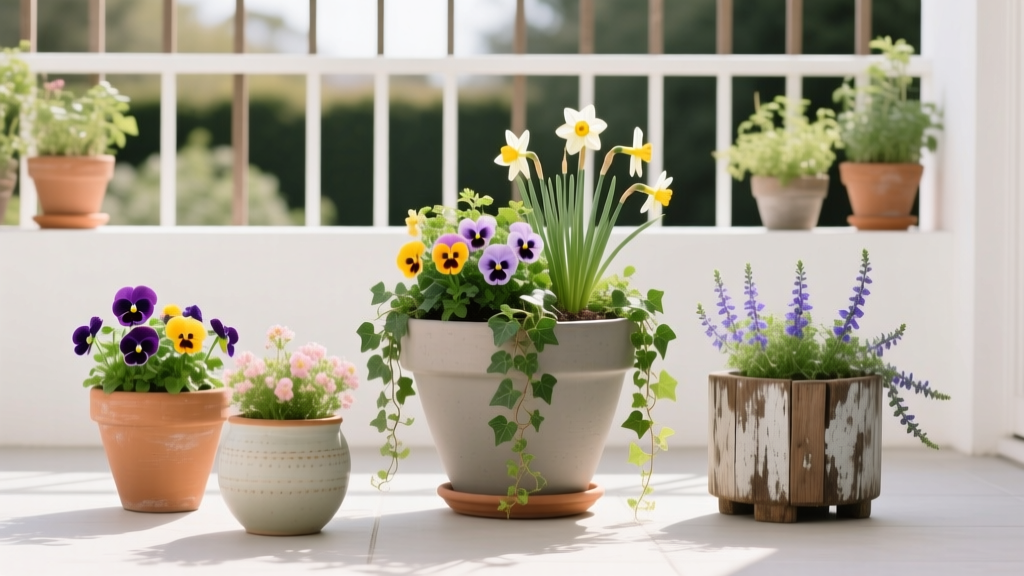
Spring Container Garden Refresh Ideas
The next 2–4 weeks decide whether your containers coast into summer or struggle all season. After winter, potting mix is often compacted, salts may be concentrated, roots can be heaved upward by freeze-thaw, and pests wake up fast when nights stay above 45°F. A spring refresh is less about “starting over” and more about triage: clean, cut back, re-pot what needs it, then plant cool-season color early—before heat spikes and before you’re suddenly behind your local last frost date.
Use this as a practical, do-it-now checklist. The timing cues below work anywhere if you anchor them to (1) your local average last frost date and (2) soil temperature. For many gardeners, that means the busiest window is roughly 2 weeks before last frost through 4 weeks after.
Priority 1: What to prepare first (this week)
1) Inspect, clean, and sanitize containers
Start with a fast audit: cracked pots, blocked drainage, crusty rims, wobbly saucers, and soggy mixes. Any container that sat outside all winter deserves a rinse and reset before you plant.
- Drainage check: If water doesn’t run through in 10–20 seconds, clear holes. Add pot feet or bricks to lift pots off flat surfaces.
- Salt crust removal: White crust on clay or mix is usually fertilizer salts. Scrub it off; salts can burn new roots.
- Sanitize to prevent carryover disease: Wash with soapy water, then sanitize. Many extension services recommend a 10% bleach solution for disinfection (about 1 part bleach to 9 parts water), followed by a clear-water rinse and dry time.
Timing cue: Do this on a mild day above 50°F so pots dry quickly. Wet, cool pots can harbor fungi.
2) Decide: refresh the top, or repot completely?
Containers don’t all need full repotting every spring, but many benefit from it. Use these quick triggers:
- Top-dress only (replace top 2–3 inches) if: plants are perennials with stable roots, drainage is good, and last year’s growth was strong.
- Full repot if: roots circle the pot, mix is hydrophobic (water runs down the sides), pot feels unusually light/dry, or plants declined last summer.
- Pot size rule: If roots fill the container edge-to-edge, move up 1–2 inches in diameter (not 6 inches—too much wet mix can rot roots in spring).
Temperature threshold: Repot when daytime highs are reliably above 55°F so roots recover quickly.
3) Refresh potting mix the right way (avoid “soil” shortcuts)
Spring is when people are tempted to reuse last year’s mix as-is. You can reuse some, but improve it so it drains and feeds evenly.
- For annuals: Dump and start fresh if last year had disease (mildew, blight) or chronic pests (whiteflies). Otherwise, reuse up to 1/3 old mix blended with 2/3 fresh potting mix plus compost (10–20% by volume).
- For perennials: Remove 20–30% of old mix from the top and sides and replace with fresh potting mix/compost blend.
- Skip garden soil: It compacts in pots, starving roots of oxygen.
“Good container media must provide both water-holding capacity and air space; compaction reduces oxygen and predisposes roots to disease.” — Extension horticulture guidance on container substrates (e.g., University Extension container media recommendations)
Fertilizer reset: If you used slow-release fertilizer last year, assume it’s spent. Add a new slow-release at label rate, or plan a liquid feeding schedule starting 2 weeks after planting.
Spring container refresh checklist (prep)
- Clean pots, saucers, and trays; sanitize if disease occurred last year
- Confirm drainage holes are open; elevate large containers
- Decide top-dress vs repot based on root and mix condition
- Blend fresh potting mix; avoid straight compost (too fine) and avoid garden soil
- Set up watering tools now (hose timer, watering can, drip kit)
Priority 2: What to prune and tidy (right after prep)
1) Cut back overwintered container perennials
Many container perennials look rough in early spring. Pruning now directs energy into clean new growth and reduces fungal carryover.
- Herbs (woody): Cut back lavender and rosemary lightly—avoid cutting into old, leafless wood. Aim to remove winter burn and shape plants.
- Ornamental grasses: Shear to 3–6 inches before new growth elongates.
- Hardy perennials: Remove dead stems to the base once you see green at the crown.
Timing cue: Prune when buds swell but before rapid growth—often 1–3 weeks before your average last frost date.
2) Remove last year’s debris (it’s pest habitat)
Old leaves and spent flowers in pots are prime hiding places for slugs, sowbugs, and fungal spores. Don’t compost diseased debris; bag it.
Pest prevention tie-in: Cleaning now reduces aphids and mites later because you’re removing eggs and sheltered colonies before they explode.
Priority 3: What to plant now (by temperature and frost date)
Planting is the fun part, but the best spring containers start with the right plants at the right temperatures. Use this simple framework:
- Cool-season containers: Plant when nights are mostly above 28–32°F and daytime highs are 45–65°F.
- Warm-season containers: Plant when nights are reliably above 50°F and soil temps are consistently 60°F+ (especially for basil, peppers).
Concrete timing anchors: Target these windows relative to your local average last frost date: 4 weeks before: sow/plant hardy cool-season items; 2 weeks before: most cool-season color; frost date week: transition plantings and hardening off; 2 weeks after: warm-season annuals in protected spots; 4 weeks after: heat lovers everywhere.
Cool-season “instant refresh” containers (plant 2–6 weeks before last frost)
These tolerate chill and make your patio look alive early:
- Pansies/violas (long bloom in cool weather)
- Snapdragons (upright structure; frost-tolerant once established)
- Dusty miller, sweet alyssum (edgers/spillers)
- Edibles: lettuce, arugula, spinach, peas on a small trellis, parsley, cilantro
USDA zones note: In USDA Zone 7–9, you can often plant these in late February through March; in Zones 4–6, think late March through April, depending on your frost date.
Warm-season color and edibles (plant 2–4 weeks after last frost, or nights > 50°F)
- Annuals: petunias, calibrachoa, zinnias, lantana (warmth lover), marigolds
- Edibles: basil (best after nights > 50°F), tomatoes (after frost, with hardening off), peppers (prefer 60°F+ nights)
- Structure plants: dwarf conifers (in larger pots), cordyline (warm zones), small grasses
Hardening-off timeline: Give seedlings 7–10 days of gradual outdoor exposure. Start with 1–2 hours in bright shade, then increase daily. Wind is often more damaging than sun in early spring.
Spring container combos that work (fast recipes)
Pick one “thriller,” two “fillers,” and one “spiller,” sized to your pot.
- Cool-season combo: snapdragon (thriller) + pansies (filler) + dusty miller (filler) + alyssum (spiller)
- Edible spring combo: parsley (thriller) + leaf lettuce (filler) + cilantro (filler) + trailing nasturtium (spiller)
- Post-frost combo: dwarf zinnia (thriller) + calibrachoa (filler) + verbena (filler) + sweet potato vine (spiller)
Priority 4: What to protect (because spring is chaotic)
1) Frost and wind protection for containers
Containers cool faster than in-ground beds. A “light frost” that barely nips the lawn can freeze a pot’s root zone.
- Frost cloth target: Cover when forecast lows are 32°F or lower. If you’ve planted tender annuals early, cover at 35°F to be safe.
- Moveable strategy: Group pots against a south- or west-facing wall to capture radiant heat.
- Wind rule: If gusts exceed 20–25 mph, move tall containers to shelter; wind desiccates foliage and can topple top-heavy planters.
Regional reality: In high-elevation and interior climates, you can see a warm 75°F day followed by a 28°F night in spring. Keep frost cloth and plant caddies ready even after you think winter is done.
2) Watering: avoid both drought and root rot
Early spring is tricky: air is cool, but wind and sun can still dry pots. Meanwhile, roots grow slowly in cold media.
- Finger test: Water when the top 1 inch is dry. If it’s wet and cold, wait.
- Morning watering: Water early so foliage dries by afternoon (reduces Botrytis and mildew risk).
- Saucer warning: Don’t let pots sit in water; empty saucers after watering.
3) Pest and disease prevention (spring-specific)
Spring pests often arrive with tender new growth. Catching them early prevents infestations in May and June.
- Aphids: Inspect new tips weekly. Blast off with water; follow with insecticidal soap if needed.
- Slugs/snails: Hide under rims and saucers. Remove hiding spots and consider iron phosphate bait in rainy regions.
- Fungus gnats: Common in consistently wet potting mix indoors/outdoors. Let the surface dry between waterings; use sticky traps as indicators.
- Powdery mildew: Prevent by spacing plants for airflow and watering at soil level. Avoid high nitrogen early.
Extension guidance consistently emphasizes sanitation and scouting as primary IPM steps. For example, university IPM programs recommend regular inspection and physical controls first, escalating only as needed.
Timing you can follow: a spring container schedule (by month)
| Time window | What to do | Plant ideas | Watch-outs |
|---|---|---|---|
| Late Feb–March (Zones 7–9) / March–April (Zones 4–6) | Clean pots; top-dress or repot; cut back perennials | Pansies, violas, lettuce, parsley | Cold wet mix; late freezes |
| 2–4 weeks before last frost | Plant cool-season containers; start hardening off seedlings | Snapdragons, alyssum, spinach, peas | Cover if ≤ 32°F; wind burn |
| Last frost week | Swap in transition plants; fertilize lightly after new growth starts | Herbs, tougher annuals in protected spots | Don’t overwater; roots still slow |
| 2 weeks after last frost (nights > 50°F) | Plant warm-season annuals; set up drip or watering routine | Petunias, calibrachoa, basil | Aphids on tender tips |
| 4+ weeks after last frost (soil ≥ 60°F) | Full summer changeover; heavier feeding begins | Tomatoes, peppers, lantana | Heat spikes; check daily moisture |
Three real-world spring scenarios (adjustments that matter)
Scenario 1: Cold springs (Upper Midwest, New England, Zones 3–5)
If your last frost commonly lands in early-to-mid May, resist planting warm-season annuals just because the garden center is stocked. Focus on cool-season containers first, then transition.
- Best play: Build a “spring show” pot now (pansies, violas, greens), then plan to swap 50–70% of plants after frost.
- Concrete cue: Wait until nights stay above 50°F before basil and most tropical annuals.
- Container insulation: Use thicker pots (ceramic, wood) or double-pot tender plants (nursery pot set inside a decorative pot) to buffer cold nights.
Scenario 2: Warm spring, surprise late frost (Mid-Atlantic, Transition Zones 6–7)
These regions can sprint into summer, then backslide. Prepare for protection instead of delaying all planting.
- Best play: Plant cool-season and “in-between” plants (snapdragons, dusty miller) early; keep tender annuals in moveable pots.
- Frost plan: If a late frost threatens (28–32°F), move pots into a garage overnight or cover with frost cloth to the ground.
- Pruning timing: Don’t prune tender perennials too early; wait until you see active buds to avoid dieback after cold snaps.
Scenario 3: Wet coastal spring vs. dry windy spring (Pacific Northwest vs. High Plains)
Rainy regions fight root diseases; arid, windy regions fight dehydration and windburn.
- Wet spring strategy (coastal/PNW): Emphasize drainage—fresh mix, fewer saucers, and avoid overpotting. Choose mildew-resistant varieties and provide airflow.
- Dry windy strategy (High Plains/interior West): Add water-holding components (a bit more compost, or a quality potting mix formulated for moisture retention). Use windbreak placement and mulch the surface with fine bark to slow evaporation.
- Concrete cue: If afternoon wind regularly hits 20+ mph, move containers to a spot with morning sun and afternoon shelter.
What to plant: a quick priority list by zone and timing
USDA Zone 3–5 (shorter season)
Now to last frost: pansies, violas, alyssum, lettuce, spinach, parsley. After last frost + 2 weeks: petunias, marigolds, basil (if nights > 50°F). After soil hits 60°F: tomatoes/peppers in large containers with consistent feeding.
USDA Zone 6–7 (classic “two springs” pattern)
Now: spring color pots plus herb containers. At last frost: transition planters with snapdragons and early annuals in protected microclimates. Two weeks after: full warm-season changeover.
USDA Zone 8–10 (early and fast)
Now: refresh and plant aggressively; watch for early heat. Cool-season blooms may fade quickly when highs exceed 80°F. Plan to replace pansies with heat lovers by mid-to-late spring, and shift containers to afternoon shade sooner than you think.
Mini-timelines you can execute this weekend
60-minute refresh (for 2–3 medium pots)
- Pull weeds and old debris (10 minutes)
- Scrub rims and clear drain holes (10 minutes)
- Replace top 2–3 inches of mix; add slow-release fertilizer (15 minutes)
- Plant cool-season color or greens; water in (20 minutes)
- Label and set a weekly scouting reminder (5 minutes)
Half-day reset (for big statement containers)
- Slide pot onto a dolly; empty and inspect roots (30 minutes)
- Trim circling roots; repot with fresh mix (45 minutes)
- Install a simple drip ring or add a watering tube (20 minutes)
- Plant a structured design (thriller/filler/spiller) (45 minutes)
- Top with mulch; water thoroughly; place in final location (20 minutes)
Extension-backed best practices (quick references)
Two evidence-based points to anchor your spring approach:
- Sanitation reduces disease carryover: University Extension materials commonly recommend cleaning and disinfecting pots when reusing them, especially after disease issues. (Example guidance: Extension publications on greenhouse/containers sanitation; many cite bleach solutions as a disinfectant standard.)
- Potting media performance matters: Research and Extension resources emphasize that container substrates must balance water retention with aeration; compaction and poor drainage are common causes of root decline. (Container media recommendations are widely published by land-grant universities.)
Citations: Colorado State University Extension (2019) provides guidance on cleaning and disinfecting reused pots and tools to reduce disease spread; and University of Florida IFAS Extension (2020) discusses the importance of well-aerated container media and avoiding poorly draining mixes in container production and home plantings.
Final spring checks (do these after planting)
- Water-in rule: Water until you see steady drainage. If mix shrinks away from the pot edge, soak gently and refill gaps with fresh mix.
- Mulch thinly: A 1/2-inch layer of fine bark or compost can reduce evaporation and soil splash (which spreads disease).
- Start scouting now: Check leaf undersides weekly for aphids and mites. Early action is 10x easier than May cleanup.
- Fertilize on schedule: If using liquid feed, start 10–14 days after planting, then every 7–14 days depending on plant vigor and rainfall.
- Keep frost cloth handy: Don’t pack it away until you’re at least 2 weeks past your average last frost date.
Once your containers are clean, draining well, and planted to match real temperatures—not just the calendar—you’ve bought yourself the easiest possible summer. The spring refresh is the moment to fix what will be hard to fix later: drainage, root space, and plant timing. Everything after that is just watering, feeding, and swapping out what fades as the weather turns.