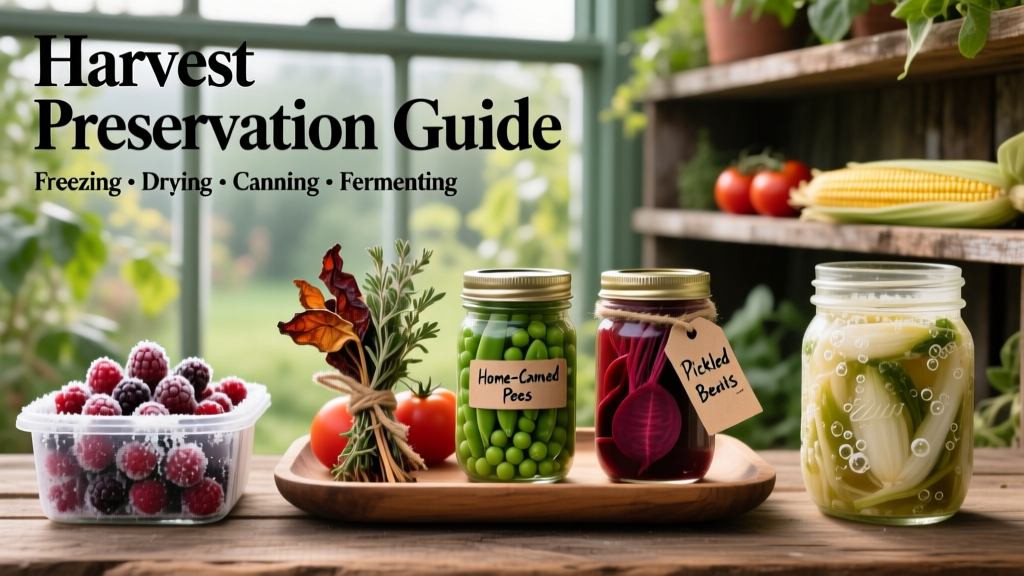
Harvest Preservation Guide: Freezing, Drying, Canning, and Fermenting Basics
Why Preserve Your Harvest?
A productive garden produces more food than you can eat fresh. Preservation lets you enjoy summer tomatoes in January, freeze pesto from your basil surplus, and ferment your own sauerkraut from fall cabbage. Four methods cover everything: freezing, drying, canning, and fermenting.
Method 1: Freezing (Easiest)
Best For
- Tomatoes (whole or sauce), berries, peppers, corn, peas, beans, herbs
Process
- Wash and prep produce
- Blanch vegetables (boil 2-3 min, ice bath 2 min) — preserves color and texture
- Flash freeze on baking sheet (prevents clumping)
- Transfer to freezer bags, remove air, label with date
Storage: 8-12 months at 0F
Method 2: Dehydrating (Longest Shelf Life)
Best For
- Herbs, tomatoes, peppers, mushrooms, fruit leather, jerky
Process
- Slice uniformly (1/4 inch for fruits, 1/8 inch for vegetables)
- Arrange on dehydrator trays (no overlap)
- Set temperature: herbs 95F, vegetables 125F, fruits 135F
- Dry until leathery or crisp (4-24 hours depending on moisture content)
- Condition: store in jar for 7 days, shake daily — if condensation forms, dry more
Storage: 1-5 years in airtight containers, cool dark place
Method 3: Water Bath Canning (For High-Acid Foods)
Best For
- Jams, jellies, pickles, salsa, tomato sauce (with added acid), fruits
Equipment
- Water bath canner or large stockpot with rack
- Mason jars, lids, and bands
- Jar lifter, funnel, bubble remover
Process
- Sterilize jars (boil 10 minutes)
- Prepare recipe (use tested recipes from Ball or NCHFP only)
- Fill jars, leaving specified headspace
- Wipe rims, apply lids and bands (fingertip tight)
- Process in boiling water bath for recipe-specified time
- Remove, cool 24 hours, check seals (lid should not flex)
Storage: 1 year for best quality, shelf-stable
Method 4: Lacto-Fermentation (Probiotic)
Best For
- Sauerkraut, kimchi, pickles, hot sauce, carrots, beets
Process (Sauerkraut Example)
- Shred cabbage (5 lbs)
- Mix with 3 tablespoons sea salt (no iodine)
- Massage 10 minutes until brine forms
- Pack into clean jar, pressing down until brine covers cabbage
- Weight down (submerged vegetables don't spoil)
- Cover with cloth, ferment at 65-75F for 1-4 weeks
- Taste weekly — refrigerate when desired sourness is reached
Storage: 6+ months refrigerated
Which Method for Each Crop?
| Crop | Best Method | Alternative |
|---|---|---|
| Tomatoes | Canning (sauce) | Freezing, drying |
| Peppers | Freezing | Drying, fermenting |
| Herbs | Drying | Freezing in oil |
| Berries | Freezing | Canning (jam) |
| Cabbage | Fermenting | Freezing (blanched) |
| Beans | Freezing | Canning (pressure) |
Final Thoughts
Start with freezing — it's foolproof and requires no special equipment. Once comfortable, try fermenting (sauerkraut is the easiest entry point). Canning is the most technical — use only tested recipes and follow them exactly for food safety.