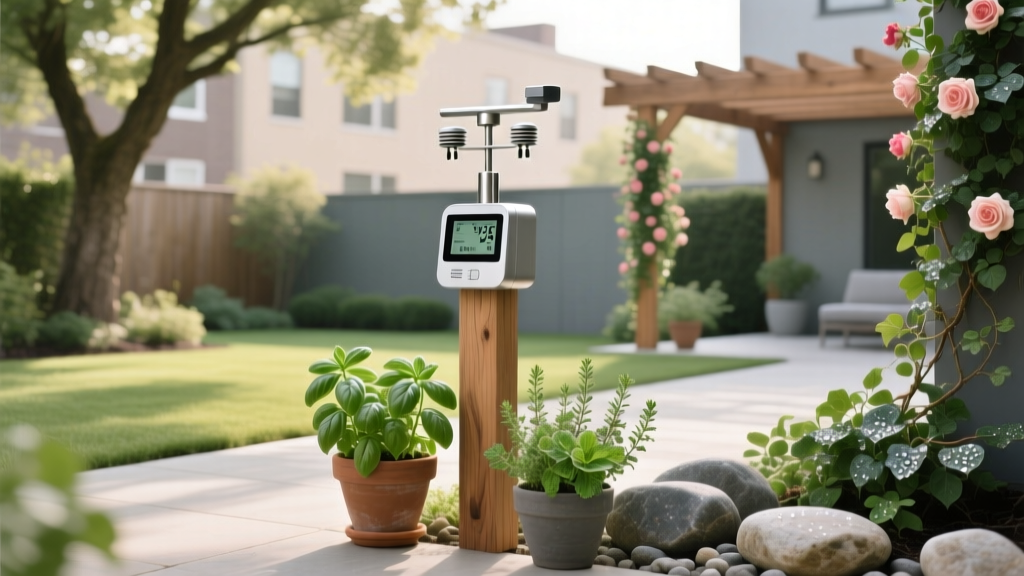
Making a Garden Weather Station Setup
Most backyard “weather station” setups fail for one boring reason: they’re mounted in the wrong place. A thermometer on a sunny fence can read 10–30°F hotter than the air your tomatoes actually live in, and a rain gauge under a tree can “prove” you got 0.00" during a downpour. If you want numbers you can trust (and actually use to water, frost-protect, and time sprays), the setup matters more than the gadget.
Below are the shortcuts, hacks, and proven tricks I use when helping gardeners set up a small, reliable weather station—without turning your yard into a science experiment.
Start With Placement (Because Sensors Lie When You Mount Them Wrong)
Tip: Put your temperature/humidity sensor over grass, not over a patio
Hard surfaces soak up heat and re-radiate it, especially at dusk. Mount your sensor over turf or a mulched bed, not over concrete, gravel, decking, or next to a south-facing wall. Aim for 4–6 ft (1.2–1.8 m) above ground—high enough to avoid splashback and low enough to reflect garden conditions.
Example: One patio-mounted sensor in full afternoon sun showed 96°F while a shaded, properly sited sensor over lawn read 84°F—two completely different watering decisions.
Tip: Follow the “2× height” rule for distance from obstacles
For decent airflow, keep sensors away from anything that blocks wind: fences, sheds, hedges. A quick field rule is to place the station at least 2× the height of the nearest obstacle (e.g., 8 ft away from a 4 ft fence). This reduces heat pockets and humidity traps that skew readings.
Example: If your sensor is 3 ft from a 6 ft hedge, it’s basically measuring “hedge microclimate,” not your garden.
Tip: Rain gauges need open sky—think “funnel to the clouds”
Rain gauges under branches or roof drip lines underreport, sometimes by a lot. Give the gauge an open view of the sky and keep it level; even a slight tilt can make light rain read as zero. If you can, mount the gauge so the rim is 2–5 ft above ground—high enough to avoid splash-in from soil during heavy storms.
Example: A gauge 18" from a roof edge can overcount in a light shower (drip lines) and undercount in wind-driven rain (eddies). Move it out into the open and the numbers suddenly match what your beds experience.
Tip: Wind sensors belong higher—don’t expect miracles at fence height
Gardeners often mount the anemometer on a post near the beds, then wonder why wind reads “calm.” Standard wind measurements are taken at 10 m (33 ft), which most of us won’t do, but you can improve results by getting it above nearby turbulence—on a shed roof, pergola, or a pole that clears the fence line.
Example: Put the anemometer at the top of a 12 ft pole in the open part of your yard; you’ll catch gusts that explain why seedlings desiccate even when it “doesn’t feel windy” at ground level.
Pick Sensors That Actually Help You Garden (Not Just Fun Numbers)
Tip: Prioritize rainfall + temperature first (they drive most garden decisions)
If you only buy two measurements, make them rain and air temperature. Those two numbers decide irrigation timing, frost protection, and many pest/disease windows. A basic station with outdoor temp/humidity + tipping-bucket rain gauge often starts around $50–$120, and you can build from there.
Example: Keeping a running 7-day rainfall total (say 0.6") instantly tells you whether you’re actually meeting a typical veggie target of roughly 1.0" per week (adjust by climate, soil, and crop).
Tip: Add a soil temperature probe if you start seeds outdoors
Soil temperature is a better germination predictor than air temperature. A $15–$40 probe can help you avoid sowing beans into 52°F soil that sits for weeks. Track soil temp at 2–4" depth where seeds live, ideally in the morning before the sun heats the surface.
Example: In spring, air might hit 70°F midday while soil stays 55°F—great for peas, frustrating for basil.
Tip: Leaf wetness is optional—use it if disease pressure is your main headache
Leaf wetness sensors help estimate how long foliage stays damp, which is a big driver for fungal issues. They’re most useful in humid regions or tight plantings where powdery mildew and blights pop up. If you skip leaf wetness, you can still approximate risk using overnight humidity and temperature trends.
Example: If your station shows 90%+ humidity from 10 p.m. to 6 a.m. and temps in the 60s, you’re in “keep airflow up and avoid night watering” territory.
DIY Upgrades That Make Cheap Stations Perform Like Expensive Ones
Tip: Add a radiation shield (or make one) to stop sun-fried temperature readings
Direct sun is the #1 reason backyard thermometers read too hot. If your sensor doesn’t come with a real radiation shield, buy one ($15–$40) or DIY a “stacked saucer” shield using white plastic plant saucers, spacers, and screws. Keep vents between layers so air moves through while sunlight is blocked.
Example: A simple DIY shield can drop peak daytime errors from “way off” to within a couple degrees—close enough to decide on shade cloth or extra watering.
Tip: Calibrate rainfall using the “known pour” test
Tipping-bucket gauges are surprisingly adjustable. Pour a measured amount of water into the gauge slowly—try 1 cup (236 mL) at a steady pace—and compare the reading to what it should equal for your funnel area (check the manual). If it’s off by more than 5–10%, adjust the screws (most models allow this) until it matches.
Example: If your gauge reports 0.08" when it should be 0.10", it will under-water your beds all season unless you tune it.
Tip: Use a simple drip edge and splash guard for cleaner rain data
If your gauge sits near bare soil or mulch, heavy rain can splash in and inflate totals. A quick fix is to place the gauge in a short section of wider PVC (like a “collar”) that blocks side splash without blocking overhead rain. Also avoid roof drip lines entirely; they create false spikes.
Example: In a thunderstorm, splash-in can add 0.1–0.2" to your totals—enough to skip a watering you really needed.
Data You’ll Actually Use: Set Alerts and Track Simple Metrics
Tip: Set a frost alert at 36°F (not 32°F)
Waiting for 32°F is a rookie move—your garden can frost above freezing due to radiational cooling at plant level. Set your station alert to 36°F so you have time to cover tender plants, water in the afternoon for heat storage, or move containers closer to the house.
Example: A 36°F alert at 9 p.m. gives you time to throw row cover over peppers before the 4 a.m. dip.
“The standard air temperature is measured at about 5 feet above ground in a shaded, well-ventilated shelter; readings taken in sun or near buildings can be significantly warmer.” — NOAA/National Weather Service guidance on standard observing practices
Tip: Track “rainfall since last deep watering” instead of daily totals
Daily totals are interesting; cumulative totals are useful. Make a note when you deep-water, then track rain since that moment to decide if you need to irrigate again. For many veggie beds, a practical checkpoint is: if you’ve had <0.75–1.0" over 7 days (including irrigation), plan a deep soak.
Example: You deep-watered Sunday; by Friday you’ve logged 0.2" rain—time to water, even if two days “felt humid.”
Tip: Use degree-days for pests if you like nerdy shortcuts (it’s faster than guessing)
Some stations and apps calculate growing degree days (GDD), which helps time pest emergence and plant development. If you’re already tracking temperatures, GDD is “free insight” once set up. Many extension programs use degree-day models for better timing than calendar dates.
Example: If you keep missing the right window for certain caterpillars or borers, aligning scouting with heat accumulation beats guessing “mid-June.”
For science-backed reference on temperature/measurement standards, NOAA and meteorological observing practices emphasize proper siting and shielding for representative air temperature readings (NOAA/NWS, 2020). For gardeners using weather data to time plant protection and pest management, cooperative extension degree-day and weather-based advisories are widely used tools (e.g., university extension IPM programs, 2018–2023).
Money-Saving Choices: Where to Spend and Where to Cheap Out
Tip: Spend on a good rain gauge and shield; save on “extra” sensors
Rainfall and air temp accuracy drive the biggest decisions, so put money there first. A solid tipping-bucket rain sensor plus a decent radiation shield is worth more than a flashy solar/UV readout you never use. Many gardeners get better results upgrading a $80 station with a $25 shield than buying a $250 station and mounting it wrong.
Example: If your rainfall runs 15% low, you’ll overwater or underwater all season—your water bill will notice.
Tip: Use rechargeable batteries and a maintenance schedule (it prevents “data ghosting”)
Stations don’t usually die dramatically; they just start dropping readings. Swap batteries on a schedule—every 6 months is easy to remember (spring and fall), or sooner in cold climates. Rechargeables cut costs, and cleaning the rain funnel at the same time keeps accuracy up.
Example: A clogged funnel can turn a real 0.4" rain into a reported 0.1". One quick rinse fixes it.
Tip: If Wi‑Fi is flaky, choose local display first and treat cloud sync as a bonus
Many home stations depend on stable Wi‑Fi; gardens are often far from routers. A station with a strong indoor console (that still logs data during outages) prevents gaps. If needed, a $25–$60 Wi‑Fi extender aimed toward the garden-facing wall is usually cheaper than replacing the whole station.
Example: If your router is on the opposite end of the house, the console can sit near a window and bridge the signal reliably.
Comparison Table: Two Practical Setups Most Gardeners Choose Between
| Setup | What you get | Typical cost | Best for | Watch-outs |
|---|---|---|---|---|
| Basic station + DIY shield | Temp/humidity + rain (sometimes wind) | $60–$140 (plus $10–$25 DIY shield) | Most veggie/backyard gardens | Needs careful placement; calibrate rain |
| “Pro” station with better shielding | Temp/humidity + rain + wind + solar/UV (often better housing) | $180–$400 | Large properties, serious data tracking | Still wrong if mounted near walls/trees; more parts to maintain |
Real-World Scenarios: How Gardeners Use Weather Stations to Make Better Calls
Scenario: The raised-bed vegetable grower who keeps overwatering
Raised beds drain faster, so it’s easy to “panic water” after a hot day. Set a weekly target and let the station rain total keep you honest: if you’ve logged 0.9" since last weekend, you probably don’t need another deep soak—spot-water only the thirstiest containers. Pair this with morning soil checks at 2–3" depth to confirm.
Scenario: The suburban gardener with a heat-trapping fence
If your station is within a few feet of a dark fence, nighttime temperatures can read warmer than your open beds—then you miss frost risk in low spots. Move the sensor so it’s 8–12 ft away from fencing, or mount it on a freestanding post over lawn. Set that 36°F alert and you’ll catch radiational cooling nights before damage happens.
Scenario: The humid-climate gardener battling powdery mildew
When mildew shows up “out of nowhere,” it’s usually a pattern you didn’t see: long humid nights plus crowded foliage. Use your station to flag stretches of 85–95% nighttime humidity and respond with practical moves—thin inner leaves, switch to morning watering only, and avoid overhead sprinklers in late day. If you spray (organic or otherwise), time it when leaves will dry within a few hours, not right before an all-night damp spell.
Scenario: The container gardener on a balcony with weird wind
Balconies create wind tunnels; plants dry out fast even when temps are moderate. Mount a small wind sensor or at least place the temp/humidity sensor where it catches airflow, not in a sheltered corner. If you routinely see gusts above 15–20 mph, plan on more frequent watering, heavier pots, and windbreak mesh—not because “it’s hot,” but because the air is stripping moisture.
Keep It Reliable: Maintenance That Takes 10 Minutes (and Saves a Season)
Tip: Clean the rain funnel monthly during pollen season
Pollen, leaf bits, and bird gifts clog funnels and jam tipping buckets. During heavy pollen, check it every 2–4 weeks; otherwise, once a month is fine. A quick rinse and a soft brush is usually all it takes—skip harsh chemicals that can leave residues.
Example: If spring storms seem “low” compared to your neighbor’s gauge, a pollen mat in the funnel is often the culprit.
Tip: Level-check the rain gauge after any big windstorm
Windstorms wiggle mounts loose, and a tilted gauge misreads light rains first (the ones you depend on between storms). Keep a small bubble level in your garden tool box and check after gusty weather. Tighten brackets and re-level in under 2 minutes.
Example: After a storm, a gauge can tilt just enough to undercount drizzles that add up over a week.
Tip: Audit your station twice a year against a cheap backup thermometer
You don’t need lab calibration—just a sanity check. Twice a year (spring/fall), place a $10 shaded thermometer near the station for an hour and compare. If you’re seeing a consistent offset like +4°F, it’s usually placement, sun exposure, or a missing/dirty shield rather than a “bad sensor.”
Example: If your station is always warmer than the shaded backup in mid-afternoon, your shield ventilation is likely blocked or the site gets reflected heat.
The fun part of a garden weather station isn’t the graphs—it’s the moment you realize your yard has patterns you can work with. Once your sensors are shaded, sited, and calibrated, you’ll stop guessing when to water, when to cover plants, and why diseases spike. Get the placement right, keep the rain gauge honest, and your station becomes the quiet little sidekick that saves you time, money, and a lot of “why did my plants do that?” moments.
Citations: NOAA/National Weather Service standard observing siting guidance for representative air temperature measurements (NOAA/NWS, 2020). University cooperative extension and IPM programs widely document weather- and degree-day-based timing for pest scouting and management decisions (e.g., Extension IPM resources, 2018–2023).