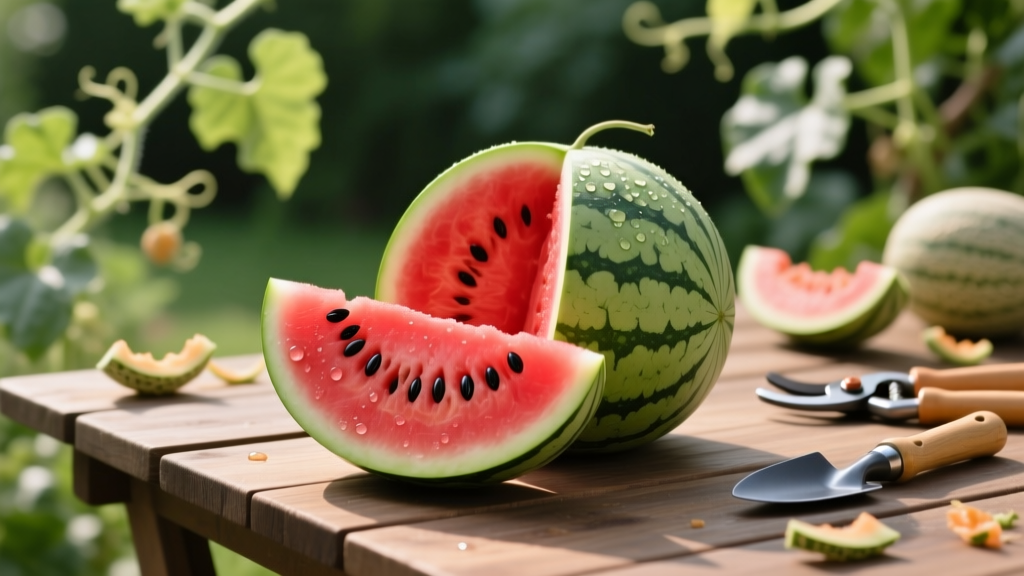
How to Tell When a Watermelon Is Truly Ripe
The most common watermelon mistake isn’t picking too early—it’s trusting the wrong “signal.” Plenty of melons thump like a drum and still taste like crunchy cucumber. The good news: ripeness has a handful of reliable clues, and once you know which ones actually track sugar and flavor, you’ll stop gambling on every harvest.
Watermelons don’t keep sweetening after you pick them (they’re non-climacteric fruit), so timing matters more than with tomatoes or peaches. That’s why the best growers stack several signs together instead of betting on a single trick. Let’s get you to that “I can tell from across the patch” confidence.
Start With the Signs That Don’t Lie (Most of the Time)
1) Check the field spot color (and what “buttery” really looks like)
Headline: A creamy field spot beats a white one every time.
Flip the melon and look at the “field spot” (where it rested on the ground). A ripe watermelon usually has a creamy yellow to deep buttery yellow spot; a pale or bright white spot often means it hasn’t finished. If your patch gets heavy sun and warm nights, that spot can turn a richer yellow faster—so pair this with one more sign below.
Example: If the field spot looks like a fresh stick of butter (not a ping-pong ball), it’s usually in the sweet zone. When it’s chalky white, give it 5–10 more days if you’re still within the variety’s maturity window.
2) Follow the tendril rule—but use the right tendril
Headline: Watch the tendril closest to the fruit stem, not any random curl.
Find the curly tendril on the vine right next to the stem where the melon attaches. When that tendril turns brown and dries up, the fruit is often mature. University of Florida IFAS notes that tendril drying near the fruit is a widely used maturity indicator for watermelon (UF/IFAS Extension, 2020).
Example: If the tendril is half-green/half-brown, you’re in the “almost there” window—check again in 48–72 hours, especially during hot spells when vines shift quickly.
3) Use days-to-maturity as a “guardrail,” not a calendar promise
Headline: Count days from fruit set, not from seed packet daydreams.
Seed packets might say 75–90 days, but that’s usually from sowing or transplanting under average conditions. For ripeness, the more useful count is days after fruit set (when you first notice a marble-to-tennis-ball sized melon). Many standard varieties ripen about 35–45 days after fruit set, though weather can stretch or shrink that.
Example: Mark fruit set with a twist tie or painter’s tape on the vine. If you tagged it on July 1, you’ll start checking hard around August 5–15 depending on variety and heat.
4) Look for “sugar webbing” (and know when it’s just scars)
Headline: Tan webbing can be a good sign—if it’s net-like, not gouged.
Some melons develop tan, corky “webbing” or freckles from bee activity and minor skin stretching as sugars build. Light webbing isn’t a guarantee of sweetness, but in combination with a buttery field spot and a drying tendril, it’s a strong vote for ripeness.
Example: A melon with a deep yellow spot and a dry tendril plus a little webbing is usually a better bet than a perfectly smooth melon with a white spot.
Sound, Shape, and Feel: Useful… If You Calibrate Them
5) Thump test: compare two melons, don’t judge in isolation
Headline: The thump test works best as a side-by-side comparison.
Thumping is subjective, but you can make it practical: thump a known underripe melon (white field spot, green tendril) and compare it to your candidate. Ripe melons tend to sound more deep and hollow; underripe often sound sharper or “tight.” If you only thump one melon, you’re basically reading tea leaves.
Example: In a patch of five melons, thump all five and rank them. Then cross-check the top two with field spot and tendril—your odds jump dramatically.
6) Weight test: ripe should feel “too heavy for its size”
Headline: Density is a sneakily good signal of juiciness.
Pick it up (don’t yank—support it with both hands). A ripe melon often feels surprisingly heavy because it’s packed with water and developed flesh. If it feels light compared to similarly sized melons, it may be underripe—or it may have uneven watering issues.
Example: If two melons look the same size and one feels like it’s got an extra 2–3 pounds in it, start your deeper inspection with the heavier one.
7) Shape check: consistent shape beats perfect size
Headline: Odd bulges can signal stress that affects eating quality.
A uniformly shaped melon is more likely to have developed evenly. Misshapen fruits can come from inconsistent pollination or early stress, and they’re more prone to bland zones or texture weirdness. This isn’t a “don’t eat it” rule—just a sorting trick.
Example: If you’re choosing which melon to harvest first for a party, pick the most evenly shaped one among the ripe candidates.
8) Rind finish: matte is better than shiny (most varieties)
Headline: A glossy sheen often means “still growing,” not “ready.”
Many watermelons shift from a slightly shiny rind to a more matte, dull finish as they mature. The color contrast can also look a bit “set,” not vibrant like a brand-new fruit. Use this as a supporting clue—some varieties keep a bit of shine.
Example: If the rind looks like it was freshly waxed and the tendril is still green, it’s almost certainly early.
Vine Clues and Harvest Timing Hacks
9) Track vine health: a dying vine can trick you
Headline: A brown tendril means something; a collapsing vine means “double-check.”
If the whole vine is declining from disease or heat, tendrils may dry before the fruit is truly ready. In that case, prioritize field spot color and days after fruit set over vine cues. This is especially common during late-season powdery mildew outbreaks.
Example: If your vine looks rough in late August and the tendril is brown, but the field spot is still white, wait—your plant may be “giving up” early rather than signaling ripeness.
10) Harvest in the cool part of the day for cleaner flavor and less cracking
Headline: Morning harvest reduces heat stress and messy splits.
Pick melons in the morning when they’re cooler and internal pressure is lower. It’s a small thing, but it can reduce hairline cracking and makes the fruit easier to handle. If you’re going straight to refrigeration, cooling down from morning temps is gentler than from midday heat.
Example: If it’s going to hit 92°F today, harvest between 7–10 a.m. and move the melons into shade immediately.
11) Cut with a little stem: it’s a tiny freshness hack
Headline: Leave a 1–2 inch stem stub to reduce stem-end issues.
Use pruners or a knife and leave about 1–2 inches of stem attached. This reduces the chance of tearing the rind and gives you a cleaner stem end. It’s a small detail that helps if you’re storing the melon for a few days before cutting.
Example: Gardeners who twist-pull often end up with a ragged stem scar; that’s where rot can start if the melon sits on a warm counter.
Quick Decision Tools (When You’ve Got More Than One Melon)
12) Use a simple “2-out-of-3 rule” for confidence
Headline: Require two strong signs plus one supporting sign.
My favorite shortcut is to demand two of the big three (buttery field spot, brown tendril nearest fruit, correct days-after-fruit-set) plus one supporting sign (matte rind, heavy feel, webbing). This keeps you from being fooled by a single indicator, especially thumping.
Example: Field spot: deep yellow (yes). Tendril: brown (yes). Days after fruit set: ~38 (yes). That’s a confident harvest even if the thump test feels ambiguous.
13) Don’t pay for gimmicks unless you’re growing a lot
Headline: A $0 trick can beat a $25 gadget for home gardens.
Some growers use refractometers to measure sugar (Brix), but they require juice—meaning you’ve already cut something. For home gardeners, your best “tool” is a roll of painter’s tape ($4–$6) to tag fruit set dates and a $12 pair of pruners for clean harvests. If you’re selling at market, that’s when specialized tools might start paying off.
| Method | Cost | Best for | Accuracy (home garden) | Downside |
|---|---|---|---|---|
| Field spot + tendril check | $0 | Most gardeners | High when combined | Harder on trellised melons |
| Days after fruit set (tagging) | $4–$6 (tape) | Gardeners who forget dates | High as a guardrail | Needs a quick weekly walk-through |
| Thump test | $0 | Experienced pickers | Medium (better with comparison) | Easy to misread alone |
| Refractometer (Brix) | $20–$60 | Market growers | High for what you test | Destructive sampling; extra steps |
Real-World Scenarios (So You Know What to Do When It’s Messy)
14) Scenario: The “perfect” melon that tasted bland last year
Headline: Last year’s bland melon was probably picked on looks alone.
If you harvested based on size and stripe color, you likely picked before sugars finished. This season, tag fruit set and wait until at least 35 days (typical range) before you even start getting serious about field spot and tendril checks. The difference between “pretty” and “ripe” is often just 7 extra days on the vine.
Example: A gardener who always picked at first sign of a yellow spot started waiting until the spot was deep buttery and the tendril browned—suddenly the same variety tasted like a different fruit.
15) Scenario: Heavy rain hit and now you’re worried about split melons
Headline: After a soak, harvest the ripe ones sooner rather than later.
A big rain after a dry stretch can make ripe melons take up water fast, increasing cracking risk. If you’ve had 1–2 inches of rain in 24–48 hours and you already have ripe signals (yellow field spot + brown tendril), go ahead and harvest. Move them into shade and let them dry off before storage.
Example: If storms dump rain on Friday and your melon was “two-out-of-three ripe” on Thursday, Friday evening is a smart harvest window.
16) Scenario: Trellised watermelons (no field spot you can see)
Headline: On a trellis, tendril + timing become your top two indicators.
When a melon hangs in a sling, the field spot may be tiny or absent. In that case, rely heavily on the nearest tendril drying and your fruit set date tag. You can also watch for the rind finish turning matte and the fruit feeling “full” when supported in the sling.
Example: On a cattle-panel trellis, tag fruit set and plan to start checking at day 35; if the tendril is brown by day 40, harvest even if you can’t see a field spot.
17) Scenario: Short-season gardeners racing first frost
Headline: Prioritize the most mature fruit set first—and don’t waste time guessing.
If frost is 10–14 days out, your best move is to harvest melons that are closest to maturity (oldest fruit set tag + browning tendril). Immature melons won’t magically ripen indoors, so focus on what has a chance. If you use floating row cover, even a 2–4°F bump overnight can buy a little time for borderline fruit.
Example: Three melons set on July 10, July 20, and Aug 1: harvest the July 10 melon first if it has ripe signals, and don’t sacrifice it while waiting on the Aug 1 long shot.
Small Details That Boost Sweetness (Before You Even Test Ripeness)
18) Stop heavy watering right before harvest—on purpose
Headline: Too much water late can dilute flavor, even if the melon is “ripe.”
Once you’re in the final stretch (roughly the last 7–10 days before expected harvest), avoid flooding the patch unless plants are wilting hard. Overwatering near harvest can lead to watery texture and milder flavor. This is not “let it suffer,” it’s “don’t overdo it when the fruit is finishing.”
Example: If you’ve been drip irrigating, reduce runtime by about 25–50% during the last week—enough to keep vines functional but not soaking the root zone daily.
19) Use mulch to prevent the “one side bland” problem
Headline: Stable soil moisture helps the whole melon ripen evenly.
Straw or leaf mulch 2–3 inches thick keeps moisture swings smaller, which helps the plant deliver sugars steadily. It also keeps field spots cleaner and reduces rot risk. DIY option: shredded leaves cost $0 and work surprisingly well if you keep them from matting.
Example: In sandy beds, a mulched patch often produces melons that taste consistent from center to rind, compared to bare soil where flavor can be uneven after hot, dry weeks.
A Few Trusted Notes from the Pros
“Ground spot color and drying of the tendril nearest the fruit are two of the most commonly used maturity indicators for watermelon.” — UF/IFAS Extension, 2020
Those two signs show up again and again because they’re tied to plant development, not wishful thinking. Kansas State University Research and Extension also emphasizes the usefulness of the ground spot and tendril condition when judging maturity (K-State Research and Extension, 2018).
Three Fast “Pick or Wait” Checklists (Use These in the Garden)
20) The 30-second checklist (when you’re carrying pruners)
Headline: Decide fast with three checks you can do standing up.
Check the nearest tendril (brown?), glance at rind finish (matte?), and do a quick lift (heavy?). If you get 2 yeses, take the extra 20 seconds to look for the field spot or confirm your fruit set date. This prevents the classic “I picked it because it looked big” regret.
21) The “I’m hosting tonight” checklist
Headline: Choose the best-eating melon, not the biggest one.
Pick the melon that hits the big three: buttery field spot, brown tendril, and correct timing. If two melons qualify, choose the heavier one and the one with a bit of webbing. Chill it for 6–12 hours before serving for the cleanest flavor (cold also firms texture).
22) The “I want to store it a few days” checklist
Headline: Harvest ripe, then store smart—don’t try to ripen on the counter.
A ripe watermelon can sit at room temp for a short period, but quality holds better if stored around 50–60°F if you have a cool basement or spare fridge setting. If you only have a kitchen counter, keep it out of sun and plan to cut within 3–5 days. Once cut, wrap and refrigerate and aim to finish within 3 days for best taste.
If you want the simplest “shortcut” to ripe watermelons, it’s this: tag fruit set, then harvest when the closest tendril is brown and the field spot turns buttery yellow. Do that consistently for one season, and you’ll stop second-guessing every melon you pick—and you’ll start being the gardener who brings the reliably sweet slices.
Sources: University of Florida IFAS Extension (2020); Kansas State University Research and Extension (2018).